
For the vast majority of market participants, investing is synonymous with “going long.” The traditional philosophy—and a historically successful one—is to buy quality assets and hold them as the economy grows. However, financial markets are characterized by cycles of expansion and contraction. When the macroeconomic environment shifts toward high inflation, rising interest rates, or geopolitical instability, the S&P 500—the benchmark for the American equity market—can experience significant drawdowns.
Shorting the S&P 500 is the process of positioning a portfolio to profit when the index declines. While it is often viewed as a strategy for aggressive speculators, shorting also serves as a critical risk management tool for conservative investors looking to hedge their long-term holdings. Understanding how to navigate this side of the market requires a grasp of specific financial instruments, ranging from simple exchange-traded funds to complex derivative contracts.
The Most Accessible Method: Inverse Exchange-Traded Funds (ETFs)
For retail investors and those who prefer the simplicity of a standard brokerage account, inverse ETFs represent the most straightforward path to shorting the S&P 500. Unlike traditional shorting, which involves borrowing shares on margin, buying an inverse ETF is a “long” purchase of a product designed to move in the opposite direction of the index.
Single Inverse ETFs (1x)
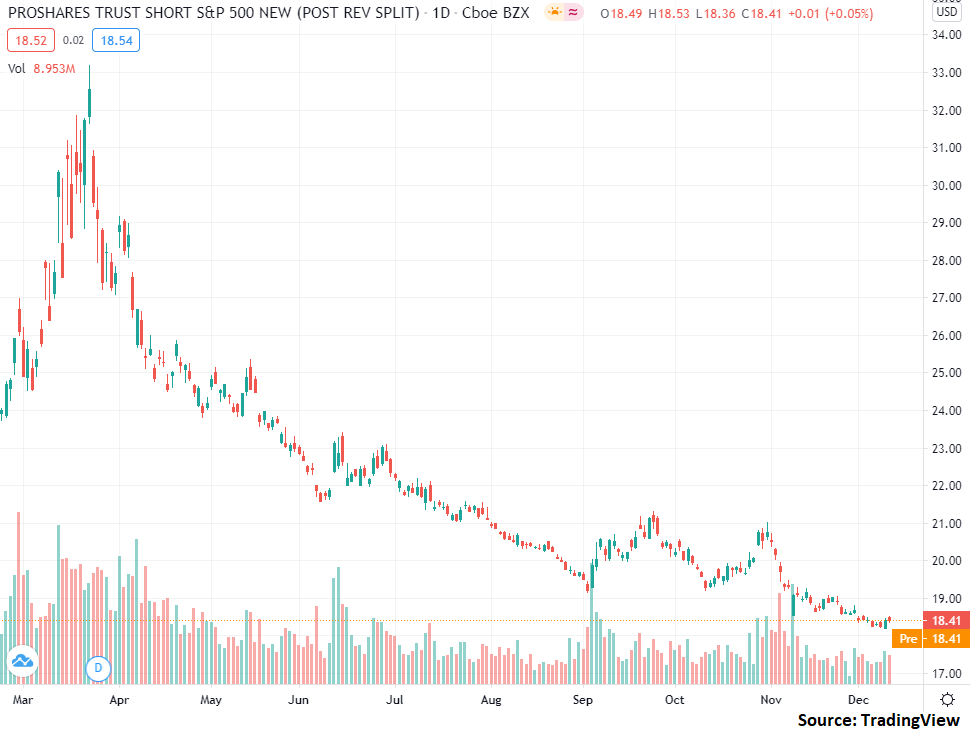
A standard inverse ETF, such as the ProShares Short S&P 500 (SH), aims to deliver the daily inverse return of the S&P 500. If the S&P 500 drops by 1% on a given day, the ETF is designed to rise by approximately 1%. This is an ideal tool for investors who anticipate a market correction but do not want to deal with the complexities of margin calls or the expiration dates associated with options. It allows for a bearish tilt within a traditional IRA or 401(k) where margin trading might be restricted.
Leveraged Inverse ETFs (2x and 3x)
For those seeking higher volatility and greater profit potential from a downward move, leveraged inverse ETFs offer double or triple the daily inverse performance. Tickers like the ProShares UltraShort S&P 500 (SDS) provide -2x exposure, while the ProShares UltraPro Short S&P 500 (SPXU) offers -3x exposure.
While the allure of triple-digit gains during a market crash is high, these instruments are structurally dangerous for long-term holding. Because they are rebalanced daily, they are subject to “volatility decay.” In a choppy market where the S&P 500 moves up and down without a clear trend, a leveraged inverse ETF can lose value even if the index ends up lower over a month. These are tactical tools for short-term trades, not “buy and hold” investments.
The Mechanism of Inverse ETFs
Inverse ETFs achieve their goals through the use of swap agreements and other derivatives behind the scenes. The fund manager enters into contracts with investment banks to receive the inverse return of the benchmark. For the end-user, the process is seamless; you simply buy and sell the ticker symbol like any other stock. However, the expense ratios for these funds are typically higher than standard index funds, often ranging from 0.75% to 1.00% annually.
Leveraging Options for Bearish Positions
Options trading provides a more surgical way to short the S&P 500. Options allow investors to define their risk precisely, leverage their capital, and even profit from a market that stays flat or moves slightly lower. When shorting the S&P 500 via options, traders typically look at the SPDR S&P 500 ETF Trust (SPY) or the index itself (SPX).
Buying Put Options
The most common bearish option strategy is buying a put option. A put option gives the holder the right, but not the obligation, to sell the underlying asset at a specific “strike price” before a certain expiration date. If the S&P 500 falls below the strike price, the value of the put option increases.
The primary advantage of buying puts is “defined risk.” The most you can lose is the premium paid for the option. However, options are “decaying assets.” Every day that the market does not move lower, the option loses “time value” (theta). To be successful, the investor must be right about the direction of the market and the timing of the move.
Bear Put Spreads
To mitigate the high cost of premiums and the impact of time decay, many sophisticated traders use a bear put spread. This involves buying a put option at a higher strike price and simultaneously selling a put option at a lower strike price.
The premium received from selling the lower put offsets the cost of the higher put. While this limits the maximum potential profit if the market goes into a freefall, it lowers the “break-even” point of the trade. It is an excellent strategy for a moderate bear market where a steady, controlled decline is expected.

Selling Call Options (Shorting Volatility)
Another way to express a bearish view is to sell (write) call options. When you sell a call, you are obligated to sell the asset at the strike price if the buyer exercises the option. This is a high-risk strategy if done “naked” (without owning the underlying shares), as the potential loss is theoretically infinite if the market surges. However, for those holding a large portfolio of stocks, selling “covered calls” against their position can provide a small cushion during a downturn, as the premium collected offsets some of the losses in the underlying equity.
Professional Grade: Futures and CFDs
For institutional investors and active day traders, the preferred method for shorting the S&P 500 is often through the futures market or Contracts for Difference (CFDs). These instruments offer high liquidity, 24-hour trading access, and extreme capital efficiency.
S&P 500 E-mini and Micro E-mini Futures
The Chicago Mercantile Exchange (CME) offers E-mini S&P 500 futures, which are standardized contracts to buy or sell the value of the index at a future date. To short the market here, a trader “sells” a contract.
The E-mini is a powerful tool because it trades nearly 24 hours a day, five days a week. This allows traders to react to news in the overnight markets or during European trading hours. The Micro E-mini (MES) has made this accessible to smaller accounts, as it is one-tenth the size of a standard E-mini contract.
Futures require “margin,” which is a small deposit to control a much larger position. This leverage can lead to massive gains, but it also means that a small move against the trader can result in a “margin call,” requiring the immediate injection of more cash or the forced liquidation of the position.
Contracts for Difference (CFDs)
In many jurisdictions outside the United States, CFDs are a popular way to short indices. A CFD is a contract between a trader and a broker to exchange the difference in the price of the S&P 500 from the time the contract is opened to when it is closed.
CFDs are popular because they allow for very granular position sizing. Unlike futures, where you must trade a whole contract, CFDs often allow you to trade in smaller increments. However, the “spread” (the difference between the buy and sell price) and overnight financing costs can eat into profits if the position is held for an extended period.
Strategic Risk Management and the “Short Squeeze”
Shorting is inherently riskier than going long for one fundamental reason: the S&P 500 has a long-term upward bias. Historically, the American economy grows, and the companies within the S&P 500 innovate and increase their earnings. When you short the index, you are fighting against this long-term gravity.
The Unlimited Loss Potential
When you buy a stock, your maximum loss is 100% (the stock goes to zero). When you short an asset—specifically when using margin or selling naked options—your potential loss is technically unlimited because there is no ceiling on how high the market can go. This is why stop-loss orders are non-negotiable for short sellers. A stop-loss automatically closes your position if the market rises to a certain level, preventing a catastrophic loss of capital.
Understanding the Short Squeeze
While more common in individual stocks, a “short squeeze” can occur in the broader market indices during periods of high bearish sentiment. If a large number of traders are short and the market suddenly receives positive news, the rush to “cover” (buy back) short positions creates a surge in demand. This buying pressure drives prices even higher, forcing more short sellers to exit, creating a feedback loop of rapidly rising prices. Recognizing when the market is “overcrowded” on the short side is a vital skill for timing exits.
Hedging vs. Speculation
It is important to distinguish between shorting for profit (speculation) and shorting for protection (hedging).
-
Speculators look for technical breakdowns, such as the S&P 500 falling below its 200-day moving average, to initiate shorts. They aim to exit with a cash profit.
-
Hedgers use short positions to offset potential losses in their long-term portfolios. If an investor owns $100,000 in diversified stocks and fears a 10% correction, they might buy put options or an inverse ETF. If the market falls, the gain on the short position compensates for the decline in their stocks. If the market rises, the “cost” of the hedge is viewed as an insurance premium.
Conclusion: Mastering the Downside
Shorting the S&P 500 is an essential skill for any complete investor. Whether through the simplicity of inverse ETFs, the strategic flexibility of options, or the high-leverage environment of futures, the ability to profit during a bear market provides a psychological and financial edge.
However, the golden rule of shorting is discipline. Because the market tends to “climb a wall of worry” and fall “via the elevator,” short trades often move much faster than long trades. Successful short sellers are those who manage their margin strictly, understand the mechanics of the instruments they are using, and—most importantly—know when to take their profits and wait for the next cycle. In the world of finance, the ability to protect capital during a crisis is often what separates long-term winners from those who are wiped out by volatility.
aViewFromTheCave is a participant in the Amazon Services LLC Associates Program, an affiliate advertising program designed to provide a means for sites to earn advertising fees by advertising and linking to Amazon.com. Amazon, the Amazon logo, AmazonSupply, and the AmazonSupply logo are trademarks of Amazon.com, Inc. or its affiliates. As an Amazon Associate we earn affiliate commissions from qualifying purchases.