
In the dynamic world of finance, understanding how to quantify change is not just a useful skill; it’s an indispensable tool for informed decision-making. Whether you’re tracking the growth of your investments, analyzing a business’s revenue trajectory, or simply trying to make sense of your personal budget, the ability to calculate a percentage increase between two numbers provides invaluable insights. This fundamental mathematical concept empowers individuals and businesses alike to measure progress, identify trends, and strategize for the future.
Beyond mere arithmetic, percentage increase offers a standardized way to compare growth across different scales, making disparate figures relatable and understandable. A $100 increase might seem significant for a $200 initial investment but negligible for a $20,000 portfolio. Expressing this change as a percentage levels the playing field, revealing the true magnitude of growth. In the realm of money, where every decision has financial implications, mastering this calculation is a cornerstone of financial literacy.
This article will demystify the process of calculating percentage increase, break down its core components, and illustrate its pervasive relevance across various financial applications. By the end, you’ll not only know how to perform this calculation but also why it’s a critical skill for navigating the complexities of your financial journey.
The Core Formula: Unlocking Growth Metrics
At its heart, calculating a percentage increase is about understanding the relative change between an initial value and a subsequent value. It transforms raw numbers into a digestible proportion, indicating how much larger the new number is compared to the old one, expressed as a fraction of 100.
Understanding the Components: Old vs. New
Before diving into the calculation, it’s crucial to correctly identify the two pivotal numbers: the Old Value (or initial value) and the New Value (or final value).
- Old Value (Initial Value): This is the baseline, the starting point from which you are measuring growth. It could be your initial investment amount, last year’s sales figure, or your previous month’s income. This number serves as the denominator in our calculation, representing the whole against which the change is measured.
- New Value (Final Value): This is the subsequent, usually larger, number that reflects the current or later state. It could be the current value of your investment, this year’s sales, or your current month’s income. For a percentage increase, the new value must always be greater than the old value.
Confusing these two values is a common mistake that can lead to erroneous results, or even calculate a percentage decrease instead of an increase. Always ensure you’re clear about which number represents the starting point and which represents the end point of the period you’re analyzing.
The Step-by-Step Calculation
The formula for calculating percentage increase is straightforward:
$$ text{Percentage Increase} = left( frac{text{New Value} – text{Old Value}}{text{Old Value}} right) times 100 $$
Let’s break this down into actionable steps:
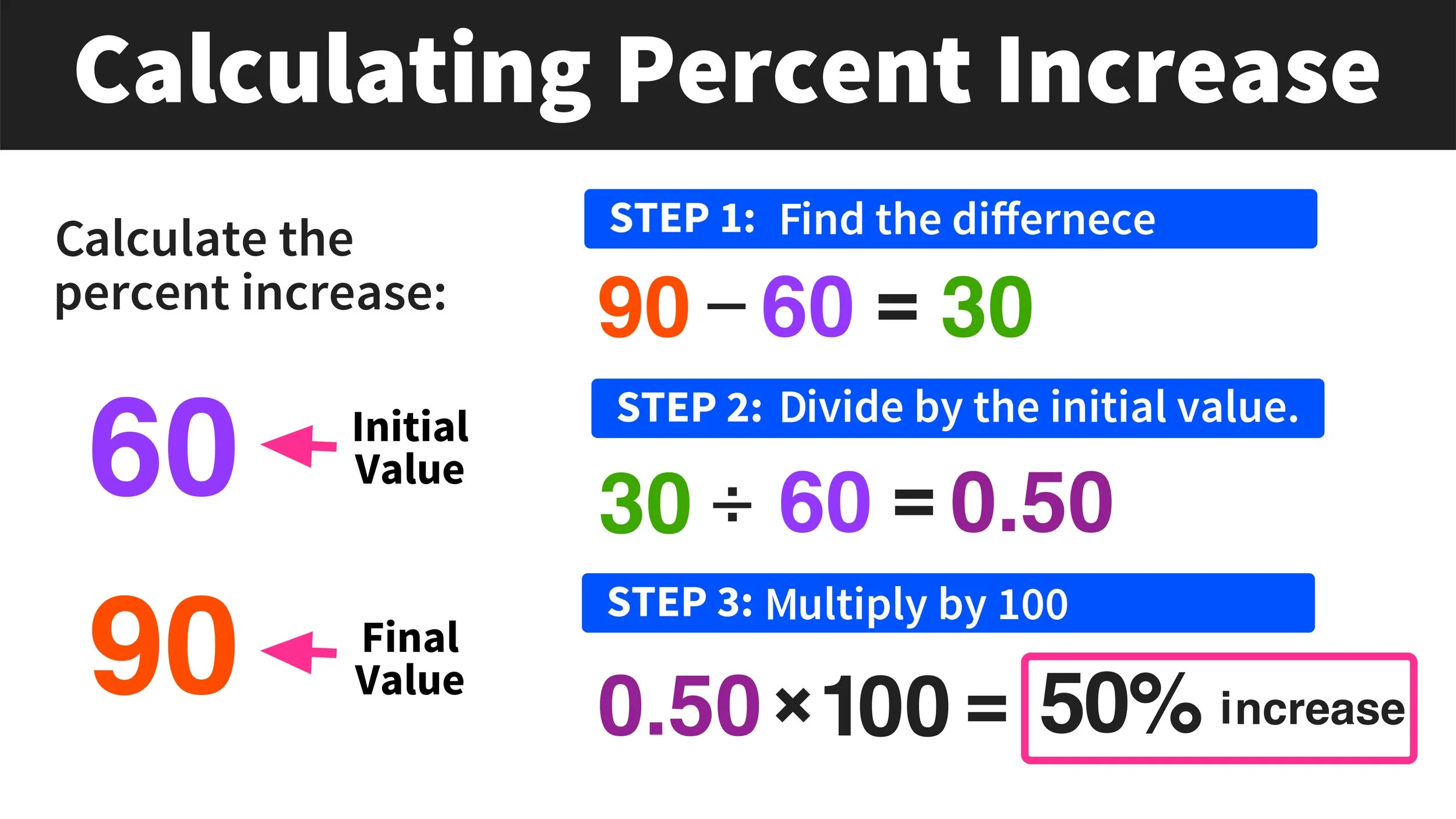
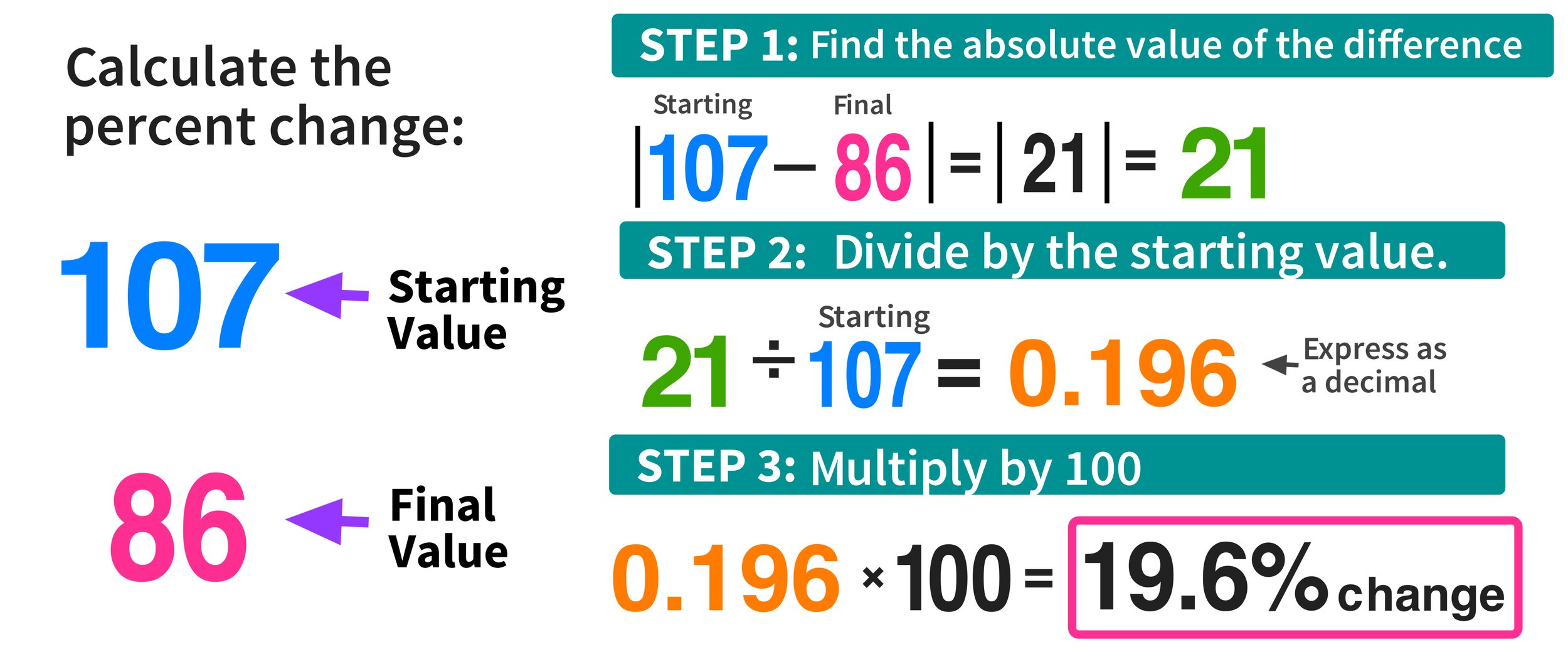
- Calculate the Absolute Increase: Subtract the Old Value from the New Value. This tells you the raw numerical difference between the two points.
- Absolute Increase = New Value – Old Value
- Divide by the Old Value: Take the absolute increase you just calculated and divide it by the Old Value. This step converts the absolute change into a decimal fraction relative to the starting point.
- Relative Increase (as a decimal) = Absolute Increase / Old Value
- Multiply by 100: To express this decimal as a percentage, multiply the result by 100. This is the final percentage increase.
- Percentage Increase = Relative Increase (as a decimal) × 100
Example:
Imagine your investment portfolio was worth $10,000 at the beginning of the year (Old Value) and grew to $12,500 by year-end (New Value).
- Absolute Increase: $12,500 – $10,000 = $2,500
- Divide by Old Value: $2,500 / $10,000 = 0.25
- Multiply by 100: 0.25 × 100 = 25%
Therefore, your investment portfolio saw a 25% increase.
Practical Applications in Personal Finance
For individuals managing their own money, the percentage increase calculation is far more than an academic exercise; it’s a critical tool for monitoring progress, making informed decisions, and achieving financial goals.
Investment Growth and Returns
One of the most common and impactful applications is evaluating investment performance. When you invest in stocks, bonds, mutual funds, or real estate, you want to know how much your money has grown. Percentage increase allows you to:
- Compare different investments: A stock that went from $10 to $12 (20% increase) might seem less impressive than one that went from $100 to $105 (5% increase) at first glance, but the percentage tells the real story of which investment yielded a higher rate of return relative to its initial cost.
- Calculate Return on Investment (ROI): ROI is essentially a percentage increase calculation, often expressed over a specific period. It helps you understand the efficiency of your investment, allowing you to optimize your portfolio.
- Track Portfolio Performance: Monitoring the percentage increase of your overall portfolio year-over-year helps you assess your financial strategy’s effectiveness and make necessary adjustments to stay on track with your long-term wealth accumulation goals.
Tracking Savings and Budget Changes
Percentage increase is also invaluable for managing personal cash flow and savings:
- Savings Growth: Are your savings growing at the rate you expect? Calculating the percentage increase in your savings account balance each month or year can provide motivation and highlight whether you’re meeting your savings targets.
- Budget Adjustments: When your income increases, or certain expenses rise, understanding the percentage change helps you adjust your budget proportionally. For instance, if your rent increases by 5%, you can see the direct impact on your monthly budget.
- Debt Reduction Progress: While often about decrease, tracking the percentage reduction in outstanding debt can be a powerful motivator, showing the progress you’ve made against the initial amount owed. Conversely, understanding the percentage increase in minimum payments due to rising interest rates is crucial for financial planning.
Navigating Salary Negotiations
When it comes to your income, knowing how to calculate percentage increase is a powerful negotiating tool:
- Evaluating Job Offers: If you’re considering a new job or promotion, you can calculate the percentage increase in salary to understand the true financial benefit compared to your current earnings. This helps you compare offers objectively.
- Assessing Annual Raises: Is your annual raise keeping pace with inflation or your career growth? If your salary increases from $60,000 to $63,000, that’s a 5% increase. You can then benchmark this against industry averages or the cost of living index to gauge its real value.
- Setting Income Goals: If you aim to increase your income by a certain percentage each year, this calculation helps you define clear targets and measure your success.
Business Finance and Economic Insights
Beyond individual finances, percentage increase is a cornerstone of business analysis and economic reporting. It provides critical metrics for stakeholders, investors, and policymakers.
Analyzing Revenue and Profit Expansion
For businesses, tracking growth is paramount. Percentage increase is used to:
- Monitor Sales Growth: Comparing current quarter sales to the previous quarter or year helps businesses understand their market penetration and the effectiveness of their sales strategies. A 15% increase in quarterly revenue, for example, is a strong indicator of business health.
- Assess Profitability: Analyzing the percentage increase in net profit over time reveals how efficiently a business is turning revenue into actual earnings. This is a key metric for investors and management.
- Evaluate Marketing Campaigns: By comparing sales before and after a marketing initiative, businesses can calculate the percentage increase in sales attributable to the campaign, thereby measuring its ROI.
Understanding Market Share and Economic Trends
At a macro level, percentage increase helps in understanding broader economic shifts:
- Market Share Growth: Businesses measure the percentage increase in their market share to understand their competitive position and growth within their industry.
- GDP Growth: Economists and governments regularly report GDP growth as a percentage increase, indicating the health and expansion of an entire economy. A 3% GDP growth rate signifies a growing economy.
- Sectoral Growth: Understanding which industries or sectors are experiencing the highest percentage growth (e.g., tech, renewable energy) can guide investment decisions and policy-making.
The Impact of Inflation
Inflation, the rate at which the general level of prices for goods and services is rising, is almost always expressed as a percentage increase.
- Cost of Living: When the Consumer Price Index (CPI) increases by, say, 3% annually, it means that, on average, goods and services cost 3% more than the previous year. Understanding this percentage helps individuals and businesses adjust their budgets and pricing strategies.
- Purchasing Power: A percentage increase in inflation directly impacts the purchasing power of money. If your salary increases by 2% but inflation is 4%, your real purchasing power has effectively decreased.
- Investment Planning: Investors consider inflation rates (percentage increase) when setting return expectations. A 7% investment return is excellent, but if inflation is 5%, your “real” return is only 2%.
Common Pitfalls and Best Practices
While calculating percentage increase is fundamental, certain errors can lead to misinterpretations. Adhering to best practices ensures accuracy and meaningful insights.
Avoiding Miscalculations: The Importance of the Base
The most common mistake is using the wrong “Old Value” or base number in the denominator of the formula.
- Always use the initial (older) number as the base: If you accidentally divide by the New Value, your calculation will be incorrect and will represent a different concept (e.g., the percentage the old value is of the new value, or a decrease if the new value is smaller).
- Ensure consistent units: Make sure both the Old and New values are in the same units (e.g., both in dollars, both in units sold) to avoid skewed results.
- Beware of negative numbers or zero as the Old Value: The formula breaks down if the Old Value is zero, as division by zero is undefined. If starting from zero, a percentage increase isn’t typically calculated; instead, the absolute increase is reported. If the Old Value is negative, the interpretation of percentage change becomes more complex and requires careful consideration of context.
Leveraging Financial Tools for Accuracy
While mental math or a basic calculator suffices for simple scenarios, more complex financial analysis benefits from dedicated tools:
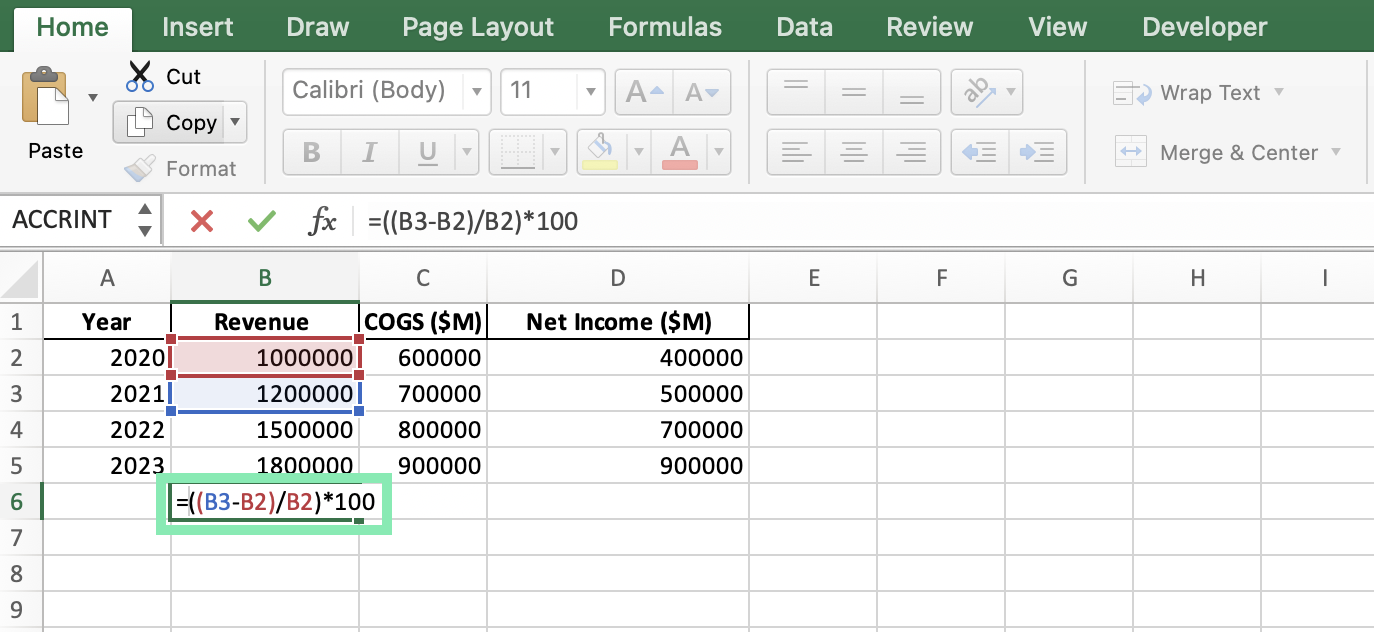
- Spreadsheets (Excel, Google Sheets): These are indispensable for financial calculations. You can easily set up columns for Old Value, New Value, and use the percentage increase formula to automate calculations across many data points. This is particularly useful for tracking portfolios, budget lines, or sales figures over time.
- Online Financial Calculators: Numerous websites offer free percentage increase calculators. These are quick and convenient for one-off calculations and can help verify your manual work.
- Financial Software: Personal finance apps and business accounting software often integrate percentage change calculations directly into their reporting features, providing visual dashboards of growth metrics.
Utilizing these tools not only saves time but also significantly reduces the risk of manual errors, ensuring the accuracy of your financial analysis.
Conclusion: Empowering Financial Decisions
Understanding how to calculate a percentage increase between two numbers is more than just a mathematical exercise; it’s a vital skill for anyone navigating the financial landscape. From evaluating your personal investments and managing your household budget to analyzing business performance and comprehending economic trends, this simple calculation provides a powerful lens through which to view growth, assess progress, and make informed decisions.
By mastering the core formula, recognizing its diverse applications, and adhering to best practices, you equip yourself with an essential tool for financial literacy. In a world constantly evolving with numbers and data, the ability to accurately measure and interpret percentage increases transforms raw figures into meaningful insights, empowering you to better control your financial destiny and strategically plan for a prosperous future.
aViewFromTheCave is a participant in the Amazon Services LLC Associates Program, an affiliate advertising program designed to provide a means for sites to earn advertising fees by advertising and linking to Amazon.com. Amazon, the Amazon logo, AmazonSupply, and the AmazonSupply logo are trademarks of Amazon.com, Inc. or its affiliates. As an Amazon Associate we earn affiliate commissions from qualifying purchases.