
Understanding how to calculate percentages of money is not merely a mathematical exercise; it is a cornerstone of financial literacy, an indispensable skill that empowers individuals and businesses to make informed decisions. From deciphering sales discounts and calculating investment returns to managing personal budgets and comprehending loan interest, percentages permeate nearly every aspect of our financial lives. Mastering this fundamental concept transforms abstract numbers into actionable insights, enabling better planning, saving, and wealth creation. This article will demystify percentage calculations, providing clear methods, real-world applications, and practical tools to help you confidently navigate the financial landscape.
The Indispensable Role of Percentages in Financial Literacy
At its core, a percentage is a way of expressing a number as a fraction of 100. The term “percent” literally means “per hundred.” This universal language allows us to compare proportions, understand rates, and measure changes in a standardized way, making it profoundly useful when dealing with money.
What is a Percentage and Why Does it Matter for Your Money?
A percentage provides a relative measure rather than an absolute one, which is incredibly powerful in finance. For instance, knowing you saved $20 is good, but knowing you saved 20% on a $100 item (a 20% discount) or that your investment grew by 20% in a year gives you a much clearer picture of efficiency, value, and performance. Without percentages, comparing a return of $50 on a $1,000 investment to a return of $500 on a $10,000 investment would be less intuitive. Both represent a 5% return, indicating equivalent performance despite vastly different absolute dollar amounts. This relative comparison is crucial for assessing opportunities, managing risks, and setting realistic financial goals.
Everyday Scenarios Where Percentages Drive Decisions
Percentages are woven into the fabric of our daily financial interactions. Consider these common scenarios:
- Shopping: Sales often advertise discounts like “30% off all items” or “Buy one, get one 50% off.” Understanding how to quickly calculate these percentages helps you determine the actual savings and whether a deal is truly beneficial.
- Tips and Taxes: When dining out, calculating a 15-20% tip is standard practice. Similarly, sales tax, income tax, and property tax are all expressed and calculated using percentages of a base amount.
- Banking and Loans: Interest rates on savings accounts, credit cards, mortgages, and personal loans are all quoted as Annual Percentage Rates (APR) or Annual Percentage Yields (APY). Knowing how these percentages translate into actual dollar amounts of interest earned or paid is vital for managing debt and growing savings.
- Investments: The performance of your stock portfolio, mutual funds, or retirement accounts is typically measured in percentage gains or losses. Understanding these figures allows you to evaluate investment strategies and monitor your financial growth.
- Budgeting: Many personal finance experts recommend allocating percentages of your income to various categories like housing (30%), food (15%), savings (20%), and discretionary spending (35%). Percentages offer a flexible budgeting framework that scales with your income.
Mastering the Core Calculations: Step-by-Step Guides
While modern tools can automate many calculations, understanding the underlying formulas empowers you to verify results and perform quick mental estimations. Here are the fundamental methods for figuring out percentages of money.
Calculating a Percentage of a Number (Finding the Part)
This is the most common percentage calculation, used for discounts, taxes, and tips.
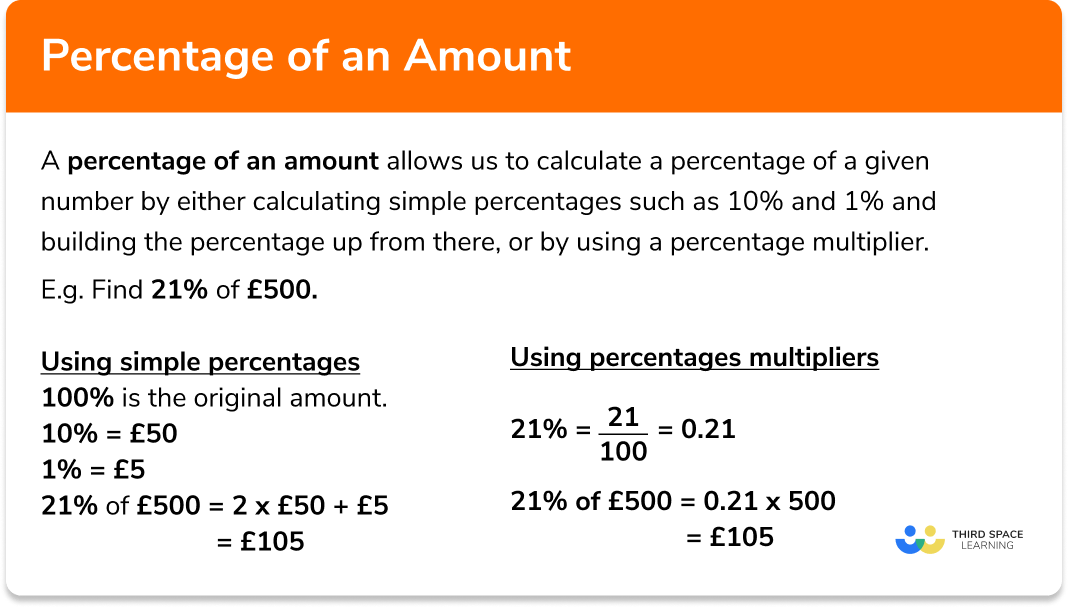
Formula: (Percentage / 100) * Total Amount
Example: You want to find 15% of $200 (e.g., a tip or a discount).
- Convert the percentage to a decimal:
15 / 100 = 0.15 - Multiply the decimal by the total amount:
0.15 * $200 = $30
So, 15% of $200 is $30.
Calculating What Percentage One Number is of Another (Finding the Rate)
This calculation helps you understand proportions, such as what portion of your income goes to rent or the profit margin on a sale.
Formula: (Part / Whole) * 100
Example: You spent $75 on groceries from a total monthly budget of $500. What percentage of your budget went to groceries?
- Divide the part by the whole:
$75 / $500 = 0.15 - Multiply by 100 to convert to a percentage:
0.15 * 100 = 15%
So, 15% of your budget was spent on groceries.
Calculating the Original Amount Before a Percentage Was Added or Subtracted
This “reverse percentage” calculation is useful for determining the original price of an item after a discount or the pre-tax cost of a service.
For a Discount/Reduction:
Formula: Current Amount / (1 - (Discount Rate / 100))
Example: You bought a shirt for $40 after a 20% discount. What was the original price?
- Convert discount rate to decimal:
20 / 100 = 0.20 - Subtract from 1:
1 - 0.20 = 0.80 - Divide the current amount by this value:
$40 / 0.80 = $50
The original price was $50.
For a Tax/Increase:
Formula: Current Amount / (1 + (Tax Rate / 100))
Example: A service bill is $105, which includes 5% sales tax. What was the price before tax?
- Convert tax rate to decimal:
5 / 100 = 0.05 - Add to 1:
1 + 0.05 = 1.05 - Divide the current amount by this value:
$105 / 1.05 = $100
The pre-tax price was $100.
Calculating Percentage Increase or Decrease (Change Over Time)
This is essential for tracking growth (e.g., investments, salary increases) or decline (e.g., asset depreciation, inflation).
Formula: ((New Value - Old Value) / Old Value) * 100
Example of Increase: Your investment grew from $1,000 to $1,200. What is the percentage increase?
- Find the difference:
$1,200 - $1,000 = $200 - Divide by the old value:
$200 / $1,000 = 0.20 - Multiply by 100:
0.20 * 100 = 20%
The investment had a 20% increase.
Example of Decrease: Your car’s value dropped from $15,000 to $12,000. What is the percentage decrease?
- Find the difference (New Value – Old Value):
$12,000 - $15,000 = -$3,000 - Divide by the old value:
-$3,000 / $15,000 = -0.20 - Multiply by 100:
-0.20 * 100 = -20%
The car’s value decreased by 20%.
Real-World Financial Applications for Savvy Money Management
Beyond the basic arithmetic, applying these percentage calculations in specific financial contexts unlocks greater control and understanding of your money.
Personal Budgeting and Expense Tracking
The ability to categorize spending as a percentage of income or total expenses is fundamental to effective budgeting. The popular 50/30/20 rule, for instance, suggests allocating 50% of your income to needs, 30% to wants, and 20% to savings and debt repayment. By converting your actual spending into percentages, you can quickly identify areas where you might be overspending or falling short of your savings goals. This method makes budgeting flexible and scalable, adapting automatically as your income changes.
Understanding Investments and Returns
Percentages are the language of investing.
- Return on Investment (ROI): This is typically calculated as
((Net Profit / Cost of Investment) * 100). It’s a critical metric for evaluating the profitability of any investment. - Annual Percentage Yield (APY): For savings accounts or Certificates of Deposit (CDs), APY reflects the real rate of return over a year, taking into account the effect of compounding interest.
- Portfolio Allocation: Investors often diversify their portfolios by allocating specific percentages to different asset classes (e.g., 60% stocks, 30% bonds, 10% cash) to manage risk. Monitoring these percentages helps rebalance the portfolio as market values fluctuate.
Navigating Loans, Debt, and Interest Rates
Understanding percentage rates is paramount when dealing with borrowed money.
- Annual Percentage Rate (APR): This is the yearly cost of a loan, including interest and other fees. Knowing how to calculate the actual interest paid over the life of a loan or credit card balance can highlight the true cost of borrowing.
- Debt-to-Income Ratio (DTI): Lenders use DTI (calculated as
(Total Monthly Debt Payments / Gross Monthly Income) * 100) to assess your ability to manage monthly payments and repay debts. A lower DTI percentage typically indicates lower risk to lenders. - Interest Payments: Whether simple or compound, interest is always a percentage of the principal amount. Accurately calculating these helps forecast future debt burdens or savings growth.
Business Finance: Profit Margins, Discounts, and Sales Tax
In business, percentages are vital for profitability analysis and pricing strategies.
- Profit Margins: Gross Profit Margin (
(Gross Profit / Revenue) * 100) and Net Profit Margin ((Net Profit / Revenue) * 100) are key indicators of a company’s financial health and operational efficiency. - Pricing and Discounts: Businesses frequently use percentages to calculate discounts, markups, and sales prices. Understanding how a 10% discount affects revenue versus a 20% increase in sales volume requires solid percentage acumen.
- Sales Tax and Payroll: Calculating sales tax to be collected and remitted, or determining payroll deductions (like income tax withholding, social security, and health insurance premiums) are all percentage-based operations critical for compliance and accurate financial reporting.
Leveraging Tools and Avoiding Common Pitfalls
While the formulas are straightforward, applying them consistently and accurately is key. Modern tools can significantly simplify the process, but awareness of common mistakes can save you from miscalculations.
Essential Tools for Accurate Percentage Calculations
- Basic Calculators: For quick, one-off calculations, a standard calculator (physical or on your smartphone) is sufficient. Ensure you know how to use the ‘%’ button if available, or simply use the decimal conversion method.
- Spreadsheets (Excel, Google Sheets): For more complex financial planning, budgeting, or investment tracking, spreadsheets are invaluable. They allow you to set up dynamic formulas that automatically update as numbers change. For example,
=(A1/B1)*100calculates the percentage of cell A1 relative to B1. - Online Percentage Calculators: Numerous websites offer free, specialized percentage calculators for specific scenarios like tips, discounts, or loan interest. They are convenient for quick checks.
- Financial Apps: Many personal finance, budgeting, and investment apps integrate percentage calculations directly into their features, providing real-time insights into your financial situation without manual effort.
Mental Math Shortcuts for Quick Estimates
Sometimes you need a quick estimate without a calculator.
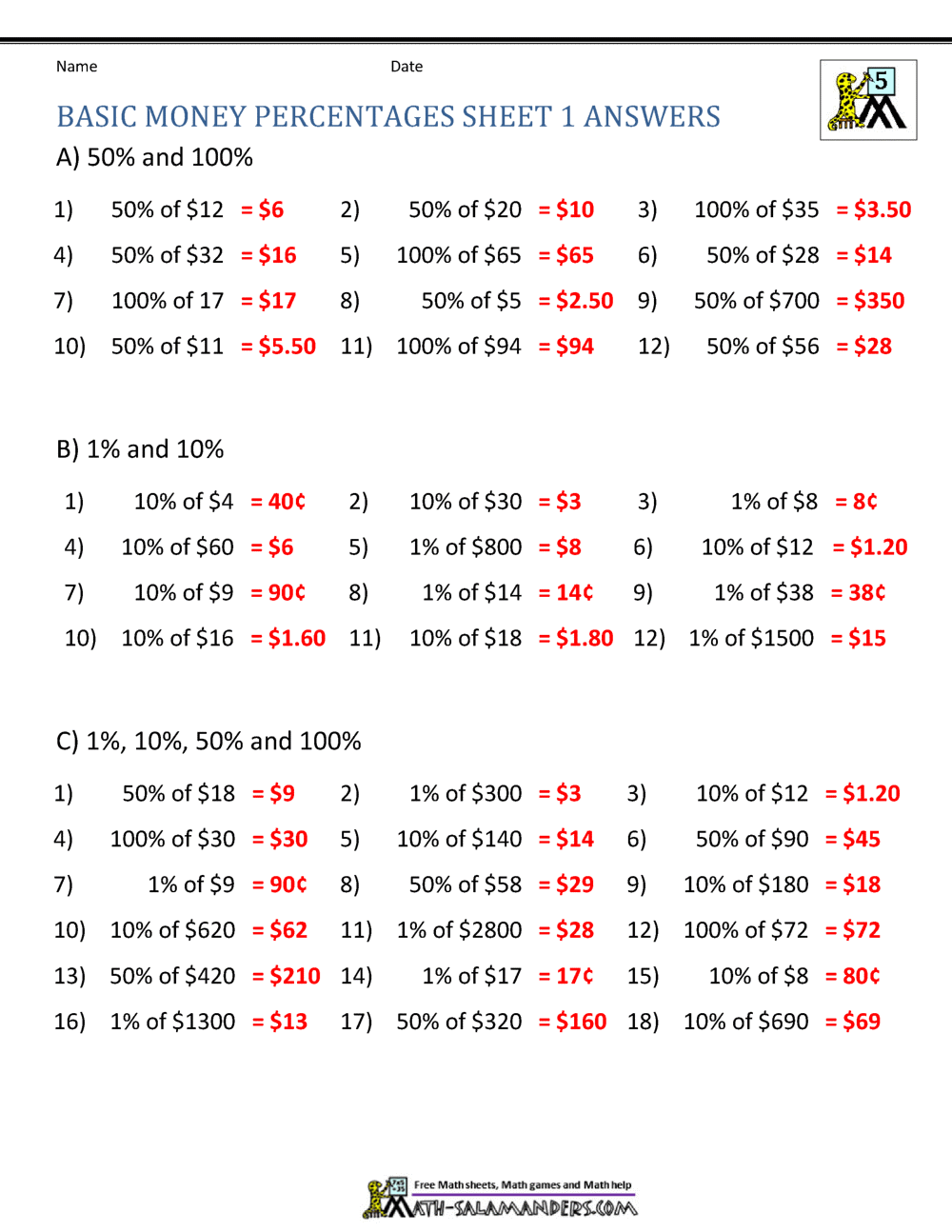
- Finding 10%: Move the decimal point one place to the left. (e.g., 10% of $150 is $15.00).
- Finding 1%: Move the decimal point two places to the left. (e.g., 1% of $150 is $1.50).
- Breaking Down Percentages: For 15%, calculate 10% and add half of that (which is 5%). For 25%, calculate 10% twice and add half of 10%, or simply divide by 4.
These shortcuts are excellent for estimating tips, sales prices, or gauging interest costs on the fly.

Common Mistakes to Avoid
- Confusing “Percentage Points” with “Percentage Change”: If an interest rate goes from 5% to 10%, that’s a 5 percentage point increase, but a 100% percentage increase in the rate itself. The distinction is crucial in financial discussions.
- Incorrect Base Amount: Always ensure you’re calculating the percentage from the correct original or total amount. A discount of 10% off the original price is different from 10% off the discounted price.
- Rounding Errors: When dealing with money, especially in large sums or over extended periods, rounding prematurely can lead to significant inaccuracies. Maintain precision until the final step.
- Ignoring Context: A high percentage doesn’t always mean a large absolute amount, and vice-versa. A 50% gain on a $10 investment is less impactful than a 1% gain on a $1,000,000 investment. Always consider the base value.
In conclusion, the ability to figure out percentages of money is more than a numerical skill; it’s a financial superpower. It equips you to accurately interpret financial data, evaluate opportunities, identify risks, and make sound decisions that contribute to your financial well-being. By understanding the fundamental calculations, applying them to real-world scenarios, and utilizing available tools while avoiding common pitfalls, you can confidently navigate the complexities of personal and business finance, empowering you to achieve your monetary goals.
aViewFromTheCave is a participant in the Amazon Services LLC Associates Program, an affiliate advertising program designed to provide a means for sites to earn advertising fees by advertising and linking to Amazon.com. Amazon, the Amazon logo, AmazonSupply, and the AmazonSupply logo are trademarks of Amazon.com, Inc. or its affiliates. As an Amazon Associate we earn affiliate commissions from qualifying purchases.