
In a world brimming with sales, discounts, and promotional offers, the ability to quickly and accurately calculate a percentage off a price is more than just a useful skill – it’s a fundamental aspect of financial literacy. Whether you’re a savvy shopper hunting for the best deal, a business owner pricing products, or an investor assessing returns, understanding how to decipher percentages empowers you to make informed decisions that impact your bottom line. This article delves into the straightforward methods of calculating discounts, explores their broader financial applications, and equips you with the insights needed to navigate the financial landscape with confidence.

The Financial Savvy Behind Discount Calculations
At its core, figuring out a percentage off a price is a simple mathematical operation. However, the implications of mastering this skill extend far beyond mere arithmetic. It’s about empowering yourself financially, ensuring you get true value for your money, and making strategic choices that align with your financial goals.
More Than Just a Number: The Power of Smart Spending
The allure of a “20% off” or “save 50%” sign can be powerful, often driving impulse purchases. But a truly financially savvy individual doesn’t just see the discount; they understand its actual monetary value and compare it against their needs and budget. This critical thinking prevents overspending and ensures that a “deal” is genuinely beneficial. When you can quickly calculate the exact savings, you move from an emotional reaction to a logical assessment, transforming yourself from a passive consumer into an active participant in your financial well-being. This skill is a cornerstone of intelligent personal finance, enabling you to stretch your income further and make every dollar count.
Impact on Your Budget and Financial Goals
Every dollar saved through smart discount calculations is a dollar that can be redirected towards your financial goals. This could mean accelerating debt repayment, bolstering your emergency fund, contributing more to investments, or saving for a significant purchase like a down payment on a house. Consistently applying this skill to everyday spending can lead to substantial cumulative savings over time. For instance, saving an extra $20 per week might seem small, but over a year, that’s over $1,000 – a sum that can make a tangible difference in your financial trajectory. By understanding the real cost after a discount, you maintain tighter control over your budget, ensuring your spending remains aligned with your long-term aspirations rather than being swayed by fleeting promotions.
Deconstructing the Discount: Step-by-Step Calculation Methods
Calculating a percentage off a price can be approached in a couple of straightforward ways. Both methods yield the same result, so you can choose the one that feels most intuitive to you.
Method 1: The Subtraction Approach (Calculate Discount Amount First)
This method involves first calculating the monetary value of the discount and then subtracting it from the original price.
-
Convert the Percentage to a Decimal: Divide the percentage by 100.
-
Example: For a 25% discount, divide 25 by 100 = 0.25.
-
Example: For a 15% discount, divide 15 by 100 = 0.15.
-
-
Calculate the Discount Amount: Multiply the original price by the decimal equivalent of the discount percentage.
-
Example: If an item costs $80 and is 25% off: $80 * 0.25 = $20. (The discount amount is $20).
-
Example: If a service costs $120 and is 15% off: $120 * 0.15 = $18. (The discount amount is $18).
-
-
Subtract the Discount Amount from the Original Price: This gives you the final price you will pay.
-
Example: Original price $80 – Discount $20 = $60. (The final price is $60).
-
Example: Original price $120 – Discount $18 = $102. (The final price is $102).
-
Method 2: The Direct Multiplication Approach (Calculate Final Price Directly)
This method streamlines the process by directly calculating the percentage of the price you will pay.
-
Determine the Percentage You Will Pay: Subtract the discount percentage from 100%.
-
Example: For a 25% discount, you will pay 100% – 25% = 75% of the original price.
-
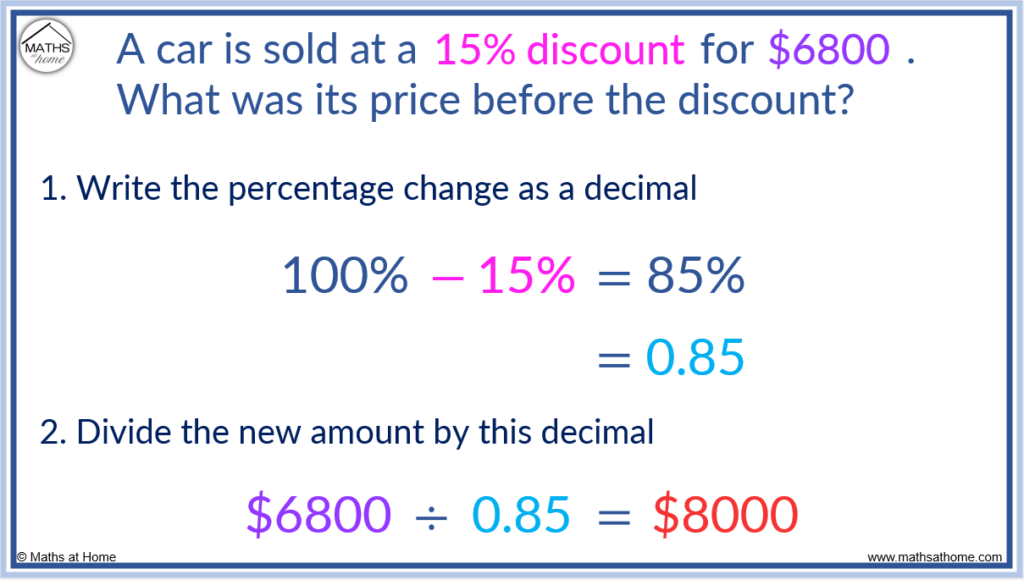
Example: For a 15% discount, you will pay 100% – 15% = 85% of the original price.
-
-
Convert This Percentage to a Decimal: Divide the percentage you will pay by 100.
-
Example: 75% becomes 0.75.
-
Example: 85% becomes 0.85.
-
-
Multiply the Original Price by This Decimal: This directly gives you the final price.
-
Example: If an item costs $80 and is 25% off: $80 * 0.75 = $60. (The final price is $60).
-
Example: If a service costs $120 and is 15% off: $120 * 0.85 = $102. (The final price is $102).
-
Both methods are equally valid and provide the correct answer. Practice both to see which one resonates more with your personal calculating style.
Practical Tips for Mental Math and Estimation
While calculators are readily available, developing a knack for estimating discounts mentally can be incredibly useful for quick decisions.
-
10% Rule: To find 10% of a number, simply move the decimal one place to the left. (e.g., 10% of $75 is $7.50).
-
20% Rule: Double the 10% value (e.g., 20% of $75 is $7.50 * 2 = $15).
-
25% Rule: Find one-quarter of the price (e.g., 25% of $80 is $80 / 4 = $20).
-
50% Rule: Halve the price (e.g., 50% of $120 is $60).
Using these approximations can help you quickly gauge the savings and decide if a deal is worth investigating further with a precise calculation.
Beyond the Sale Rack: Financial Applications of Percentage Calculations
The ability to calculate percentages isn’t confined to retail discounts. It’s a foundational mathematical skill with broad applications across various aspects of personal and business finance, serving as a critical tool for understanding financial health and making strategic decisions.
Understanding Interest Rates and Loan Repayments

One of the most significant financial applications of percentages is in understanding interest rates. Whether it’s the Annual Percentage Rate (APR) on a credit card, a mortgage, or a personal loan, interest is almost always expressed as a percentage. Knowing how to calculate the cost of borrowing – the percentage of the principal that accrues over time – is essential for managing debt effectively and avoiding financial pitfalls. It allows you to compare loan offers, understand the true cost of your borrowing, and strategize for faster repayment.
Investment Returns and Portfolio Growth
For investors, percentages are the language of performance. Return on Investment (ROI), percentage gains or losses, and dividend yields are all expressed using percentages. Calculating the percentage growth of your portfolio, understanding compound annual growth rates (CAGR), and evaluating the percentage yield of different assets are crucial for assessing investment performance, comparing opportunities, and making informed decisions about where to allocate your capital to achieve your financial growth objectives.
Business Finance: Markups, Margins, and Profitability
In the business world, percentage calculations are integral to almost every financial operation. Businesses use percentages to set prices (markup percentages), determine profitability (gross profit margin, net profit margin), calculate sales commissions, analyze cost reductions, and understand market share. For example, a business might aim for a 30% gross profit margin on its products, meaning that for every dollar of sales, 30 cents is gross profit after accounting for the cost of goods sold. Mastering these calculations is vital for setting sustainable pricing strategies, assessing financial health, and ensuring long-term viability.
Tax Calculations and Deductions
Taxes, whether sales tax, income tax, or property tax, are typically calculated as a percentage of a base amount. Understanding how these percentages apply helps individuals and businesses accurately budget for tax liabilities, optimize deductions, and ensure compliance. For example, knowing the local sales tax rate allows you to anticipate the final price of a purchase, while understanding income tax brackets and deduction percentages helps in financial planning and tax preparation.
Tools and Strategies for Seamless Calculations
While mental math is valuable, modern financial life often benefits from various tools and strategies to ensure accuracy and efficiency in percentage calculations.
The Ubiquitous Calculator: Your Best Friend
The most straightforward and universally accessible tool is a basic calculator. Whether it’s a dedicated device, an app on your smartphone, or the one built into your computer’s operating system, a calculator provides precise results instantly. Learn to use its percentage function (often denoted by a ‘%’ button) for even faster calculations. Knowing how to correctly input numbers and functions is key to leveraging this tool effectively for everything from calculating a store discount to figuring out interest on a loan.
Spreadsheet Software (Excel/Google Sheets): For Complex Scenarios
For more complex financial scenarios, such as budgeting, tracking multiple discounts, or analyzing investment returns over time, spreadsheet software like Microsoft Excel or Google Sheets is invaluable. You can set up formulas to automatically calculate percentages off prices, apply various discount tiers, or model different financial outcomes. This is particularly useful for small businesses managing inventory pricing or individuals tracking their spending against budget percentages.
Online Calculators and Mobile Apps
The digital landscape offers a plethora of specialized online percentage calculators and mobile apps designed to simplify specific financial calculations. Many banking apps also include budgeting tools that might incorporate percentage-based analysis. These tools can be incredibly handy for on-the-go calculations, comparison shopping, or quickly understanding the impact of a particular percentage in different financial contexts.
The Power of Price Comparison and Unit Pricing
While not a direct percentage calculation, the strategy of price comparison and understanding unit pricing is intrinsically linked to maximizing savings, where percentages play a hidden role. By comparing the percentage discount offered by different retailers or calculating the unit price (e.g., price per ounce or per item), you can ensure you’re getting the absolute best value. This involves assessing not just the advertised percentage off, but the final cost relative to the quantity or equivalent value elsewhere.
Common Discount Traps and Smart Consumer Practices
Even with perfect calculation skills, consumers can fall victim to misleading offers if they aren’t vigilant. Understanding percentage calculations goes hand-in-hand with smart consumer habits.
Beware of Inflated “Original” Prices
A common marketing tactic is to inflate the “original” or “retail” price of an item, making the percentage discount appear much larger than it actually is. Always do your research to determine the true market value of an item before being swayed by a seemingly steep discount. Websites and apps dedicated to price history can be powerful allies here.
The Lure of “Too Good to Be True” Discounts
If a discount seems extraordinarily high (e.g., 90% off), it might be too good to be true. This could indicate a clearance item with limited stock, an inferior product, or even a scam. While genuine deep discounts exist, maintaining a healthy skepticism and investigating the reason behind such a significant price reduction is a prudent financial practice.
Double-Checking Your Math (or Theirs)
Errors happen, both in your calculations and sometimes in the advertised pricing. Always take a moment to double-check your own calculations, especially for significant purchases. Similarly, verify the final price at checkout to ensure the discount has been correctly applied by the retailer.
Focusing on Needs vs. Wants, Even with Discounts
Perhaps the most crucial smart consumer practice is to prioritize needs over wants, even when a tempting discount presents itself. A 50% discount on an item you don’t need is still 50% of your money spent unnecessarily. The goal of financial savvy isn’t just to save money on purchases, but to avoid unnecessary purchases altogether. Before buying, ask yourself if you would purchase the item at its full price if you genuinely needed it. If the answer is no, then the discount might just be an incentive to spend, rather than to save.
By mastering the simple art of percentage calculation and coupling it with informed financial practices, you transform a basic math skill into a powerful tool for personal wealth management, smart spending, and strategic financial decision-making. In the intricate dance of modern finance, understanding “percentage off a price” is not just about saving a few dollars; it’s about building a robust foundation for your financial future.
aViewFromTheCave is a participant in the Amazon Services LLC Associates Program, an affiliate advertising program designed to provide a means for sites to earn advertising fees by advertising and linking to Amazon.com. Amazon, the Amazon logo, AmazonSupply, and the AmazonSupply logo are trademarks of Amazon.com, Inc. or its affiliates. As an Amazon Associate we earn affiliate commissions from qualifying purchases.