
In the realm of personal finance and wealth management, numbers are the primary language. Whether you are evaluating a potential investment, calculating the interest on a loan, or determining how much of your monthly income should go toward savings, one mathematical concept stands above the rest: the percentage. Understanding how to calculate the percentage of a number is not just a basic arithmetic skill; it is a fundamental pillar of financial literacy that empowers individuals to make informed, strategic decisions with their capital.
Percentages allow us to standardize comparisons. They turn abstract figures into relative values, giving us a clearer picture of growth, risk, and cost. In this comprehensive guide, we will explore the mechanics of percentage calculations through the lens of money, providing you with the tools to navigate the complex financial landscape with confidence.
The Foundation of Financial Literacy: Understanding the Percentage Formula
Before diving into complex financial scenarios, one must master the basic mechanics of the percentage. At its core, a percentage represents a fraction of 100. The word itself comes from the Latin per centum, meaning “by the hundred.” In money management, this allows us to scale financial data regardless of the total dollar amount involved.
The Basic Equation: Part, Whole, and the 100 Factor
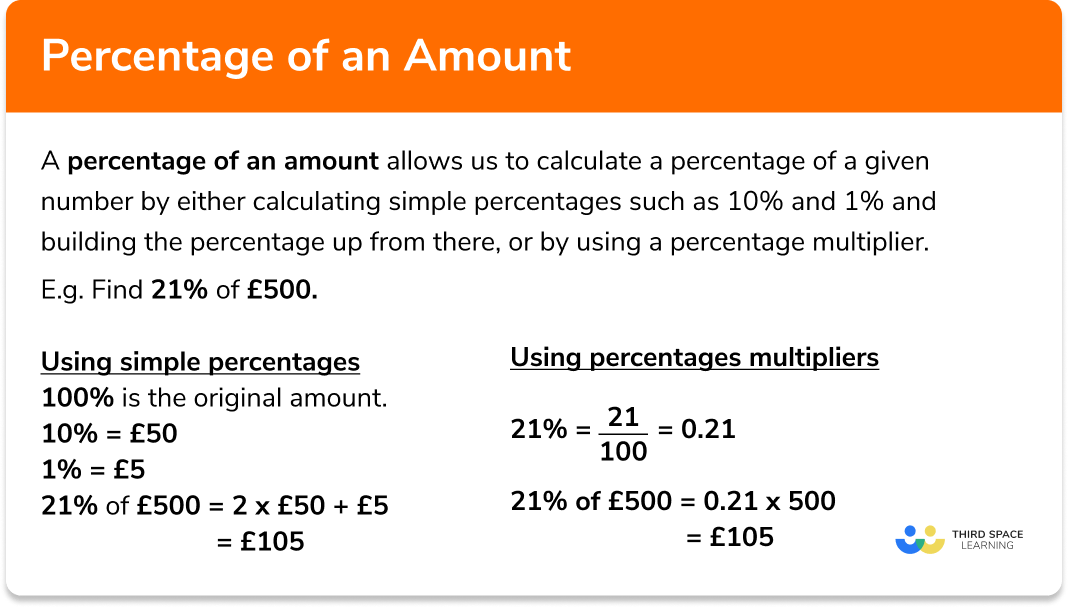
To calculate the percentage of a specific number, you are essentially trying to find a portion of a total. The standard formula is:
Percentage Value = (Total Amount × Percentage Rate) / 100
For example, if you want to find 15% of a $2,000 investment, you multiply 2,000 by 15, resulting in 30,000. You then divide by 100 to get $300. In financial terms, this might represent a dividend payment, a commission, or a tax obligation.
Understanding the inverse is equally important: finding what percentage one number is of another. If you saved $500 out of a $5,000 paycheck, the formula becomes:
(Part / Whole) × 100 = Percentage
In this case, ($500 / $5,000) = 0.10. Multiplying by 100 gives you 10%. Recognizing these relationships is the first step in auditing your own financial health.
Decimal Conversions: The Short-Cut to Fast Math
In professional financial environments, experts rarely use the “divide by 100” step as a separate action. Instead, they convert percentages into decimals immediately. To convert a percentage to a decimal, simply move the decimal point two places to the left (e.g., 7% becomes 0.07, and 25% becomes 0.25).
This conversion makes mental math and spreadsheet calculations significantly faster. If you need to calculate a 7% sales tax on a $150 purchase, you can simply multiply 150 by 0.07 to arrive at $10.50. Mastering the decimal shift allows for rapid-fire financial analysis during negotiations or while reviewing bank statements.
Percentages in Personal Finance: Mastering Interest and Debt
Perhaps the most critical application of percentage calculations lies in the management of debt and interest. In the world of money, interest is the price of time. Whether you are paying it (debt) or receiving it (savings), the rate is almost always expressed as a percentage.
Annual Percentage Rates (APR) and Credit Costs
When you take out a loan or use a credit card, the lender charges an Annual Percentage Rate (APR). Understanding how this percentage applies to your balance is vital for debt management. If you carry a $5,000 balance on a credit card with a 20% APR, you aren’t just paying 20% once. Interest is often compounded daily.
To calculate the monthly interest cost, you would take the annual rate (0.20), divide it by 12 months (approximately 0.0166), and multiply that by your balance. This shows that a 20% APR on $5,000 results in roughly $83 in interest charges in a single month. By understanding the “how” behind this percentage, consumers can see why paying down high-interest debt is the most effective “investment” they can make.
The Power of Compound Interest
On the flip side of debt is the “eighth wonder of the world,” as Albert Einstein reportedly called it: compound interest. This is where you calculate a percentage not just on your principal investment, but also on the interest that has already been earned.
If you have $10,000 in a high-yield savings account earning a 5% annual interest rate, at the end of year one, you calculate 5% of $10,000 ($500), bringing your total to $10,500. In year two, you don’t just earn another $500; you earn 5% of $10,500 ($525). While the percentage remains the same, the “number” it is being calculated against grows. Over decades, this percentage-based growth is what builds generational wealth.
Investment Metrics: Calculating ROI and Market Gains

For the savvy investor, percentages are the primary metric for success. Total dollar gains are often misleading; a $1,000 profit is impressive on a $2,000 investment but mediocre on a $100,000 investment.
Return on Investment (ROI) Basics
The most common calculation in the investing world is the Return on Investment (ROI). This tells you the percentage of profit or loss relative to the cost of the investment. The formula is:
ROI = [(Current Value – Original Cost) / Original Cost] × 100
If you bought shares in a fintech company for $1,200 and sold them for $1,500, your net profit is $300. To find the percentage gain: ($300 / $1,200) = 0.25, or 25%. Calculating ROI allows you to compare the performance of different asset classes—such as real estate, stocks, or gold—on an even playing field.
Portfolio Allocation and Diversification Percentages
Professional money managers use percentages to manage risk through “asset allocation.” They might suggest a portfolio comprised of 70% stocks, 20% bonds, and 10% cash. To execute this, an investor must know how to calculate these percentages based on their total net worth.
If your total investable capital is $250,000, a 10% cash allocation means you should hold $25,000 in liquid accounts. As the market fluctuates, these percentages will shift (a process known as “drift”). If your stocks perform exceptionally well, they might grow to represent 80% of your portfolio. Rebalancing requires you to calculate the dollar amount needed to sell or buy to return to your original percentage targets, ensuring you don’t take on more risk than intended.
Business Finance and Profitability
For entrepreneurs and business owners, calculating percentages is a daily necessity. It is the difference between running a sustainable enterprise and going bankrupt.
Gross vs. Net Profit Margins
A business’s health is often measured by its “margins”—the percentage of revenue that remains after costs.
- Gross Profit Margin: This is calculated by taking (Revenue – Cost of Goods Sold) / Revenue. It shows the percentage of money left over from sales before administrative expenses and taxes.
- Net Profit Margin: This is the “bottom line.” It is calculated by taking (Total Net Income / Total Revenue) × 100.
If a business brings in $1,000,000 in revenue but only keeps $100,000 as net profit, it has a 10% net margin. If a competitor brings in only $500,000 but keeps $100,000, they have a 20% margin. Despite having lower revenue, the second business is more efficient and potentially more valuable because its profit percentage is higher.
Tax Calculations and Effective Tax Rates
Taxation is perhaps the most ubiquitous application of percentage math. However, the “sticker price” of a tax bracket is rarely what a person actually pays. In a progressive tax system, different portions of your income are taxed at different percentage rates.
To find your “effective tax rate,” you calculate the total tax paid as a percentage of your total income. If you earned $100,000 and paid $15,000 in total taxes after deductions, your effective tax rate is 15%, even if your highest dollar was taxed in a 24% bracket. Knowing how to calculate these percentages allows for better tax planning and more accurate budgeting for the year ahead.
Using Financial Tools to Automate Percentage Calculations
While understanding the manual math is essential for conceptual clarity, modern financial management relies heavily on digital tools to handle these calculations with precision and speed.
Spreadsheet Mastery (Excel and Google Sheets)
For anyone serious about their money, spreadsheets are the ultimate tool. To calculate a percentage in Excel, you don’t need to multiply by 100 manually. If cell A1 contains the “part” and cell B1 contains the “total,” you simply enter the formula =A1/B1 and click the “Percent Style” button in the toolbar.
Spreadsheets allow for “What-If” analysis. You can set up a budget where you calculate 20% of your income for savings. By changing the income figure, the spreadsheet automatically recalculates the dollar amount, allowing for dynamic financial planning.

Financial Calculators and Digital Apps
Beyond spreadsheets, specialized financial calculators (like the HP 12C or digital equivalents) are designed to calculate complex percentages like “percentage change” or “compound annual growth rate” (CAGR) with just a few keystrokes. Furthermore, budgeting apps like YNAB or Mint automatically categorize your spending into percentages, showing you that, for example, 35% of your money is going to housing.
By mastering the calculation of percentages, you move from being a passive observer of your bank account to an active architect of your financial future. Whether you are calculating the tip at a business lunch or the projected growth of a retirement fund, the humble percentage is the most powerful tool in your financial toolkit.
aViewFromTheCave is a participant in the Amazon Services LLC Associates Program, an affiliate advertising program designed to provide a means for sites to earn advertising fees by advertising and linking to Amazon.com. Amazon, the Amazon logo, AmazonSupply, and the AmazonSupply logo are trademarks of Amazon.com, Inc. or its affiliates. As an Amazon Associate we earn affiliate commissions from qualifying purchases.