
Understanding how to calculate your monthly car payment is a fundamental step in responsible financial planning, whether you’re buying your first car or upgrading to a new model. This isn’t just about crunching numbers; it’s about gaining clarity, managing your budget effectively, and making informed decisions that impact your long-term financial health. A car loan represents a significant commitment, often spanning several years, and knowing precisely what goes into that monthly figure empowers you to negotiate better terms, avoid financial strain, and ensure your vehicle ownership experience is a positive one. This guide will demystify the process, breaking down the components of a car loan, walking you through manual calculation methods, exploring the convenience of digital tools, and offering strategies to optimize your monthly outlay.
Deconstructing the Car Loan: Key Components
Before diving into the calculations, it’s crucial to understand the individual elements that collectively determine your monthly car payment. Each component plays a distinct role in shaping the final figure you’ll pay each month.
The Principal Amount: What You Borrow
The principal is the core of your loan – it’s the actual amount of money you are borrowing to purchase the vehicle. This figure is derived from the car’s agreed-upon price, less any down payment you make and the value of any trade-in vehicle. A lower principal means less money to repay, which directly translates to lower monthly payments and less interest accumulated over the life of the loan.
The Interest Rate: The Cost of Borrowing
Interest is essentially the cost you pay to borrow the principal. Expressed as a percentage, the interest rate is one of the most significant factors influencing your monthly payment. A higher interest rate means a larger portion of your monthly payment goes towards servicing the debt, rather than reducing the principal. Interest rates are typically determined by various factors, including your creditworthiness, the loan term, and prevailing market rates.
The Loan Term: Your Repayment Timeline
The loan term, or repayment period, is the length of time you have to pay back the loan, usually expressed in months (e.g., 36, 48, 60, 72, or even 84 months). A shorter loan term generally results in higher monthly payments because you’re paying back the principal over a condensed period. However, shorter terms also mean you pay less interest overall, as the loan is repaid quicker. Conversely, a longer loan term leads to lower monthly payments but results in more interest paid over the life of the loan. It’s a trade-off between affordability and total cost.
The Down Payment and Trade-In: Reducing Your Principal
These two elements are powerful tools for reducing your overall loan amount and, consequently, your monthly payments. A down payment is an initial lump sum of cash you pay towards the car’s purchase price. A trade-in involves using the value of your current vehicle as a credit towards the new car’s price. Both effectively reduce the principal amount you need to borrow, thereby lowering your monthly payments and the total interest you’ll accrue. Financial advisors often recommend a substantial down payment (e.g., 10-20% for new cars) to secure better loan terms and mitigate depreciation.
The Manual Calculation Method: Empowering Your Understanding
While online calculators offer speed and convenience, understanding the underlying formula for calculating car payments provides a deeper insight into your financial commitment. This knowledge empowers you to scrutinize loan offers and truly grasp how each variable impacts your payment.
The Car Loan Payment Formula
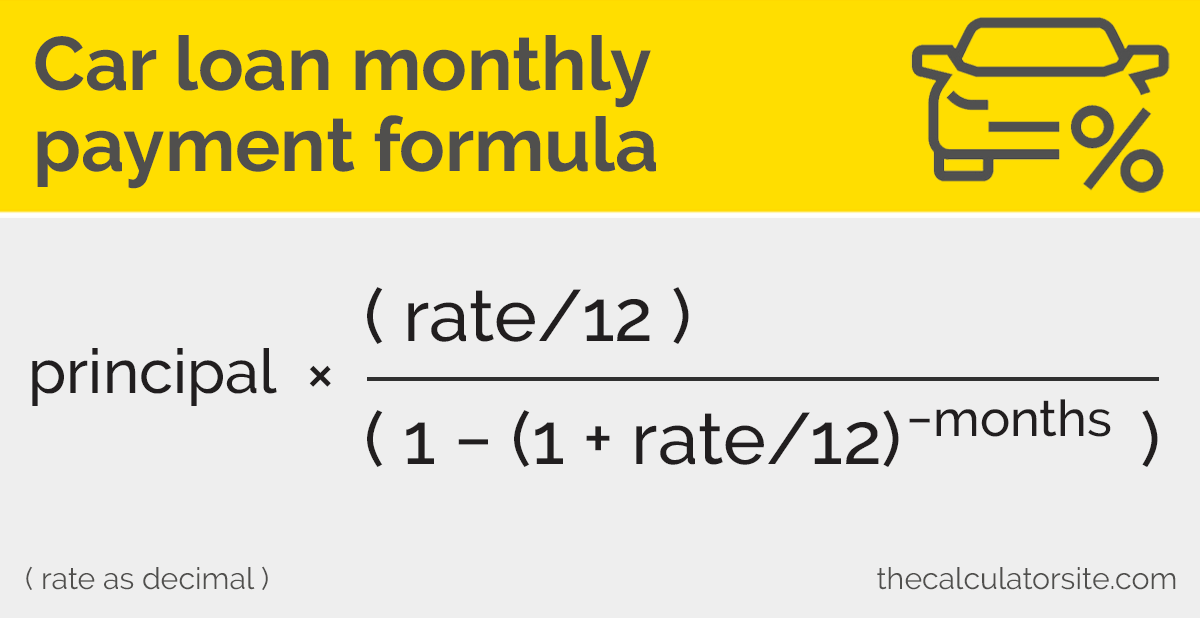
The standard formula used by lenders to calculate monthly loan payments is as follows:
$M = P [ i(1 + i)^n ] / [ (1 + i)^n – 1]$
Where:
- M = Your monthly payment
- P = Principal loan amount (the total amount you borrowed after down payment and trade-in)
- i = Your monthly interest rate (your annual interest rate divided by 12)
- n = Total number of payments (your loan term in years multiplied by 12)
This formula, often referred to as the amortization formula, accounts for both the principal repayment and the interest accruing each month over the life of the loan.
Step-by-Step Calculation Example
Let’s put the formula into practice with a hypothetical scenario:
- Car Price: $30,000
- Down Payment: $5,000
- Principal (P): $25,000 ($30,000 – $5,000)
- Annual Interest Rate: 6%
- Monthly Interest Rate (i): 0.06 / 12 = 0.005
- Loan Term: 60 months (5 years * 12 months)
- Total Number of Payments (n): 60
Now, let’s plug these values into the formula:
- Calculate $(1 + i)^n$: $(1 + 0.005)^{60} = (1.005)^{60} approx 1.34885$
- Calculate $i(1 + i)^n$: $0.005 times 1.34885 approx 0.00674425$
- Calculate $(1 + i)^n – 1$: $1.34885 – 1 = 0.34885$
- Divide step 2 by step 3: $0.00674425 / 0.34885 approx 0.0193318$
- Multiply by the Principal (P): $25,000 times 0.0193318 approx 483.295$
Therefore, your estimated monthly payment (M) would be approximately $483.30.
Why Manual Calculation Still Matters
While the process can seem intricate, performing a manual calculation or at least understanding its components offers several benefits. It provides transparency, helping you verify the figures provided by lenders and preventing you from blindly accepting terms. It also sharpens your financial literacy, giving you a deeper appreciation for how interest accrues and how different variables impact your overall cost of borrowing. This empowers you to engage in more informed discussions with dealerships and lenders.
Leveraging Technology: Online Calculators and Financial Tools
In today’s digital age, manual calculations, while educational, aren’t always necessary for quick estimates. A plethora of online calculators and financial tools have made determining monthly car payments remarkably straightforward and efficient.
The Convenience and Speed
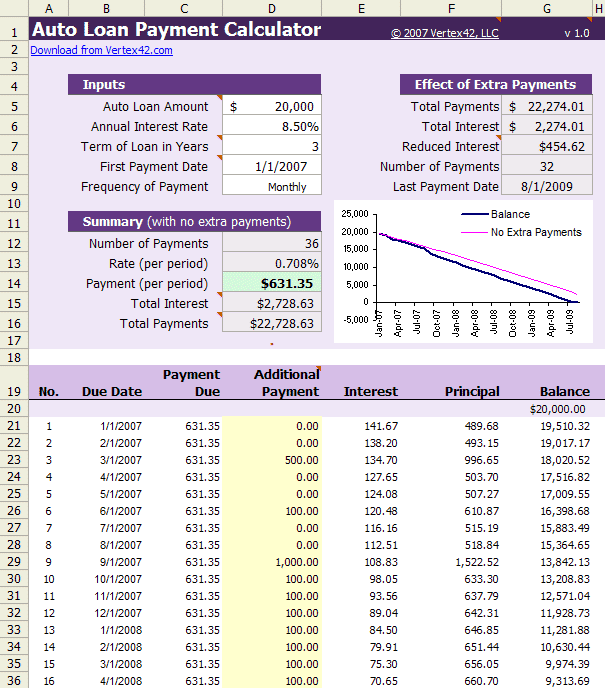
Online car payment calculators are ubiquitous, available on bank websites, automotive portals, and financial planning sites. They are designed for ease of use: you simply input the loan principal, interest rate, and loan term, and with a click, you receive an instant monthly payment estimate. This speed allows for rapid scenario planning, letting you quickly see how a change in interest rate or loan term impacts your budget.
Exploring Different Scenarios
One of the greatest advantages of these tools is their ability to facilitate “what-if” analyses. You can effortlessly adjust variables like the down payment, trade-in value, interest rate, or loan term to see how each change affects your monthly payment. Want to know if extending your loan from 60 to 72 months makes a significant difference? Or how much a 1% lower interest rate saves you? These calculators provide immediate answers, helping you tailor a loan structure that aligns with your budget and financial goals.
Integrating with Budgeting Tools
Many modern budgeting and personal finance apps integrate loan calculation features or allow you to import calculated payment figures directly into your budget. This seamless integration helps you see how a potential car payment fits into your broader financial picture, alongside other expenses like housing, utilities, and savings. By visualizing the impact on your cash flow, you can make more responsible borrowing decisions and avoid overextending yourself financially.
Beyond the Basics: Factors Influencing Your Payment
While the principal, interest, and term are the direct inputs into the payment formula, several underlying factors indirectly but significantly influence these inputs, thereby shaping your final monthly payment.
Your Credit Score: The Gateway to Better Rates
Your credit score is arguably the most critical determinant of the interest rate you’ll be offered. Lenders use your credit score as a primary indicator of your creditworthiness and your likelihood to repay the loan. Individuals with excellent credit scores (typically 750+) are perceived as lower risk and generally qualify for the lowest interest rates. Conversely, those with lower credit scores will face higher interest rates to compensate lenders for the increased risk. Improving your credit score before applying for a car loan can lead to substantial long-term savings.
Additional Costs: Taxes, Fees, and Insurance
Remember that the monthly loan payment typically only covers the principal and interest of the vehicle itself. There are several other costs associated with car ownership that, while not part of the loan calculation, are crucial for your overall monthly budget:
- Sales Tax: Varies by state and can be substantial. In some cases, sales tax can be rolled into the car loan, increasing the principal.
- Documentation Fees: Fees charged by dealerships for processing paperwork.
- Registration and Licensing Fees: Annual or biennial costs to register your vehicle.
- Car Insurance: A mandatory expense that can vary widely based on your vehicle, driving record, age, and location. This is a significant monthly cost that must be factored into your total budget.
- Maintenance and Fuel: Ongoing operational costs that should not be overlooked.
Ignoring these additional expenses can lead to budget shortfalls, making it seem like your car payment is affordable when the total cost of ownership is not.
Understanding APR vs. Interest Rate
When shopping for a loan, you’ll often encounter both an “interest rate” and an “APR” (Annual Percentage Rate). While similar, they are not identical. The interest rate is simply the cost of borrowing the principal. The APR, however, represents the total cost of borrowing over the loan term, expressed as an annual percentage. It includes the interest rate plus any additional fees, such as origination fees or discount points, that are rolled into the loan. Always compare APRs when evaluating loan offers, as it provides a more accurate representation of the true cost of the loan. A higher APR means a more expensive loan, even if the stated interest rate appears similar to another offer.
Strategies to Optimize and Reduce Your Monthly Payment
Once you understand how your car payment is calculated and what factors influence it, you can employ several strategies to lower your monthly outlay and save money over the loan’s lifetime.
Increasing Your Down Payment
This is one of the most direct and effective ways to reduce your monthly payment. A larger down payment shrinks the principal amount you need to borrow, which in turn lowers both your monthly payments and the total amount of interest you’ll pay over the loan term. It also helps create a buffer against depreciation, reducing the likelihood of being “upside down” (owing more than the car is worth) on your loan.
Opting for a Shorter vs. Longer Loan Term
While a longer loan term (e.g., 72 or 84 months) offers lower monthly payments, it comes at the cost of significantly more interest paid over time. If your budget allows, opting for a shorter loan term (e.g., 36 or 48 months) will result in higher monthly payments but will save you thousands in interest over the life of the loan. It’s a balance between immediate affordability and long-term financial efficiency.
Improving Your Credit Score
As discussed, your credit score is paramount. Before even stepping into a dealership, take steps to improve your creditworthiness. This could involve paying down existing debts, disputing inaccuracies on your credit report, or simply maintaining a consistent history of on-time payments. A better credit score can unlock significantly lower interest rates, directly reducing your monthly payments.
Shopping Around for the Best Rates
Never settle for the first loan offer you receive, especially from a dealership. Instead, apply for pre-approval from multiple lenders – banks, credit unions, and online lenders – before you start car shopping. This allows you to compare interest rates and terms from various sources and leverage competing offers to secure the best possible deal. Getting pre-approved also gives you a clear budget and negotiation power at the dealership.

Refinancing Your Car Loan
If you already have a car loan but your credit score has improved, interest rates have dropped, or you simply found a better offer, consider refinancing. Refinancing involves taking out a new loan to pay off your existing car loan, often with a lower interest rate or a more favorable term. This can lead to a noticeable reduction in your monthly payment and potentially significant savings on total interest paid.
Calculating your monthly car payment is more than a mathematical exercise; it’s a vital component of responsible financial management. By understanding the core components of a loan, mastering the calculation methods, utilizing available financial tools, and employing strategic planning, you can approach car ownership with confidence and ensure it aligns perfectly with your broader financial goals.
aViewFromTheCave is a participant in the Amazon Services LLC Associates Program, an affiliate advertising program designed to provide a means for sites to earn advertising fees by advertising and linking to Amazon.com. Amazon, the Amazon logo, AmazonSupply, and the AmazonSupply logo are trademarks of Amazon.com, Inc. or its affiliates. As an Amazon Associate we earn affiliate commissions from qualifying purchases.