
Understanding how interest is calculated on your savings is one of the most fundamental skills in personal finance. It is the difference between simply storing money and actively growing wealth. While many savers see their balances fluctuate month to month based on bank statements, few take the time to deconstruct the mechanics behind those numbers. Knowing how to calculate interest allows you to compare financial products accurately, project your future net worth, and make informed decisions about where to park your capital.
At its core, interest is the cost of borrowing money. When you deposit funds into a savings account, you are effectively lending your money to the bank. In exchange for the right to use your capital for their own lending operations, the bank pays you interest. However, the way this interest is calculated—whether it is simple or compound, and how frequently it is applied—can significantly alter your long-term financial trajectory.
The Mathematical Foundation: Simple vs. Compound Interest
The first step in calculating interest is distinguishing between simple and compound interest. While simple interest is easier to calculate, compound interest is the mechanism that drives significant wealth accumulation over time.
Simple Interest: The Basic Model
Simple interest is calculated only on the principal amount—the initial sum of money you deposited. It does not take into account any interest that has already been earned. The formula for simple interest is:
I = P × r × t
Where:
-
I is the interest earned.
-
P is the principal amount (your initial deposit).
-
r is the annual interest rate (expressed as a decimal).
-
t is the time the money is invested (expressed in years).
For example, if you deposit $10,000 into a specialized account that pays 5% simple interest for three years, you would earn $1,500 ($10,000 × 0.05 × 3). At the end of the term, your total balance would be $11,500. While straightforward, simple interest is rarely used in modern consumer savings accounts; it is more commonly found in short-term loans or specific types of bonds.
Compound Interest: The Engine of Growth
Most savings accounts, high-yield savings accounts (HYSAs), and certificates of deposit (CDs) use compound interest. Compounding occurs when the interest earned in one period is added to the principal, and then the interest for the next period is calculated on that new, larger balance. Essentially, you are earning interest on your interest.
The formula for compound interest is more complex:
A = P(1 + r/n)^(nt)
Where:
-
A is the final amount (principal + interest).
-
P is the principal.
-
r is the annual interest rate (decimal).
-
n is the number of times interest compounds per year.
-
t is the number of years.
The variable n is critical. If your interest compounds monthly, n is 12. If it compounds daily, n is 365. The more frequently your interest compounds, the faster your balance grows.
Decoding the Impact of Compounding Frequency and APY
When shopping for financial products, you will encounter two primary terms: Annual Percentage Rate (APR) and Annual Percentage Yield (APY). Understanding the difference between these two is the key to mastering interest calculations.
APR vs. APY
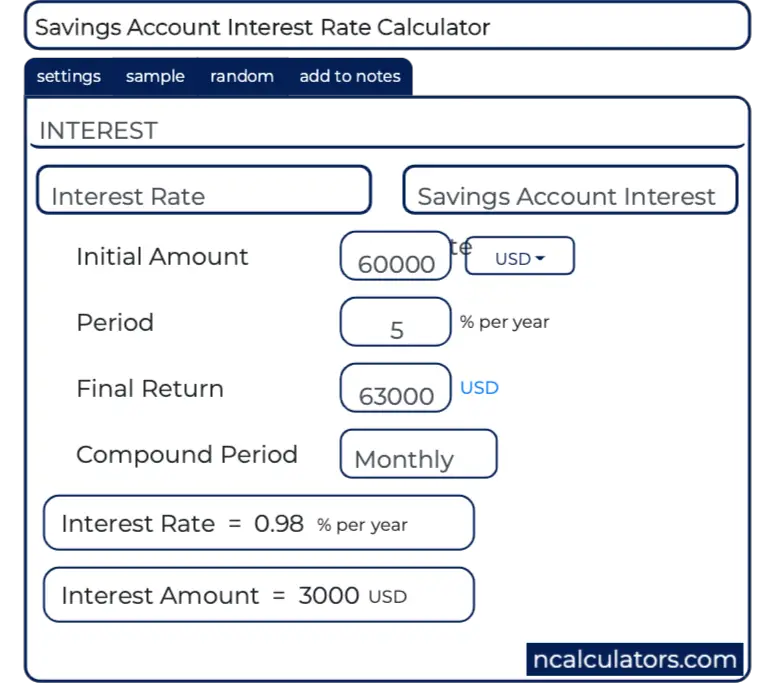
APR represents the periodic interest rate multiplied by the number of periods in a year. It does not account for compounding. APY, on the other hand, reflects the real rate of return on your savings because it includes the effect of compounding interest.
If a bank offers an interest rate of 4.00% that compounds monthly, the APY will actually be 4.07%. This is because each month, your balance grows slightly, and the next month’s 4% (divided by 12) is applied to that larger balance. When calculating your actual returns, always look for the APY, as it provides a more accurate representation of what you will earn over a one-year period.
The Power of Daily Compounding
Many modern high-yield savings accounts compound interest daily, even if they only credit that interest to your account once a month. This means the bank calculates your interest every single day based on your closing balance. For the saver, daily compounding is the gold standard. While the difference between monthly and daily compounding on a small balance might seem negligible in the short term, over decades and with larger sums of money, the difference can amount to thousands of dollars.
The Rule of 72
For a quick mental calculation of how long it will take for your savings to double at a specific interest rate, investors use the “Rule of 72.” By dividing 72 by your annual interest rate, you get the approximate number of years it will take for your initial deposit to 100% grow. For instance, at a 6% interest rate, your money will double in roughly 12 years (72 / 6 = 12). This is a powerful tool for long-term financial planning and visualizing the impact of different interest rates.
Factors That Influence Your Earnings Potential
Calculating interest is not just about the formulas; it is about the variables that go into them. Several external and internal factors dictate how much you will actually see in your account at the end of the year.
The Role of the Federal Reserve
In the United States, the federal funds rate set by the Federal Reserve acts as a benchmark for the entire economy. When the Fed raises rates to combat inflation, banks typically increase the interest rates they offer on savings accounts and CDs. Conversely, in a low-rate environment, your interest earnings may drop. Monitoring the macroeconomic landscape helps you anticipate when to lock in rates through fixed-term vehicles like CDs or when to stay liquid in an HYSA to ride a rising rate environment.
Account Types and Liquidity
The type of account you choose dictates the interest calculation method and the rate itself.
-
Standard Savings Accounts: Often offer the lowest rates, sometimes as low as 0.01%, meaning your interest earnings will be negligible regardless of compounding.
-
High-Yield Savings Accounts (HYSA): Typically offered by online banks, these accounts offer rates significantly higher than the national average. They usually use daily compounding.
-
Certificates of Deposit (CDs): These offer a fixed rate for a fixed term. The interest is often compounded daily or monthly, but you lose liquidity, as withdrawing funds before the term ends usually results in a penalty.
-
Money Market Accounts (MMAs): These often provide tiered interest rates, where higher balances earn a higher percentage.
Inflation and the Real Rate of Return
When calculating interest, it is vital to distinguish between the nominal interest rate and the real rate of return. If your savings account pays 4% interest but inflation is running at 3%, your “real” growth in purchasing power is only 1%. If inflation exceeds your interest rate, you are effectively losing value even though your balance is increasing. A sophisticated approach to savings involves seeking yields that consistently outperform the Consumer Price Index (CPI).
Strategic Approaches to Maximize Your Interest
Once you understand how to calculate interest, you can begin to use strategies that leverage these mathematical truths to build wealth more efficiently.
The Strategy of CD Laddering
Because longer-term CDs typically offer higher interest rates but restrict access to cash, many savvy savers use a “laddering” strategy. By dividing a lump sum into several CDs with different maturity dates (e.g., 1-year, 2-year, 3-year, 4-year, and 5-year), you ensure that a portion of your money becomes available every year. As each CD matures, you reinvest it into a new 5-year CD at the highest current rate. This allows you to capture the higher interest rates associated with long-term commitments while maintaining a steady stream of liquid capital.
Automating the Compounding Process
The most effective way to maximize interest is to increase the principal (P) as often as possible. By setting up automated transfers from your paycheck to your savings account, you ensure that the principal on which your interest is calculated is constantly growing. Because of the way compounding works, adding money early in the year is significantly more beneficial than adding the same amount at the end of the year, as that money has more time to “cycle” through the compounding periods.
Minimizing Leakage: Fees and Taxes
No interest calculation is complete without accounting for “leakage”—the factors that reduce your net gains.
-
Bank Fees: Monthly maintenance fees can easily wipe out any interest earned, especially on smaller balances. Always calculate your “break-even” point to ensure the interest earned exceeds the cost of maintaining the account.
-
Taxation: In most jurisdictions, interest earned on savings is considered taxable income. If you are in a high tax bracket, you may only keep 60% to 70% of the interest you calculate. Understanding your marginal tax rate allows you to calculate your after-tax yield, which is the only number that truly matters for your bottom line.

Conclusion: The Long-Term Perspective
Calculating interest on savings is a blend of simple arithmetic and strategic foresight. While the formulas provide the “how,” your choice of financial vehicles and your consistency in saving provide the “why.” By focusing on accounts that offer high APYs, understanding the benefits of frequent compounding, and accounting for external factors like inflation and taxes, you transform your savings from a static pool of cash into a dynamic engine for financial independence.
The most important takeaway is that time is the most powerful variable in any interest equation. The sooner you begin applying these calculations and optimizing your savings strategy, the more weight the compounding exponent carries. In the world of finance, those who understand interest earn it; those who don’t, pay it. Mastering these calculations puts you firmly in the first category.
aViewFromTheCave is a participant in the Amazon Services LLC Associates Program, an affiliate advertising program designed to provide a means for sites to earn advertising fees by advertising and linking to Amazon.com. Amazon, the Amazon logo, AmazonSupply, and the AmazonSupply logo are trademarks of Amazon.com, Inc. or its affiliates. As an Amazon Associate we earn affiliate commissions from qualifying purchases.