
The ability to manipulate fractions is a cornerstone of mathematical literacy, serving as a prerequisite for advanced disciplines such as algebra, calculus, and data science. While adding two fractions is a common task, the complexity increases when a third term is introduced. In the context of modern technology and software development, understanding the underlying logic of fraction addition is essential for creating robust algorithms, building educational tools, and ensuring precision in financial or engineering software.
This guide provides a comprehensive breakdown of the methodologies used to add three fractions, ranging from traditional manual calculations to high-efficiency digital implementations. By mastering these techniques, users can transition from basic arithmetic to a deeper understanding of computational logic.

The Mathematical Framework: Algorithmic Thinking in Fractions
At its core, adding three fractions requires a systematic approach known as algorithmic thinking. Before a computer or a human can solve the problem, they must follow a set of defined steps to ensure the final result is accurate and simplified.
The Problem of Unlike Denominators
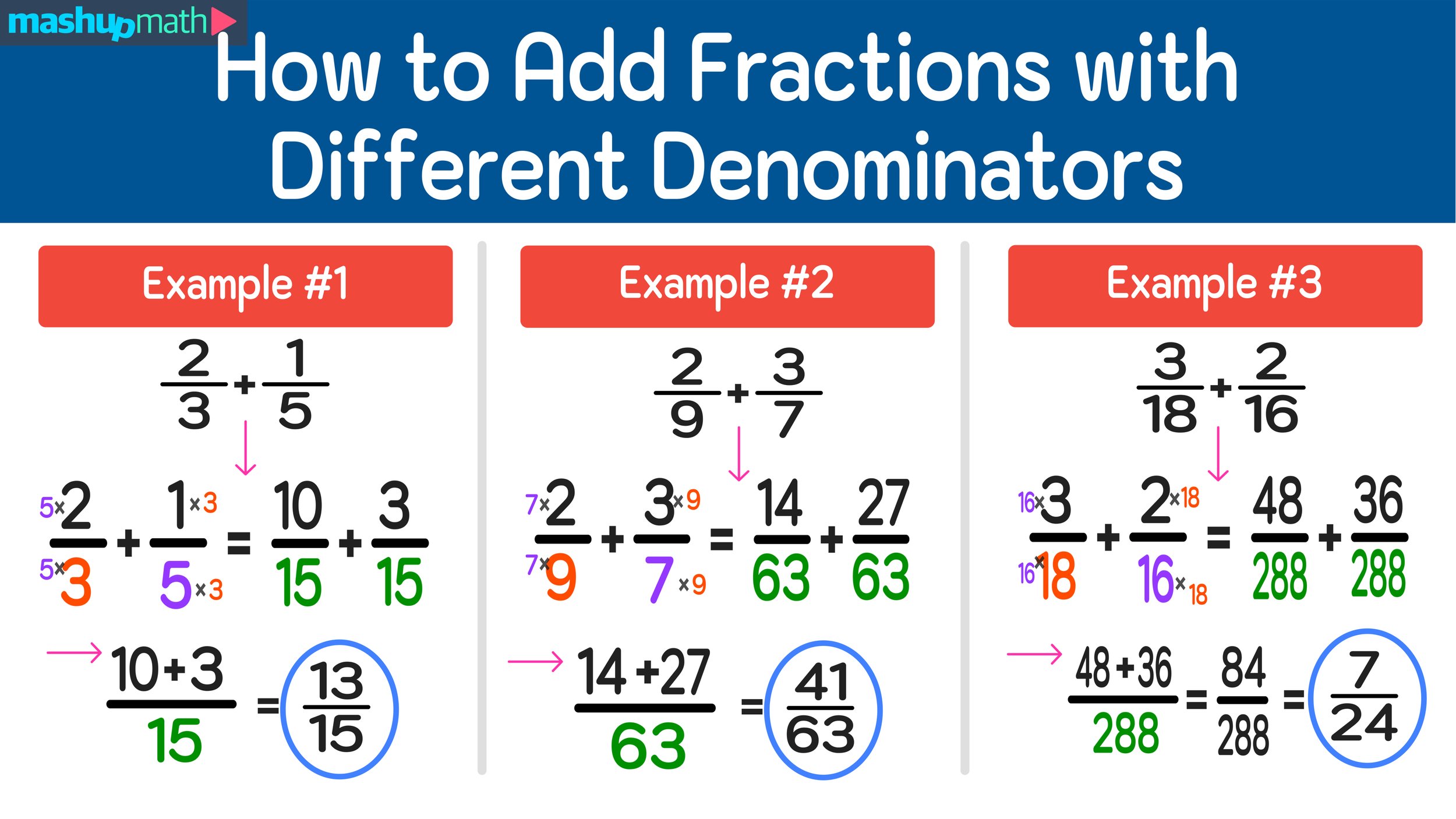
The primary hurdle in adding fractions like 1/2, 1/3, and 1/4 is that they represent different “slices” of a whole. In technical terms, the denominators are not common. To perform addition, all fractions must be converted to a shared scale. This scale is the Least Common Denominator (LCD).
Finding the Least Common Denominator (LCD)
The LCD is the smallest number that all three denominators can divide into without a remainder. For the denominators 2, 3, and 4, the multiples are:
-
2: 2, 4, 6, 8, 10, 12, 14…
-
3: 3, 6, 9, 12, 15…
-
4: 4, 8, 12, 16…
The number 12 is the smallest value shared by all three lists. In software development, this process is often automated using the Least Common Multiple (LCM) function, which is a staple in mathematical libraries.
Converting and Summing
Once the LCD is identified, each fraction must be adjusted:
-
Scale the Numerators: Divide the LCD by the original denominator and multiply the numerator by that result. For 1/2, 12 divided by 2 is 6; therefore, 1/2 becomes 6/12.
-
Maintain Equality: This process ensures the value of the fraction remains the same even though its appearance changes.
-
Perform the Addition: Once all fractions share the denominator of 12 (6/12, 4/12, and 3/12), simply add the numerators (6 + 4 + 3 = 13).
-
Final Result: The sum is 13/12, which can be expressed as a mixed number (1 1/12) or a decimal (1.0833…).
Using Spreadsheets to Automate Fraction Addition
For professionals in finance, logistics, or data analysis, manually calculating fractions is inefficient. Spreadsheet software like Microsoft Excel and Google Sheets offers powerful tools to handle these calculations with precision.
Formatting Cells for Fractional Display
By default, most spreadsheets convert fractions into dates or decimals. To add three fractions and see the result in a fractional format, you must change the cell category:
-
Highlight the target cells.
-
Navigate to Format > Number > Fraction.
-
Choose the “Up to two digits” or “Up to three digits” setting to ensure accuracy for more complex denominators.
Utilizing the LCM Function
If you are building a template that requires adding three variable fractions, you can use the LCM function to find the common denominator automatically. For denominators in cells A1, B1, and C1, the formula =LCM(A1, B1, C1) will return the LCD. This is particularly useful in inventory management where parts of units are tracked across different batches.
The Direct Formula Method
The simplest way to add three fractions in a spreadsheet is to input the values directly. Entering =1/2 + 1/3 + 1/4 into a cell formatted as a fraction will yield the correct result. However, for dynamic data, referencing cells (e.g., =D1+D2+D3) is the preferred method, allowing the sum to update automatically as the inputs change.
Coding the Solution: Python and JavaScript Implementation
In software engineering, handling fractions as floating-point decimals can lead to precision errors. For example, 1/3 represented as 0.33333333 can cause rounding issues in high-stakes environments like legal tech or structural engineering. This is why many programming languages provide specialized modules for “symbolic” math.
Python’s fractions Module
Python includes a built-in module specifically designed for rational number arithmetic. This ensures that 1/3 stays 1/3 throughout the calculation.
from fractions import Fraction


# Defining the three fractions


f1 = Fraction(1, 2)


f2 = Fraction(1, 3)


f3 = Fraction(1, 4)


# Adding them together


result = f1 + f2 + f3


print(result)  # Output: 13/12
This code is highly efficient because it automatically handles the LCD and simplification in the background, mirroring the manual logic discussed earlier but at a much higher speed.
JavaScript Logic for Web Applications
Since JavaScript does not have a native fraction type, developers often use libraries like fraction.js or write custom functions to handle the math. A custom function to add three fractions would typically involve a helper function to find the Greatest Common Divisor (GCD) to simplify the final result.
Building these tools is essential for educational apps (EdTech) that help students visualize how fractions combine. By creating interactive interfaces where users can input three denominators, developers can provide real-time visual feedback on the summation process.
AI-Powered Solvers and the Future of Computational Math
The rise of Artificial Intelligence and symbolic computation engines has transformed how we approach mathematical problem-solving. Tools like WolframAlpha and modern Large Language Models (LLMs) can process complex fractional expressions instantly.
Symbolic Computation Engines
Unlike a standard calculator that converts everything to decimals, symbolic engines treat fractions as objects. When you ask a tool like WolframAlpha to “add 1/2, 1/3, and 1/4,” it doesn’t just give you 1.0833; it provides the exact rational sum (13/12), the mixed number, and the visual representation on a number line. This precision is vital in fields like cryptography and physics.
AI in the Classroom and Workspace
AI tools are now capable of explaining the “why” behind the “how.” If a user asks an AI how to add three fractions, the model can generate a step-by-step breakdown tailored to the user’s current knowledge level. This democratization of high-level math tutoring allows non-technical professionals to handle complex ratios and proportions in their daily workflows without needing a deep background in mathematics.
Optical Character Recognition (OCR)
Apps like Photomath use OCR tech to scan handwritten math problems. For a student or a contractor looking at three fractions on a blueprint, these apps use computer vision to identify the numbers and cloud-based algorithms to return the sum instantly. This bridge between the physical and digital worlds is a prime example of tech simplifying traditional arithmetic.

Digital Best Practices for High-Precision Calculations
When working with fractions in a digital environment, certain best practices ensure that accuracy is maintained and errors are minimized.
-
Avoid Early Decimal Conversion: Never convert fractions to decimals mid-calculation. Rounding 1/3 to 0.33 early on will result in a “drift” in your final answer. Keep everything in fractional or symbolic form until the very last step.
-
Use 64-bit Integers: For software handling very large denominators (common in high-frequency trading or complex scientific simulations), ensure the system uses 64-bit integers to prevent overflow errors during the LCD multiplication phase.
-
Validate User Input: In any app or spreadsheet, ensure that denominators cannot be set to zero. A “Divide by Zero” error is a common bug that can crash simple scripts or invalidate entire datasets.
-
Automate Simplification: Always include a step to reduce the fraction to its simplest form. A result of 50/100 is correct, but 1/2 is the standard for professional reporting and clean data visualization.
By integrating these technological insights with the fundamental rules of arithmetic, adding three fractions becomes more than just a schoolhouse exercise. It becomes a streamlined process within a larger digital ecosystem, enabling greater precision and efficiency in any field that relies on numerical data. Whether you are using a Python script, an Excel formula, or an AI assistant, the logic remains the same: find the common ground, scale the values, and combine them into a unified whole.
aViewFromTheCave is a participant in the Amazon Services LLC Associates Program, an affiliate advertising program designed to provide a means for sites to earn advertising fees by advertising and linking to Amazon.com. Amazon, the Amazon logo, AmazonSupply, and the AmazonSupply logo are trademarks of Amazon.com, Inc. or its affiliates. As an Amazon Associate we earn affiliate commissions from qualifying purchases.