
Percentages are the universal language of finance. From understanding the discount on a new car to deciphering the interest rate on a mortgage, from calculating your investment returns to comprehending the national inflation rate, a solid grasp of percentages isn’t just useful – it’s indispensable. In an increasingly complex financial world, the ability to accurately calculate and interpret percentages empowers individuals and businesses to make informed decisions, avoid costly mistakes, and unlock opportunities. This article will demystify percentages, breaking down the core concepts and calculations into practical, easy-to-understand steps, all within the crucial context of personal and business finance.
The Fundamentals: What Exactly is a Percentage?
At its core, a percentage is simply a way of expressing a number as a fraction of 100. The word “percent” literally means “per hundred” or “out of one hundred.” When you see the symbol “%” appended to a number, it’s signaling a relationship to a whole that has been divided into 100 equal parts. Understanding this basic definition is the foundation for all subsequent financial calculations.
Defining the Basics: Percentage as “Per Hundred”
Imagine a pie chart where the entire pie represents 100%. If a slice of that pie is 25% of the total, it means that slice makes up 25 out of every 100 parts of the pie. Mathematically, 25% can be written as the fraction 25/100 or as the decimal 0.25. This conversion between percentages, fractions, and decimals is critical because calculations are often easier with decimals or fractions.
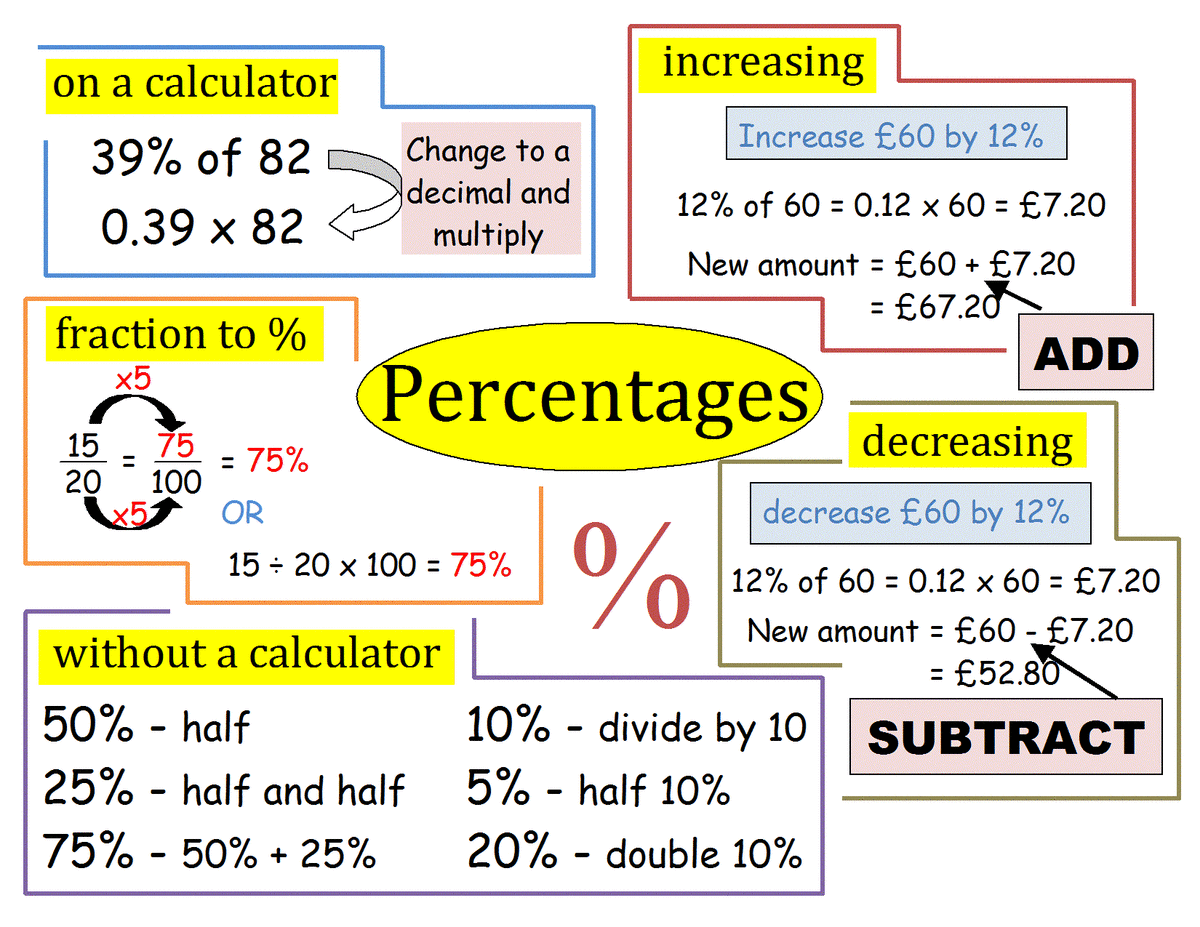
To convert a percentage to a decimal, simply divide by 100 (or move the decimal point two places to the left).
-
Example: 15% = 15/100 = 0.15
-
Example: 0.5% = 0.5/100 = 0.005
To convert a decimal to a percentage, multiply by 100 (or move the decimal point two places to the right).
-
Example: 0.75 = 0.75 * 100 = 75%
-
Example: 1.2 = 1.2 * 100 = 120% (This shows percentages can be greater than 100%, meaning more than the whole.)
Why They Matter in Finance
In the realm of money, percentages are ubiquitous because they provide a standardized, relatable way to compare quantities and express change. Consider a few examples:
-
Interest Rates: Whether it’s the interest you earn on a savings account, the rate you pay on a credit card balance, or the annual percentage rate (APR) of a mortgage, interest is almost always expressed as a percentage. This tells you what proportion of the principal amount you’ll pay or earn over a specific period.
-
Discounts and Sales Tax: When you buy goods, discounts are advertised as percentages off the original price (e.g., “20% off!”). Sales tax, on the other hand, is a percentage added to the price.
-
Investment Returns: The performance of stocks, bonds, or mutual funds is typically reported as a percentage return over a period. This allows for easy comparison between different investments, regardless of their initial principal.
-
Tax Rates: Income tax, capital gains tax, and property tax are all levied as percentages of a specific value or income bracket.
-
Inflation: The rate at which the cost of living increases is measured as a percentage, indicating the erosion of purchasing power over time.
-
Profit Margins: Businesses calculate their gross and net profit as a percentage of revenue, providing a clear indicator of profitability and efficiency.
Without percentages, comparing financial figures across different contexts would be incredibly cumbersome. They normalize information, making it universally understandable.
Core Calculations: How to Find a Percentage of a Number
The most fundamental percentage calculation involves finding a specific percentage of a given number. This is a skill you’ll use daily, often without realizing it.
The Basic Formula: (Part / Whole) * 100 or (Percentage / 100) * Whole
There are two primary ways to approach this, depending on what information you have:
1. Finding what percentage one number is of another:
If you want to know what percentage ‘X’ is of ‘Y’, the formula is:
(X / Y) * 100 = Percentage
-
Example: If you spent $200 on groceries out of a $1000 monthly budget, what percentage of your budget went to groceries?
($200 / $1000) * 100 = 0.20 * 100 = 20%
2. Finding a specific percentage of a given number:
If you want to find ‘P’% of a number ‘N’, the formula is:
(P / 100) * N = Result (Or, convert P to a decimal first: 0.P * N = Result)
-
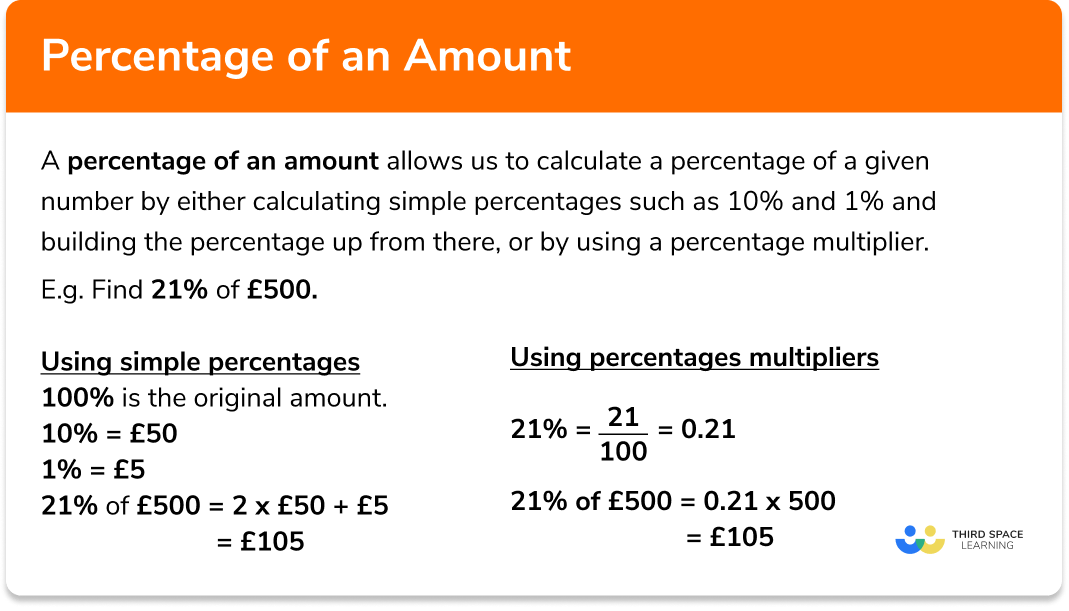
Example: What is 15% of $500?
(15 / 100) * $500 = 0.15 * $500 = $75
Practical Applications: Discounts and Markups
These core calculations are immediately applicable to everyday financial scenarios:
-
Discounts: A common use is calculating the actual saving or final price during a sale.
-
Scenario: A jacket originally costs $120 and is on sale for 25% off.
-
Calculation:
-
Discount amount: 25% of $120 = (25/100) * $120 = 0.25 * $120 = $30
-
Final price: $120 – $30 = $90
-
-
Alternative (one step): If it’s 25% off, you’re paying 75% of the original price. 0.75 * $120 = $90.
-
-
Markups: Businesses use markups to determine their selling price based on cost.
-
Scenario: A product costs a business $50 to produce, and they want a 40% markup.
-
Calculation:
-
Markup amount: 40% of $50 = (40/100) * $50 = 0.40 * $50 = $20
-
Selling price: $50 + $20 = $70
-
-
Interest Calculations: Simple Interest
Understanding how percentages apply to interest is fundamental for loans, savings, and investments. Simple interest is the most straightforward: it’s calculated only on the principal amount.
-
Formula: Simple Interest = Principal * Rate * Time (I = P * R * T)
- Where R is the annual interest rate expressed as a decimal, and T is the time in years.
-
Scenario: You deposit $1,000 into a savings account with a simple annual interest rate of 3%. How much interest will you earn in 2 years?
-
Calculation:
-
Interest = $1,000 * 0.03 * 2 = $60
-
Total amount after 2 years = $1,000 + $60 = $1,060
-
Beyond the Basics: Understanding Percentage Change
While finding a percentage of a number is crucial, equally important is the ability to calculate percentage change. This helps us understand growth, decline, and relative movement in financial figures over time.
Calculating Percentage Increase
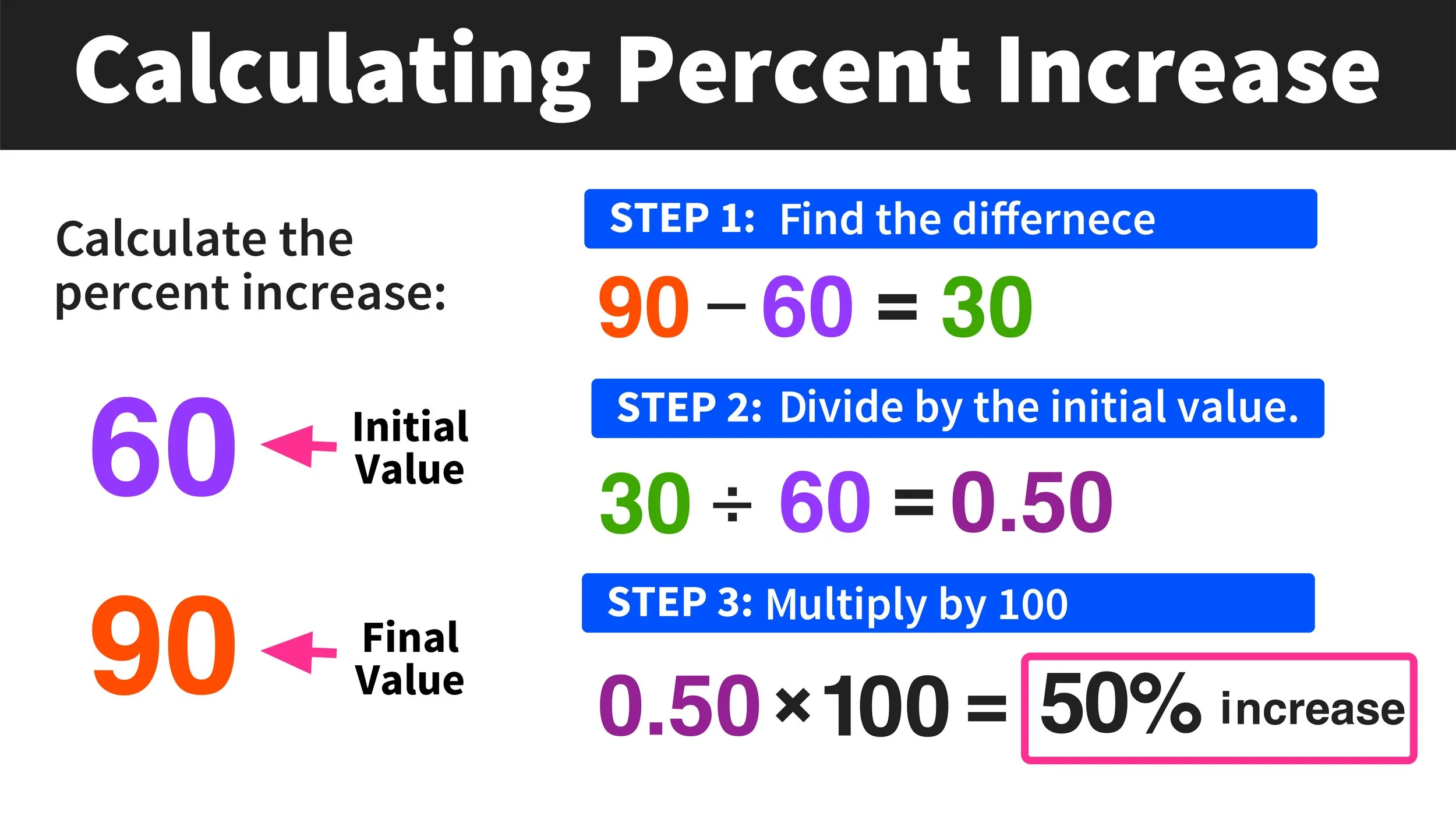
When a value grows, we calculate the percentage increase to quantify that growth relative to its starting point. This is vital for assessing investment performance, sales growth, or salary raises.
-
Formula: ((New Value – Original Value) / Original Value) * 100
-
Scenario: Your investment portfolio grew from $10,000 to $12,000 in a year. What is the percentage increase?
-
Calculation:
-
($12,000 – $10,000) / $10,000 = $2,000 / $10,000 = 0.20
-
0.20 * 100 = 20% increase
-
Calculating Percentage Decrease
Conversely, when a value shrinks, the percentage decrease tells us the relative decline. This is relevant for understanding depreciation, market corrections, or a drop in sales.
-
Formula: ((Original Value – New Value) / Original Value) * 100
- Note: The numerator is positive to reflect the amount of decrease.
-
Scenario: A stock you own dropped from $50 per share to $45 per share. What is the percentage decrease?
-
Calculation:
-
($50 – $45) / $50 = $5 / $50 = 0.10
-
0.10 * 100 = 10% decrease
-
Financial Scenarios: Investment Returns and Inflation
These percentage change calculations are the backbone of many financial analyses:
-
Investment Returns: When a financial advisor talks about a “15% annual return,” they’re referring to a percentage increase in the value of your assets over a year. Calculating this yourself allows you to verify performance and compare options.
-
Inflation: If the Consumer Price Index (CPI) increases by 3% in a year, it means that, on average, goods and services cost 3% more than they did previously. This directly impacts the purchasing power of your money, meaning your existing funds buy 3% less.
-
Business Growth/Decline: Companies meticulously track percentage changes in revenue, profit, customer base, and market share to gauge their health and trajectory.
Reversing the Calculation: Finding the Original Number
Sometimes, you know the final value after a percentage change and need to work backward to find the original amount. This “reverse percentage” calculation is a powerful tool in financial problem-solving.
When You Know the Percentage and the Part
This scenario arises when you know what a certain percentage is of an unknown total.
-
Formula: Original Number = Part / (Percentage as a decimal)
-
Scenario: You paid $75 for a shirt that was 25% off its original price. What was the original price?
- Here, $75 represents 75% of the original price (100% – 25% discount).
-
Calculation:
- Original Price = $75 / 0.75 = $100
Real-World Use Cases: Tax-Inclusive Pricing, Pre-Tax Income
-
Tax-Inclusive Pricing: Imagine an item costs $108, and you know this price includes a 8% sales tax. What was the price before tax?
-
The $108 represents 108% of the pre-tax price (100% original price + 8% tax).
-
Pre-tax Price = $108 / 1.08 = $100
-
-
Pre-Tax Income: If your take-home pay after a 20% tax deduction is $1,600, what was your gross (pre-tax) income?
-
Your take-home pay represents 80% of your gross income (100% – 20% tax).
-
Gross Income = $1,600 / 0.80 = $2,000
-
These inverse calculations are particularly useful for budgeting, verifying receipts, or negotiating prices, ensuring you understand the true value before or after additional charges.
Common Financial Pitfalls and Nuances with Percentages
While seemingly straightforward, percentages can lead to misinterpretations if their nuances aren’t understood.
The “Percentage Point” vs. “Percentage Change”
This distinction is crucial, especially when discussing interest rates or market share.
-
Percentage Change: Refers to the relative change of a value. If an interest rate goes from 2% to 3%, it’s a 50% increase in the interest rate itself (1 percentage point increase / 2% original rate = 0.50 or 50%).
-
Percentage Point Change: Refers to the absolute difference between two percentage values. If an interest rate goes from 2% to 3%, it’s a 1 percentage point increase.
Using “percentage points” avoids the confusion of implying a proportional increase when you mean an absolute difference between two percentages. For instance, saying “the unemployment rate increased by 2 percentage points” (e.g., from 5% to 7%) is clearer than saying “the unemployment rate increased by 40%” (which is technically true but can sound misleadingly large).
Compounding Effects
The power of compound interest is perhaps the most significant financial concept involving percentages. It means earning interest not just on your initial principal, but also on the accumulated interest from previous periods.
- Example: If you invest $1,000 at 10% annual interest, after year 1 you have $1,100. In year 2, you earn 10% on $1,100 ($110), bringing your total to $1,210. This is more than the $1,200 you would have with simple interest ($100 each year). Over long periods, even small percentage differences in compound interest rates can lead to vastly different outcomes. Understanding this is key to long-term wealth building and also to the escalating cost of debt.
Misinterpreting Data
Percentages can be used to distort or emphasize certain aspects of data if not presented with full context.
-
“Sales up by 300%!” sounds impressive, but if sales went from $10 to $40, the absolute increase is small.
-
“Only 1% of products fail!” sounds good, but if a company sells a million products, that’s 10,000 failures.
Always ask: “Percentage of what?” and “What are the absolute numbers involved?”
Conclusion
The ability to “work out percentages” is not merely an academic exercise; it’s a fundamental life skill, particularly within the financial landscape. From the small decisions of daily budgeting and navigating sales to the significant choices surrounding investments, loans, and business strategy, percentages provide the indispensable framework for understanding, comparing, and projecting financial outcomes. By mastering the basic calculations – finding a percentage of a number, calculating percentage change, and even reversing these operations – you equip yourself with the tools to decipher financial statements, evaluate opportunities, and identify potential risks.
Embracing percentage literacy allows you to move beyond simply accepting financial figures at face value. It empowers you to question, analyze, and ultimately make more confident and advantageous decisions with your money. So, take the time to practice these calculations, understand their context, and watch as the world of finance becomes clearer, more manageable, and more amenable to your financial goals.
aViewFromTheCave is a participant in the Amazon Services LLC Associates Program, an affiliate advertising program designed to provide a means for sites to earn advertising fees by advertising and linking to Amazon.com. Amazon, the Amazon logo, AmazonSupply, and the AmazonSupply logo are trademarks of Amazon.com, Inc. or its affiliates. As an Amazon Associate we earn affiliate commissions from qualifying purchases.