
For many, tax season is an annual event synonymous with April 15th, a single deadline for filing and paying the bulk of their tax liability. However, for a significant portion of the workforce—including self-employed individuals, freelancers, gig workers, small business owners, investors, and those with substantial unearned income—tax obligations extend beyond this singular date. If you’re in this category, understanding and proactively managing quarterly estimated tax payments is not just a recommendation; it’s a critical component of sound financial planning and compliance, designed to help you avoid unwelcome penalties and maintain financial stability throughout the year.

The U.S. tax system operates on a “pay-as-you-go” principle. This means that taxpayers are expected to pay most of their tax liability during the year, either through payroll withholding or by making estimated tax payments. When your income isn’t subject to adequate withholding—as is often the case with non-employee income—the responsibility shifts to you to estimate and remit your taxes directly to the IRS (and often your state tax authority) four times a year. This comprehensive guide will demystify the process, from identifying your obligation to calculating, paying, and strategically managing your estimated tax payments, ensuring you navigate this crucial financial responsibility with confidence and precision.
Understanding Estimated Taxes: Who Needs to Pay?
The first step in making estimated tax payments is to determine if you are actually required to do so. This isn’t a universal requirement, but rather applies to specific financial situations where income isn’t adequately covered by traditional payroll withholding.
Identifying Your Obligation: The $1,000 Threshold and Beyond
Generally, you must pay estimated tax if you expect to owe at least $1,000 in tax for the year. This threshold applies to individuals. For corporations, the threshold is significantly higher, typically $500. However, the $1,000 figure is a general guideline; the true trigger is whether your withholding and refundable credits will cover less than 90% of your current year’s tax liability or 100% of your prior year’s tax liability (110% if your prior year’s adjusted gross income was over $150,000). These are known as “safe harbor” rules, which, if met, allow you to avoid underpayment penalties even if your actual tax liability ends up being higher.
Common Income Sources Requiring Estimated Payments
Several types of income typically don’t have taxes withheld and thus necessitate estimated payments:
-
Self-Employment Income: This is perhaps the most common reason for estimated taxes. If you work for yourself as a freelancer, independent contractor, or small business owner, you are responsible for paying both income tax and self-employment taxes (Social Security and Medicare taxes) on your net earnings.
-
Rental Income: If you own rental properties, the income you receive is generally not subject to withholding, making estimated payments a must.
-
Investment Income: This includes dividends, interest, capital gains from the sale of stocks or other assets, and other types of investment returns, unless they are from tax-advantaged accounts or subject to backup withholding.
-
Alimony Income: For divorce decrees executed before 2019, alimony payments received are taxable income to the recipient and usually require estimated tax payments.
-
Pensions and Annuities (without withholding): While some pensions offer withholding options, if you choose not to have tax withheld, you’ll need to make estimated payments.
-
Gambling Winnings: Substantial winnings from lotteries, casinos, or other forms of gambling are taxable and often require estimated payments.
-
Gig Economy Income: The rise of the gig economy means more people earn income through platforms like ridesharing, food delivery, or online marketplaces. This income is typically not subject to withholding.
The Penalty for Underpayment: Why Accuracy Matters
The IRS imposes penalties for underpaying your estimated taxes, even if you eventually pay all your taxes when you file your annual return. The penalty is calculated based on the amount of underpayment, the period of underpayment, and the applicable interest rate. This penalty underscores the importance of accurately estimating your income and tax liability throughout the year and making timely payments. Failing to plan for estimated taxes can turn a profitable year into a financially stressful one, eroding a portion of your hard-earned income.
Calculating Your Estimated Tax Liability
Once you’ve determined you need to pay estimated taxes, the next crucial step is accurately calculating how much to pay. This involves projecting your income and expenses for the entire tax year.
Estimating Your Annual Income and Deductions
The core of estimated tax calculation is an informed projection. You’ll need to forecast all your income sources for the year, including self-employment earnings, investment returns, rental income, and any other income not subject to withholding. Simultaneously, estimate your deductions (standard or itemized) and any credits you anticipate qualifying for.
A good starting point is to review your previous year’s tax return (Form 1040) as a baseline. Consider any significant changes expected in the current year, such as a new business venture, a substantial increase or decrease in earnings, or a major life event like marriage, divorce, or the birth of a child, which can impact your deductions and credits.
Utilizing Tax Forms: Form 1040-ES and Worksheets
The IRS provides Form 1040-ES, “Estimated Tax for Individuals,” which includes a worksheet to help you calculate your estimated tax. This worksheet guides you through estimating your adjusted gross income, deductions, and credits, ultimately arriving at your total estimated tax liability. It then helps you divide this total into four quarterly payments. While you don’t file Form 1040-ES itself, using its worksheet is essential for accurate calculation. Many tax software programs also offer tools to assist with this calculation.
Strategies for Accuracy: Lookback Method vs. Current Year Projections
There are generally two main strategies for calculating your estimated tax:
-
Current Year Projection: This method involves projecting your current year’s income, deductions, and credits as accurately as possible. It’s often the best approach if your income and expenses are expected to be significantly different from the previous year.
-
Lookback Method (Prior Year’s Tax): This strategy utilizes the “safe harbor” rule. You can avoid penalties by paying at least 100% of your prior year’s tax liability (or 110% if your prior year’s AGI was over $150,000). This method is simpler and guarantees no underpayment penalty, but it might result in overpaying if your income is significantly lower this year, tying up capital unnecessarily.
Adjusting for Life Changes: Dynamic Estimation
It’s important to remember that estimated tax payments aren’t set in stone for the entire year. Life happens, and your financial situation can change. If you have a significant increase or decrease in income, a major new deduction, or a life event that impacts your tax situation, you should recalculate your estimated tax. You can adjust your subsequent quarterly payments to reflect these changes. For instance, if your income unexpectedly spikes in the third quarter, you’d increase your third and fourth-quarter payments to compensate.
The Payment Process: How and When to Pay
Once you’ve calculated your estimated tax, the next step is to make your payments accurately and on time. The IRS has specific deadlines and approved methods for submitting these payments.
Payment Deadlines: The Four Quarters Explained
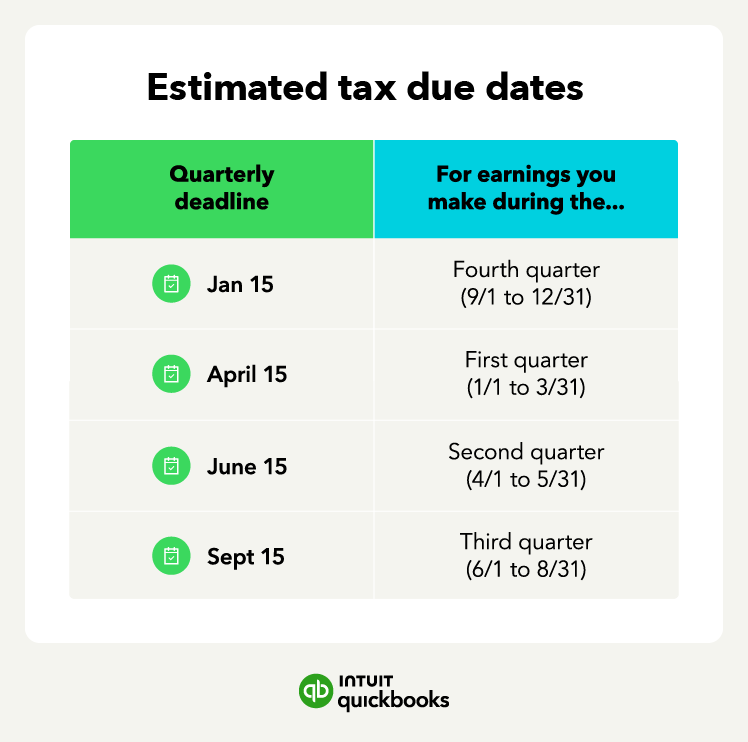
Estimated taxes are paid in four equal installments throughout the year, each corresponding to an earning period. The payment deadlines are:
-
Quarter 1 (January 1 to March 31): Due April 15
-
Quarter 2 (April 1 to May 31): Due June 15
-
Quarter 3 (June 1 to August 31): Due September 15
-
Quarter 4 (September 1 to December 31): Due January 15 of next year
If any of these dates fall on a weekend or holiday, the deadline is typically pushed to the next business day. It’s crucial to mark these dates on your calendar and set reminders to avoid missing payments and incurring penalties.

Official Payment Methods: IRS Direct Pay, EFTPS, Mail, and More
The IRS offers several convenient ways to make estimated tax payments:
-
IRS Direct Pay: This is a free, secure online service that allows you to pay directly from your checking or savings account. You can schedule payments up to 365 days in advance.
-
Electronic Federal Tax Payment System (EFTPS): This is another free online service, particularly popular with businesses and tax professionals. It requires enrollment and is ideal for scheduling recurring payments.
-
Credit or Debit Card: You can pay through approved third-party payment processors, though these services usually charge a small processing fee.
-
Electronic Funds Withdrawal (EFW): If you file your tax return electronically (e-file), you can choose to make your first estimated payment for the next year at the same time.
-
Mail: You can send a check or money order along with Form 1040-ES payment voucher to the IRS. While reliable, this method is slower and offers less proof of payment than electronic options.
State Estimated Taxes: Don’t Forget Your Local Obligations
It’s critical to remember that estimated taxes often apply at the state level as well. Most states with an income tax also require estimated tax payments if you meet their specific thresholds. The rules, deadlines, and payment methods can vary significantly from state to state, so you’ll need to research your individual state’s requirements. Many states mirror the federal deadlines, but some have unique schedules. Failing to pay state estimated taxes can result in separate state-level penalties.
Special Considerations: Farmers, Fishermen, and Annualized Income
Certain taxpayers have special rules:
-
Farmers and Fishermen: If at least two-thirds of your gross income is from farming or fishing, you have the option to make one estimated tax payment by January 15 of the following year, or file your annual return by March 1 and pay all tax due.
-
Annualized Income Method: If your income varies significantly throughout the year (e.g., a seasonal business), you might benefit from the annualized income method. This allows you to pay estimated tax based on the income you earned during each payment period, rather than assuming equal income throughout the year. This can help you avoid underpayment penalties if most of your income is earned later in the year.
Strategies for Managing Your Estimated Tax Payments
Effectively managing your estimated tax payments goes beyond simple calculation and remittance. It involves strategic planning and leveraging tools to maintain financial health.
Setting Aside Funds: Dedicated Accounts and Savings Strategies
One of the most effective strategies is to treat estimated taxes like any other recurring expense. As you earn income that will be subject to estimated tax, immediately set aside a percentage of it into a separate savings account. This dedicated “tax savings” account ensures that the funds are available when payment deadlines arrive, preventing you from accidentally spending the money or feeling a pinch when the tax bill is due. A common rule of thumb for self-employed individuals is to set aside 25-35% of their net earnings, though the exact percentage will depend on your income level, deductions, and tax bracket.
Professional Assistance: When to Consult a Tax Advisor
While many individuals can navigate estimated taxes themselves, there are times when professional guidance is invaluable. If your financial situation is complex, your income is highly variable, or you’re unsure about specific deductions or credits, consulting a qualified tax advisor (e.g., a CPA or Enrolled Agent) is a wise investment. A professional can help you accurately project income, identify all eligible deductions, ensure compliance with federal and state regulations, and advise on strategies to minimize your overall tax liability. They can also help you understand and implement the annualized income method if it’s beneficial for your situation.
Leveraging Technology: Financial Tools for Tracking Income and Expenses
Modern financial technology can significantly simplify the management of estimated taxes.
-
Accounting Software: Tools like QuickBooks, FreshBooks, or Xero can track all your income and expenses, categorize transactions, and generate reports that make calculating your estimated tax liability much easier.
-
Budgeting Apps: Apps like Mint or YNAB can help you monitor your cash flow and ensure you’re setting aside enough money for taxes.
-
Tax Software: Programs like TurboTax or H&R Block offer features that guide you through estimated tax calculations and even help you make payments. Many can also project your income and tax liability for the upcoming year based on your current year’s filing.
Quarterly Review: Reassessing Your Financial Picture
Don’t just calculate your estimated tax once at the beginning of the year and forget about it. Make it a habit to conduct a brief financial review before each quarterly payment deadline.
-
Review actual income and expenses: Compare what you’ve actually earned and spent to your initial projections.
-
Adjust for changes: If your income has been higher or lower than expected, or if you’ve incurred unexpected deductible expenses, adjust your subsequent estimated payments accordingly.
-
Anticipate future events: Consider any upcoming financial changes that might impact your tax liability for the rest of the year. This proactive approach ensures your payments remain accurate and helps you avoid both underpayment penalties and unnecessary overpayments.
Avoiding Pitfalls and Ensuring Compliance
Navigating estimated taxes effectively requires not only understanding the mechanics but also anticipating potential challenges and knowing how to respond.
Understanding Safe Harbor Rules to Prevent Penalties
The IRS provides “safe harbor” rules to help taxpayers avoid underpayment penalties. As mentioned earlier, if you pay at least 90% of your current year’s tax liability or 100% of your prior year’s tax liability (110% if your prior year’s AGI was over $150,000), you will generally not be subject to a penalty, even if you end up owing more when you file your return. Understanding and strategically applying these rules can provide peace of mind and simplify your estimated tax planning. For those with highly variable income, meeting the prior year’s tax liability threshold is often the easiest way to guarantee penalty avoidance.
What to Do If You Miss a Payment or Underpay
If you realize you’ve missed an estimated tax payment or have underpaid for a previous quarter, don’t panic.
-
Pay immediately: Make the missed payment as soon as possible. While a penalty may still apply for the period of underpayment, paying late is better than not paying at all.
-
Adjust future payments: Increase your subsequent quarterly payments to catch up and cover the shortfall from earlier quarters.
-
Form 2210: When you file your annual tax return, the IRS uses Form 2210, “Underpayment of Estimated Tax by Individuals, Estates, and Trusts,” to calculate any penalty. In some cases, you might be able to reduce or eliminate the penalty if the underpayment was due to an unforeseen circumstance or casualty, or if you are a farmer or fisherman.
The Importance of Record-Keeping
Meticulous record-keeping is fundamental to accurate estimated tax payments and overall tax compliance. Maintain detailed records of all your income, expenses, and any tax-related transactions. This includes invoices, receipts, bank statements, and any other documentation that supports your income and deductions. Good records not only simplify the estimated tax calculation process but are also invaluable in the event of an IRS audit, helping you substantiate your claims and avoid potential issues. Digital record-keeping solutions, such as cloud-based storage for scanned documents, can be particularly efficient.
Future Planning: Incorporating Estimated Taxes into Your Budget
Finally, true financial mastery involves integrating estimated tax planning into your broader financial strategy and annual budget. Don’t view estimated taxes as an isolated, annual burden. Instead, factor them into your monthly cash flow projections. This means allocating funds for taxes as a regular, non-negotiable expense, just like rent or utilities. By making estimated taxes a consistent part of your financial planning, you transform a potentially stressful obligation into a manageable, routine aspect of your financial life, ensuring compliance, avoiding penalties, and safeguarding your financial well-being year after year.
In conclusion, quarterly estimated tax payments are a vital responsibility for many taxpayers in the pay-as-you-go system. By understanding who needs to pay, diligently calculating your liability, utilizing appropriate payment methods, and adopting sound management strategies, you can navigate this aspect of personal and business finance with confidence and precision. Proactive planning, accurate estimation, and timely payments are the keys to avoiding penalties and maintaining a healthy financial standing throughout the year.
aViewFromTheCave is a participant in the Amazon Services LLC Associates Program, an affiliate advertising program designed to provide a means for sites to earn advertising fees by advertising and linking to Amazon.com. Amazon, the Amazon logo, AmazonSupply, and the AmazonSupply logo are trademarks of Amazon.com, Inc. or its affiliates. As an Amazon Associate we earn affiliate commissions from qualifying purchases.