
The S&P 500 is often described as the “gold standard” of the American stock market. For decades, it has served as the primary benchmark for the health of the U.S. economy and the go-to vehicle for both institutional investors and everyday individuals looking to grow their net worth. If you have ever wondered how to transition from a saver to an investor, understanding the S&P 500 is your most logical first step.
Investing in the S&P 500 does not mean buying 500 individual stocks manually. Instead, it involves utilizing specific financial instruments designed to track the index’s performance. This guide will walk you through the mechanics of the S&P 500, the best ways to gain exposure to it, and the strategic considerations you should keep in mind as you build your portfolio.
Understanding the S&P 500 Index
Before putting your money to work, it is vital to understand exactly what you are investing in. The Standard & Poor’s 500, commonly known as the S&P 500, is a stock market index that tracks the performance of 500 of the largest companies listed on stock exchanges in the United States.
What Makes Up the Index?
The S&P 500 is not just a random collection of companies. To be included, a company must meet strict criteria regarding market capitalization, liquidity, and profitability. Generally, these are “large-cap” companies, meaning they have a market value of billions of dollars. When you invest in the S&P 500, you are essentially buying a small piece of Apple, Microsoft, Amazon, Berkshire Hathaway, and Alphabet (Google), alongside hundreds of other industry leaders across sectors like healthcare, energy, and consumer staples.
Market-Cap Weighting Explained
One of the most important technical aspects of the S&P 500 is that it is a float-adjusted market-capitalization-weighted index. In simpler terms, this means that companies with a higher market value have a larger impact on the index’s performance. If a massive company like Apple sees a significant price movement, it will affect the index more than a smaller company at the bottom of the list. This structure is designed to reflect the actual composition of the U.S. equity market accurately.
Historical Performance and Expectations
Historically, the S&P 500 has delivered an average annual return of approximately 10% before inflation. While the market does experience “red” years—periods where the value drops significantly—the long-term trajectory has been consistently upward. This reliability is why legendary investors like Warren Buffett often recommend that the average person simply buy an S&P 500 index fund and hold it for the long term.
Choosing Your Investment Vehicle: ETFs vs. Mutual Funds
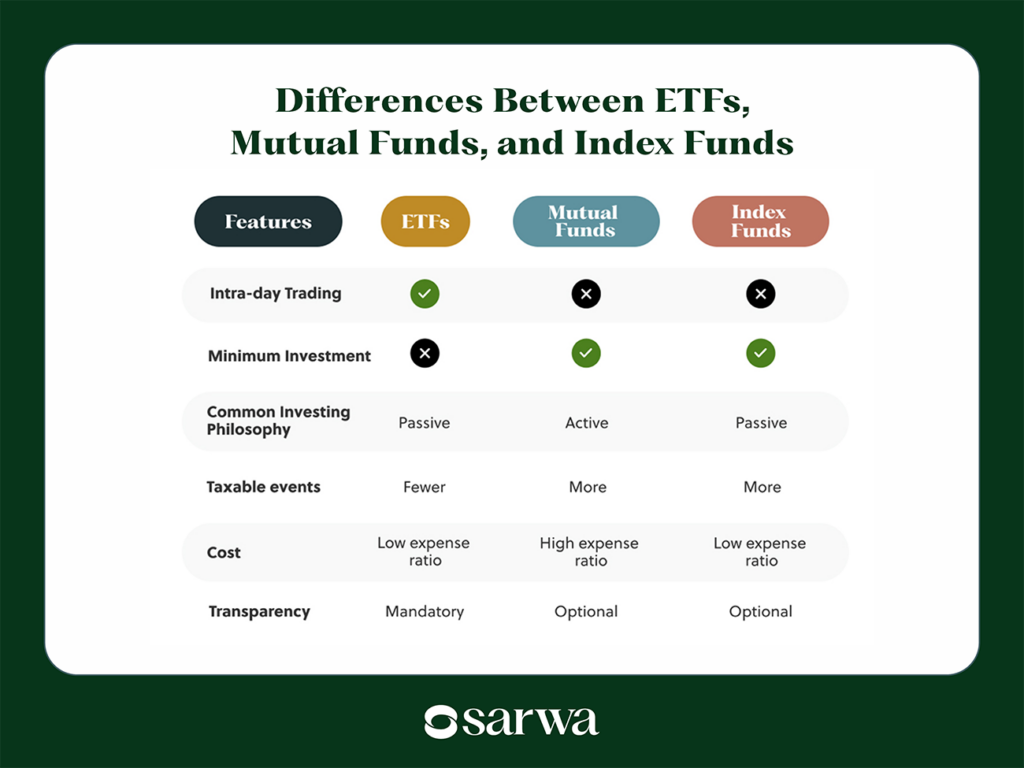
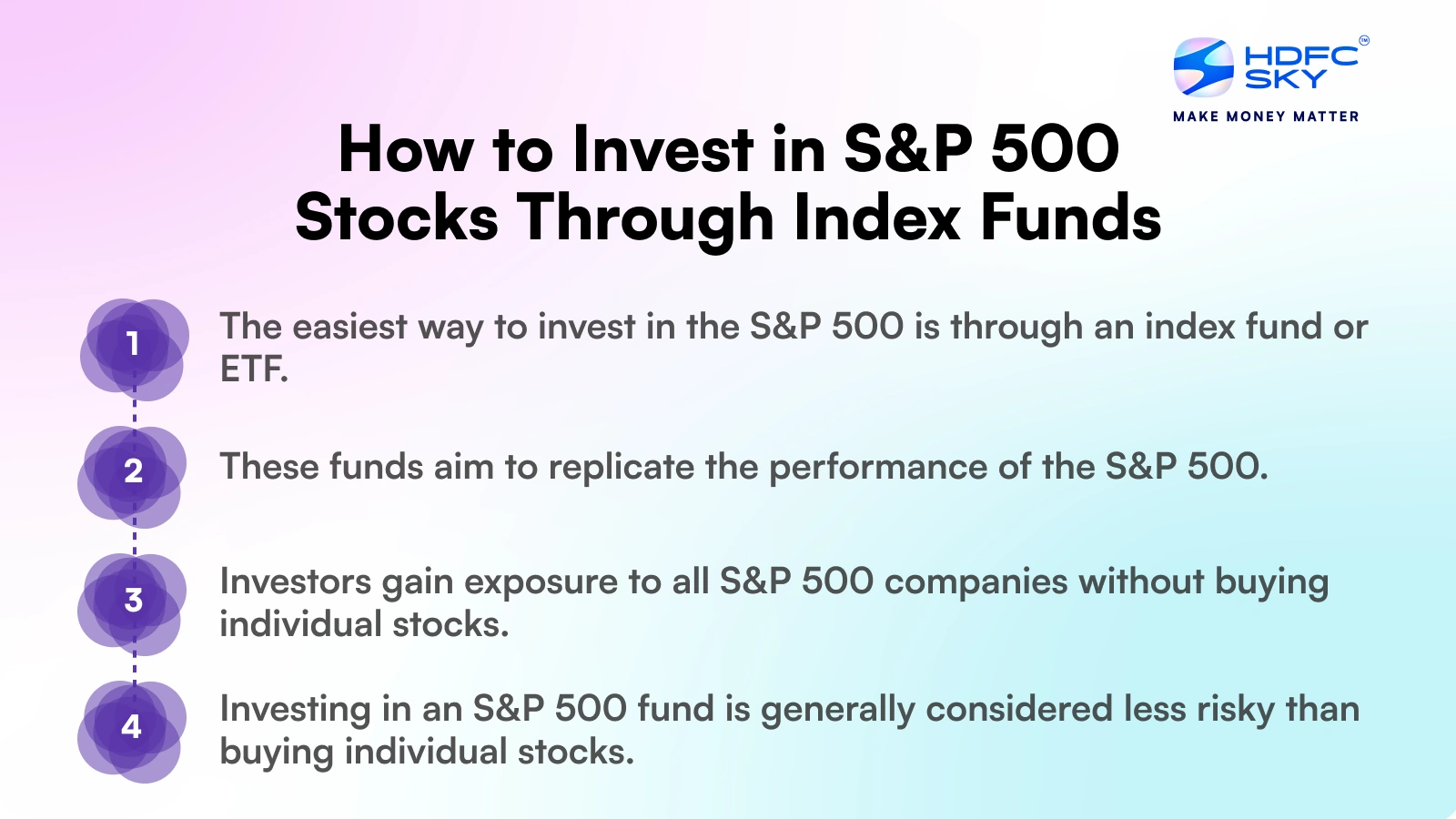
You cannot “buy” the S&P 500 directly because it is an index (a list), not a stock. To invest in it, you must use a fund that mirrors the index. The two primary ways to do this are through Exchange-Traded Funds (ETFs) and Index Mutual Funds.
Exchange-Traded Funds (ETFs)
ETFs are arguably the most popular way to invest in the S&P 500 today. They trade on an exchange just like individual stocks, meaning their price fluctuates throughout the trading day. Popular S&P 500 ETFs include the SPDR S&P 500 ETF Trust (SPY), the iShares Core S&P 500 ETF (IVV), and the Vanguard S&P 500 ETF (VOO).
The primary advantage of ETFs is their low “expense ratio”—the annual fee charged by the fund manager. For example, VOO and IVV often have expense ratios as low as 0.03%, meaning you only pay $3 for every $10,000 invested. Additionally, ETFs are generally more tax-efficient than mutual funds, making them ideal for taxable brokerage accounts.
Index Mutual Funds
Index mutual funds operate similarly to ETFs but with a few key differences. They are priced only once at the end of the trading day. Some investors prefer mutual funds because they allow for “automatic investing,” where you can set a specific dollar amount (e.g., $200 every payday) to be invested regardless of the share price.
While many mutual funds have higher fees, “index” mutual funds from providers like Fidelity (e.g., FXAIX) or Vanguard (e.g., VFIAX) offer competitive rates that rival ETFs. However, be aware that some mutual funds require a “minimum initial investment,” which could be anywhere from $1,000 to $3,000.
Direct Stock Ownership vs. Indexing
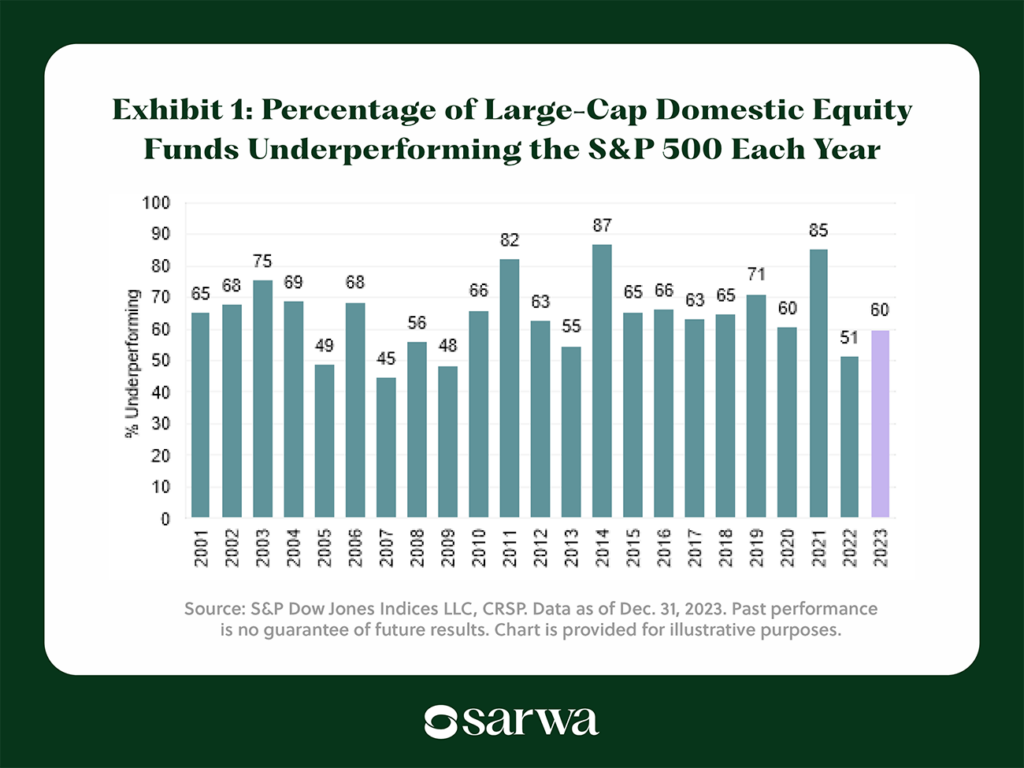
While you could technically try to buy shares of all 500 companies, it is impractical for the average investor. It would require massive amounts of capital and constant rebalancing. Using an ETF or Mutual Fund provides “instant diversification,” reducing the risk that the failure of a single company will ruin your entire portfolio.
Step-by-Step Guide to Making Your First Investment
Once you have decided on the type of fund you want to use, the actual process of investing is straightforward. Modern financial technology has made it possible to start with as little as a few dollars.
1. Open a Brokerage Account
To buy an S&P 500 fund, you need a brokerage account. You can choose between traditional “Big Three” brokers like Charles Schwab, Fidelity, or Vanguard, or modern fintech apps like Robinhood or Betterment. When choosing a broker, look for one that offers $0 commissions on stock and ETF trades and a user-friendly interface.
2. Determine Your Account Type
You must decide which “bucket” your money will sit in.
- Individual Brokerage Account: This is a standard taxable account. You can withdraw your money at any time, but you will owe taxes on any gains.
- IRA or Roth IRA: These are retirement accounts. They offer significant tax advantages—either tax-deductible contributions (Traditional) or tax-free growth (Roth)—but they usually have restrictions on when you can withdraw the money.
- 401(k): If your employer offers a retirement plan, check if an S&P 500 index fund is one of the options. This is often the easiest way to invest using pre-tax dollars.
3. Search for the Ticker Symbol
Once your account is funded, use the search bar to find your chosen fund. If you want the Vanguard ETF, you would search for “VOO.” If you want the SPDR version, you would search for “SPY.”
4. Place a “Market” or “Limit” Order
A “Market Order” buys the shares immediately at the current market price. A “Limit Order” allows you to set the maximum price you are willing to pay. For long-term S&P 500 investors, a market order is usually sufficient, as the goal is to get the money into the market as soon as possible.
Investment Strategies: Maximizing Returns and Managing Risk
Simply buying the S&P 500 is a great start, but how you manage that investment over time will determine your ultimate success.
The Power of Dollar-Cost Averaging (DCA)
One of the biggest mistakes new investors make is trying to “time the market.” They wait for a “dip” to buy, often missing out on gains while they wait. A more effective strategy is Dollar-Cost Averaging. This involves investing a fixed amount of money at regular intervals, regardless of the price. When the market is high, your money buys fewer shares; when the market is low, your money buys more. Over time, this lowers your average cost per share and removes the emotional stress of volatility.
Reinvesting Dividends
Most companies in the S&P 500 pay dividends—a portion of their profits distributed to shareholders. When you own an S&P 500 fund, you will receive these dividends periodically. Instead of taking that money as cash, you should set your account to “DRIP” (Dividend Reinvestment Plan). This automatically uses your dividends to buy more shares of the fund, leading to powerful compounding growth over the years.
Understanding the Risks
While the S&P 500 is diversified, it is not “risk-free.” It is a 100% equity investment, meaning it can be volatile. During the 2008 financial crisis or the 2020 pandemic crash, the index saw significant short-term drops. Investors must have a “stomach for volatility” and a time horizon of at least 5 to 10 years. If you need the money for a down payment on a house next year, the S&P 500 may not be the right place for it.
Conclusion: The Path to Financial Independence
Investing in the S&P 500 is one of the most effective ways to build wealth because it bets on the long-term growth and innovation of the American economy. By choosing a low-cost ETF or mutual fund, utilizing a tax-advantaged account, and staying disciplined through market cycles, you can turn relatively small monthly contributions into a substantial nest egg.
The key is not to find the perfect moment to start, but to simply start. In the world of finance, “time in the market” almost always beats “timing the market.” By owning the 500 largest companies in the U.S., you aren’t just saving money; you are participating in the global engine of capitalism, allowing your capital to work just as hard as you do.
aViewFromTheCave is a participant in the Amazon Services LLC Associates Program, an affiliate advertising program designed to provide a means for sites to earn advertising fees by advertising and linking to Amazon.com. Amazon, the Amazon logo, AmazonSupply, and the AmazonSupply logo are trademarks of Amazon.com, Inc. or its affiliates. As an Amazon Associate we earn affiliate commissions from qualifying purchases.