
In the landscape of personal finance, one of the most effective ways to preserve capital and increase net worth is through the disciplined use of targeted discounts and incentive programs. For military members, veterans, and their families, the Home Depot military discount represents a significant opportunity to reduce the overhead of home ownership and property management. However, as the retail giant has transitioned to a more digitized, centralized verification system, the “how-to” of securing this 10% reduction has evolved from a simple showing of an ID card to a structured financial strategy.

Understanding how to navigate this system is not just about a single transaction; it is about integrating a consistent 10% savings into your long-term household budget. For a veteran or active-duty member engaged in a major home renovation, these savings can amount to hundreds of dollars annually, which, when reinvested or used to offset high-interest debt, contributes significantly to overall financial health.
Understanding the Financial Value of the Home Depot Military Discount
The Home Depot military discount is a 10% price reduction offered to eligible service members on most in-stock purchases. While 10% might seem modest in the context of a single bag of mulch, its impact on a comprehensive annual budget is substantial. To appreciate the fiscal utility of this program, one must look at the macro view of home maintenance costs.
The 10% Advantage: Quantifying Annual Savings
Financial advisors often suggest that homeowners set aside 1% to 2% of their home’s value annually for maintenance and repairs. For a $400,000 home, that equates to $4,000 to $8,000 per year. By utilizing a 10% military discount, a qualifying individual can effectively lower that annual expenditure by $400 to $800.
Over a decade of homeownership, this represents a $4,000 to $8,000 capital preservation. If those saved funds are diverted into a low-cost index fund with an average annual return of 7%, the compound interest effect transforms a simple retail discount into a significant retirement asset. This is the hallmark of sophisticated personal finance: recognizing that small, recurring savings are the building blocks of long-term wealth.
Eligibility and the Impact on Household Budgeting
The eligibility criteria for the discount have been refined to focus on those who have served or are currently serving. This includes active-duty members, reservists, and veterans with an honorable discharge. From a budgeting perspective, the inclusion of spouses is a critical feature. By ensuring that the spouse of a service member is also registered, the household can maintain its savings strategy regardless of who is performing the errand.
This program serves as a “financial shield” against the rising costs of raw materials and inflation in the construction sector. By locking in a 10% lower price point than the general public, military households gain a competitive advantage in the real estate market, as their cost-basis for home improvements remains lower than that of their neighbors.
The Digital Registration Process: Integrating Financial Security and Verification
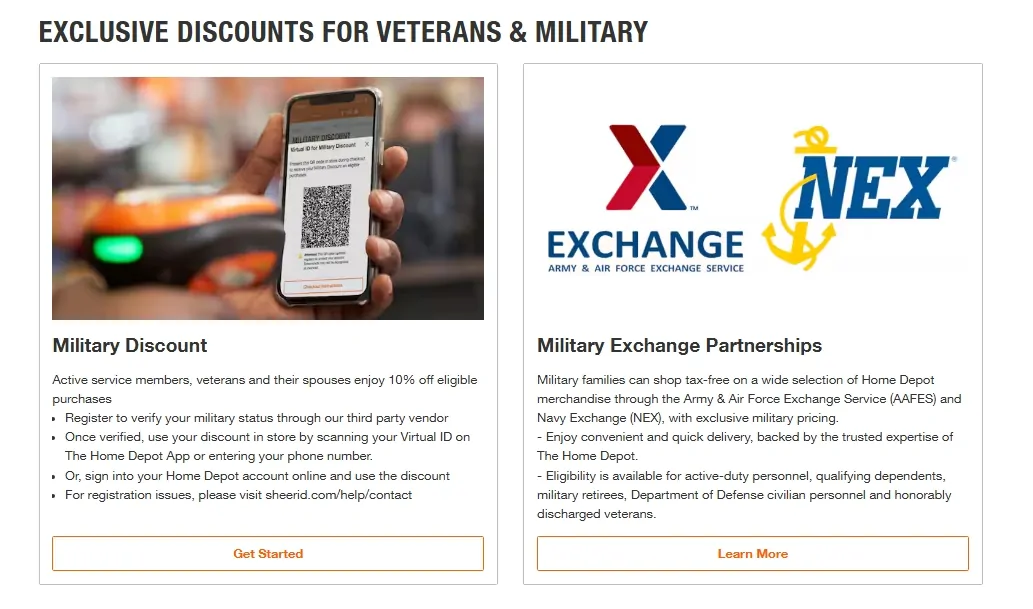
In years past, securing a military discount was a manual process involving the presentation of a Common Access Card (CAC) or a DD-214 form at the cash register. While simple, this method was prone to inconsistency and lacked the security features necessary in a modern financial environment. Home Depot has since moved to a digital verification system through a partnership with SheerID.
The Role of SheerID in Financial Data Privacy
From a personal finance and digital security standpoint, the use of a third-party verification service like SheerID is a protective measure for the consumer. Rather than sharing sensitive military documentation with every cashier at a local branch, the service member provides their information once to a secured, encrypted platform. This minimizes the risk of identity theft—a financial disaster that can take years and thousands of dollars to rectify.
For the user, this means that their military status is tied to their Home Depot account digitally. Once the verification is complete, the discount is applied via a personal QR code within the Home Depot mobile app. This digital integration ensures that the discount is applied accurately and consistently, removing the “human error” factor that can often lead to missed savings opportunities.
Step-by-Step Registration for Long-Term Fiscal Benefit
To initiate this savings stream, the user must follow a specific protocol:
-
Account Creation: Create or log in to a personal account on the Home Depot website or mobile app.
-
Verification: Navigate to the “Military Discount” page and follow the prompts to verify status through SheerID. This usually requires name, branch of service, and status (Active, Veteran, etc.).
-
Authentication: In some cases, documentation may need to be uploaded. Once verified, the status is permanently linked to the account.
-
Utilization: When shopping in-store, the user must scan their personal “Virtual ID” (the QR code) at checkout. For online purchases, the discount is automatically applied to eligible items in the cart once logged in.
By completing this process once, the service member automates a portion of their financial savings, adhering to the principle of “setting and forgetting” wealth-building habits.
Strategic Spending: Navigating Terms, Conditions, and Exclusions
To truly master the financial aspect of the Home Depot military discount, one must understand the fine print. Like any corporate incentive, there are boundaries designed to protect the company’s margins, and a savvy consumer must navigate these to ensure they are getting the maximum possible value.
Identifying the $400 Annual Cap and Its Financial Implications
Perhaps the most important financial detail of the Home Depot military discount is the annual maximum savings cap. As of current policy, the 10% discount is capped at a total savings of $400 per calendar year. This means the discount applies to the first $4,000 of eligible spending.
For the disciplined budgeter, this cap necessitates a strategic approach to project timing. If a homeowner is planning both a kitchen refresh and a deck build in the same year, and the total material cost exceeds $4,000, the “excess” spending will not receive the 10% reduction. In this scenario, it may be financially prudent to split the projects across two calendar years—purchasing $4,000 worth of materials in November and the remainder in January—to maximize the discount’s utility across two separate annual caps.
Managing Project Budgets Around Non-Discountable Items
Not every item in the store is eligible for the military discount. Generally, the discount excludes installation services, delivery fees, gift cards, and certain “commodity” items like raw lumber or wire in high-volume quantities that are already priced at thin margins.
From a business finance perspective, understanding these exclusions prevents “budget creep.” When estimating the ROI (Return on Investment) of a home improvement project, the homeowner should calculate the 10% savings only on eligible hardware, tools, and fixtures. If a project relies heavily on lumber and professional installation, the effective discount may drop from 10% to 3% or 4% of the total project cost. Recognizing this early allows for more accurate financial forecasting and prevents overextension of credit.
Scaling Your Savings: Combining the Discount with Other Financial Tools
In the world of personal finance, “stacking” refers to the practice of using multiple different savings methods on a single purchase. While Home Depot’s policy generally prohibits stacking the military discount with other promotional coupons or “Buy One Get One” (BOGO) offers, there are still ways to enhance the total financial benefit.
Leveraging Cash-Back Credit Cards and Loyalty Programs
The most effective way to “stack” the military discount is through the use of a high-yield cash-back credit card. If a veteran uses a credit card that offers 2% cash back on all purchases and applies the 10% military discount at the register, the effective savings rate moves to 12%.
For individuals who use the Home Depot for business purposes—such as those managing “side hustle” rental properties—pairing the military discount with the Home Depot Pro Xtra loyalty program can yield even greater results. While the 10% discount cannot always be combined with “Pro” volume pricing, the spending still counts toward Pro Xtra goals, which can lead to “Perks” like tool rental credits or specialized business services.
Timing Purchases with Seasonal Sales Cycles
While the military discount remains constant throughout the year, the base price of goods fluctuates. A professional approach to spending involves tracking the price cycles of high-ticket items like appliances or power tools. Purchasing an item when it is already marked down for a seasonal sale—and then applying the military discount—results in the lowest possible cost-basis. However, users must be cautious; if an item is marked as a “Special Buy” or a “Clearance” item, the military discount may not apply. The key is to identify “In-Stock” items that are on temporary price reduction rather than permanent clearance.
Long-Term Wealth Management Through Smarter Home Improvement
The ultimate goal of using the Home Depot military discount is not just to save money at the register, but to enhance one’s overall financial position. For many veterans, their home is their largest financial asset.
Improving Real Estate Value via Cost-Effective Maintenance
Every dollar saved on maintenance is a dollar of equity earned. By consistently applying the 10% military discount to high-quality materials, homeowners can maintain their property at a higher standard than they might otherwise afford. This proactive maintenance prevents “deferred maintenance” costs, which can be catastrophic to a home’s resale value. In the world of real estate investing, a well-maintained home sells faster and at a premium, making the military discount a tool for capital gains.

The Psychology of Disciplined Spending for Veterans
Finally, the process of registering for and using the military discount reinforces a mindset of disciplined spending. In personal finance, the “small wins” matter. The act of opening the app, scanning the code, and seeing the 10% reduction at every visit fosters a habit of intentionality. For many service members transitioning to civilian life, maintaining this level of financial discipline is crucial for long-term stability.
In conclusion, the Home Depot military discount is more than a “thank you” for service; it is a powerful financial instrument for those who know how to use it. By understanding the digital registration process, respecting the $400 annual cap, and strategically timing purchases, veterans and active-duty members can significantly reduce their cost of living and increase their capacity for investment and wealth building. In the quest for financial independence, every 10% matters.
aViewFromTheCave is a participant in the Amazon Services LLC Associates Program, an affiliate advertising program designed to provide a means for sites to earn advertising fees by advertising and linking to Amazon.com. Amazon, the Amazon logo, AmazonSupply, and the AmazonSupply logo are trademarks of Amazon.com, Inc. or its affiliates. As an Amazon Associate we earn affiliate commissions from qualifying purchases.