
In the world of personal finance, investing, and business, a profound understanding of percentages isn’t just an advantage—it’s an absolute necessity. From decoding interest rates on your credit card statement to calculating investment returns, determining profit margins, or even just understanding a discount at your favorite store, percentages are the universal language of financial transactions and analysis. This guide will demystify percentage calculations, embed them in real-world financial contexts, and equip you with the knowledge to make more informed money decisions.
The Fundamental Role of Percentages in Finance
Percentages are more than just a mathematical concept; they are a critical tool for comparing values, understanding proportions, and tracking change over time, especially in financial scenarios. They provide a standardized way to express a part of a whole, making it easier to grasp the significance of numbers that might otherwise seem abstract.
Why Percentages are Indispensable for Financial Literacy
Financial literacy hinges on the ability to interpret and apply numerical information effectively. Percentages play a pivotal role in nearly every aspect of managing your money:
- Budgeting: When you allocate a certain percentage of your income to housing, food, or savings, you’re setting clear, proportionate spending guidelines that are scalable regardless of your income level.
- Savings Goals: Tracking how close you are to a savings goal (e.g., “I’ve saved 30% of my down payment”) provides clear progress indicators.
- Debt Management: Understanding the annual percentage rate (APR) on loans and credit cards is crucial for evaluating the true cost of borrowing and strategizing debt repayment. High APRs can dramatically increase the total amount you repay.
- Investment Performance: The success of your investments is almost always measured in percentage returns, allowing you to compare different assets or strategies over various periods.
- Taxes: Income tax brackets, sales tax, and capital gains tax are all calculated as percentages of relevant financial figures.
Without a solid grasp of percentages, navigating these common financial situations can feel like sailing without a compass, leading to misjudgments and potentially costly errors.
Unlocking Financial Decisions with Percentage Insights
The power of percentages extends beyond mere calculation; it empowers better decision-making. Should you take a personal loan with an 8% interest rate or put the expense on a credit card with 19% APR? Is a stock that gained 15% this year a better performer than another that gained 10%? These questions, and countless others, are answered by understanding and comparing percentages. They allow for an apples-to-apples comparison, normalizing data across different scales and magnitudes.
Basic Percentage Calculation: The Foundation
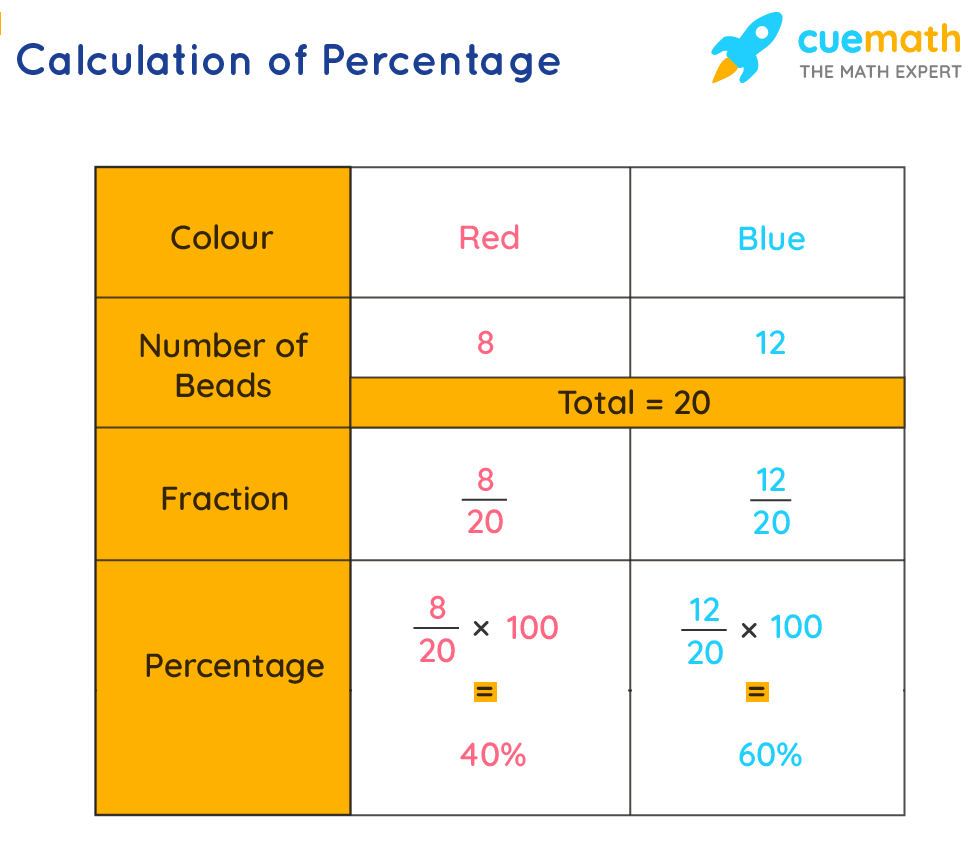
At its core, calculating a percentage is straightforward. It’s about understanding the relationship between a part and its whole, and then expressing that relationship out of one hundred.
Understanding the Core Formula: Part/Whole x 100
The most fundamental percentage formula is:
Percentage = (Part / Whole) x 100
Let’s break this down with a simple financial example:
Imagine you have a monthly income of $4,000 (the “Whole”) and you spent $1,200 on rent (the “Part”). To find what percentage of your income goes to rent:
- Part = $1,200
- Whole = $4,000
Percentage of income on rent = ($1,200 / $4,000) x 100 = 0.30 x 100 = 30%
This means 30% of your monthly income is allocated to rent.
Finding a Percentage of a Number
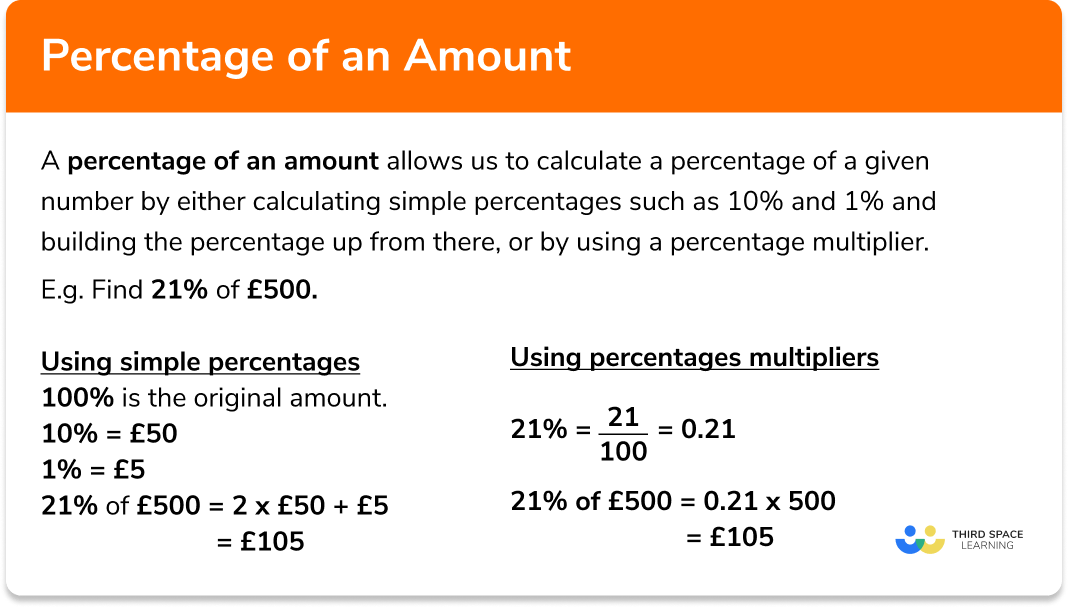
Another common scenario is needing to find a specific percentage of a given number. This is often used for calculating discounts, sales tax, or interest. The formula here is:
Amount = Percentage (as a decimal) x Whole
To convert a percentage to a decimal, simply divide it by 100. For example, 25% becomes 0.25.
-
Example 1: Discount Calculation
You see an item priced at $80, and it’s on sale for 25% off.
Discount amount = 25% (or 0.25) x $80 = $20
The final price would be $80 – $20 = $60. -
Example 2: Sales Tax
You buy an item for $100, and the sales tax is 7%.
Sales tax amount = 7% (or 0.07) x $100 = $7
The total cost would be $100 + $7 = $107.
Converting Between Decimals, Fractions, and Percentages
Fluency in converting between these forms is crucial for quick financial calculations:
- Percentage to Decimal: Divide by 100 (e.g., 50% = 0.50).
- Decimal to Percentage: Multiply by 100 (e.g., 0.75 = 75%).
- Fraction to Percentage: Divide the numerator by the denominator, then multiply by 100 (e.g., 1/4 = 0.25 x 100 = 25%).
- Percentage to Fraction: Place the percentage over 100 and simplify (e.g., 20% = 20/100 = 1/5).
These fundamental conversions streamline your ability to work with financial data in various formats.
Real-World Financial Applications of Percentages
The beauty of percentages lies in their versatility across the financial spectrum. From personal budget management to complex business analysis, they provide clarity and quantifiable insights.
Personal Finance: Budgeting, Savings, and Debt
- Budgeting: Financial advisors often recommend budgeting rules like the 50/30/20 rule, where 50% of income goes to needs, 30% to wants, and 20% to savings and debt repayment. These are directly percentage-based allocations. If your monthly after-tax income is $5,000, your budget for needs would be 50% of $5,000 = $2,500.
- Savings Rate: This is the percentage of your income that you save. A high savings rate (e.g., 15-20% or more) is a strong indicator of financial health and future wealth accumulation.
- Understanding Interest on Loans/Credit Cards: If you have a credit card balance of $1,000 with an 18% APR, the interest charged over a year (assuming no payments) would be 18% of $1,000 = $180. Understanding this helps you prioritize paying off high-interest debt.
Investing: Returns, Diversification, and Risk Assessment
- Return on Investment (ROI): This is a key metric for investors, calculated as ((Current Value – Initial Investment) / Initial Investment) x 100. A stock bought for $1,000 and now worth $1,200 has an ROI of (($1,200 – $1,000) / $1,000) x 100 = 20%.
- Asset Allocation Percentages: Diversifying your investment portfolio often involves allocating specific percentages to different asset classes (e.g., 60% stocks, 30% bonds, 10% cash). This strategy aims to manage risk and optimize returns.
- Portfolio Growth: Tracking the percentage growth of your overall portfolio allows you to assess the effectiveness of your investment strategy over time, factoring in both gains and losses.
Business Finance: Profit Margins, Discounts, and Growth
- Gross and Net Profit Margins:
- Gross Profit Margin: (Gross Profit / Revenue) x 100. Indicates the percentage of revenue left after covering the cost of goods sold.
- Net Profit Margin: (Net Profit / Revenue) x 100. Shows the percentage of revenue left after all expenses, including taxes, have been deducted. These margins are vital for assessing a business’s profitability and efficiency.
- Sales Tax and VAT Calculations: Businesses collect and remit these taxes, which are always a percentage of the sale price.
- Percentage Growth in Revenue/Customers: Companies constantly track their growth as a percentage year-over-year or quarter-over-quarter. For example, “Our revenue grew by 15% this quarter” provides a clear, comparable metric of performance.
Beyond Basics: Advanced Percentage Concepts for Financial Insight
While the foundational calculations are essential, some more advanced percentage concepts offer deeper financial insights, particularly in investing and business strategy.
Percentage Change: Tracking Growth and Decline
The percentage change formula helps measure the relative change between two values over time. It’s especially useful for tracking inflation, stock price movements, or business growth rates.
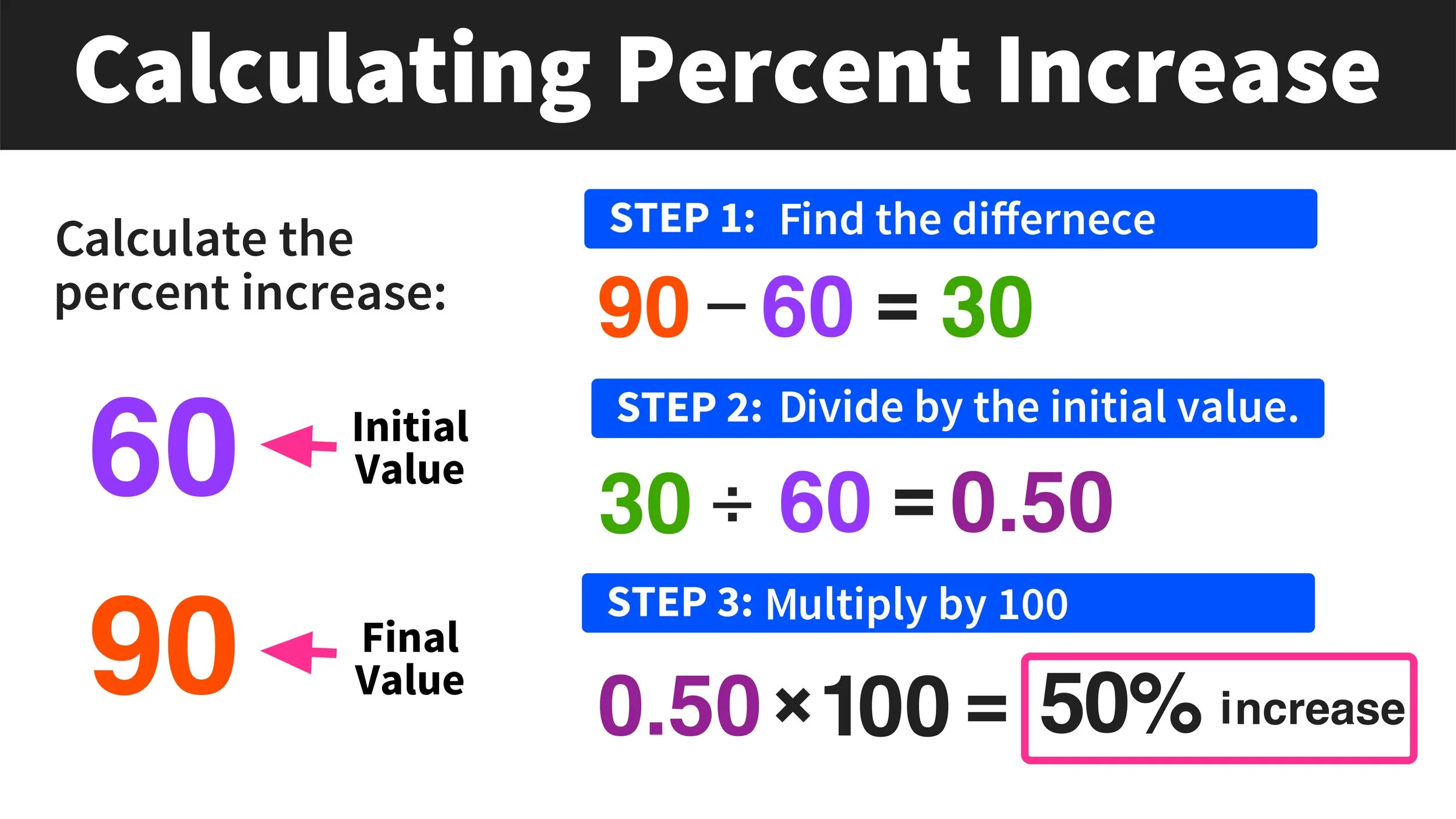
Percentage Change = ((New Value – Old Value) / Old Value) x 100
- Example: Stock Price Fluctuation
A stock was $50 last year and is now $55.
Percentage Change = (($55 – $50) / $50) x 100 = ($5 / $50) x 100 = 0.10 x 100 = +10%
If it dropped to $45:
Percentage Change = (($45 – $50) / $50) x 100 = (-$5 / $50) x 100 = -0.10 x 100 = -10%
This allows you to understand the magnitude of change relative to the initial value.
Compound Interest: The Eighth Wonder of the World
Albert Einstein is often (though perhaps apocryphally) quoted as calling compound interest the “eighth wonder of the world.” It’s the interest you earn not only on your initial principal but also on the accumulated interest from previous periods. Understanding its power is fundamental to long-term wealth building.
While the calculation can be complex (A = P(1 + r/n)^(nt)), the core concept is that a small percentage gain, compounded over many years, leads to exponential growth. For instance, investing $10,000 at a modest 7% annual return compounded annually, after 30 years, would grow to over $76,000, far more than simple interest would yield. This principle underscores the importance of starting to save and invest early.
Markup, Markdown, and Discounts
These are crucial for both consumers and businesses:
- Markup: The percentage added to the cost of a product to determine its selling price. If a product costs a business $10 and they apply a 50% markup, the markup amount is $5, and the selling price is $15.
- Markdown: A reduction in the selling price, often expressed as a percentage. A 20% markdown on a $100 item reduces the price by $20.
- Discounts: Similar to markdowns, these are percentage reductions offered to customers, often for promotional purposes or bulk purchases. Understanding how to calculate these allows you to verify savings or set competitive pricing.
Leveraging Financial Tools for Percentage Calculation
While manual calculation is fundamental, modern financial tools can automate and simplify percentage calculations, especially for more complex scenarios or large datasets.
The Ubiquitous Calculator: From Basic to Scientific
For quick, one-off calculations, a basic calculator is indispensable. Most smartphones include a calculator app, and desktop operating systems provide one. For more involved financial planning, a scientific or financial calculator can handle formulas for compound interest, future value, and present value.
Spreadsheet Power: Excel and Google Sheets for Complex Analysis
Spreadsheets are arguably the most powerful tool for financial percentage analysis. Programs like Microsoft Excel and Google Sheets allow you to:
- Automate calculations: Set up formulas to automatically calculate percentages based on changing inputs (e.g., a budget spreadsheet that instantly shows spending percentages as you enter expenses).
- Create financial models: Build complex models to project investment growth, loan amortization schedules, or business profit scenarios, all heavily reliant on percentage calculations.
- Visualize data: Generate charts and graphs to visually represent percentage allocations (e.g., pie charts for budget categories) or percentage changes over time.
Learning basic spreadsheet functions for percentages (like A1/B1*100 or using the percentage format) can dramatically enhance your financial analysis capabilities.
Online Calculators and Financial Apps: Convenience and Automation
The internet is rife with specialized online calculators and mobile apps designed to handle specific percentage-based financial tasks:
- Mortgage calculators: Determine monthly payments and total interest paid based on loan principal, interest rate (APR), and loan term.
- ROI calculators: Quickly assess potential or actual returns on investments.
- Budgeting apps: Many apps automatically categorize transactions and display your spending as percentages of your income or budget categories.
- Compound interest calculators: Illustrate the long-term growth of investments with various interest rates and compounding frequencies.
These tools offer convenience and accuracy, especially for complex calculations that would be tedious to perform manually. However, always ensure you understand the underlying percentage principles so you can interpret the results correctly and confidently.
Mastering percentage calculations is not just about crunching numbers; it’s about gaining a deeper understanding of your financial world. It empowers you to make smarter decisions about how you earn, spend, save, and invest, ultimately leading to greater financial confidence and control. Start practicing these core skills, and you’ll soon find yourself navigating the financial landscape with newfound clarity and insight.
aViewFromTheCave is a participant in the Amazon Services LLC Associates Program, an affiliate advertising program designed to provide a means for sites to earn advertising fees by advertising and linking to Amazon.com. Amazon, the Amazon logo, AmazonSupply, and the AmazonSupply logo are trademarks of Amazon.com, Inc. or its affiliates. As an Amazon Associate we earn affiliate commissions from qualifying purchases.