
Understanding how interest is calculated on your savings account is a cornerstone of effective personal finance. It’s not merely a numerical exercise; it’s about comprehending how your money grows over time, empowering you to make informed decisions about where and how you save. For many, a savings account is the first step into the world of financial growth, and demystifying its mechanics is crucial for building long-term wealth. This guide will walk you through the essential concepts, calculations, and strategies to confidently understand and maximize the interest earned on your hard-won savings.

Understanding the Fundamentals of Savings Interest
Before diving into complex calculations, it’s vital to grasp the basic principles that govern how banks pay you for depositing your money. Interest is essentially the cost of borrowing money, or in your case, the reward for lending your money to a bank. When you deposit funds into a savings account, the bank uses that money to lend out to others, invest, or operate, and in return, they pay you a percentage of your deposit as interest.
What is Interest and How Does It Work?
Interest, in its simplest form, is the money paid regularly at a particular rate for the use of money lent, or for delaying the repayment of a debt. For savings accounts, it’s the payment you receive from the bank for keeping your money with them. This payment is typically expressed as an annual percentage rate (APR) or annual percentage yield (APY).
The core idea is that your initial deposit, known as the principal, earns a percentage over a specified period. This percentage is your interest rate. The higher the rate, the more you earn. However, the true magic and complexity come from how often this interest is added to your principal – a concept known as compounding.
The Difference Between Simple and Compound Interest
The distinction between simple and compound interest is perhaps the most critical concept to grasp for any saver. It dictates the actual growth trajectory of your funds.
Simple Interest
Simple interest is the easiest to calculate and understand. It’s calculated only on the original principal amount of a deposit. This means your interest earnings do not themselves earn interest. While simple interest is common for short-term loans or very basic financial products, it’s rarely applied to traditional savings accounts in a way that maximizes your long-term gains.
Formula for Simple Interest:
Simple Interest = Principal × Rate × Time
Where:
- Principal (P): The initial amount of money deposited.
- Rate (R): The annual interest rate (expressed as a decimal, e.g., 3% = 0.03).
- Time (T): The duration for which the money is deposited, in years.
Compound Interest
Compound interest, often hailed as the “eighth wonder of the world” by Albert Einstein, is where your money truly starts to work for you. It’s calculated on the initial principal and also on all the accumulated interest from previous periods. This means that your interest earnings start earning interest themselves, leading to exponential growth over time. Most modern savings accounts utilize compound interest, as it’s more beneficial for the saver.
The frequency of compounding is crucial. Interest can be compounded daily, monthly, quarterly, semi-annually, or annually. The more frequently interest is compounded, the faster your money grows, because your interest starts earning interest sooner.
APR vs. APY: Knowing Your True Returns
When evaluating savings accounts, you’ll encounter two key terms: Annual Percentage Rate (APR) and Annual Percentage Yield (APY). While they sound similar, understanding their difference is vital for comparing savings options accurately.
- APR (Annual Percentage Rate): This represents the simple annual rate of interest without taking into account the effects of compounding. It’s the nominal rate. For savings accounts, APR usually indicates the basic interest rate before compounding is applied.
- APY (Annual Percentage Yield): This is the more important figure for savers as it reflects the effective annual rate of return, taking into account the compounding frequency. APY tells you the total amount of interest you’ll earn in a year, assuming the interest is compounded and added back to your principal. Because of compounding, the APY will almost always be higher than the APR for any account that compounds interest more frequently than annually.
Always compare APY when choosing a savings account because it provides a truer picture of your potential earnings. If an account has an APR of 2% and compounds monthly, its APY might be 2.02%, meaning you’ll effectively earn 2.02% over the year.
Key Factors Influencing Your Interest Earnings
Beyond understanding simple versus compound interest and the difference between APR and APY, several practical factors directly impact how much interest you actually earn on your savings account. Being aware of these elements allows you to optimize your savings strategy.
Your Account Balance and the Interest Rate
The two most straightforward factors determining your interest earnings are your principal balance and the advertised interest rate.
- Your Account Balance: Simply put, the more money you have in your savings account, the more interest you will earn, assuming the same interest rate. A higher principal means a larger base on which the interest rate is applied. This highlights the importance of consistent saving and building a substantial emergency fund or long-term savings pool.
- The Interest Rate: This is the percentage figure the bank offers. Higher interest rates naturally lead to higher earnings. Interest rates for savings accounts can vary significantly between financial institutions and can also fluctuate with broader economic conditions (e.g., changes in the federal funds rate). High-yield savings accounts, often found at online banks, typically offer much better rates than traditional brick-and-mortar banks due to lower overhead costs.
It’s crucial to shop around and compare rates regularly. A seemingly small difference of 0.5% or 1% can translate into significant additional earnings over several years, especially with compound interest.
The Power of Compounding Frequency
As discussed, compounding frequency is a critical determinant of your actual earnings. The more often your interest is calculated and added to your principal balance, the more rapidly your money grows. This is because the newly added interest then begins to earn interest itself.
Daily, Monthly, Quarterly, and Annual Compounding Explained
Let’s break down how different compounding frequencies impact your balance:
- Daily Compounding: Interest is calculated and added to your principal every single day. This is the most advantageous for savers as it maximizes the “interest on interest” effect, leading to the highest APY for a given APR. Many high-yield savings accounts compound daily.
- Monthly Compounding: Interest is calculated and added once a month. This is still very beneficial, as it allows for frequent growth.
- Quarterly Compounding: Interest is calculated and added four times a year (every three months).
- Annual Compounding: Interest is calculated and added only once a year. While still better than simple interest, it offers the slowest growth among compounding methods.
To illustrate, imagine two accounts, both with a 2% APR. Account A compounds daily, and Account B compounds annually. After one year, Account A’s APY will be slightly higher (e.g., 2.02%) than Account B’s (which would be exactly 2%). While the difference might seem small in a single year, over decades, with larger balances, these small compounding advantages accumulate into substantial sums.
Step-by-Step Guide to Calculating Savings Interest
Now that we’ve covered the theoretical groundwork, let’s get into the practical application of calculating interest on your savings account. Understanding the formulas empowers you to verify your earnings and project future growth.
Calculating Simple Interest
While less common for long-term savings accounts, knowing how to calculate simple interest provides a foundational understanding.
Scenario: You deposit $1,000 into an account with a 2% simple annual interest rate for 3 years.
Formula: Simple Interest = P × R × T
Calculation:
- P = $1,000
- R = 0.02 (2% expressed as a decimal)
- T = 3 years
Simple Interest = $1,000 × 0.02 × 3 = $60
After 3 years, you would have $1,000 (principal) + $60 (interest) = $1,060.
Notice that the $20 interest earned each year is only on the initial $1,000.

Unraveling Compound Interest Calculations
Calculating compound interest manually can be more complex, especially with frequent compounding. However, the core formula is crucial to understand.
The General Compound Interest Formula:
A = P(1 + r/n)^(nt)
Where:
- A = The future value of the investment/loan, including interest (your total balance).
- P = The principal investment amount (the initial deposit).
- r = The annual interest rate (as a decimal).
- n = The number of times that interest is compounded per year.
- t = The number of years the money is invested or borrowed for.
Practical Examples and Formulas
Let’s use an example to illustrate compound interest.
Scenario: You deposit $1,000 into a savings account with a 2% annual interest rate, compounded monthly, for 3 years.
Values:
- P = $1,000
- r = 0.02
- n = 12 (compounded monthly, so 12 times a year)
- t = 3 years
Step-by-Step Calculation:
- Calculate r/n: 0.02 / 12 = 0.001666…
- Calculate (1 + r/n): 1 + 0.001666… = 1.001666…
- Calculate nt: 12 × 3 = 36
- Calculate (1 + r/n)^(nt): (1.001666…)^36 ≈ 1.061757
- Calculate A: $1,000 × 1.061757 = $1,061.76
After 3 years, your total balance would be approximately $1,061.76.
The total interest earned would be $1,061.76 – $1,000 = $61.76.
Compare this to the $60 earned with simple interest. The difference, while seemingly small here, demonstrates the power of compounding. Over longer periods and with larger sums, this difference becomes substantial.
What if it compounded daily?
If n = 365 (daily compounding), the calculation would be:
A = $1,000 * (1 + 0.02/365)^(365*3)
A = $1,000 * (1.00005479)^1095
A ≈ $1,061.83
Interest earned = $61.83.
Slightly more than monthly compounding, showcasing the impact of compounding frequency.
Tools and Strategies for Accurate Interest Calculation
While understanding the formulas is empowering, manually calculating compound interest for varying durations and frequent compounding can be tedious and prone to error. Fortunately, several tools and strategies simplify this process.
Leveraging Online Calculators and Financial Apps
The easiest and most accurate way to calculate interest is by using specialized tools:
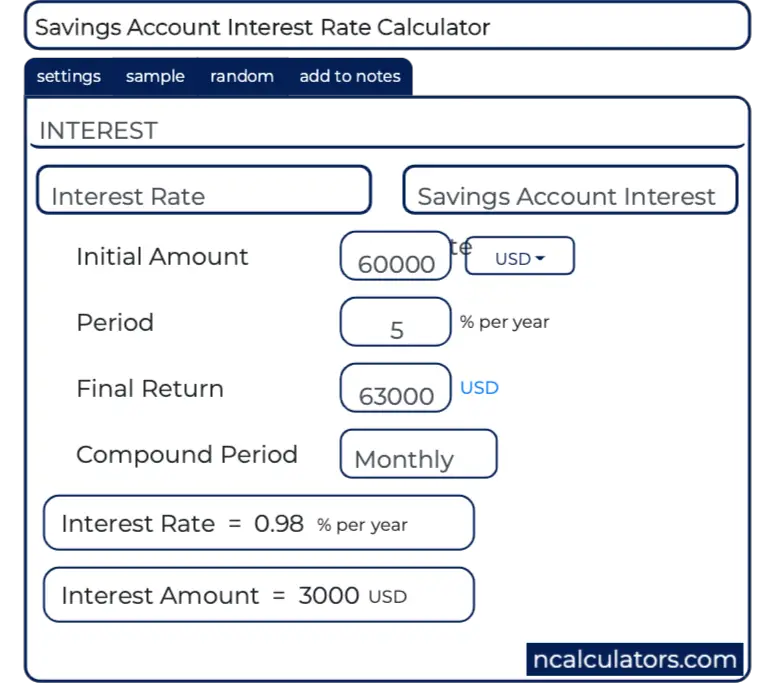
- Online Compound Interest Calculators: A quick search for “compound interest calculator” will yield numerous free tools from financial institutions, educational websites, and independent platforms. These calculators allow you to input your principal, interest rate, compounding frequency, and time horizon to instantly see your projected earnings. Many also offer interactive graphs to visualize growth.
- Bank Websites: Most banks provide their own savings calculators on their websites, which can be useful for seeing projections specific to their products.
- Personal Finance Apps: Apps like Mint, YNAB (You Need A Budget), Personal Capital, or even some banking apps offer features to track your savings growth, often including projections based on your current rates. While they might not show the raw calculation, they provide excellent visual representations and tracking.
When using these tools, always double-check that you are entering the correct annual interest rate (as a decimal or percentage) and the correct compounding frequency.
Using Spreadsheets for Personalized Tracking
For those who prefer a more hands-on approach or want to build a customized financial model, spreadsheets (like Microsoft Excel or Google Sheets) are invaluable.
You can set up a simple spreadsheet to calculate your interest manually or use built-in functions:
-
Manual Calculation: Create columns for Year, Beginning Balance, Interest Earned, and Ending Balance. Calculate interest for each period and add it to the principal for the next period. This is excellent for understanding the mechanics.
-
FV (Future Value) Function: Excel and Google Sheets have a
FVfunction that’s perfect for compound interest:
FV(rate, nper, pmt, [pv], [type])rate: The interest rate per period (e.g., annual rate / number of compounding periods).nper: The total number of payment periods in an investment (e.g., years * number of compounding periods).pmt: The payment made each period (for savings accounts, usually 0 if you’re not making regular additional deposits).pv: The present value, or the total value of all future payments now (your initial principal, entered as a negative number).type: (Optional) When payments are due (0 for end of period, 1 for beginning).
Example for our $1,000, 2% monthly compounded for 3 years:
=FV(0.02/12, 3*12, 0, -1000)
This would return approximately $1,061.76, confirming our manual calculation.
Spreadsheets offer flexibility for scenarios like adding regular deposits, withdrawals, or varying interest rates, making them powerful tools for detailed financial planning.
Understanding Bank Statements and Disclosures
Finally, don’t overlook your bank’s own resources.
- Bank Statements: Your monthly or quarterly bank statements will clearly show the interest earned during that period and how it was applied to your account. Reviewing these regularly helps you track your progress and ensures accuracy.
- Account Disclosures: When you open a savings account, the bank provides a detailed disclosure agreement. This document outlines the exact interest rate, compounding frequency, any minimum balance requirements, fees, and how interest is calculated. It’s often overlooked but contains crucial information. Refer back to it if you have questions about specific calculations.
By utilizing these tools and understanding your bank’s reporting, you can maintain a clear and accurate picture of your savings account’s growth.
Maximizing Your Savings Interest: Beyond the Basics
Understanding how interest is calculated is the first step; the next is leveraging that knowledge to maximize your earnings. It’s not just about finding the highest rate, but also about strategic savings habits and informed financial choices.
Choosing the Right Savings Account
Not all savings accounts are created equal. Different types cater to different needs and offer varying interest rates and features.
- High-Yield Online Savings Accounts: These typically offer the most competitive interest rates because online banks have lower overhead costs than traditional brick-and-mortar institutions. They are ideal for emergency funds and long-term savings goals where immediate physical access to funds isn’t critical.
- Traditional Bank Savings Accounts: While convenient, these often have lower interest rates. They might be suitable if you prioritize the convenience of a local branch and ATM access for occasional deposits or withdrawals.
- Money Market Accounts (MMAs): These accounts blend features of savings and checking accounts, often offering higher interest rates than traditional savings accounts and sometimes coming with check-writing privileges or debit cards. However, they may have higher minimum balance requirements.
- Certificates of Deposit (CDs): CDs offer fixed interest rates for a fixed term (e.g., 6 months, 1 year, 5 years). They generally offer higher rates than standard savings accounts but penalize early withdrawals. CDs are excellent for money you won’t need for a specific period.
When choosing, consider the APY, minimum balance requirements, any monthly fees, and your need for liquidity (how easily you can access your money).
Strategies for Growing Your Savings
Beyond picking the right account, your saving habits play a crucial role in compounding success.
- Automate Your Savings: Set up automatic transfers from your checking account to your savings account each payday. This “pay yourself first” strategy ensures consistent contributions, building your principal faster and allowing compounding to work its magic more effectively.
- Increase Your Contributions: As your income grows or expenses decrease, make an effort to increase your regular savings contributions. Even small, consistent increases can significantly impact your balance over time.
- Avoid Unnecessary Withdrawals: Every time you withdraw from your savings, you reduce your principal, thereby reducing the base on which interest is calculated. Try to keep your savings funds specifically for their intended purpose to allow uninterrupted compounding.
- Take Advantage of Windfalls: Bonuses, tax refunds, or unexpected gifts are excellent opportunities to boost your savings significantly and accelerate your compounding journey.
Regular Monitoring and Adjustments
The financial landscape is not static, and neither should your savings strategy be.
- Review Your Account Annually: At least once a year, review your savings account’s interest rate. Compare it with current market offerings, especially from high-yield online banks. Interest rates can change, and you might find a better deal elsewhere.
- Consider “Laddering” CDs: If you use CDs, a CD ladder involves staggering your CD maturities. For example, instead of putting all your money into one 5-year CD, you might invest in 1-year, 2-year, 3-year, 4-year, and 5-year CDs. As each CD matures, you can reinvest it into a new 5-year CD, giving you access to a portion of your funds annually while still benefiting from higher long-term rates.
- Stay Informed About Economic Trends: General interest rates are influenced by central bank policies and economic conditions. Being aware of these trends can help you anticipate rate changes and decide whether to lock in a rate with a CD or keep funds liquid in a high-yield savings account.
By actively engaging with your savings accounts, understanding the mechanics of interest calculation, and applying smart strategies, you can transform your savings from a static nest egg into a dynamic engine of wealth creation. The power of compounding, fueled by consistent contributions and smart choices, is a financial force that everyone can harness.
aViewFromTheCave is a participant in the Amazon Services LLC Associates Program, an affiliate advertising program designed to provide a means for sites to earn advertising fees by advertising and linking to Amazon.com. Amazon, the Amazon logo, AmazonSupply, and the AmazonSupply logo are trademarks of Amazon.com, Inc. or its affiliates. As an Amazon Associate we earn affiliate commissions from qualifying purchases.