
Compound interest, often hailed as the “eighth wonder of the world” by Albert Einstein, is a fundamental concept in personal finance and investing that every individual should grasp. It’s the engine behind long-term wealth creation, enabling your money to grow not just on your initial principal, but also on the accumulated interest from previous periods. Understanding how to calculate it is not merely an academic exercise; it’s a critical skill that empowers you to make informed financial decisions, whether you’re saving for retirement, planning an investment, or even navigating debt. This article will demystify compound interest, providing a clear, step-by-step guide to its calculation and exploring its profound implications for your financial journey, strictly within the realm of personal finance and investment strategies.
The Fundamentals of Compound Interest: Understanding the “Eighth Wonder”
Before diving into the mechanics of calculation, it’s essential to build a solid foundation of what compound interest truly is and why it holds such a revered status in the financial world. It’s more than just an interest rate; it’s a growth mechanism.
What Exactly is Compound Interest?
In its simplest definition, compound interest is the interest on a loan or deposit calculated based on both the initial principal and the accumulated interest from previous periods. Unlike simple interest, which is only calculated on the original principal amount, compound interest continually earns interest on the interest that has already been added. This creates a snowball effect, where your money grows at an accelerating rate over time. Imagine a snowball rolling down a hill; it picks up more snow, getting larger and accumulating more snow faster as it grows. Your investments, when benefiting from compound interest, behave in a similar fashion.
This powerful concept applies universally, from savings accounts and certificates of deposit (CDs) to stocks, bonds, and even real estate investments. For borrowers, compound interest can be a burden, as it means the interest on their loans can also accumulate rapidly. For savers and investors, however, it is an incredible ally, turning modest initial contributions into substantial sums over the long term.
Why Compound Interest Matters for Your Financial Future
The significance of compound interest cannot be overstated. For individuals aspiring to achieve financial independence, build wealth, or reach specific financial goals like retirement, a down payment on a house, or funding education, understanding and leveraging compound interest is non-negotiable.
Here’s why it’s so crucial:
- Accelerated Growth: It’s the primary driver of exponential growth in investments. A small sum invested early can grow into a fortune thanks to the power of compounding over decades.
- Combating Inflation: Your money loses purchasing power over time due to inflation. Investments that compound at a rate higher than inflation help preserve and grow your real wealth.
- Motivates Early Investment: The longer your money has to compound, the more significant the impact. This incentivizes starting to save and invest as early as possible.
- Impact on Debt: On the flip side, understanding compound interest is vital for managing debt. High-interest credit card debt, for example, can compound rapidly, making it difficult to pay off if not managed strategically. Knowing how it works encourages prompt debt repayment.
In essence, compound interest transforms modest, consistent financial habits into extraordinary long-term outcomes, making it the bedrock of sound financial planning.
Deconstructing the Compound Interest Formula
To truly harness the power of compound interest, you must understand how it’s calculated. Fortunately, the formula, while it may look intimidating at first glance, is quite straightforward once broken down.
The Core Formula Explained
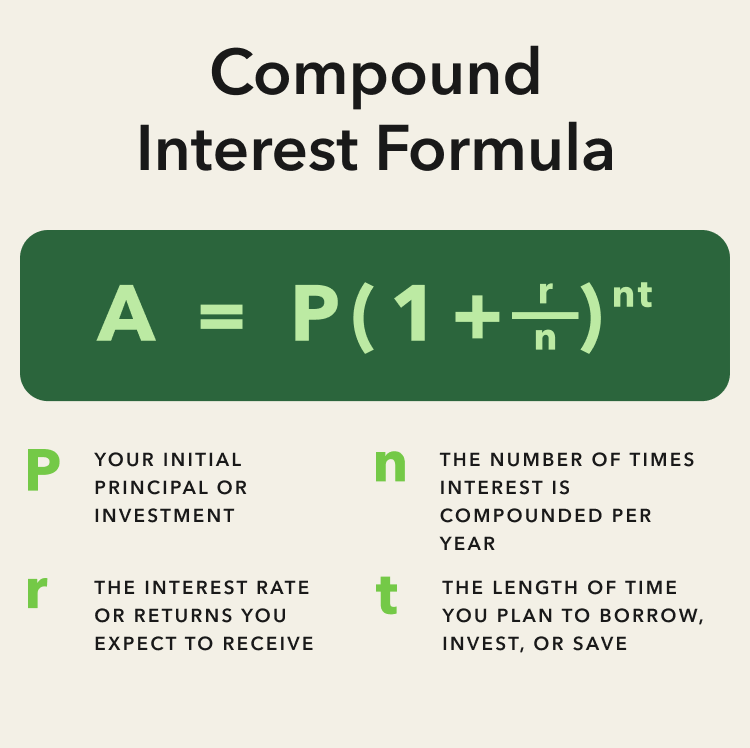
The standard formula for calculating compound interest is:
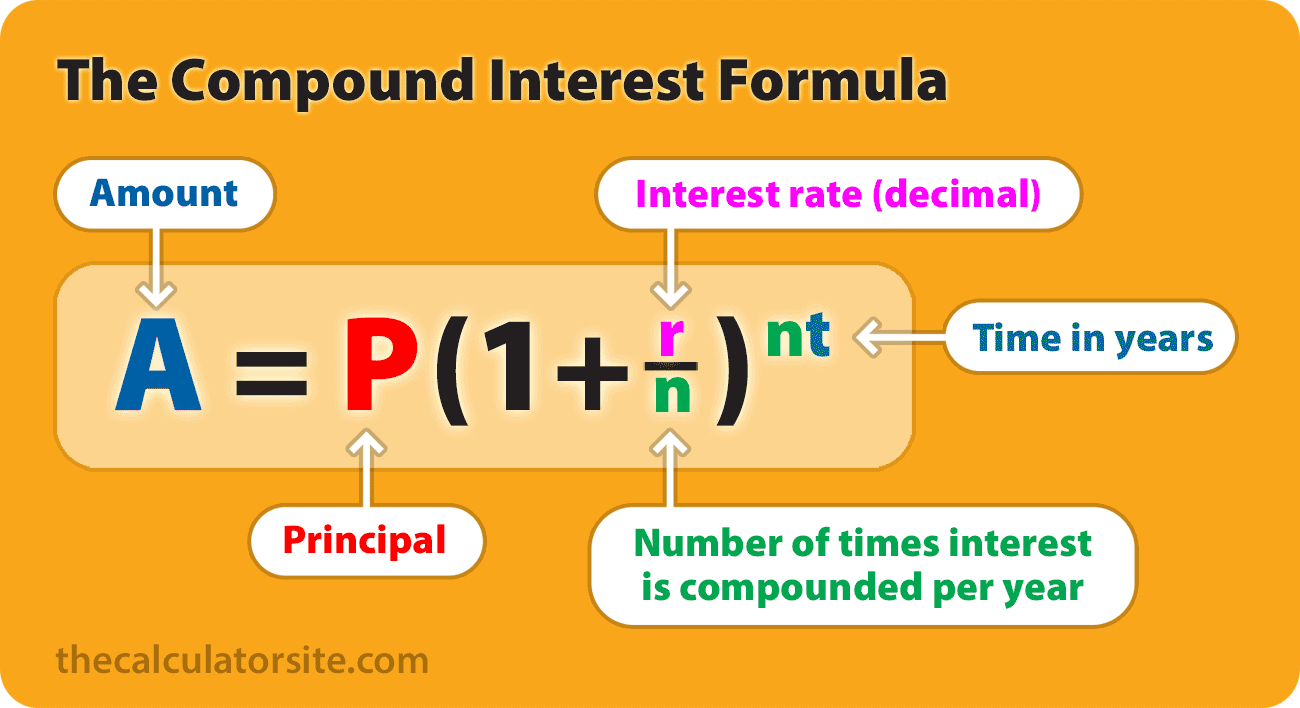
A = P (1 + r/n)^(nt)
Let’s break down each component of this equation:
- A = Future Value of the Investment/Loan, including interest: This is the total amount you will have at the end of the investment period.
- P = Principal Investment Amount (the initial deposit or loan amount): This is the starting amount of money.
- r = Annual Interest Rate (as a decimal): This is the stated interest rate per year. Remember to convert percentages to decimals (e.g., 5% becomes 0.05).
- n = Number of Times that Interest is Compounded Per Year: This refers to how frequently the interest is calculated and added to the principal.
- Annually: n = 1
- Semi-annually: n = 2
- Quarterly: n = 4
- Monthly: n = 12
- Daily: n = 365
- t = Number of Years the Money is Invested or Borrowed For: The duration of the investment.
The formula essentially calculates the growth factor (1 + r/n) for each compounding period (n) and then raises it to the total number of compounding periods (nt). Finally, it multiplies this growth factor by the initial principal (P) to arrive at the future value (A).
Step-by-Step Calculation Example
Let’s walk through an example to illustrate how to use the compound interest formula.
Scenario: You invest $10,000 in a savings account that offers an annual interest rate of 5%, compounded monthly. You plan to keep the money invested for 10 years. What will be the total amount in your account after 10 years?
1. Identify Your Variables:
- P (Principal) = $10,000
- r (Annual Interest Rate) = 5% = 0.05 (as a decimal)
- n (Number of Times Compounded Per Year) = Monthly = 12
- t (Number of Years) = 10
2. Substitute the Variables into the Formula:
A = 10,000 * (1 + 0.05/12)^(12*10)
3. Perform the Calculation:
- First, calculate r/n: 0.05 / 12 ≈ 0.00416667
- Next, add 1 to that result: 1 + 0.00416667 = 1.00416667
- Then, calculate nt: 12 * 10 = 120
- Now, raise (1 + r/n) to the power of nt: (1.00416667)^120 ≈ 1.647009
- Finally, multiply by the principal: A = 10,000 * 1.647009 ≈ $16,470.09
So, after 10 years, your initial $10,000 investment would have grown to approximately $16,470.09 due to compound interest. To find the actual interest earned, you would subtract the principal from the future value: $16,470.09 – $10,000 = $6,470.09.
Beyond the Basics: Factors Influencing Compound Growth
While the formula provides the quantitative answer, understanding the qualitative impact of each variable allows for more strategic financial planning. Each component plays a crucial role in accelerating or decelerating the rate of compound growth.
The Critical Role of Compounding Frequency (n)
The ‘n’ in the formula (number of times interest is compounded per year) has a significant, often underestimated, impact on the final amount. The more frequently interest is compounded, the faster your money grows, because interest starts earning interest sooner.
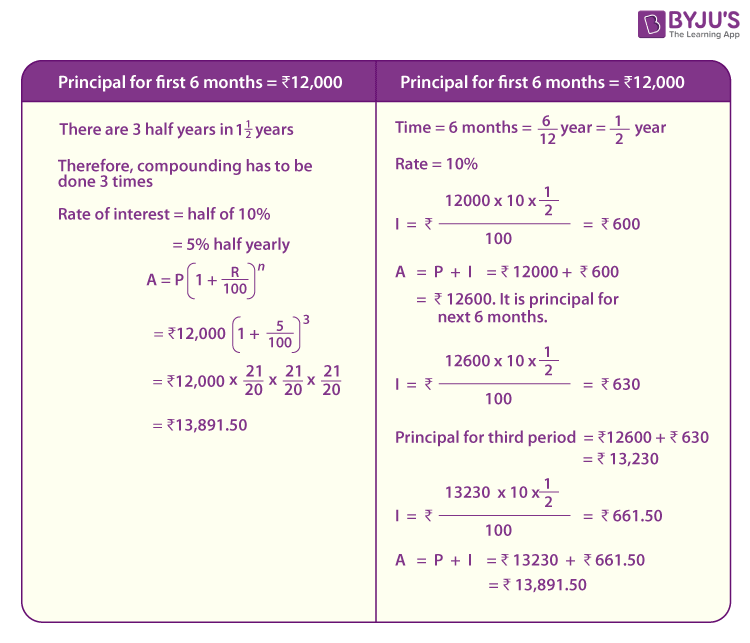
- Annual (n=1): Interest is added once a year.
- Semi-Annual (n=2): Interest is added twice a year.
- Quarterly (n=4): Interest is added four times a year.
- Monthly (n=12): Interest is added twelve times a year.
- Daily (n=365): Interest is added daily, leading to the fastest growth for a given annual rate.
For example, $10,000 at 5% for 10 years compounded annually yields $16,288.95. Compounded monthly, as shown in our example, yields $16,470.09. This difference, while seemingly small over 10 years, becomes substantial over longer periods or with larger principal amounts, illustrating the advantage of higher compounding frequency.
Time (t) as Your Greatest Ally
Perhaps the most potent variable in the compound interest formula is ‘t’ – time. The longer your money has to grow, the more powerful the compounding effect becomes. This is why financial advisors consistently preach the importance of starting to save and invest early.
Consider two individuals, both investing $5,000 annually at a 7% interest rate.
- Investor A: Starts at age 25 and invests for 10 years ($50,000 total). Then stops investing, letting the money compound until age 65.
- Investor B: Starts at age 35 and invests for 30 years ($150,000 total) until age 65.
Despite Investor A investing less money and for a shorter period, their final sum at age 65 will likely be significantly higher than Investor B’s, simply because their money had more time to compound. This “time value of money” underscores that the earlier you start, the less you may need to save each month to reach your financial goals.
The Impact of Interest Rate (r) and Principal (P)
While time and compounding frequency are often overlooked, the interest rate (r) and the principal amount (P) are more intuitively understood drivers of compound growth.
- Higher Interest Rate (r): A higher interest rate directly translates to faster growth. Finding investments with competitive, sustainable returns is crucial. Even a small difference in the annual rate can lead to a substantial difference in the future value over many years. For instance, growing $10,000 at 7% vs. 5% over 20 years (compounded annually) would result in approximately $38,696 vs. $26,532 respectively – a difference of over $12,000 just from a 2% rate difference.
- Larger Principal (P): The more money you start with, the more interest you earn, and thus the more base for that interest to compound upon. While not everyone has a large principal to begin with, consistent contributions (which effectively increase your “principal” over time) are just as powerful. This highlights the importance of regular savings and investments, even if they are small initially.
Practical Tools and Real-World Applications
Calculating compound interest manually for complex scenarios or long periods can be tedious. Fortunately, various tools simplify this process, making financial planning more accessible.
Leveraging Online Calculators and Spreadsheets
- Online Compound Interest Calculators: Numerous free online calculators are available. These tools typically allow you to input your principal, interest rate, compounding frequency, and time period, instantly providing the future value and the total interest earned. They are excellent for quick estimations and comparing different scenarios. Many financial institution websites, investment platforms, and personal finance blogs host these calculators.
- Spreadsheet Software (Excel, Google Sheets): For more detailed financial modeling, spreadsheet programs like Microsoft Excel or Google Sheets are invaluable. They have built-in functions that can calculate future value (FV) with compound interest.
- The
FVfunction typically takes arguments such as rate, nper (number of periods), pmt (payment per period, usually 0 for a single lump sum investment), pv (present value or principal), and type. - Example:
=FV(rate/n, n*t, 0, -P)whererateis the annual rate,nis compounding frequency,tis years, andPis principal. ThePis usually negative to represent an outflow of cash.
Spreadsheets offer the flexibility to change variables easily, analyze different scenarios, and track investments over time, making them a powerful tool for sophisticated financial planning.
- The
Compound Interest in Savings, Investments, and Debt
Understanding compound interest is not just theoretical; it has direct applications across all facets of personal finance:
- Savings Accounts: Most high-yield savings accounts compound interest daily or monthly, allowing your emergency fund or short-term savings to grow steadily.
- Investments (Stocks, Bonds, Mutual Funds): When you invest in instruments that pay dividends or interest, and you choose to reinvest those earnings, you are directly leveraging compound interest. The reinvested dividends purchase more shares, which in turn generate more dividends, creating a powerful feedback loop.
- Retirement Accounts (401(k), IRA): These accounts are prime examples of long-term compounding. Contributions made early in your career have decades to grow tax-deferred or tax-free, leading to substantial wealth accumulation for retirement.
- Loans and Debt: On the flip side, compound interest can work against you with loans. Credit card interest, for example, is usually compounded daily or monthly, meaning if you carry a balance, the interest quickly adds up on both your original purchase and the interest from previous billing cycles. Understanding this motivates faster debt repayment. Mortgages and auto loans also involve compound interest, though usually on a predictable, amortization schedule.
Simple vs. Compound Interest: A Clear Distinction
It’s crucial to distinguish compound interest from simple interest.
- Simple Interest: Calculated only on the original principal amount. The interest earned does not become part of the principal for future interest calculations.
- Formula:
Simple Interest = P * r * t - Example: $10,000 at 5% simple interest for 10 years would earn $500 per year ($10,000 * 0.05). Total interest after 10 years = $5,000. Final amount = $15,000.
- Formula:
- Compound Interest: As we’ve seen, interest is calculated on the principal and accumulated interest.
- Example (from above): $10,000 at 5% compounded monthly for 10 years resulted in $16,470.09.
The difference of $1,470.09 ($16,470.09 – $15,000) over 10 years highlights why compound interest is the preferred mechanism for wealth building and a significant factor to be aware of when assessing any financial product.
Maximizing Your Compounding Potential: Strategies for Growth
Understanding the “how” of calculating compound interest is just the first step. The next is applying that knowledge strategically to maximize its benefits for your financial goals.
Starting Early and Staying Consistent
As discussed, time is your most valuable asset when it comes to compounding. The earlier you begin investing, even with small amounts, the more significant the impact of compound growth. Don’t wait until you have a large sum; start with what you can, and make consistent contributions. Automating your investments (e.g., setting up automatic transfers from your checking account to your investment account) is an excellent way to maintain consistency and leverage dollar-cost averaging, further enhancing your long-term returns.
Reinvesting Returns for Accelerated Growth
For investments that generate income (like dividends from stocks or interest from bonds), choosing to reinvest those returns is paramount. When you reinvest dividends, they purchase additional shares or principal, which then earn their own dividends or interest. This creates a powerful cycle where your investment base continually grows, accelerating your compounding. Many investment platforms offer automatic dividend reinvestment plans (DRIPs) to make this process seamless.
Understanding the “Rule of 72”
The “Rule of 72” is a quick and useful mental shortcut to estimate how long it will take for an investment to double at a given annual rate of return, or what rate of return you need to double your money within a certain number of years.
- Formula: Divide 72 by the annual interest rate (as a whole number, not a decimal).
- Example: If you earn a 6% annual return, it will take approximately 72 / 6 = 12 years for your money to double.
- Alternatively, to find the rate needed to double your money in a certain number of years: Divide 72 by the number of years.
- Example: To double your money in 8 years, you would need an annual return of approximately 72 / 8 = 9%.
While an approximation, the Rule of 72 is an excellent tool for quick financial estimations and emphasizes the significant impact of both interest rates and time on wealth accumulation.
In conclusion, mastering the calculation and understanding the dynamics of compound interest is a cornerstone of effective personal finance. It transforms the often-abstract concept of financial growth into a tangible, actionable strategy. By understanding its formula, appreciating the variables that influence it, and employing smart financial habits, you can effectively leverage this “eighth wonder of the world” to build a secure and prosperous financial future.
aViewFromTheCave is a participant in the Amazon Services LLC Associates Program, an affiliate advertising program designed to provide a means for sites to earn advertising fees by advertising and linking to Amazon.com. Amazon, the Amazon logo, AmazonSupply, and the AmazonSupply logo are trademarks of Amazon.com, Inc. or its affiliates. As an Amazon Associate we earn affiliate commissions from qualifying purchases.