
Student loan debt has become a defining characteristic of the modern financial landscape, impacting millions of borrowers across various demographics. For many, the monthly bill from a loan servicer is the largest line item in their budget, often rivaling or exceeding housing costs. Reducing these payments is not merely a matter of convenience; it is a critical step toward achieving broader financial goals such as homeownership, retirement savings, and emergency fund stability.
Lowering your student loan payments requires a multifaceted approach that involves understanding the nuances of federal programs, the mechanics of private refinancing, and the tactical application of tax laws. Whether you are dealing with federal loans, private debt, or a combination of both, several structured pathways exist to alleviate the immediate pressure on your monthly cash flow.

Leveraging Federal Repayment Plans
For borrowers with federal student loans, the most powerful tools for payment reduction are the Income-Driven Repayment (IDR) plans. These plans are designed to ensure that loan payments remain affordable relative to a borrower’s income and family size. Unlike standard repayment plans, which divide the total balance into equal installments over ten years, IDR plans calculate payments based on a percentage of your discretionary income.
The SAVE Plan: A New Standard for Savings
The Saving on a Valuable Education (SAVE) plan represents the most significant shift in federal student loan policy in decades. Replacing the older REPAYE plan, SAVE increases the amount of income protected from the payment calculation. Specifically, it raises the income exemption from 150% to 225% of the federal poverty guideline. For many single borrowers, this means that if you earn less than approximately $32,800 a year, your monthly payment could be $0.
Beyond the low monthly payment, the SAVE plan includes a critical interest subsidy. If your calculated monthly payment does not cover the interest that accrues that month, the government waives the remaining interest. This prevents the “ballooning balance” effect where borrowers see their debt grow despite making regular payments.
Traditional IDR Options: IBR, PAYE, and ICR
While SAVE is the primary focus for many, other IDR plans like Income-Based Repayment (IBR), Pay As You Earn (PAYE), and Income-Contingent Repayment (ICR) remain relevant depending on when you first borrowed and your specific financial situation. These plans typically cap payments at 10% to 15% of discretionary income.
A key benefit of all IDR plans is the promise of eventual loan forgiveness. After 20 or 25 years of qualifying payments, any remaining balance is forgiven. While this can result in a “tax bomb” (where the forgiven amount is treated as taxable income), current federal law has suspended this tax through 2025, and there is ongoing legislative discussion regarding a permanent exemption.
Graduated and Extended Repayment
If you do not qualify for a low IDR payment but still need immediate relief, the Graduated Repayment Plan or the Extended Repayment Plan may be viable. Graduated plans start with lower payments that increase every two years, assuming your income will rise over time. Extended plans allow you to stretch the repayment term up to 25 years, significantly lowering the monthly obligation, though this increase the total interest paid over the life of the loan.
Strategic Refinancing and Consolidation
For those with high-interest private loans or federal loans that do not qualify for certain programs, refinancing and consolidation offer a path toward lower payments through market-based mechanisms.
When to Refinance with Private Lenders
Refinancing involves taking out a new loan with a private lender to pay off your existing student loans. This is most effective when you have a strong credit score, a stable income, and a low debt-to-income ratio. By securing a lower interest rate, you can reduce your monthly payment without necessarily extending the life of the loan.
However, refinancing federal loans into a private loan is a move that requires extreme caution. Once federal loans are refinanced privately, they lose all federal protections, including access to IDR plans, Public Service Loan Forgiveness (PSLF), and administrative forbearance. Refinancing is generally best reserved for those with high-interest private debt who are certain they will not need federal safety nets.
The Mechanics of Federal Loan Consolidation
Federal loan consolidation is different from private refinancing. A Direct Consolidation Loan allows you to combine multiple federal loans into a single loan with one servicer. The interest rate on a consolidated loan is the weighted average of the rates on the loans being consolidated, rounded up to the nearest one-eighth of a percent.
While consolidation doesn’t typically lower your interest rate, it can lower your payment by giving you access to longer repayment terms (up to 30 years). It is also a necessary step for borrowers with older federal loans (such as FFELP or Perkins loans) to become eligible for the SAVE plan or PSLF.
Timing the Market and Improving Credit
Your ability to reduce payments through refinancing is heavily dependent on your credit profile. Before applying with private lenders, take steps to optimize your credit score by paying down revolving credit card debt and ensuring there are no errors on your credit report. Furthermore, monitoring the Federal Reserve’s interest rate environment can help you time your refinancing to lock in the lowest possible fixed rate.
Maximizing Forgiveness and Subsidy Programs
Reducing a payment to zero or having the debt eliminated entirely is the ultimate form of payment reduction. Various programs exist to reward specific career paths or employer-sponsored benefits.
Public Service Loan Forgiveness (PSLF)
The PSLF program is designed for those working in the non-profit sector or for government agencies. After making 120 qualifying monthly payments under an income-driven repayment plan while working full-time for a qualifying employer, the remaining balance is forgiven tax-free. Because PSLF requires you to be on an IDR plan, you benefit twice: first from a lower monthly payment based on your income, and second from total debt elimination after ten years of service.
Employer Assistance Programs (Section 127)
A growing trend in corporate benefits is student loan repayment assistance. Under Section 127 of the Internal Revenue Code, employers can provide up to $5,250 per year in tax-free student loan repayment assistance to their employees. This benefit does not count as taxable income for the employee. If your employer offers this, it directly reduces your out-of-pocket monthly cost, allowing you to reallocate those funds elsewhere in your budget.
State-Specific Forgiveness and Specialized Grants
Many states offer their own loan repayment assistance programs (LRAPs), particularly for professionals in high-demand or underserved fields such as healthcare, education, and law. For example, a primary care physician working in a rural area may qualify for state grants that pay off a significant portion of their debt in exchange for a multi-year commitment. Researching your state’s higher education agency can uncover niche opportunities that aren’t advertised at the federal level.
Tactical Financial Habits to Lower Monthly Costs
Sometimes, reducing your student loan payment is achieved through small, tactical adjustments rather than major structural changes to the loan itself.
The Autopay Discount
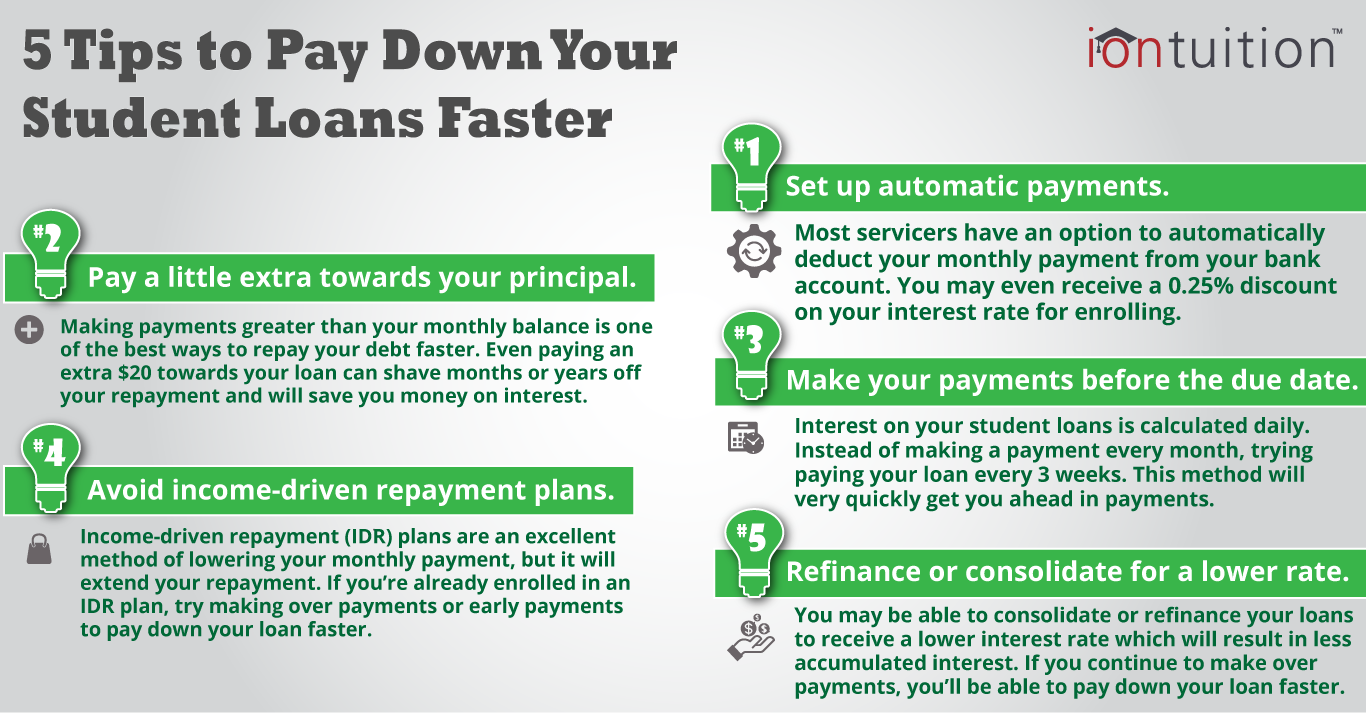
Almost every student loan servicer—both federal and private—offers a 0.25% interest rate reduction if you sign up for automatic debit payments. While a quarter of a percent may seem negligible, on a large balance, it can shave significant dollars off the monthly interest accrual. This ensures that a larger portion of your payment goes toward the principal, or in the case of some private loans, it directly reduces the required monthly minimum.
Using Tax Deductions to Offset Costs
The IRS allows borrowers to deduct up to $2,500 of student loan interest paid during the year from their taxable income. This is an “above-the-line” deduction, meaning you do not need to itemize to claim it. While this doesn’t change the bill you receive from your servicer, it increases your tax refund or decreases your tax liability, effectively lowering the “net cost” of your student debt over the course of the year.
Strategic Lump Sum Payments
While it sounds counterintuitive to pay more to pay less, making a one-time lump sum payment (from a bonus, tax refund, or inheritance) can be used to “re-amortize” or “recast” certain private loans. While federal loans don’t typically lower the monthly payment after a lump sum (they just shorten the term), some private lenders will allow you to recalculate the monthly payment based on the new, lower principal balance.
Navigating Hardship: Deferment and Forbearance
When financial circumstances become dire—such as in the event of job loss or medical emergency—the goal shifts from “reducing” payments to “pausing” them.
Deferment vs. Forbearance
Deferment allows you to stop making payments under specific conditions, such as returning to school, unemployment, or military service. For subsidized federal loans, the government may pay the interest during deferment. Forbearance is similar but usually easier to obtain for general financial hardship; however, interest continues to accrue on all loan types during forbearance.

The Risks of Long-Term Pauses
While deferment and forbearance provide immediate relief, they should be used sparingly. The accrual of interest can lead to capitalization, where unpaid interest is added to the principal balance, increasing the total amount owed and the future monthly payment. Whenever possible, switching to an IDR plan with a $0 or near-$0 payment is preferable to forbearance, as it counts toward forgiveness timelines and often includes interest subsidies.
By combining these strategies—prioritizing federal IDR plans for their flexibility, exploring private refinancing for high-interest debt, and utilizing tax advantages—borrowers can move from a state of financial strain to a position of control. Reducing student loan payments is not a one-time event but an ongoing process of optimization that adjusts as your career and income evolve.
aViewFromTheCave is a participant in the Amazon Services LLC Associates Program, an affiliate advertising program designed to provide a means for sites to earn advertising fees by advertising and linking to Amazon.com. Amazon, the Amazon logo, AmazonSupply, and the AmazonSupply logo are trademarks of Amazon.com, Inc. or its affiliates. As an Amazon Associate we earn affiliate commissions from qualifying purchases.