
Navigating the complexities of tax season can often feel like a daunting annual ritual. For the 2023 tax year, which you’ll be filing in 2024, understanding your obligations, options, and opportunities is crucial for a smooth process. Beyond merely submitting forms, effective tax filing is a key component of sound personal financial management. It’s an opportunity to ensure compliance, maximize potential refunds, and minimize liabilities, all while gaining a clearer picture of your financial health. This comprehensive guide will walk you through everything you need to know, from gathering documents to choosing the right filing method, ensuring you’re well-equipped to tackle your 2023 tax obligations with confidence.

Understanding Your Filing Requirements and Deadlines
Before diving into the “how-to,” it’s essential to first establish whether you need to file and what critical dates you must observe. Ignoring these foundational steps can lead to penalties, interest, and unnecessary stress.
Who Needs to File Their 2023 Taxes?
The obligation to file a federal income tax return primarily hinges on your gross income, filing status, and age. For the 2023 tax year, these thresholds have specific figures. Generally, if your gross income exceeds certain limits (e.g., $13,850 for single filers under 65, $27,700 for married filing jointly under 65), you are required to file. However, even if your income falls below these thresholds, you might still want to file to claim refundable tax credits, such as the Earned Income Tax Credit or the Child Tax Credit, which could result in a refund. Self-employed individuals typically must file if their net earnings from self-employment were $400 or more. Furthermore, if you received advanced premium tax credits, paid estimated taxes, or owe special taxes, filing is mandatory regardless of income.
Key Dates and Deadlines for 2023 Taxes
The cornerstone of tax filing is adherence to deadlines. Missing these can result in penalties that eat into your financial resources. For most individual taxpayers, the primary deadline for filing 2023 federal income tax returns and paying any taxes owed is April 15, 2024. If April 15th falls on a weekend or holiday, the deadline is typically pushed to the next business day. For example, in 2024, because April 15th is a Monday, it serves as the deadline.
If you cannot meet this deadline, you can file for an extension using Form 4868, which grants you an automatic six-month extension to file, typically until October 15, 2024. It’s crucial to remember that an extension to file is not an extension to pay. Any taxes owed are still due by the April 15th deadline; filing an extension only postpones the submission of your tax return itself. Ignoring the payment deadline can lead to interest and penalties on the unpaid balance.
Gathering Your Essential Tax Documents
The success of your tax filing process heavily relies on the completeness and accuracy of your documentation. Beginning this collection early can save immense stress. Start by organizing all income-related forms, such as:
- Form W-2: From your employer(s), reporting wages, tips, and other compensation.
- Forms 1099: Including 1099-NEC (non-employee compensation), 1099-MISC (miscellaneous income), 1099-INT (interest income), 1099-DIV (dividend income), 1099-B (stock sales), 1099-R (retirement distributions), and 1099-G (government payments like unemployment).
- Form 1098: Such as 1098-E (student loan interest) or 1098-T (tuition statement).
- Statements from financial institutions: For mortgage interest, property taxes, or investment income not covered by 1099s.
- K-1s: From partnerships, S corporations, or trusts.
Beyond income, gather documents related to potential deductions and credits:
- Receipts for medical expenses, charitable contributions, or business expenses (for self-employed individuals).
- Records of IRA contributions or HSA contributions.
- Information on dependent care expenses.
- Last year’s tax return (Form 1040) is also invaluable as a reference for prior-year information, such as carryovers of losses or credits.
A well-organized system for these documents, whether digital or physical, will streamline the entire process and help ensure no opportunities for savings are missed.
Choosing Your Filing Method: A Comprehensive Guide
Once your documents are in order, the next pivotal decision is how you will file your taxes. The best method depends on your comfort level with financial tools, the complexity of your tax situation, and your budget.
Online Tax Software: DIY Digital Solutions
For many taxpayers, online tax software has become the go-to method due to its convenience, cost-effectiveness, and guided approach. These platforms are designed to simplify the tax filing process by asking a series of questions and populating the correct forms based on your answers.
- Pros: User-friendly interfaces, often with free tiers for simple returns, robust error checks, direct e-filing, and integration with financial institutions for importing data. Many offer audit support and access to tax professionals for an additional fee.
- Cons: Can become expensive for more complex returns (e.g., self-employment, investments) or if you opt for premium features. Requires a basic understanding of your financial situation and the ability to accurately input data. Users are ultimately responsible for the accuracy of their return.
- Popular Platforms:
- TurboTax: Widely recognized, highly intuitive, but can be among the more expensive options for complex situations.
- H&R Block: Offers a similar experience to TurboTax, often with competitive pricing and physical locations for in-person support.
- FreeTaxUSA: A popular choice for those seeking a truly free federal filing experience, with state filing available for a small fee. It’s less flashy but highly effective.
- TaxAct: Another strong contender, often appealing to users looking for a balance between features and cost.
These digital tools empower individuals to take control of their tax preparation, often providing real-time estimates of refunds or taxes owed, which is a powerful financial management feature.
IRS Free File Program: Eligibility and Benefits
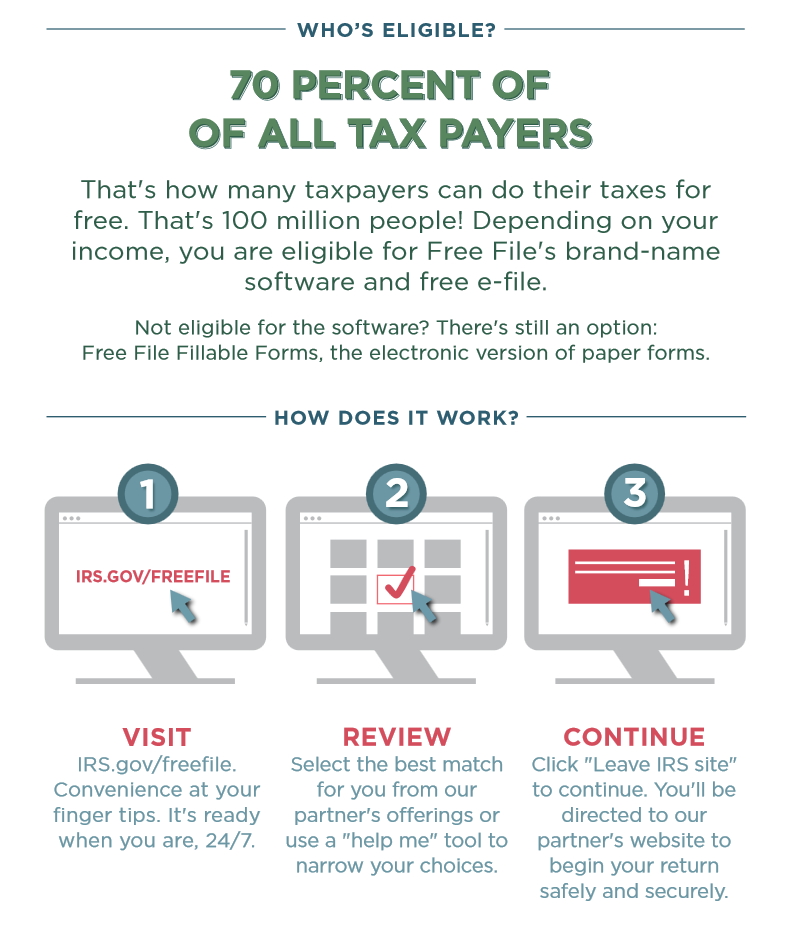
The IRS offers a program called IRS Free File, which allows eligible taxpayers to prepare and e-file their federal tax returns for free using guided tax software from various commercial partners. The primary eligibility requirement is an Adjusted Gross Income (AGI) below a certain threshold (which changes annually – for 2023 taxes, it was generally $79,000 for individuals and families).
- Benefits: Absolutely free federal filing, often with free state filing options depending on the partner. Provides access to professional-grade software for those who might otherwise pay. It’s a direct partnership with the IRS, ensuring compliance.
- How to Access: You must access the Free File program through the IRS website (IRS.gov/freefile). Do not go directly to the partner sites, as you might not get the free offer.
For those who meet the income criteria, this program is an excellent financial tool for reducing tax preparation expenses without sacrificing accuracy or convenience.
Professional Tax Preparers: Expert Assistance
For individuals with complex financial situations, significant life changes, or those who simply prefer to outsource the task, hiring a professional tax preparer can be invaluable.
- When to Consider: You own a small business, have significant investments, multiple income streams, recently bought or sold a home, experienced a divorce, inherited assets, or are dealing with international income.
- Types of Professionals:
- Certified Public Accountants (CPAs): Highly trained and licensed accounting professionals who can provide comprehensive tax planning and preparation, as well as broader financial advice.
- Enrolled Agents (EAs): Federally licensed tax practitioners authorized to represent taxpayers before the IRS. They specialize in taxation.
- Tax Attorneys: Best for highly complex legal tax issues, audits, or disputes with the IRS.
- Commercial Tax Preparation Services: Such as H&R Block or Jackson Hewitt, which offer in-person assistance for a fee, often with guarantees.
- Pros: Expertise in navigating intricate tax laws, ability to identify obscure deductions and credits, representation during an audit, peace of mind.
- Cons: Can be significantly more expensive than DIY software, requires sharing sensitive financial information.
Choosing a qualified professional is a strategic financial decision that can optimize your tax outcome and reduce stress. Look for preparers with a good reputation, relevant experience, and proper credentials.
Manual Filing: Traditional Paper Forms
While e-filing is now the dominant method, filing a paper return remains an option, though it’s increasingly less common and generally not recommended.

- When It’s Used: Sometimes preferred by individuals who are uncomfortable with technology or have extremely simple returns. Certain rare tax forms or schedules might not be easily processed electronically.
- Pros: No internet access required, physical control over your documents.
- Cons: Slower processing times for refunds, higher chance of errors, greater administrative burden (printing, mailing, tracking). The IRS encourages e-filing for accuracy and efficiency.
If you choose to file by paper, ensure all calculations are correct and keep a copy for your records. Send it via certified mail with a return receipt for proof of mailing.
Maximizing Your Deductions and Credits
One of the most impactful aspects of tax filing is leveraging deductions and credits. These financial strategies can directly reduce your taxable income or the amount of tax you owe, leading to a larger refund or a smaller tax bill.
Common Deductions to Consider
Deductions reduce your taxable income. The higher your income, the more valuable a deduction typically is. You’ll generally choose between taking the standard deduction or itemizing your deductions. For 2023, the standard deduction amounts increased (e.g., $13,850 for single filers, $27,700 for married filing jointly).
If your itemized deductions exceed the standard deduction, it’s financially beneficial to itemize. Common itemized deductions include:
- State and Local Taxes (SALT): Capped at $10,000 per household.
- Mortgage Interest: On your primary home.
- Medical Expenses: Exceeding 7.5% of your Adjusted Gross Income (AGI).
- Charitable Contributions: To qualified organizations.
Beyond itemized deductions, there are also “above-the-line” deductions that reduce your AGI, regardless of whether you itemize:
- Student Loan Interest: Up to $2,500.
- IRA Contributions: For traditional IRAs, if you meet income limits.
- Health Savings Account (HSA) Contributions: For those with high-deductible health plans.
- Self-Employment Expenses: Business-related costs for freelancers and contractors.
Thorough record-keeping for all these items is crucial to justify them if questioned by the IRS.
Exploring Valuable Tax Credits
Tax credits are often more valuable than deductions because they directly reduce the amount of tax you owe, dollar-for-dollar. Some are even refundable, meaning you could get money back even if you don’t owe any tax.
Key tax credits to investigate for 2023:
- Child Tax Credit (CTC): Up to $2,000 per qualifying child, with up to $1,600 refundable.
- Earned Income Tax Credit (EITC): A refundable credit for low-to-moderate-income working individuals and families, varying significantly based on income and number of children.
- Education Credits:
- American Opportunity Tax Credit (AOTC): Up to $2,500 for the first four years of post-secondary education, with 40% potentially refundable.
- Lifetime Learning Credit (LLC): Up to $2,000 for courses taken towards a degree or to acquire job skills.
- Dependent Care Credit: For expenses incurred to care for a qualifying individual (like a child under 13) so you can work or look for work.
- Clean Energy Credits: Including credits for energy-efficient home improvements or purchasing new clean vehicles.
Identifying and claiming all applicable credits is a cornerstone of smart financial planning during tax season.
The Impact of Life Changes on Your Taxes
Major life events significantly alter your tax situation. Proactively understanding these changes can prevent surprises and help you plan financially.
- Marriage or Divorce: Changes your filing status (Married Filing Jointly/Separately, Head of Household).
- New Child or Adopting: Makes you eligible for the Child Tax Credit, Dependent Care Credit, and potentially the EITC.
- Buying or Selling a Home: Impacts deductions like mortgage interest and property taxes, and capital gains on sale.
- Job Change or Unemployment: Affects W-2 income, potential for unemployment income, and adjustments to withholdings.
- Retirement: Impacts sources of income (pensions, Social Security), and potential for distributions from retirement accounts.
It’s advisable to consult with a tax professional or utilize robust tax software if you’ve experienced significant life changes, as these can introduce complexities and new opportunities for tax savings.
What to Expect After You File
Filing your taxes isn’t the final step; there are important considerations for the period immediately following submission and for long-term financial hygiene.
Monitoring Your Refund or Payment
If you’re expecting a refund, you’ll naturally want to know when it will arrive. The IRS offers an online tool called “Where’s My Refund?” which allows you to track the status of your federal refund. Most e-filed refunds are issued within 21 days, but paper returns can take 6-8 weeks or longer.
If you owe taxes, ensure your payment is made by the April 15th deadline (or extension deadline for estimated payments). You can pay directly from your bank account through IRS Direct Pay, by debit or credit card (with a processing fee), or by mail with a check or money order. Setting up an IRS Online Account can also provide real-time information on your balance and payment history.
The Importance of Record-Keeping
Even after filing, maintaining meticulous records is paramount. The IRS generally recommends keeping tax records for at least three years from the date you filed your original return or two years from the date you paid the tax, whichever is later. This period extends to seven years if you filed a claim for a worthless security or bad debt deduction. For property-related documents (like home purchase or sale), keep them indefinitely.
Digitizing your records is a convenient and secure way to store them. Cloud storage or encrypted external drives can protect against loss, damage, or theft, ensuring you have access to documentation if you ever need to amend a return or respond to an IRS inquiry.
Amending Your Return
If you discover an error or omitted information on a tax return you’ve already filed, you may need to file an amended return using Form 1040-X, Amended U.S. Individual Income Tax Return. Common reasons to amend include correcting filing status, adding missed deductions or credits, or reporting additional income.
Generally, you have three years from the date you filed your original return or two years from the date you paid the tax, whichever is later, to file an amended return to claim a refund. It’s usually best to wait until your original return has been fully processed before filing an amendment, especially if it affects a refund. Most tax software can guide you through the 1040-X process, or a professional can assist.
Conclusion
Filing your 2023 taxes, whether you opt for DIY software or professional assistance, is more than just a compliance task; it’s an annual opportunity to solidify your financial health. By understanding your obligations, meticulously gathering documents, strategically choosing your filing method, and proactively seeking out deductions and credits, you can ensure accuracy and optimize your financial outcome. Remember the importance of meeting deadlines, accurately reporting all income, and maintaining thorough records long after you’ve clicked “submit” or mailed your forms. Approach tax season with foresight and organization, and you’ll transform a potential burden into a powerful exercise in personal financial management.
aViewFromTheCave is a participant in the Amazon Services LLC Associates Program, an affiliate advertising program designed to provide a means for sites to earn advertising fees by advertising and linking to Amazon.com. Amazon, the Amazon logo, AmazonSupply, and the AmazonSupply logo are trademarks of Amazon.com, Inc. or its affiliates. As an Amazon Associate we earn affiliate commissions from qualifying purchases.