
In today’s fast-paced economy, the ability to accept credit card payments is no longer a luxury but a fundamental necessity for businesses aiming for growth and sustainability. Consumers increasingly rely on credit and debit cards for transactions, expecting convenience and security at every touchpoint. For entrepreneurs, small business owners, and growing enterprises, integrating credit card processing isn’t just about providing an extra payment option; it’s a strategic financial decision that directly impacts revenue, customer reach, and operational efficiency. This guide delves into the financial imperative of credit card acceptance, demystifies the underlying processes, and outlines practical pathways to empower your business to thrive in a cashless society.
The Financial Imperative: Why Credit Cards Boost Your Bottom Line
Accepting credit card payments transcends mere convenience; it’s a direct lever for financial growth. By embracing card payments, businesses unlock several key advantages that translate into improved cash flow, expanded market share, and a stronger financial footing.
Expanding Your Customer Base and Revenue Streams
The modern consumer carries less cash and expects frictionless payment experiences. Restricting payment options to cash or checks immediately alienates a significant portion of potential customers, particularly those making impulse buys, traveling, or shopping online. By accepting credit cards, businesses eliminate a major barrier to purchase, making it easier for customers to spend. This broadened accessibility doesn’t just retain existing customers; it opens doors to new demographics, including tourists, younger generations, and online shoppers who predominantly use cards. The easier it is for customers to pay, the more likely they are to complete a purchase, directly leading to increased sales volume and diversified revenue streams. Furthermore, the psychological effect of paying with a card often leads to higher average transaction values, as customers are less constrained by the physical cash in their wallet.
Enhancing Cash Flow and Sales Volume
For many businesses, waiting for checks to clear or dealing with cash reconciliation can be cumbersome and impact immediate cash flow. Credit card transactions, while incurring fees, offer immediate authorization and relatively quick settlement periods, often depositing funds into a business bank account within 1-3 business days. This accelerated cash flow allows businesses to manage expenses more effectively, invest in inventory faster, or respond to market opportunities without liquidity constraints. Moreover, the ease of swiping, tapping, or entering card details can significantly speed up the checkout process, especially during peak hours. Faster checkouts mean less waiting, happier customers, and the ability to process more transactions in a given period, directly boosting overall sales volume and operational efficiency.
Professionalism and Trust in Business Transactions
In the eyes of customers, a business that accepts credit cards signals professionalism, legitimacy, and a commitment to modern service standards. It builds trust and confidence, reassuring customers that they are dealing with a credible and established entity. For small businesses and startups, this perception can be particularly vital in competing with larger enterprises. A secure, seamless credit card payment experience not only reflects positively on your brand image but also reduces the perceived risk for customers, encouraging repeat business. From a financial perspective, this enhanced trust translates into greater customer loyalty, reduced churn, and a more stable, predictable revenue stream over the long term.
Decoding Payment Processing: Key Concepts for Business Owners
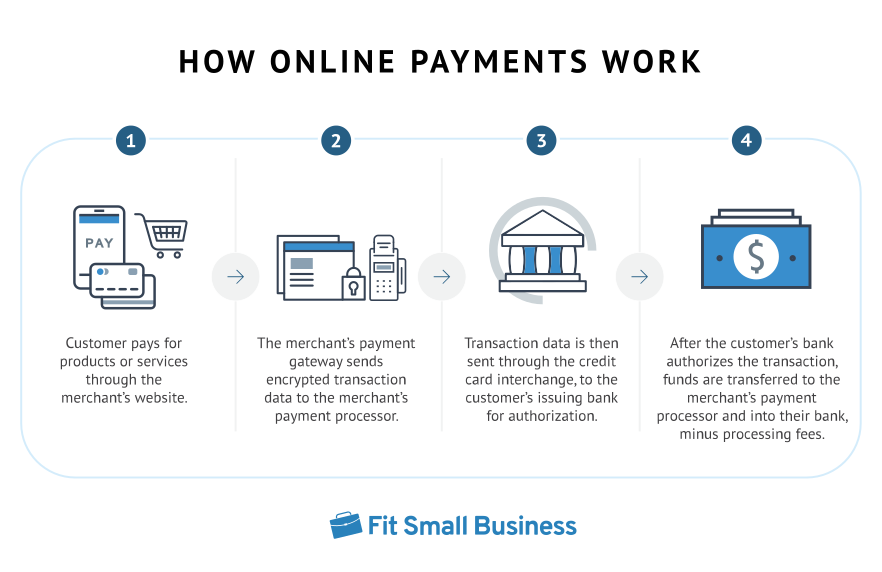
Understanding the mechanics of credit card processing is crucial for making informed financial decisions. It’s not just about swiping a card; it involves a complex ecosystem of financial institutions and technologies, each playing a role in the secure transfer of funds.
Understanding Merchant Accounts vs. Payment Service Providers (PSPs)
At the heart of credit card acceptance lies the mechanism through which funds are moved from a customer’s bank to yours. Historically, this required a dedicated merchant account, a specific type of bank account that holds funds from credit card sales before they are settled into your primary business account. Merchant accounts are typically obtained directly from banks or through independent sales organizations (ISOs) and involve an underwriting process. While they can sometimes offer lower per-transaction fees for high-volume businesses, they often come with more complex setup procedures, monthly fees, and strict contractual terms.
In contrast, Payment Service Providers (PSPs) like Square, Stripe, and PayPal have revolutionized credit card acceptance, especially for small businesses and startups. PSPs act as aggregators, allowing multiple businesses to process transactions under one large merchant account they hold. This model, often called a “third-party aggregator” or “shared merchant account,” dramatically simplifies the setup process. Businesses can often begin accepting payments within minutes of signing up, with transparent, flat-rate pricing. While PSPs might have slightly higher per-transaction fees for very large businesses, their ease of use, integrated tools, and lack of monthly fees make them an attractive and financially viable option for many, minimizing upfront investment and administrative burden.
The Anatomy of Transaction Fees
Understanding the fees associated with credit card processing is paramount for managing your profitability. These fees are typically a percentage of the transaction amount plus a small fixed fee per transaction. They are generally composed of three main components:
- Interchange Fees: These are non-negotiable fees charged by the card-issuing bank (e.g., Chase, Wells Fargo) to the acquiring bank. They represent the largest portion of the transaction cost and vary based on card type (rewards, corporate), transaction type (in-person, online), and industry. These fees compensate the issuing bank for the risk and cost of handling the transaction.
- Assessment Fees: These are fees charged by the card networks (e.g., Visa, Mastercard, Discover, American Express) for the use of their network infrastructure and branding. They are generally a small percentage of the transaction volume.
- Processor Markup: This is the fee charged by your merchant account provider or PSP for their services, which include processing the transaction, providing equipment, customer support, and managing compliance. This is where providers compete, and it’s the most negotiable part of your fee structure.
Analyzing these fees ensures that you understand the true cost of accepting credit cards and can choose a provider that aligns with your business’s financial model.
PCI DSS Compliance: Protecting Your Business and Your Customers’ Assets
Payment Card Industry Data Security Standard (PCI DSS) compliance is not just a technical checklist; it is a critical financial safeguard. PCI DSS is a set of security standards designed to ensure that all companies that process, store, or transmit credit card information maintain a secure environment. For businesses, non-compliance can lead to severe financial penalties, including fines from card brands (which can be substantial, ranging from thousands to hundreds of thousands of dollars), increased transaction fees, and even the permanent loss of the ability to process credit card payments.
More importantly, a data breach resulting from non-compliance can be catastrophic. Beyond the immediate financial losses from fraud, a breach can lead to lawsuits, damage to your business’s reputation, and a significant loss of customer trust – all of which have long-term financial repercussions. Achieving and maintaining PCI DSS compliance is an ongoing process that involves secure network configurations, robust data protection measures, regular security testing, and strict access controls. It is an investment in your business’s financial security and a commitment to protecting your customers’ sensitive financial information.
Practical Pathways to Accepting Credit Cards (Financial Tools & Strategies)
The method you choose to accept credit cards will largely depend on your business model, whether you operate primarily in-person, online, or a mix of both. Fortunately, a variety of financial tools and strategies exist to cater to every need.
In-Person Sales: Point-of-Sale (POS) Systems and Mobile Readers
For brick-and-mortar stores, restaurants, and businesses operating at pop-up events or markets, Point-of-Sale (POS) systems are indispensable. Modern POS systems are far more than just card readers; they are comprehensive financial management hubs. They typically include hardware (card reader, tablet/screen, receipt printer, cash drawer) and software that integrates payment processing with inventory management, sales tracking, employee management, and customer relationship management (CRM). Companies like Clover, Toast, and Square Offer robust POS solutions that provide detailed sales analytics, helping businesses understand their financial performance and make data-driven decisions.
For businesses on the go or those with lower transaction volumes, mobile card readers are a cost-effective and flexible solution. Devices like Square Reader, SumUp, or PayPal Here plug into a smartphone or tablet, transforming it into a mobile POS system. These readers accept magstripe, chip (EMV), and contactless (NFC) payments, making it easy to process transactions anywhere with a cellular or Wi-Fi connection. They are ideal for freelancers, mobile service providers, and small businesses seeking an affordable entry point into credit card acceptance, providing instant revenue capture without significant upfront investment.
Online Sales: E-commerce Payment Gateways and Shopping Carts
For businesses selling products or services online, a payment gateway is the digital equivalent of a physical card reader. It’s a secure service that authorizes credit card payments for e-businesses, online retailers, and traditional brick-and-mortar stores with an online presence. Popular payment gateways include Stripe, PayPal, and Authorize.net. They securely transmit transaction information from your website to the card networks and back, ensuring that sensitive data is encrypted and protected.
Many businesses integrate payment gateways directly into their e-commerce shopping cart platforms (e.g., Shopify, WooCommerce, BigCommerce). These platforms offer an all-in-one solution, combining website design, product listings, inventory management, and integrated payment processing. They streamline the entire sales cycle, from customer browsing to payment settlement, and provide comprehensive financial reporting tools, enabling businesses to track online revenue, analyze sales trends, and manage their digital finances effectively. Choosing a reliable gateway and shopping cart is crucial for converting online traffic into profitable sales and ensuring a smooth financial operation.
Invoicing and Recurring Payments: Streamlining Financial Operations
Service-based businesses, consultants, and subscription models require specific tools to manage invoicing and recurring payments efficiently. Solutions like QuickBooks Payments, FreshBooks, and Stripe Billing allow businesses to generate professional invoices that include direct payment links, enabling clients to pay instantly via credit card. This significantly reduces payment delays, improves cash flow, and minimizes the administrative burden of chasing overdue invoices.
For subscription services or recurring billing, automated recurring payment systems are a financial game-changer. These systems securely store customer card details (in a PCI-compliant manner, often tokenized) and automatically process payments at predetermined intervals. This predictable revenue stream is invaluable for financial forecasting, budgeting, and long-term business planning. By automating these processes, businesses can focus on service delivery and growth, rather than manual payment collection, thereby optimizing their financial operations and securing steady income.
Navigating the Costs and Maximizing Financial Benefits
While accepting credit cards offers undeniable financial benefits, it’s essential to approach it strategically, understanding the costs involved and implementing measures to protect your revenue.
Comparing Fee Structures and Pricing Models
The choice of a payment processor can significantly impact your profit margins. Processors typically offer different pricing models:
- Flat-Rate Pricing: (e.g., Square, Stripe) A single percentage and fixed fee per transaction, regardless of card type or transaction method. Simple and predictable, ideal for small businesses with lower volumes and smaller average tickets.
- Tiered Pricing: Groups different interchange rates into 3-4 tiers (e.g., “qualified,” “mid-qualified,” “non-qualified”). Can be opaque, as the processor decides which transactions fall into which tier, potentially leading to higher costs than anticipated.
- Interchange-Plus Pricing: (e.g., many traditional merchant accounts) The most transparent model, where the processor adds a small fixed markup (e.g., 0.20% + $0.10) directly on top of the actual interchange and assessment fees. This model is often preferred by larger businesses with high transaction volumes, as it typically offers the lowest overall costs once volume scales.
Carefully evaluating your business’s average transaction size, monthly volume, and card types accepted will help you choose the most cost-effective model and processor, directly impacting your net profit per sale. Negotiating rates, especially for larger businesses, can further optimize these costs.
Mitigating Chargebacks and Fraud: Protecting Your Revenue
Chargebacks occur when a customer disputes a transaction with their bank, forcing a reversal of funds. While sometimes legitimate (e.g., unauthorized transaction), they can also be frivolous or fraudulent. Each chargeback represents a lost sale, a chargeback fee from the processor (typically $15-$25), and administrative costs. To mitigate chargebacks, businesses should:
- Maintain clear return/refund policies.
- Provide excellent customer service to resolve issues before they escalate.
- Ship products with tracking and require signatures for high-value items.
- Use clear billing descriptors on customer statements.
Fraud prevention is another critical financial safeguard. Implementing tools like Address Verification Service (AVS), Card Verification Value (CVV), and 3D Secure (e.g., Verified by Visa, Mastercard SecureCode) for online transactions can significantly reduce the risk of fraudulent purchases. For in-person transactions, always using EMV chip readers for chip cards provides enhanced security. Investing in robust fraud detection systems not only protects your revenue from direct losses but also prevents potential fines and reputational damage associated with security breaches.
Integrating Payment Solutions with Financial Management Tools
The true financial power of credit card acceptance is unleashed when integrated with your broader financial management ecosystem. Connecting your payment processing system (POS or payment gateway) with your accounting software (e.g., QuickBooks, Xero, Sage) provides immense benefits:
- Automated Reconciliation: Sales data from your payment processor automatically syncs with your accounting software, reducing manual data entry errors and saving valuable time.
- Real-time Financial Reporting: Gain immediate insights into sales, expenses, and cash flow, enabling better financial planning and decision-making.
- Simplified Tax Preparation: Accurate and organized financial records make tax season significantly easier and reduce the risk of errors.
- Improved Budgeting and Forecasting: With comprehensive financial data, businesses can more accurately forecast future revenue and expenses, leading to more stable financial health.
By creating a cohesive financial workflow, businesses can optimize operations, minimize administrative costs, and ensure a clear, accurate picture of their financial standing.

Conclusion
Accepting credit card payments is far more than a technical upgrade; it’s a strategic investment in the financial health and growth of your business. From expanding your customer reach and boosting sales volume to enhancing professionalism and streamlining financial operations, the benefits are undeniable. By understanding the core concepts of payment processing, carefully selecting the right financial tools for your business model, and proactively managing costs and risks, you can harness the full financial potential of credit card acceptance. In today’s competitive landscape, empowering your customers with flexible payment options is not just about convenience – it’s about securing your future revenue and building a resilient, thriving enterprise.
aViewFromTheCave is a participant in the Amazon Services LLC Associates Program, an affiliate advertising program designed to provide a means for sites to earn advertising fees by advertising and linking to Amazon.com. Amazon, the Amazon logo, AmazonSupply, and the AmazonSupply logo are trademarks of Amazon.com, Inc. or its affiliates. As an Amazon Associate we earn affiliate commissions from qualifying purchases.