
In the rapidly evolving landscape of cloud computing and big data, organizations grapple with ever-increasing volumes of data, much of which resides in object storage services like Amazon S3. Extracting insights from this data traditionally involved complex, resource-intensive processes: provisioning servers, installing databases, setting up ETL (Extract, Transform, Load) pipelines, and managing infrastructure. This complexity often created bottlenecks, delaying access to crucial information and requiring specialized skills.
Enter AWS Athena, a game-changer in the realm of serverless analytics. Amazon Web Services (AWS) Athena is an interactive query service that makes it easy to analyze data directly in Amazon S3 using standard SQL. It’s designed to be simple to use, highly scalable, and incredibly cost-effective, eliminating the need for complex ETL processes or managing any infrastructure.
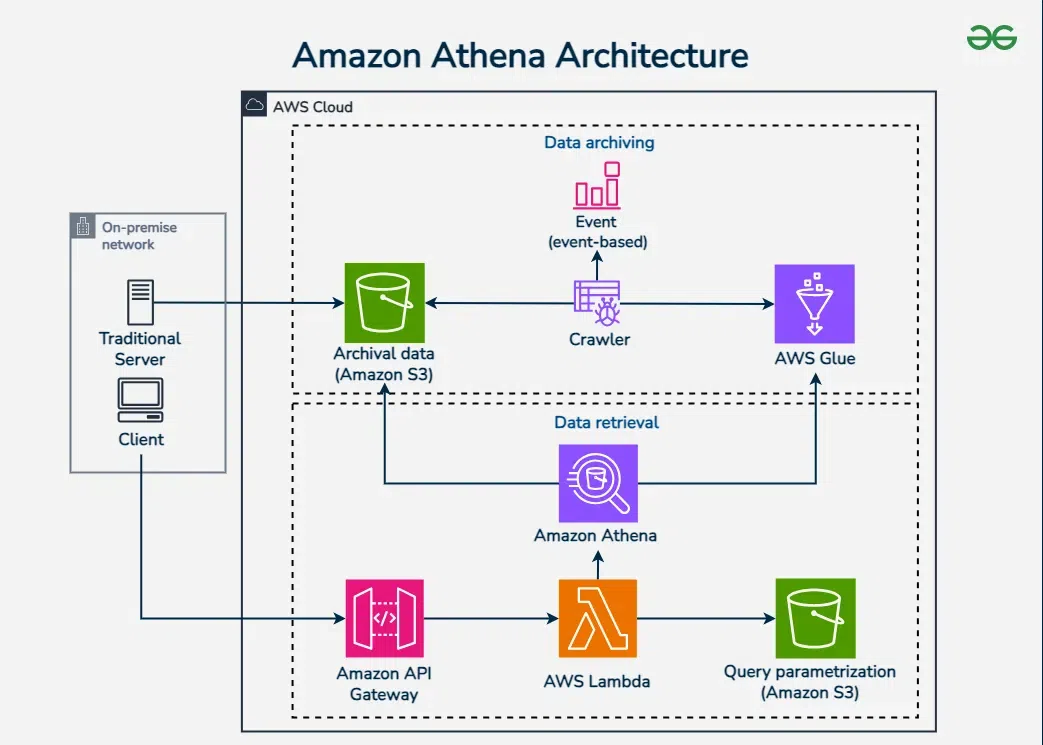
The Serverless Query Engine for S3 Data
AWS Athena represents a significant paradigm shift in how organizations approach data analysis. By abstracting away the underlying infrastructure, it allows data professionals, analysts, and developers to focus purely on querying and extracting value from their data, rather than on operational overhead.
A Paradigm Shift in Data Analysis
Before serverless options like Athena, querying vast datasets often meant substantial upfront investment in data warehouses or Hadoop clusters. These systems required continuous management, scaling, and patching, consuming valuable time and resources. The traditional ETL burden involved moving data from its source, transforming it into a specific format, and then loading it into a structured database for querying. This process could be slow, expensive, and inflexible, especially for ad-hoc analysis or rapidly changing data formats.
Athena revolutionizes this by introducing a “schema-on-read” approach and a pay-per-query model. Instead of transforming data beforehand and loading it into a database, Athena allows users to define a schema at the time of the query. This means data can reside in its raw, original format in S3 – be it CSV, JSON, Parquet, ORC, Avro, or other formats – and be queried directly. This capability significantly democratizes data access, enabling a broader range of users to perform sophisticated analyses without deep database administration knowledge.
How Athena Works Under the Hood
At its core, AWS Athena leverages Presto (now Trino), an open-source distributed SQL query engine designed for high-performance interactive analytic queries, and Apache Hive for DDL (Data Definition Language) statements to create and modify tables.
The process typically involves:
- Data in S3: Your raw or processed data resides in Amazon S3 buckets. S3 acts as your data lake, providing highly durable, scalable, and cost-effective object storage.
- Schema Definition (or Discovery): You define a table schema in Athena that points to your data in S3. This can be done manually using
CREATE TABLEstatements, or more commonly and efficiently, by integrating with the AWS Glue Data Catalog. The AWS Glue Data Catalog is a persistent metadata store that stores information about your data, such as table definitions, schemas, and partition locations, making it centrally accessible to Athena and other AWS services. - Query Execution: When you submit a SQL query in Athena, it consults the Glue Data Catalog to understand the schema and location of your data. It then dispatches the query to its distributed fleet of Presto workers. These workers fan out to scan only the necessary data from S3, process it in parallel, and return the results to you.
- Results in S3: Query results can be displayed directly in the Athena console or stored in an S3 bucket of your choice for further analysis or downstream processing.
This architectural simplicity, combined with the power of Presto, enables Athena to execute complex SQL queries against petabytes of data with impressive speed and efficiency, all without a single server to manage.
Key Features and Benefits
The design principles of AWS Athena lead to a suite of features and benefits that make it an attractive option for a wide range of analytical workloads.
Serverless Simplicity
Perhaps the most compelling feature of Athena is its serverless nature. There is no infrastructure to provision, no servers to configure, no clusters to scale, and no software to install or patch. AWS handles all the operational aspects, allowing users to initiate queries instantly. This significantly reduces IT overhead and frees up engineering teams to focus on data insights rather than infrastructure management.
Cost-Effectiveness
Athena operates on a pay-per-query model. You are charged based on the amount of data scanned by your queries. There are no charges for idle time, compute resources provisioned, or storage for the data itself (you pay for S3 storage separately). This pricing model can be highly cost-effective, especially for sporadic or ad-hoc analysis. Cost optimization strategies, such as compressing data, using columnar formats (like Parquet or ORC), and partitioning your data, can dramatically reduce the amount of data scanned and, consequently, your costs.
Scalability and Performance
Athena automatically scales its compute resources to meet the demands of your queries, whether you’re running a single query or hundreds concurrently. It can query petabyte-scale datasets stored in S3, performing parallel execution across its distributed fleet of workers. This elastic scalability ensures consistent performance even as data volumes and query complexity grow.
SQL Standard Compliance
For anyone familiar with relational databases, Athena’s use of standard ANSI SQL is a huge advantage. This familiarity reduces the learning curve for data analysts and developers, allowing them to leverage existing SQL skills to query data in S3 immediately. Athena supports complex queries, joins, window functions, and a rich set of SQL operators.
Security and Integrations
AWS Athena integrates seamlessly with AWS Identity and Access Management (IAM), allowing for fine-grained control over who can access your data and what operations they can perform. Data is encrypted at rest in S3 and in transit. Furthermore, Athena integrates with other essential AWS services:
- AWS Glue Data Catalog: For managing metadata and schemas.
- Amazon QuickSight: For business intelligence and data visualization.
- AWS Lake Formation: For centralized governance and security for data lakes.
- AWS CloudTrail: For auditing query activities.

Common Use Cases for AWS Athena
AWS Athena’s flexibility and power make it suitable for a variety of analytical tasks across different industries.
Ad-hoc Data Analysis and Exploration
Data scientists, business analysts, and researchers can quickly query raw log files, clickstream data, sensor data, or any unstructured/semi-structured data directly in S3. This is ideal for exploratory analysis, hypothesis testing, and getting quick answers without having to first load data into a traditional database.
Building Data Lakes
Athena is a cornerstone for modern data lake architectures. Organizations can dump vast amounts of diverse data into S3 (their data lake) and then use Athena to query, analyze, and extract insights from this data without prior transformation. This flexibility supports evolving analytical needs.
Business Intelligence and Reporting
Athena can be connected to popular business intelligence (BI) tools such as Amazon QuickSight, Tableau, Power BI, and others via JDBC/ODBC drivers. This enables users to create interactive dashboards and reports directly from data residing in S3, providing timely insights for decision-making.
Log File Analysis
Analyzing operational logs is a frequent requirement for troubleshooting, security auditing, and performance monitoring. Athena excels at querying large volumes of application logs, VPC Flow Logs, CloudTrail logs, ELB access logs, and other machine-generated data stored in S3, making it easy to identify trends, errors, and security incidents.
Processing IoT Data
With the proliferation of IoT devices, organizations collect massive amounts of time-series data. Athena provides a cost-effective and scalable way to query this data stored in S3, allowing for analysis of device performance, sensor readings, and identification of anomalies or patterns.
Best Practices for Optimal Athena Performance and Cost
While Athena offers inherent benefits, adopting certain best practices can significantly enhance performance and control costs.
Data Formatting and Compression
The format and compression of your data in S3 directly impact query performance and cost.
- Columnar Formats: Use columnar storage formats like Apache Parquet or Apache ORC. These formats are highly optimized for analytical queries because they allow Athena to read only the columns required by the query, reducing the amount of data scanned.
- Compression: Always compress your data using formats like Snappy, GZIP, or ZSTD. Compressed data takes up less space in S3, reducing storage costs, and more importantly, less data needs to be scanned by Athena, leading to faster queries and lower costs.
Partitioning Your Data
Partitioning data is crucial for both performance and cost optimization. By dividing your data into logical segments based on common query filters (e.g., date, region, customer ID), Athena can eliminate scanning unnecessary partitions. This dramatically reduces the amount of data scanned per query. For example, storing data with paths like s3://my-bucket/logs/year=2023/month=01/day=01/ allows Athena to only scan data for specific dates when queried.
Optimizing Query Design
Effective SQL query design plays a vital role in Athena’s efficiency.
- Select Only Necessary Columns: Avoid
SELECT *. Instead, specify only the columns you need. - Use
WHEREClauses Effectively: LeverageWHEREclauses to filter data as early as possible. When combined with partitioning, this is extremely powerful. - Use
CREATE TABLE AS SELECT(CTAS): For frequently accessed or complex aggregations, use CTAS queries to create new, optimized tables in S3 (e.g., in Parquet format, partitioned) that can serve as materialized views, improving subsequent query performance.
Utilizing AWS Glue Data Catalog
Maintain a well-defined and up-to-date schema in the AWS Glue Data Catalog. This ensures that Athena correctly interprets your data. AWS Glue crawlers can automatically discover new data and update your schemas, making data management much simpler.

Limitations and Considerations
While powerful, Athena has specific characteristics that define its ideal use cases and situations where other services might be more appropriate.
- Not for OLTP Workloads: Athena is designed for analytical queries on large datasets, not for online transaction processing (OLTP) workloads that require frequent, small, real-time updates or deletions.
- No In-place Updates/Deletes: Because it queries immutable data in S3, Athena doesn’t support
UPDATEorDELETEoperations on existing data files. For data mutation, you typically generate new data files or reprocess entire partitions. - Performance for Complex Joins: While good with standard SQL, highly complex joins across many large, unoptimized tables can still be slower than dedicated, pre-indexed data warehouses. Optimization through CTAS queries to pre-join or pre-aggregate data can mitigate this.
- Small File Problem: Having a very large number of tiny files in S3 can lead to increased overhead for Athena to list and open them, potentially impacting query performance. It’s often beneficial to consolidate small files into larger ones (e.g., 128MB to 1GB per file).
In summary, AWS Athena offers a compelling, serverless solution for querying vast amounts of data stored in Amazon S3. Its ease of use, cost-effectiveness, and scalability make it an invaluable tool for modern data analytics, enabling organizations to unlock insights from their data lakes without the burden of infrastructure management. By adhering to best practices, users can maximize Athena’s performance and ensure optimal cost efficiency.
aViewFromTheCave is a participant in the Amazon Services LLC Associates Program, an affiliate advertising program designed to provide a means for sites to earn advertising fees by advertising and linking to Amazon.com. Amazon, the Amazon logo, AmazonSupply, and the AmazonSupply logo are trademarks of Amazon.com, Inc. or its affiliates. As an Amazon Associate we earn affiliate commissions from qualifying purchases.