
The term “501(c)(3) number” is often used to refer to a crucial identifier associated with charitable organizations in the United States, signifying their tax-exempt status under federal law. While commonly sought after by potential donors and grant-making foundations, it’s important to clarify that there isn’t a single, standalone “501(c)(3) number” issued by the Internal Revenue Service (IRS) in the same way a business has a singular license number. Instead, the phrase typically refers to the organization’s Employer Identification Number (EIN), which, when coupled with an official IRS determination letter, confirms its 501(c)(3) status. This status unlocks significant financial advantages for the organization and its supporters, fundamentally shaping its operational model within the broader economy.
The Financial Bedrock: Understanding 501(c)(3) Status
At its core, 501(c)(3) status is a designation provided by the IRS to organizations that meet specific criteria under section 501(c)(3) of the Internal Revenue Code. This section grants exemption from federal income tax to corporations and any community chest, fund, or foundation organized and operated exclusively for religious, charitable, scientific, public safety testing, literary, educational, or national or international amateur sports competition, or for the prevention of cruelty to children or animals.
Origins and Purpose of Tax Exemption
The concept of tax exemption for certain organizations dates back to the early 20th century, recognizing the societal value of entities that serve public good without private profit motives. The rationale is simple: organizations engaged in activities that would otherwise fall to the government or are deemed universally beneficial to society should not be burdened with income taxes, allowing them to reinvest more resources directly into their mission. This governmental support, through foregone tax revenue, acts as a critical financial subsidy, fostering a robust philanthropic sector. For businesses, understanding the financial landscape of 501(c)(3) entities is crucial, whether for corporate social responsibility initiatives, strategic partnerships, or navigating the competitive grant-funding environment.
Key Financial Benefits for Nonprofits
Achieving 501(c)(3) status is a watershed moment for any nonprofit, opening doors to financial avenues otherwise unavailable to for-profit entities. The most significant benefit is exemption from federal income tax. This means that net earnings, which would be subject to corporate tax in a for-profit setting, can be fully retained and utilized for the organization’s programmatic activities, administrative costs, and growth.
Beyond income tax, 501(c)(3) organizations often qualify for other tax exemptions, including state and local sales tax, property tax, and sometimes even exemption from certain excise taxes, depending on the jurisdiction. These cumulative tax savings represent substantial operational budget enhancements, freeing up funds that would otherwise be allocated to various governmental levies. Furthermore, the status is a prerequisite for receiving tax-deductible contributions, a powerful incentive for individual and corporate donors, and it grants access to grants from private foundations and government agencies, which almost exclusively fund 501(c)(3) entities.
Identifying a 501(c)(3) Organization: The EIN and Determination Letter
While the term “501(c)(3) number” is colloquially used, it’s essential to understand the specific identifiers involved. There isn’t a dedicated, standalone number solely for 501(c)(3) status. Instead, two primary pieces of information confirm an organization’s tax-exempt standing.
The Employer Identification Number (EIN) as the Operational Identifier
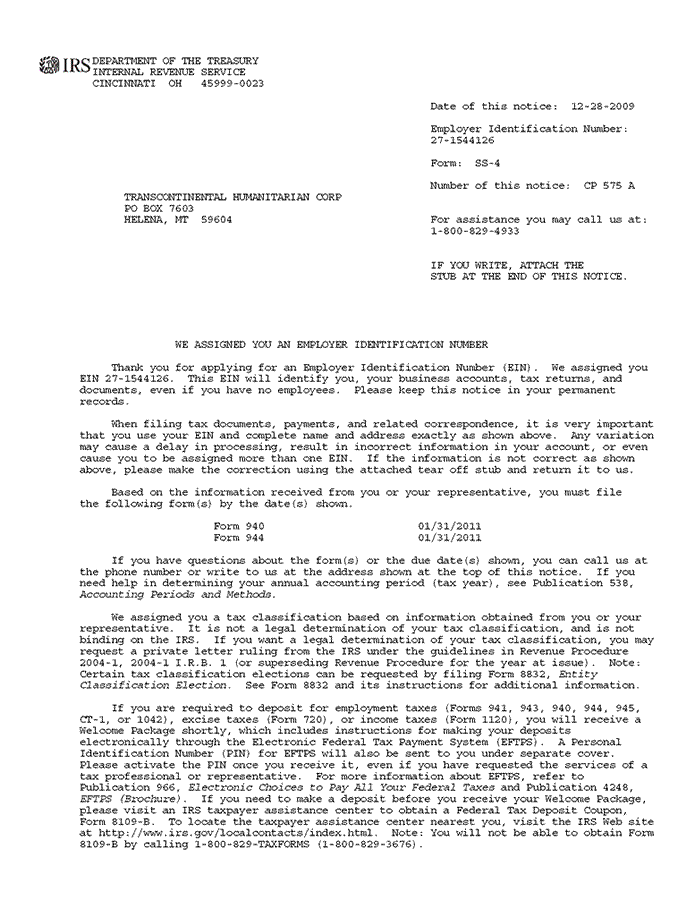
Every organization, whether for-profit or nonprofit, that employs staff or operates as a separate legal entity, needs an Employer Identification Number (EIN). This is a nine-digit number assigned by the IRS for tax administration purposes, functioning much like a Social Security number for individuals. For a 501(c)(3) organization, the EIN serves as its primary federal tax ID number. When donors or grantmakers ask for the “501(c)(3) number,” they are almost invariably requesting the organization’s EIN. This number is used on all federal tax filings, bank accounts, and legal documents, making it central to the organization’s financial and legal operations. It’s how the IRS identifies the entity for its tax-exempt purposes.
The IRS Determination Letter: The Official Proof of Status
While the EIN identifies the organization, the definitive proof of its 501(c)(3) status comes in the form of an IRS determination letter. This is an official document issued by the IRS after an organization has successfully applied for tax-exempt status (typically by filing Form 1023). The letter explicitly states that the organization meets the requirements of section 501(c)(3) of the Internal Revenue Code and is exempt from federal income tax. It also confirms that contributions made to the organization are tax-deductible under section 170 of the Code. This letter is critical for securing grants, establishing donor confidence, and proving legal compliance. Financial institutions, grant foundations, and sophisticated donors will often request a copy of this letter alongside the EIN for due diligence.
Financial Implications for Organizations: Operations and Funding
The 501(c)(3) status profoundly impacts an organization’s financial model, dictating its revenue streams, operational costs, and investment strategies.
Tax Exemption Beyond Income Tax

As mentioned, federal income tax exemption is just one facet. Most states offer corresponding income tax exemptions for 501(c)(3) organizations. Furthermore, property tax exemptions can significantly reduce overhead, especially for organizations owning real estate like schools, hospitals, or community centers. Sales tax exemptions on purchases made by the organization also contribute to cost savings, allowing more funds to be directed towards mission-related activities. These aggregated tax benefits are a major component of a nonprofit’s financial sustainability and must be factored into financial planning and budgeting.
Eligibility for Grants and Philanthropic Funding
A pivotal financial advantage is eligibility for grants. Private foundations and government agencies almost exclusively award grants to organizations that possess 501(c)(3) status. This status acts as a gatekeeper, assuring grantors that the recipient organization is legitimate, operates for public benefit, and that their funding will support a tax-exempt purpose. For nonprofits, securing grants often forms a significant, if not primary, portion of their operating budget. Understanding the financial reporting requirements and grant management best practices specific to 501(c)(3)s is critical for accessing and retaining this funding.
Navigating Unrelated Business Income Tax (UBIT)
While 501(c)(3) organizations are exempt from federal income tax on activities related to their exempt purpose, they are not entirely immune from taxation. Income generated from an “unrelated trade or business” — a trade or business that is regularly carried on and is not substantially related to the organization’s exempt purpose — is subject to Unrelated Business Income Tax (UBIT). This is a crucial financial consideration. Nonprofits must carefully assess any income-generating activities to determine if they fall under UBIT rules. Examples might include selling merchandise unrelated to their mission, operating a for-profit subsidiary, or providing services that primarily benefit private individuals rather than the public good. Mismanaging UBIT can lead to unexpected tax liabilities and even jeopardize the organization’s tax-exempt status.
Financial Implications for Donors: Maximizing Charitable Giving
The 501(c)(3) designation isn’t just beneficial for the organization; it also provides significant financial incentives for donors, fostering a culture of philanthropy.
Tax-Deductible Contributions
For individuals and corporations, contributions to a 501(c)(3) organization are generally tax-deductible. This means that donors can reduce their taxable income by the amount of their qualifying donations, within certain IRS limits. This deduction provides a direct financial incentive, effectively reducing the net cost of giving. Understanding these deduction rules is a key aspect of personal and corporate financial planning, allowing strategic charitable giving to optimize tax outcomes. Donors typically need a receipt from the organization for contributions over a certain amount, and for non-cash contributions, specific valuation rules apply.
Verification for Charitable Giving
Before making a significant donation, particularly for tax purposes, savvy donors often verify an organization’s 501(c)(3) status. This can be done by requesting a copy of the organization’s IRS determination letter or by checking the IRS’s Tax Exempt Organization Search tool. This due diligence ensures that their contributions will indeed qualify for the intended tax deductions and that they are supporting a legitimate nonprofit entity. For organizations, maintaining accurate records and being transparent about their 501(c)(3) status is essential for attracting and retaining donor support.
Maintaining 501(c)(3) Compliance and Financial Health
Maintaining 501(c)(3) status is an ongoing responsibility that requires rigorous financial management and adherence to IRS regulations.
Annual Reporting Requirements (Form 990)
To maintain their tax-exempt status, most 501(c)(3) organizations are required to file an annual information return with the IRS, typically Form 990, 990-EZ, or 990-PF, depending on their gross receipts and assets. The Form 990 provides a detailed snapshot of the organization’s financial activities, governance practices, and programmatic accomplishments. It includes information on revenue, expenses, assets, liabilities, compensation of officers, and a description of program service accomplishments. This document is a public record, used by watchdog groups, potential donors, and researchers to assess an organization’s financial health, efficiency, and accountability. Meticulous financial record-keeping and transparent reporting are paramount.
Prohibited Activities and Financial Risks
Certain activities can jeopardize an organization’s 501(c)(3) status. These include engaging in political campaign intervention (e.g., endorsing candidates), substantial lobbying (which is limited), private inurement (where net earnings benefit private individuals), and operating for purposes other than those specified in its application. Any financial activity that deviates from the organization’s stated exempt purpose or violates these prohibitions can lead to penalties, revocation of tax-exempt status, and severe financial repercussions. Strong internal controls, independent audits, and robust governance practices are vital for mitigating these risks and ensuring long-term financial viability.

Sound Financial Governance
Effective financial governance is critical for a 501(c)(3) organization. This includes establishing clear financial policies, responsible budgeting, regular financial reporting to the board, diversification of funding sources, and prudent investment management (if applicable). A strong financial foundation, coupled with transparent operations and adherence to IRS guidelines, assures stakeholders that the organization is a responsible steward of its funds and an impactful force for good, securing its place in the philanthropic ecosystem.
aViewFromTheCave is a participant in the Amazon Services LLC Associates Program, an affiliate advertising program designed to provide a means for sites to earn advertising fees by advertising and linking to Amazon.com. Amazon, the Amazon logo, AmazonSupply, and the AmazonSupply logo are trademarks of Amazon.com, Inc. or its affiliates. As an Amazon Associate we earn affiliate commissions from qualifying purchases.