
For individuals aspiring to build a career in the financial services industry, obtaining the right credentials is not just a professional milestone; it is a regulatory necessity. Among the various examinations administered by the Financial Industry Regulatory Authority (FINRA), the Series 66 exam occupies a unique and highly coveted position. Officially known as the Uniform Combined State Law Examination, the Series 66 is the gateway to becoming a dual-registered financial professional, capable of functioning as both a broker-dealer representative and an investment adviser representative. Understanding the nuances of this exam is essential for anyone looking to provide comprehensive financial planning and investment advisory services.

Understanding the Regulatory Landscape
To grasp the significance of the Series 66, one must first understand the regulatory framework governing the securities industry in the United States. Financial professionals are generally required to register with both federal authorities—specifically the Securities and Exchange Commission (SEC)—and individual state regulators.
The Role of NASAA
The Series 66 exam is developed by the North American Securities Administrators Association (NASAA). Unlike the exams developed directly by FINRA, such as the Series 7 or Series 6, the Series 66 focuses heavily on state-level regulations. NASAA represents the state agencies responsible for the protection of investors and the oversight of financial advisors. Because state laws—often referred to as “Blue Sky Laws”—can vary in their interpretation and enforcement, the Series 66 ensures that professionals operating within a state possess a standardized baseline of knowledge regarding legal compliance and ethical conduct.
The Evolution of Licensing
The industry has moved toward a more integrated approach to regulation. Historically, representatives might have taken the Series 63 (Uniform Securities Agent State Law) alongside other exams. However, the Series 66 was designed to be more efficient for those who intend to act as investment adviser representatives (IARs). By combining the material traditionally covered in the Series 63 with the content required for investment advisory registration (previously found in the Series 65), the Series 66 creates a streamlined, albeit rigorous, path to dual registration.
The Structure and Content of the Examination
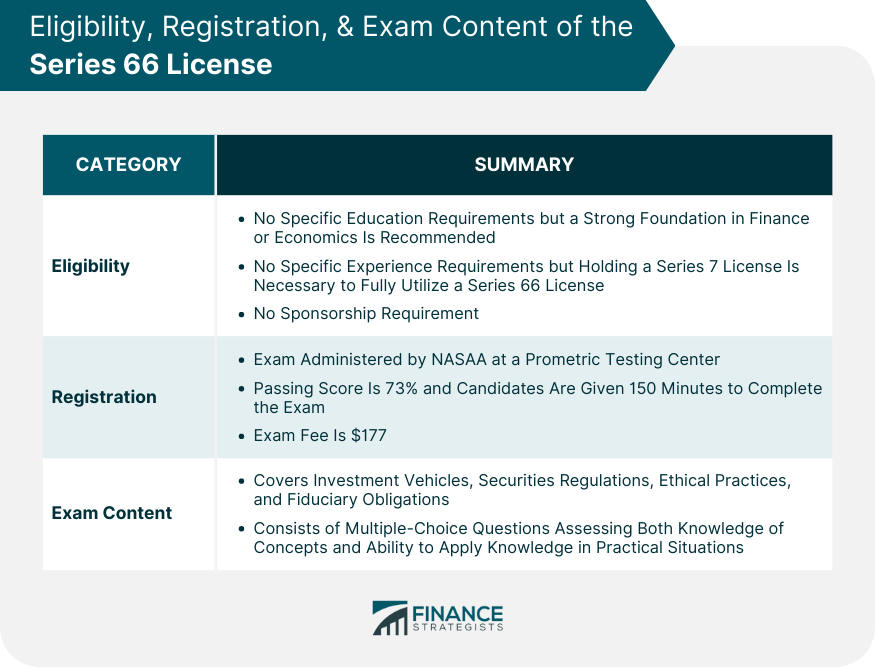
The Series 66 is a challenging assessment that demands a deep understanding of federal and state laws, as well as the practical mechanics of the investment industry. It is a 100-question, multiple-choice exam that candidates must complete within a time limit of 150 minutes.
Economic Factors and Business Information
A significant portion of the exam tests the candidate’s ability to interpret economic data and analyze business information. This includes understanding the impact of fiscal and monetary policy, the significance of economic indicators like the Consumer Price Index (CPI) and Gross Domestic Product (GDP), and the mechanics of financial statements. Candidates are expected to explain the relationship between risk and return, the time value of money, and the various methods of valuing securities. This section ensures that an advisor can articulate complex economic concepts to clients in a way that is both accurate and accessible.
Investment Vehicle Characteristics
The exam dives deep into the technical specifications of various investment products. Candidates must demonstrate proficiency in:
- Equity Securities: Common and preferred stock, warrants, and rights.
- Debt Securities: Corporate bonds, government securities, municipal bonds, and the intricacies of yield curves and duration.
- Pooled Investments: Mutual funds, Exchange Traded Funds (ETFs), and Real Estate Investment Trusts (REITs).
- Derivative Instruments: Options, futures, and forward contracts.
The depth of knowledge required here is not just theoretical; it focuses on the suitability of these products for different types of client profiles, aligning with the fiduciary responsibilities inherent in advisory work.
Laws, Regulations, and Guidelines
This is arguably the most critical component of the Series 66. It covers the Investment Advisers Act of 1940, the Securities Exchange Act of 1934, and the Uniform Securities Act. Candidates are tested on the registration requirements for investment advisers and their representatives, the rules regarding the filing of advertising, the prohibitions against fraudulent and manipulative practices, and the ethical standards mandated by regulators. Mastering this section is non-negotiable, as it dictates the legal boundaries within which a financial professional must operate to avoid disciplinary action or loss of licensure.
The Relationship Between Series 7 and Series 66
It is impossible to discuss the Series 66 without addressing its partner exam: the Series 7. The two are inextricably linked in the professional development path of a financial advisor.
The Prerequisites
The Series 66 is a “top-off” exam. To be fully licensed to conduct business, a candidate generally must pass the Securities Industry Essentials (SIE) exam, the Series 7, and the Series 66. While one can technically take the Series 66 before the Series 7, most firms require the Series 7 to be completed first. The Series 7 covers the broad scope of general securities products, while the Series 66 adds the specific legal and advisory layer necessary to manage assets and charge advisory fees.
The Combined Designation
Passing both exams grants an individual the ability to operate across the full spectrum of financial services. The Series 7 allows the representative to buy and sell stocks, bonds, and other securities for clients, typically earning commissions. The Series 66 adds the authority to provide investment advice and manage portfolios for an advisory fee. This dual-registration is the industry standard for wealth managers and financial planners, as it offers the flexibility to tailor the compensation model and service offering to the client’s specific needs.
Preparing for Success
The pass rate for the Series 66 reflects its difficulty. It is not an exam that can be “crammed” for in a few days; it requires a structured, multi-week study approach.
Developing a Study Strategy
Successful candidates often dedicate 60 to 80 hours of study time. This involves reading through comprehensive textbooks, utilizing online video lectures, and, most importantly, practicing with thousands of question banks. The goal should be to understand the “why” behind the regulation, rather than simply memorizing the rules. Because the exam often presents scenarios rather than straightforward definitions, a deep conceptual understanding is vital.
Focusing on Fiduciary Duty
The recurring theme throughout the Series 66 is the fiduciary standard. Unlike the suitability standard—which historically governed broker-dealers—the fiduciary standard requires an advisor to act in the best interest of the client at all times. The exam heavily penalizes candidates who do not prioritize this principle. When practicing, candidates should view every scenario through the lens of: “Is this action in the client’s best interest, and is it fully disclosed?”
The Importance of Practice Exams
Taking full-length, timed practice exams is the most effective way to gauge readiness. It helps candidates manage their time during the actual testing session and identifies specific weak areas—whether it be the calculation of bond yields or the intricacies of state-level registration exemptions. Candidates should aim to consistently score in the mid-80s on practice exams to ensure a comfortable margin of safety for the actual test.

The Professional Value of the License
Why do thousands of financial professionals subject themselves to the rigorous process of obtaining the Series 66? The answer lies in professional credibility and the scope of service.
The Series 66 is a badge of competence. It signals to clients that an advisor is not only well-versed in the markets and investment products but also legally and ethically grounded in the regulations designed to protect investors. In an era where trust is the most valuable currency in financial services, holding the Series 66 provides a foundation of legitimacy.
Furthermore, as the financial industry continues to move away from transactional, commission-based models toward fee-based advisory services, the Series 66 has become increasingly relevant. It allows advisors to pivot their practice toward holistic planning, where the focus is on long-term wealth management, tax-efficient investing, and comprehensive financial goal-setting.
Ultimately, the Series 66 is more than just a hurdle to clear; it is a fundamental component of a career in finance. It bridges the gap between basic sales and sophisticated advisory, ensuring that those entrusted with the life savings of clients have the knowledge, the ethics, and the regulatory expertise to perform their duties with the highest level of professionalism. For the dedicated financial advisor, the journey of passing the Series 66 is the first step toward a career characterized by integrity, technical proficiency, and a commitment to client success.
aViewFromTheCave is a participant in the Amazon Services LLC Associates Program, an affiliate advertising program designed to provide a means for sites to earn advertising fees by advertising and linking to Amazon.com. Amazon, the Amazon logo, AmazonSupply, and the AmazonSupply logo are trademarks of Amazon.com, Inc. or its affiliates. As an Amazon Associate we earn affiliate commissions from qualifying purchases.