
In the rapidly evolving landscape of artificial intelligence, the dominant architectures—Deep Neural Networks (DNNs) and Large Language Models (LLMs)—rely on continuous, high-precision mathematical operations. While these systems have achieved remarkable feats, they are fundamentally limited by their massive energy consumption and reliance on synchronous processing. This has led researchers to look toward biological inspiration, resulting in the development of Spiking Neural Networks (SNNs). Often referred to as the “third generation” of neural networks, SNNs represent a shift from calculating raw numbers to processing temporal spikes, mirroring the way the human brain operates.

The Architectural Shift: From Continuous Rates to Discrete Spikes
Traditional neural networks process information by passing continuous values through layers of neurons, applying activation functions to transform these inputs into outputs. This process is computationally expensive, requiring GPUs to perform trillions of floating-point operations per second. In contrast, SNNs operate on the principle of sparsity and time.
The Biological Blueprint
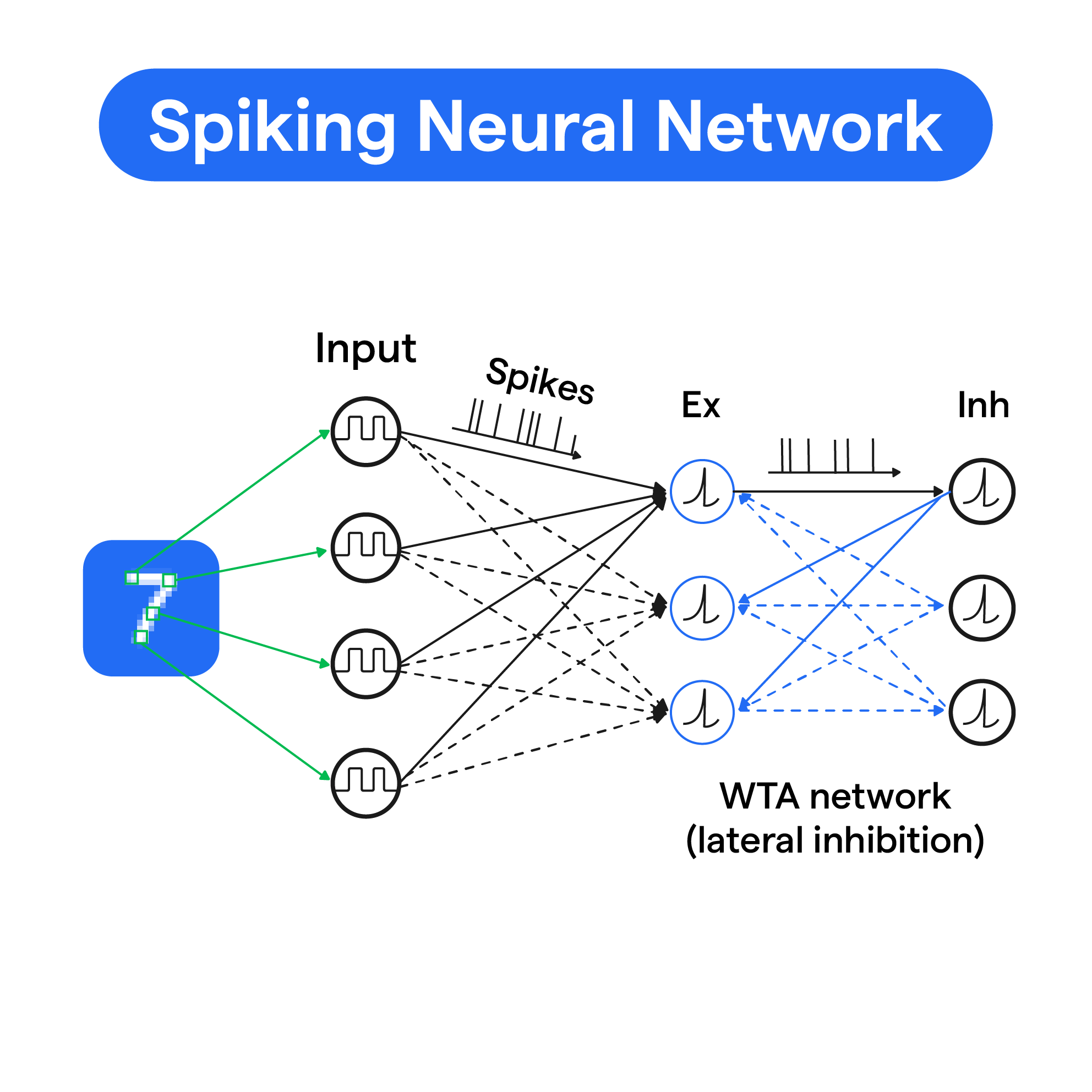
The human brain does not transmit continuous signals; it communicates through discrete electrical pulses known as action potentials, or “spikes.” A neuron in the brain remains quiet until its membrane potential reaches a specific threshold. Once that threshold is crossed, it fires a spike and resets. SNNs emulate this mechanism. Instead of constant data flow, information is encoded in the timing and frequency of these discrete spikes.
The Advantage of Asynchronous Processing
Because SNNs only “compute” when a spike occurs, they are inherently event-driven. In a static environment where data does not change rapidly, an SNN may remain largely dormant, consuming almost no power. This asynchronous nature stands in stark contrast to standard neural networks, which perform full computations regardless of whether the input signal has changed significantly. By processing data only when necessary, SNNs offer a pathway to AI models that can run on hardware with a fraction of the power requirements of today’s industry-standard processors.
Why Spiking Neural Networks Matter for Hardware Efficiency
The primary driver behind the surge in interest regarding SNNs is the looming “power wall” in AI development. As models grow larger, the energy cost of running them—both in data centers and on edge devices—becomes unsustainable. SNNs provide a hardware-software co-design opportunity that addresses this bottleneck directly.
Neuromorphic Computing
SNNs are the software counterpart to a specialized class of hardware known as neuromorphic chips. Unlike traditional Von Neumann architecture, where processing and memory are physically separated, neuromorphic hardware—such as Intel’s Loihi or IBM’s TrueNorth—integrates memory and processing in a way that mimics the synaptic connections of a biological brain. When SNNs are deployed on these chips, the efficiency gains are exponential. The network architecture and the silicon are aligned to prioritize energy efficiency, allowing for complex decision-making processes at the edge, far away from power-hungry cloud servers.
Edge AI and Low-Latency Applications
The implications for Edge AI are profound. Consider autonomous drones, wearable health monitors, or industrial sensors. These devices have limited battery life and must make real-time decisions without waiting for a cloud round-trip. An SNN can process sensory data—such as visual input or vibration patterns—using milliwatts of power. By discarding the redundant, continuous data processing required by standard AI, SNNs enable intelligence to exist in environments where it was previously technically or thermally impossible.

Overcoming the Training Gap: Challenges in SNN Adoption
Despite their immense promise, SNNs have historically lagged behind traditional models in accuracy and ease of implementation. The very mechanism that makes them efficient—the non-differentiable nature of a spike—also makes them difficult to train using standard machine learning techniques.
The Gradient Problem
Most modern AI is built on the foundation of backpropagation, an algorithm that relies on the chain rule to adjust weights within a network. This requires the network’s activation functions to be differentiable. Because a spike is binary—it either happens or it doesn’t—it lacks the smooth gradient necessary for standard backpropagation. This creates a “dead zone” for optimization.
Training Strategies
To bridge this gap, researchers have developed several clever workarounds:
- Surrogate Gradients: This approach replaces the non-differentiable spike function with a differentiable approximation during the training process, allowing backpropagation to function while still maintaining the “spiky” behavior of the network.
- ANN-to-SNN Conversion: This method involves training a traditional neural network first and then converting its weights into an SNN. While this yields high accuracy, it often sacrifices some of the unique temporal advantages of SNNs.
- Spike-Timing-Dependent Plasticity (STDP): Inspired by neurobiology, this is an unsupervised learning rule where the strength of the connection between two neurons is adjusted based on the relative timing of their spikes. This mirrors how biological brains learn through experience rather than explicit error correction.
The Future of SNNs in the AI Ecosystem
As we look toward the next decade of artificial intelligence, it is unlikely that SNNs will entirely replace Deep Learning models. Instead, we are moving toward a hybrid future. It is probable that complex, large-scale reasoning tasks will remain in the domain of high-performance Transformers and Deep Learning models, while SNNs will dominate the domain of real-time, high-speed, and low-power sensory processing.
Integration with Robotics
The field of robotics is perhaps the most immediate benefactor of SNN technology. A robotic hand designed to catch a ball, for instance, requires millisecond-level responsiveness. An SNN, coupled with event-based cameras (neuromorphic vision sensors), can process visual motion as a stream of temporal events. This creates a closed-loop system that mimics the reflex systems of animals, allowing for fluid motion and adaptive interaction that is significantly more natural than current frame-based computer vision approaches.
Sustainability and the Green AI Movement
Beyond performance, there is a mounting pressure for “Green AI.” The carbon footprint of training and deploying massive LLMs is significant. SNNs represent a shift toward sustainability. By reducing the reliance on massive, energy-intensive GPU clusters and enabling “always-on” intelligence with minimal power draw, SNNs are poised to be the backbone of the next generation of eco-friendly, sustainable AI systems.
A Paradigm Shift for Developers
For software engineers and data scientists, the transition to understanding SNNs requires a shift in perspective. It demands a move away from thinking in terms of tensors and static datasets, and toward thinking in terms of streams, temporal correlations, and event-based architectures. Libraries such as Snntorch and SpikingJelly are already lowering the barrier to entry, providing the tools necessary for practitioners to begin experimenting with these spiking architectures within popular frameworks like PyTorch.
Ultimately, SNNs represent the maturation of AI. By moving beyond the brute-force computational approach and embracing the elegance of biological computation, we are not just building smarter machines; we are building machines that operate with the efficiency, adaptability, and temporal awareness required to function seamlessly in the physical world. The journey of SNNs is far from complete, but the trajectory is clear: they are the key to unlocking an era of ubiquitous, energy-efficient, and truly responsive artificial intelligence.
aViewFromTheCave is a participant in the Amazon Services LLC Associates Program, an affiliate advertising program designed to provide a means for sites to earn advertising fees by advertising and linking to Amazon.com. Amazon, the Amazon logo, AmazonSupply, and the AmazonSupply logo are trademarks of Amazon.com, Inc. or its affiliates. As an Amazon Associate we earn affiliate commissions from qualifying purchases.