
In the rapidly advancing landscape of artificial intelligence and machine learning, the concept of the vector sum has transitioned from a high-school physics and linear algebra curriculum to the literal backbone of modern neural networks. To understand how large language models (LLMs) reason, how search engines rank information, and how recommendation systems personalize content, one must look past the interface and into the underlying mathematics. The vector sum—the process of combining multiple directed quantities into a single resultant vector—is the fundamental operation that allows computers to “think” in terms of meaning, relationships, and context.
The Mathematical Foundation of Vector Representations
At the most basic level, a vector is an ordered list of numbers. In the context of AI, these numbers represent coordinates in a high-dimensional space. When we talk about “vectorizing” text, images, or audio, we are essentially converting raw data into a numerical format that a computer can manipulate.
Understanding Vector Addition
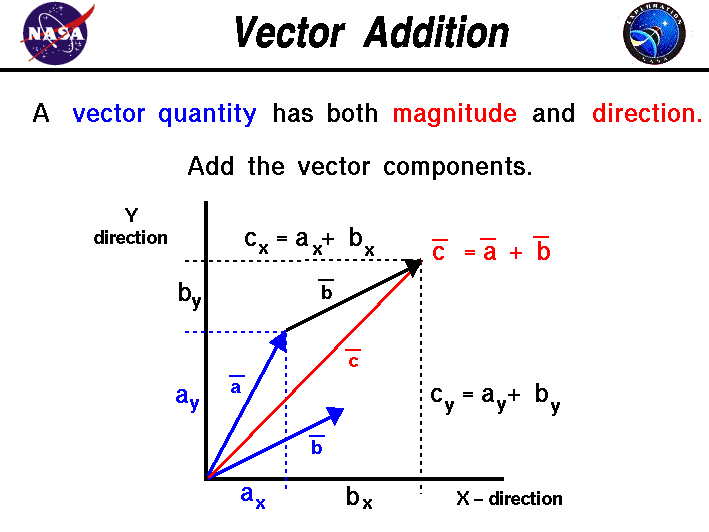
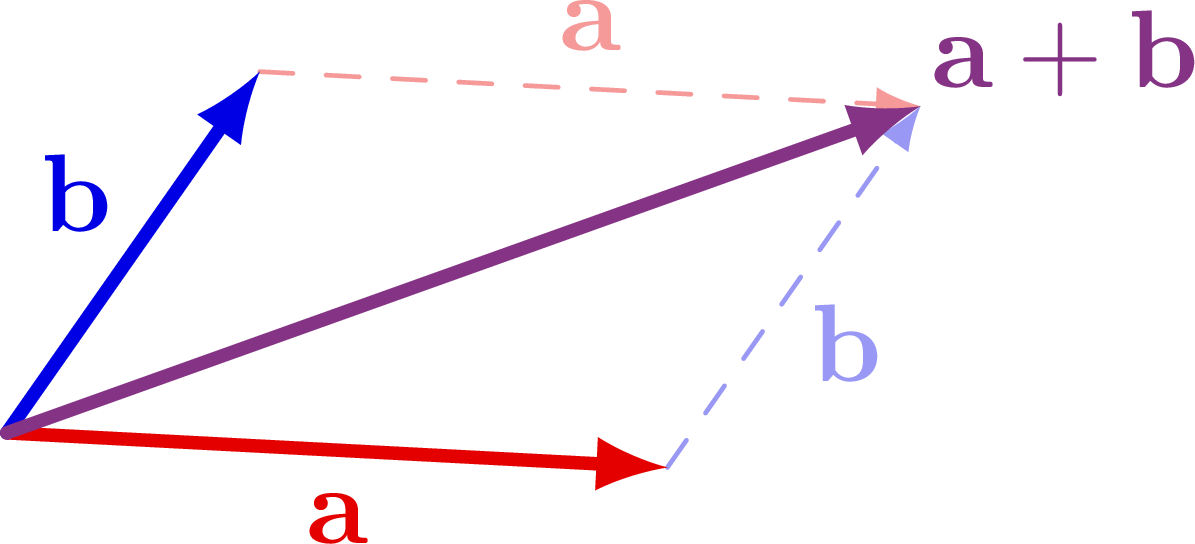
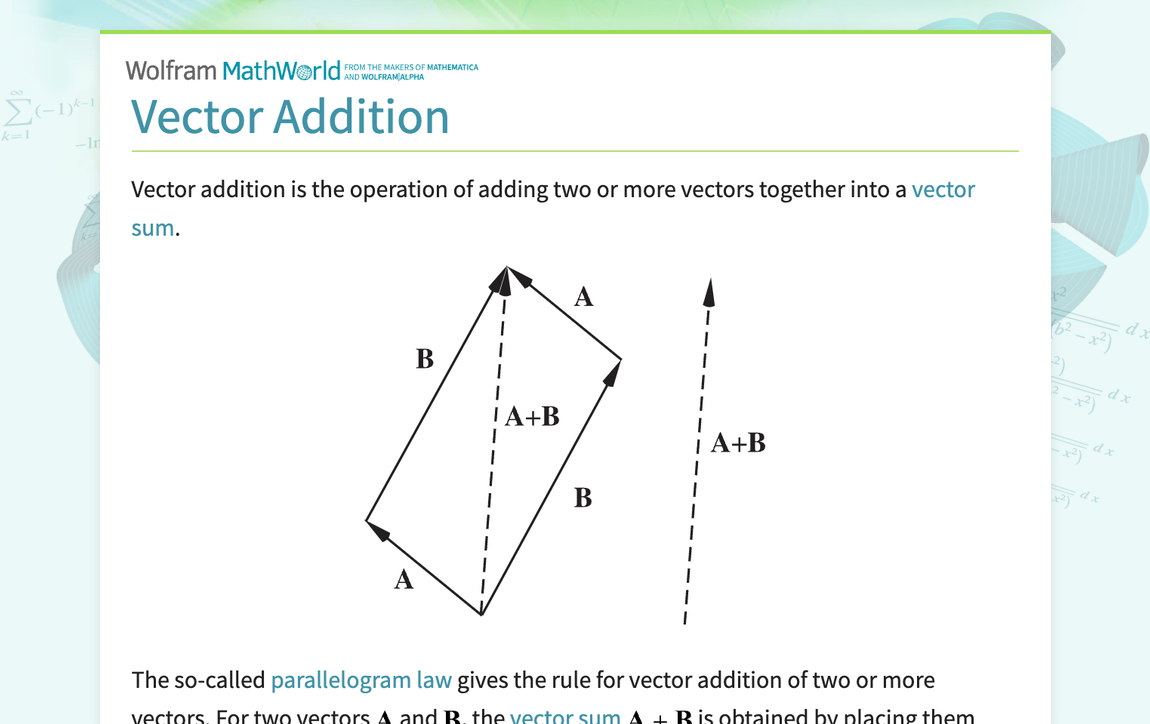
In linear algebra, the vector sum is defined as the addition of two or more vectors by adding their corresponding components. If you have vector A (x1, y1) and vector B (x2, y2), the sum is (x1+x2, y1+y2). While this sounds simplistic, when applied to thousands of dimensions, this operation becomes the core mechanism for information retrieval and synthesis.
In modern AI architectures, such as the Transformer model that powers tools like ChatGPT, tokens (words or parts of words) are converted into dense vectors known as embeddings. These embeddings represent semantic meaning. The vector sum of these embeddings allows the model to calculate the relationship between different concepts. When a machine “adds” the vector for “King” to the vector for “Woman” and subtracts “Man,” the resulting vector mathematically points toward the concept of “Queen.” This is the power of vector algebra: it transforms abstract linguistic concepts into quantifiable spatial relationships.
High-Dimensional Spaces and Neural Embeddings
Modern AI does not work in 2D or 3D space. It operates in spaces with hundreds or even thousands of dimensions. In these hyper-dimensional environments, the vector sum acts as a way to aggregate information. By summing the vectors of a paragraph, the system creates a “document embedding” that captures the overall sentiment or topic of the text. This allows for semantic search, where the system retrieves content based on the meaning of the user’s query rather than just matching keywords.
Vector Sums in Modern AI Architecture
The role of vector summation is not limited to static representations; it is an active participant in the dynamic processing of information. Every time a neural network passes data through its layers, it is performing complex vector additions and multiplications.
The Role of Attention Mechanisms
The architecture that redefined artificial intelligence—the Transformer—relies heavily on the “Attention” mechanism. Attention is effectively a weighted vector sum. Instead of treating every word in a sentence with equal importance, the model calculates “attention scores” for each word relative to others. These scores act as weights. The final representation of a word is the weighted vector sum of the entire sequence.
This is why, in the sentence “The animal didn’t cross the street because it was too tired,” the model knows “it” refers to the “animal” and not the “street.” By performing a weighted vector sum of the context surrounding “it,” the model successfully captures the syntactic and semantic dependency. The vector sum allows the model to “focus” its computational energy on the most relevant parts of the input, effectively filtering out noise and sharpening the context.
Semantic Search and Vector Databases
The rise of Vector Databases (such as Pinecone, Milvus, or Weaviate) is the direct result of our need to store and manipulate these summations. In traditional databases, you search for a specific string. In a vector database, you perform a “nearest neighbor” search. You take your query, convert it into a vector, and find the stored data whose vector representation is mathematically “closest” to your query vector.
This proximity is determined by distance metrics like Cosine Similarity or Euclidean Distance, both of which are rooted in vector arithmetic. By utilizing vector sums to aggregate data, companies can build retrieval-augmented generation (RAG) systems. These systems look at the vector sum of a massive knowledge base to provide context-aware answers, ensuring that the AI has access to verified, up-to-date, and domain-specific information.
Practical Implications for Developers and Tech Strategy
For software engineers and tech leaders, understanding the vector sum is no longer optional. It is the language in which modern applications are being written. Whether you are building a custom classifier, optimizing a recommendation engine, or integrating LLMs into your product stack, vector arithmetic is the operational layer that determines performance and accuracy.
Optimizing Machine Learning Pipelines
When building AI-driven features, the bottleneck is often the efficiency of vector operations. Because neural networks perform millions of vector sums per inference, hardware acceleration—using GPUs and TPUs—is vital. Understanding the geometry behind these sums allows developers to optimize data structures and reduce dimensionality without losing critical semantic information. Techniques like Principal Component Analysis (PCA) or t-SNE are used to manage these vectors, ensuring that the most important “directions” of the data are preserved while discarding the noise.
The Future of Multi-Modal AI
We are entering an era of multi-modal AI, where models process images, text, and video simultaneously. The bridge between these data types is the shared vector space. By mapping images and text into the same vector space, we can perform cross-modal operations. For instance, a system can take the vector sum of a descriptive text prompt and an image input to generate a new, stylized output. This alignment, known as Contrastive Language-Image Pre-training (CLIP), proves that the vector sum is the universal translator between different modes of information.
Moving Toward Vector-Native Computing
As we look toward the future, the integration of vector algebra into standard computing will only deepen. We are moving away from traditional symbolic logic toward probabilistic, geometric computing.
Why This Matters for the Tech Ecosystem
The democratization of AI through APIs means that many developers use these tools as a black box. However, the teams that achieve true competitive advantage are those that understand the underlying vector operations. If you are building a recommendation engine for an e-commerce platform, you aren’t just matching product IDs; you are summing the vector representations of a user’s historical preferences to predict their future intent. This is fundamentally a problem of vector arithmetic.
Final Synthesis: The Geometry of Intelligence
The vector sum is not just a mathematical curiosity or an esoteric theory; it is the bridge between the messy, nuanced human world and the rigid, binary world of silicon. By turning language into direction and context into coordinates, we have enabled machines to perceive similarity, detect intent, and generate human-like reasoning.
Every time a user asks an AI a question, or a search engine pulls the perfect result from a million documents, or an autonomous vehicle processes its surroundings to make a split-second decision, a sophisticated series of vector sums is occurring in the background. Understanding this concept is the key to mastering the next decade of software development. As we continue to refine how we aggregate, store, and manipulate these vectors, we are essentially refining the architecture of human knowledge itself, encoded into the elegant, multidimensional geometry of the vector sum.
aViewFromTheCave is a participant in the Amazon Services LLC Associates Program, an affiliate advertising program designed to provide a means for sites to earn advertising fees by advertising and linking to Amazon.com. Amazon, the Amazon logo, AmazonSupply, and the AmazonSupply logo are trademarks of Amazon.com, Inc. or its affiliates. As an Amazon Associate we earn affiliate commissions from qualifying purchases.