
For anyone navigating the intricate world of finance and investing, understanding the operational hours of the New York Stock Exchange (NYSE) is fundamental. Far more than mere opening and closing times, these hours dictate market liquidity, volatility, and the strategic windows available for trading and investment decisions. The NYSE, a cornerstone of global capital markets, operates within a carefully structured timetable designed to balance market access with stability and fair play. This deep dive will explore not only the standard trading schedule but also the nuances of extended hours, holiday closures, and the strategic implications for various types of investors.

Understanding the Core NYSE Trading Day
The beating heart of global equities trading occurs during the NYSE’s standard session. These hours are etched into the daily rhythm of financial professionals and active investors worldwide, setting the pace for market activity and price discovery.
The Standard Session: Open and Close Bells
The official trading hours for the New York Stock Exchange are 9:30 AM to 4:00 PM Eastern Time (ET), Monday through Friday. These hours mark the core period when the vast majority of trading volume occurs, characterized by high liquidity and tight bid-ask spreads.
The iconic opening and closing bells, once rung physically, symbolize these critical moments. The opening bell at 9:30 AM ET signifies the culmination of pre-market activity and the commencement of the official trading day, often accompanied by a flurry of initial trades and significant price movements as pent-up orders are executed. Conversely, the closing bell at 4:00 PM ET marks the end of the standard session, often seeing another surge of activity as traders close positions or execute final orders, leading to what is sometimes called the “power hour” of trading.
This predictable schedule provides a structured environment for market participants, enabling them to plan their strategies and manage risk within defined parameters. It’s a rhythm that has been maintained for decades, providing consistency and reliability in a dynamic financial landscape.
Why These Specific Hours? Market Efficiency and Global Context
The choice of 9:30 AM to 4:00 PM ET is not arbitrary; it’s a carefully considered schedule designed for several key reasons, primarily centering on market efficiency, stability, and global financial coordination.
Firstly, these hours allow for a significant overlap with the European trading day, particularly London, which is a major financial hub. By opening later than European markets but closing earlier than some Asian markets, the NYSE facilitates international trading flows and information exchange, crucial for a globalized economy. This overlap ensures that major news and economic data from different time zones can be processed and reacted to efficiently without extended periods of market closure.
Secondly, the specific duration aims to provide sufficient time for price discovery and liquidity without overwhelming participants or extending the trading day to an impractical length. A shorter day helps concentrate liquidity, leading to more efficient price formation and reduced volatility compared to a fragmented, round-the-clock market. It also provides a necessary pause for market participants to digest information, plan strategies, and for back-office operations to reconcile trades.
The Role of Market Makers and Specialists
Within these standard hours, a complex ecosystem of market makers and specialists plays a vital role. These entities are mandated to maintain orderly markets, providing liquidity by standing ready to buy or sell securities. During the 9:30 AM to 4:00 PM window, their presence is most robust, ensuring that there’s always a buyer for every seller and vice-versa, thereby facilitating continuous trading and minimizing price discontinuities. Their capital commitment and regulatory obligations contribute significantly to the depth and efficiency seen during core trading hours. This deep liquidity is one of the primary benefits of trading during the standard session, particularly for institutional investors executing large block trades.
Beyond the Standard: Extended Trading Hours
While the 9:30 AM to 4:00 PM ET window defines the core market, the advent of electronic trading has expanded access beyond these traditional boundaries. Extended trading hours, comprising pre-market and after-hours sessions, offer opportunities but also present unique challenges.
Pre-Market Trading: Setting the Stage
Pre-market trading typically occurs between 4:00 AM and 9:30 AM ET. During this period, investors can place buy and sell orders before the official market open. This session is often characterized by lower trading volumes and liquidity compared to the standard session. However, it’s a critical time for reacting to news that breaks overnight or early in the morning, such as earnings reports, economic data releases, or geopolitical events.
For instance, a company announcing better-than-expected earnings at 7:00 AM ET might see its stock price surge in pre-market trading, reflecting immediate investor reaction. Savvy traders use this period to gauge market sentiment and position themselves for the official open. However, the reduced liquidity means that bid-ask spreads can be wider, and large orders might have a greater impact on price, leading to increased volatility and potentially less favorable execution prices.
After-Hours Trading: Reacting to News and Earnings
After-hours trading generally runs from 4:00 PM to 8:00 PM ET, though some platforms may offer earlier starts or later finishes. Similar to pre-market, this period allows investors to react to news released after the market closes, such as quarterly earnings calls, analyst downgrades, or late-breaking corporate announcements.
For example, a company holding its earnings conference call shortly after the 4:00 PM close might see significant price movement during after-hours trading as investors digest the information. The dynamics are similar to pre-market: lower liquidity, wider spreads, and increased volatility. This makes after-hours trading a double-edged sword: it offers flexibility and immediate reaction capability but comes with higher risk due to thinner order books. Retail investors participating in after-hours trading must be acutely aware of these limitations.
Accessing Extended Hours: Platforms and Considerations
Accessing pre-market and after-hours trading requires a brokerage account that supports extended-hours trading. Most major online brokers offer this functionality, but it’s crucial to understand their specific rules and limitations. Some brokers might only allow certain order types (e.g., limit orders are common to mitigate price risk), or have different commission structures for extended sessions.
Key considerations for engaging in extended-hours trading include:
- Liquidity Risk: Fewer participants mean it can be harder to execute trades at desired prices, especially for large orders.
- Volatility: Prices can move more dramatically on smaller volumes, leading to rapid and unpredictable swings.
- Wider Spreads: The difference between the buy and sell price (bid-ask spread) is typically larger, increasing transaction costs.
- Order Types: Using limit orders is generally recommended to control the price at which a trade is executed, mitigating the risk of unfavorable market orders in illiquid conditions.
Extended hours are primarily for experienced traders who can closely monitor news flow and manage the associated risks.
Navigating Market Closures and Special Schedules
The NYSE’s operational calendar isn’t strictly Monday-Friday, 9:30-4:00 ET. It also accounts for national holidays and occasional early closings, which can significantly impact trading strategies and market activity.
NYSE Holidays: When the Market Rests
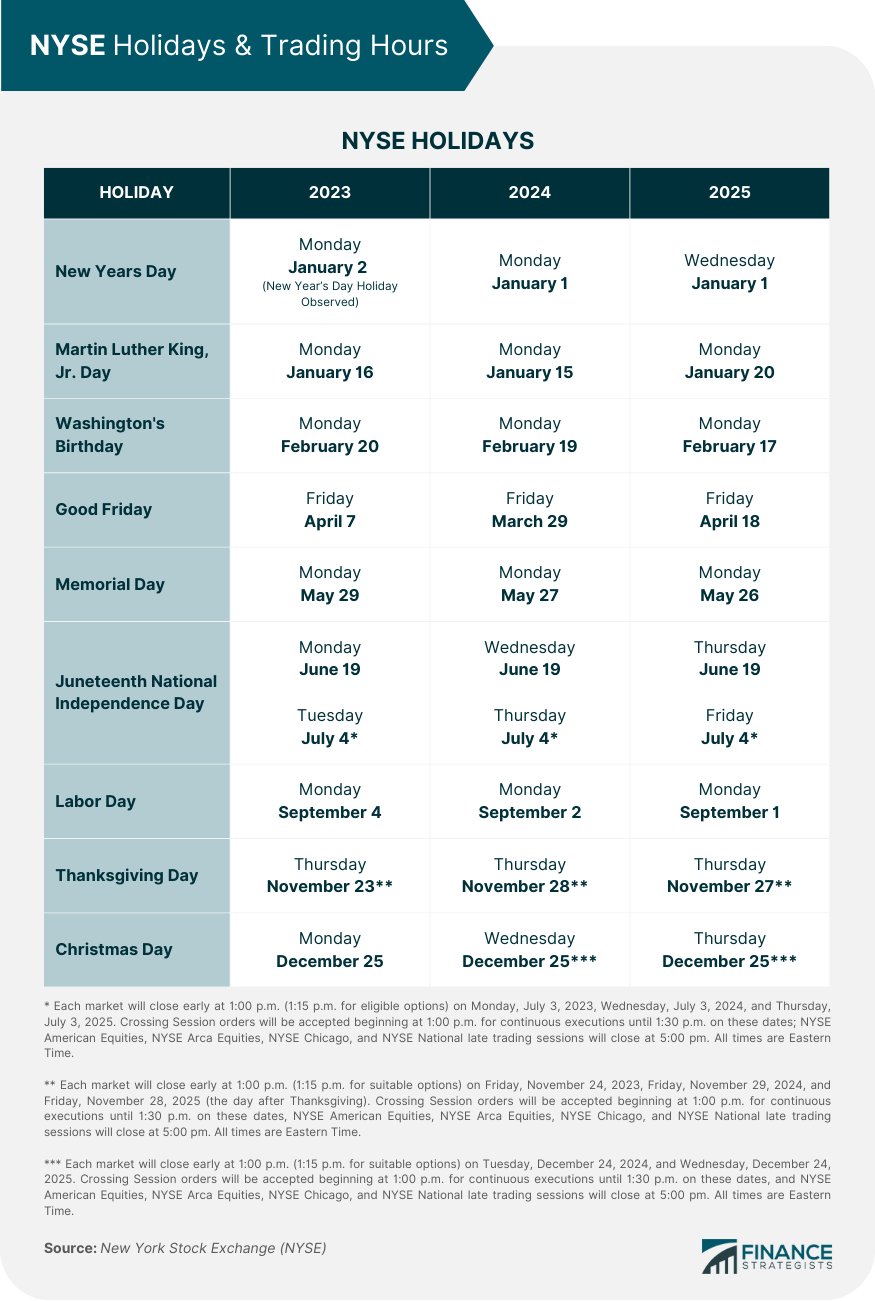
The NYSE observes several U.S. national holidays, during which the exchange is completely closed. These typically include:
- New Year’s Day
- Martin Luther King, Jr. Day
- Washington’s Birthday (Presidents’ Day)
- Good Friday
- Memorial Day
- Juneteenth National Independence Day
- Independence Day
- Labor Day
- Thanksgiving Day
- Christmas Day
When a holiday falls on a weekend, the market typically observes it on the preceding Friday or succeeding Monday. These closures are well-documented in advance on the NYSE’s official calendar. For investors, these holidays mean no trading activity, and positions held over a holiday weekend are subject to any news or events that may occur during the downtime, potentially leading to gap openings on the next trading day.
Early Closings: Abbreviated Trading Days
Occasionally, the NYSE may have early closings, often in observance of a holiday falling mid-week or in anticipation of a holiday weekend. For example, the market typically closes early at 1:00 PM ET on the day after Thanksgiving (Black Friday) and sometimes on Christmas Eve. These abbreviated sessions still operate under the same rules as a full trading day but offer a shorter window for active trading.
Early closings can result in condensed activity and potentially increased volatility around the shortened close, as traders rush to finalize positions. It’s crucial for investors to be aware of these special schedules to avoid being caught off guard and to manage their risk exposures appropriately.
Impact on Trading Strategies and Planning
Market closures, whether full holidays or early closings, require careful planning. For day traders, these periods mean a complete cessation of their primary activity, necessitating a shift in focus to research or other preparations. For swing traders and long-term investors, positions held over holidays face “gap risk” – the possibility that significant news or events during the closure could cause the stock price to open substantially higher or lower than its previous close. This can lead to unexpected gains or losses.
Prudent investors often review their portfolios and adjust positions ahead of long market closures, either by reducing exposure to volatile assets or by implementing hedging strategies. Understanding the NYSE holiday calendar is an essential part of effective risk management in investing.
The Strategic Implications of NYSE Hours for Investors
The NYSE’s operational schedule profoundly influences how different types of investors approach the market, impacting everything from trading frequency to information processing.
For Day Traders: Volatility and Liquidity Management
Day traders, who open and close positions within a single trading day, are highly dependent on the NYSE’s hours. The 9:30 AM to 4:00 PM ET window is their primary battleground, offering the highest liquidity and typically the tightest spreads.
- Opening Bell Volatility: The first hour after 9:30 AM ET is often the most volatile, driven by the execution of pre-market orders and initial reactions to news. This presents significant opportunities for quick profits but also higher risks.
- Mid-Day Lull: Activity often subsides in the late morning and early afternoon, becoming less volatile and thinner in volume. This period can be challenging for strategies reliant on high momentum.
- Closing Bell Rush: The final hour, particularly the last 30 minutes, can see a resurgence of activity as traders square off positions or participate in “power hour” moves.
Day traders must constantly monitor real-time data and adjust strategies to capitalize on the ebb and flow of liquidity and volatility throughout the standard trading day, avoiding the illiquid and risky extended hours.
For Long-Term Investors: Event-Driven Decisions
Long-term investors, focused on growth, value, or income over months or years, are less concerned with intra-day fluctuations but still need to be aware of NYSE hours for executing trades and understanding broader market movements.
- Executing Orders: While they may place orders at any time, execution will typically occur during standard hours. Large orders might be spread out over time to minimize market impact.
- Reacting to Major News: Long-term investors monitor major company announcements (earnings, mergers, product launches) or macroeconomic data. Their response might be to buy or sell, but these decisions are usually less time-sensitive than for day traders. Extended hours can provide an early indication of market reaction to such news, helping them refine their long-term thesis.
- Dollar-Cost Averaging: For those employing dollar-cost averaging strategies, regular investments are typically made without regard to specific intra-day market timings, relying on the average price over time.
For long-term investors, the focus shifts from tactical timing to strategic positioning based on fundamental analysis, with NYSE hours dictating the practical windows for portfolio adjustments.
Global Investors: Bridging Time Zones and Information Gaps
For investors outside the Eastern Time zone, especially those in Europe or Asia, NYSE hours present unique challenges and opportunities.
- Time Zone Overlap: European investors benefit from a significant overlap with NYSE hours, allowing for active participation during their business day.
- Asynchronous Information Flow: Asian investors, however, often find the NYSE operating during their night or early morning. This means they must react to market-moving news and price changes from the previous NYSE session at their market open, leading to potential “gap” reactions.
- 24/7 Monitoring: Global investors often need to track global markets around the clock to remain informed, using extended hours on the NYSE and other exchanges to gauge sentiment and plan their strategies for their local market open. Many institutional investors have global trading desks operating across different time zones to manage this complexity.
Understanding these time zone differentials is critical for international portfolio management and risk mitigation.
The Evolving Landscape of Market Access
The rigid structure of NYSE hours, while providing stability, is continually challenged by technological advancements and the rise of alternative trading venues.
The Rise of 24/7 Trading: A Glimpse into the Future?
The emergence of cryptocurrencies, which trade 24/7, has sparked debate about the future of traditional stock market hours. The continuous nature of crypto markets offers constant liquidity and immediate reaction to global events, but also constant exposure to volatility without the “cooling-off” periods provided by traditional market closures. While a 24/7 NYSE is not imminent due to significant logistical, regulatory, and stability concerns, the discussion reflects a broader trend towards increased market accessibility. Some private market platforms and dark pools already offer more extended trading.
The Impact of Technology and Automation
Electronic trading platforms, high-frequency trading (HFT), and algorithmic trading have already profoundly altered how trading occurs within and beyond NYSE hours. Technology facilitates pre-market and after-hours trading, enabling rapid execution and sophisticated strategies. Automation allows for 24/7 monitoring and rule-based trading even when humans are not actively watching the screens. This technological evolution continues to push the boundaries of traditional market structures, increasing efficiency but also introducing new forms of market complexity and risk.
Regulatory Considerations and Market Stability
Any potential shift towards significantly longer or 24/7 trading hours for major exchanges like the NYSE would entail immense regulatory hurdles. Regulators prioritize market stability, fairness, and investor protection. Key considerations would include:
- Surveillance and Enforcement: Monitoring a continuous market for manipulation or fraud would be incredibly challenging.
- Operational Resilience: Ensuring systems can handle continuous operations without downtime or vulnerabilities.
- Human Factor: The impact on market professionals who currently rely on downtime to manage risk and prepare for the next session.
For now, the NYSE’s traditional hours, augmented by established extended trading windows, strike a balance between providing robust market access and maintaining the stability and integrity crucial for a financial system of its scale. Understanding these hours is not just about knowing when to trade, but about comprehending the underlying mechanisms that govern one of the world’s most influential financial markets.
aViewFromTheCave is a participant in the Amazon Services LLC Associates Program, an affiliate advertising program designed to provide a means for sites to earn advertising fees by advertising and linking to Amazon.com. Amazon, the Amazon logo, AmazonSupply, and the AmazonSupply logo are trademarks of Amazon.com, Inc. or its affiliates. As an Amazon Associate we earn affiliate commissions from qualifying purchases.