
Securing a loan, whether for a new home, a car, a business venture, or an educational pursuit, is a significant financial decision. While the prospect of acquiring necessary funds is exciting, the commitment of regular repayments often evokes a mix of anticipation and apprehension. Understanding precisely how your monthly loan payments are calculated is not merely a matter of curiosity; it’s a fundamental pillar of sound financial planning. This knowledge empowers you to budget effectively, negotiate terms confidently, and ultimately, manage your debt responsibly, avoiding financial strain down the road.
This comprehensive guide will demystify the process, breaking down the variables that influence your loan payments and providing you with the tools and insights to calculate them yourself. By the end, you’ll not only understand the numbers but also gain a strategic perspective on managing your financial obligations.
Understanding the Core Components of a Loan
Before delving into formulas and calculations, it’s crucial to grasp the foundational elements that constitute any loan agreement. These components are the building blocks upon which your monthly payment is constructed.
Principal Amount
The principal is the original sum of money you borrow from a lender. If you take out a $20,000 car loan, $20,000 is your principal. Your monthly payments are primarily designed to gradually pay down this principal amount, alongside the interest accrued. The larger the principal, all else being equal, the higher your monthly payment will be and the more interest you are likely to pay over the loan’s lifetime. Conversely, making a larger down payment on a secured loan (like a mortgage or car loan) directly reduces the principal amount you need to borrow, thus lowering your subsequent monthly payments.
Interest Rate
The interest rate is essentially the cost of borrowing money, expressed as a percentage of the principal. It’s the fee the lender charges for the use of their funds. Interest rates can be:
- Fixed: The interest rate remains constant throughout the life of the loan. This provides predictability and stability in your monthly payments, making budgeting easier.
- Variable (or Adjustable): The interest rate can change over the life of the loan, typically tied to a benchmark index (like the prime rate). This means your monthly payments could fluctuate, potentially increasing or decreasing. While a variable rate might start lower than a fixed rate, it carries the risk of higher future payments.
The Annual Percentage Rate (APR) is another crucial term to understand. It represents the total cost of borrowing, including the nominal interest rate and any additional fees or charges (like origination fees, discount points, or mortgage insurance premiums) that are part of the loan. APR provides a more accurate overall cost of a loan compared to just the interest rate. A higher interest rate or APR will directly translate to a higher monthly payment and a greater total cost over the loan term.
Loan Term (or Amortization Period)
The loan term refers to the length of time you have to repay the loan, typically expressed in months or years. Common terms include 30 years for mortgages, 5 years for car loans, and 10-20 years for student loans. The loan term has a significant impact on both your monthly payment and the total interest you pay:
- Shorter Term: A shorter loan term means you’ll pay off the principal faster. This results in higher monthly payments because you’re condensing the repayment into a shorter period. However, you’ll pay significantly less in total interest over the life of the loan, as the principal is exposed to interest for a shorter duration.
- Longer Term: A longer loan term spreads the principal repayment over more months, leading to lower monthly payments. This can make a loan more affordable on a month-to-month basis. The trade-off, however, is that you will pay substantially more in total interest over the loan’s extended life, as the principal accrues interest for a longer period.
Other Fees and Charges
While not directly part of the monthly payment calculation per se, various fees can impact the overall cost of your loan and may sometimes be rolled into the principal or paid upfront. These include origination fees (a charge for processing the loan), application fees, closing costs (for mortgages), late payment fees, and prepayment penalties (less common now, but still exist for some loans). Understanding these charges is essential for assessing the true cost of borrowing and ensuring you factor them into your financial planning.
The Formula Behind Your Monthly Payment
At the heart of every loan repayment schedule is a powerful mathematical formula. While it might look intimidating at first, breaking it down reveals its elegant logic.
The Amortization Formula Explained
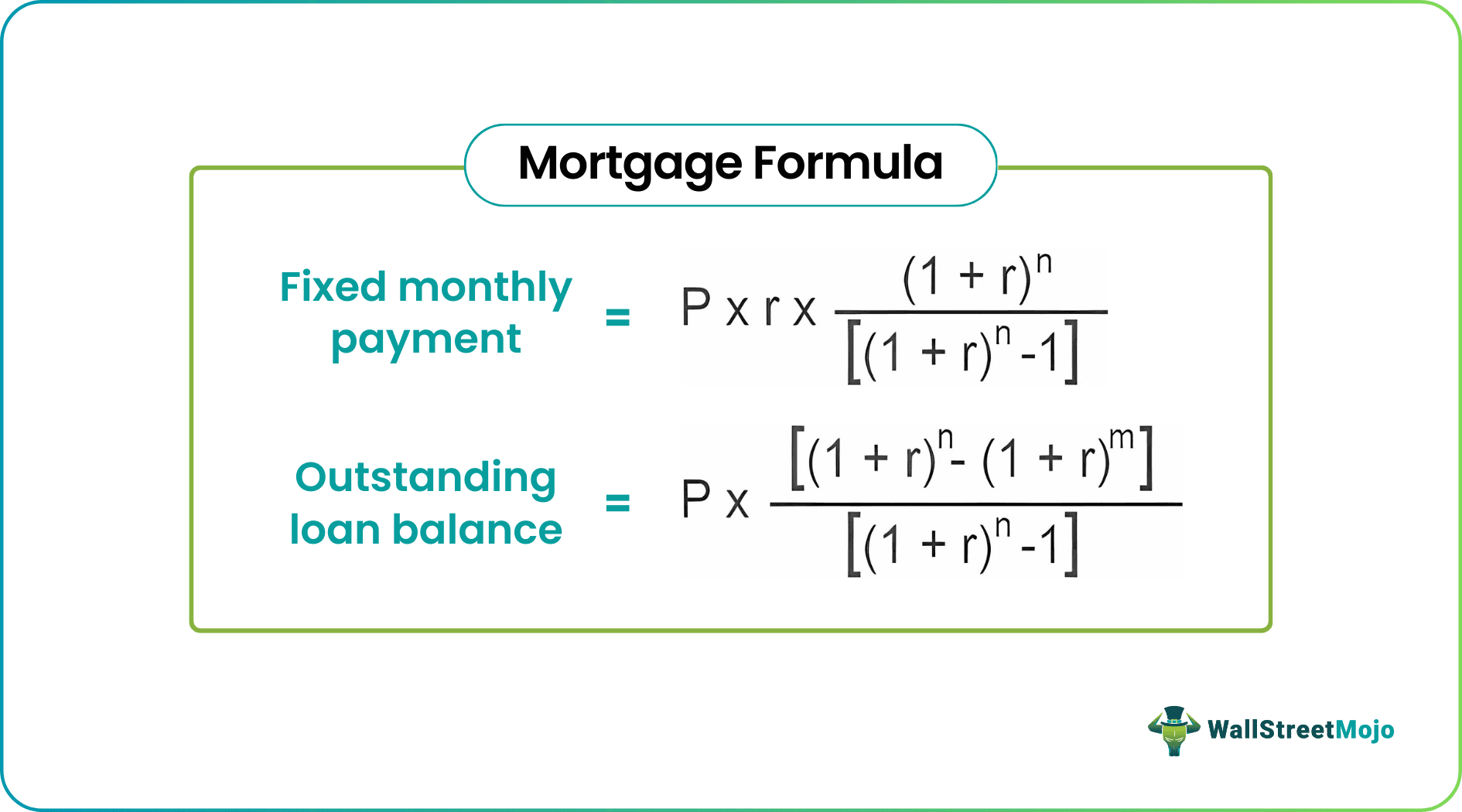
The standard formula for calculating monthly loan payments (for a fixed-rate, fully amortizing loan) is:
$text{M} = text{P} left[ frac{text{i}(1 + text{i})^n}{(1 + text{i})^n – 1} right]$
Where:
- M = Your monthly loan payment
- P = The principal loan amount (the initial amount borrowed)
- i = Your monthly interest rate (the annual interest rate divided by 12)
- n = The total number of payments over the loan’s lifetime (the loan term in years multiplied by 12)
Let’s dissect the variables to ensure correct input:
- Principal (P): This is straightforward – the initial amount of money you borrowed.
- Monthly Interest Rate (i): This is where many people make a common mistake. If your annual interest rate is, say, 6%, you cannot use 6 in the formula. You must first convert it to a decimal (6% = 0.06) and then divide it by 12 to get the monthly rate. So, for a 6% annual rate,
i = 0.06 / 12 = 0.005. - Total Number of Payments (n): This is the loan term in months. If you have a 5-year loan,
n = 5 years * 12 months/year = 60 payments. For a 30-year mortgage,n = 30 * 12 = 360 payments.
Step-by-Step Calculation Example
Let’s put the formula into action with a practical example:
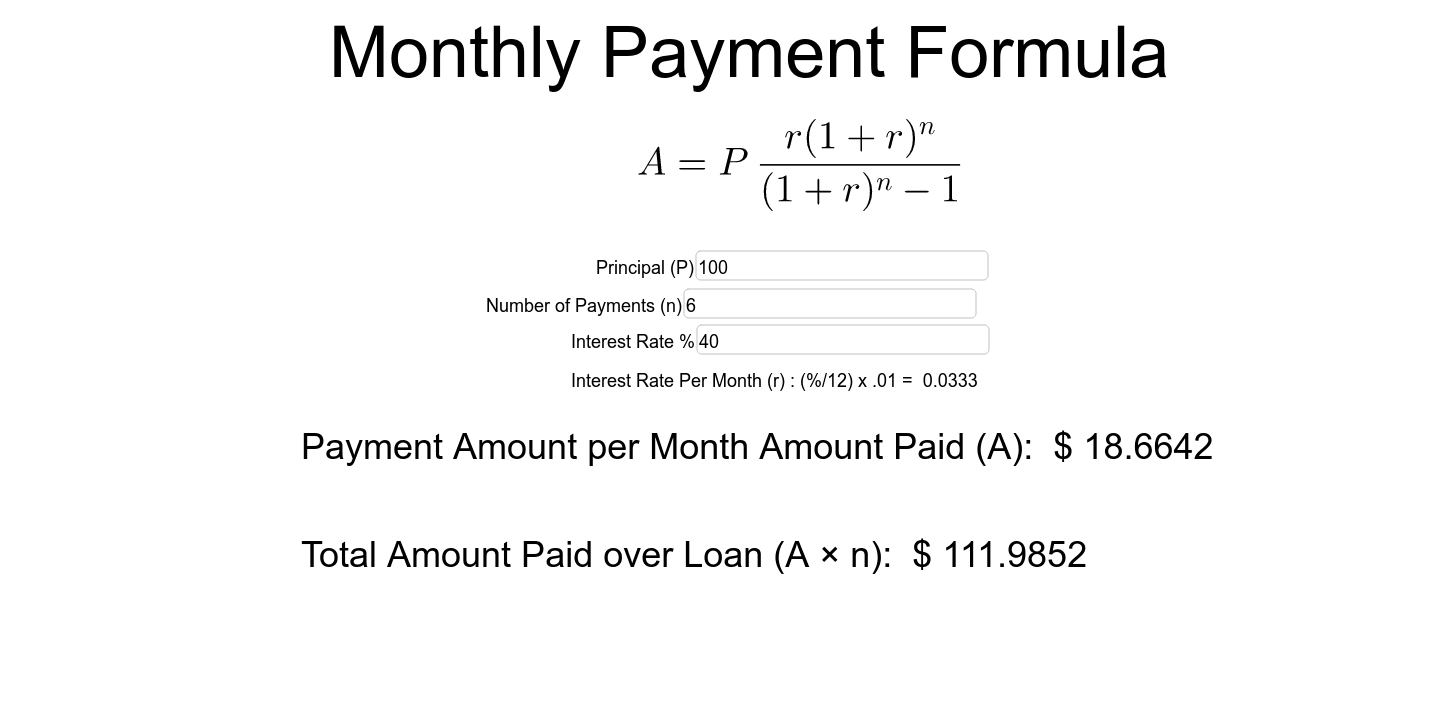
Imagine you take out a $15,000 personal loan with an annual interest rate of 7% over a 3-year term.
-
Identify P: P = $15,000
-
Calculate i (monthly interest rate):
- Annual rate = 7% = 0.07
- Monthly rate (i) = 0.07 / 12 = 0.00583333
-
Calculate n (total number of payments):
- Loan term = 3 years
- Total payments (n) = 3 years * 12 months/year = 36
-
Plug values into the formula:
$text{M} = 15000 left[ frac{0.00583333(1 + 0.00583333)^{36}}{(1 + 0.00583333)^{36} – 1} right]$
Let’s break down the calculation:
- First, calculate $(1 + i)^n$: $(1 + 0.00583333)^{36} = (1.00583333)^{36} approx 1.232938$
- Now, calculate the numerator: $0.00583333 * 1.232938 approx 0.007192$
- Then, calculate the denominator: $1.232938 – 1 = 0.232938$
- Divide the numerator by the denominator: $0.007192 / 0.232938 approx 0.030873$
- Finally, multiply by the principal: $15000 * 0.030873 approx 463.095$
So, your estimated monthly payment (M) would be approximately $463.10.
Using Online Calculators and Spreadsheets
While understanding the manual calculation is invaluable, performing it by hand every time can be cumbersome. Fortunately, many tools can do the heavy lifting for you:
- Online Loan Calculators: A plethora of free online calculators are available from banks, financial institutions, and independent finance websites. You simply input the principal, interest rate, and loan term, and they instantly provide the monthly payment, often with an amortization schedule showing how much principal and interest you pay each month.
- Spreadsheet Software (Excel/Google Sheets): For those comfortable with spreadsheets, the PMT function is incredibly useful. The syntax is
PMT(rate, nper, pv, [fv], [type]).rate: The monthly interest rate (e.g., 0.07/12 for 7% annual).nper: The total number of payments (e.g., 36 for a 3-year loan).pv: The present value or principal loan amount.[fv]: Future value (optional, typically 0 for a loan).[type]: When payments are due (optional, 0 for end of period, 1 for beginning).
Using our example:=PMT(0.07/12, 3*12, -15000)would yield approximately $463.10. Note the negative sign for the principal, as it’s an outflow of money for you.
Factors Influencing Your Monthly Payments and Total Cost
The amortization formula highlights the direct mathematical relationship between the loan’s core components and your monthly payment. However, it’s also critical to understand the real-world implications of each variable and how various external factors can influence them.
Impact of Interest Rates
Even a seemingly small difference in the interest rate can have a profound impact on both your monthly payment and the total amount of interest you pay over the loan’s lifetime. For instance, on a $300,000, 30-year mortgage:
- At 4% interest, the monthly payment is approximately $1,432, and total interest paid is around $215,600.
- At 5% interest, the monthly payment jumps to approximately $1,610, and total interest paid is around $279,600.
That 1% difference adds nearly $180 to your monthly payment and over $64,000 to the total cost of the loan! This underscores the importance of securing the lowest possible interest rate.
The Power of the Loan Term
As previously discussed, the loan term is a powerful lever. Opting for a shorter term, while increasing your monthly payment, dramatically reduces the total interest paid. Conversely, a longer term makes payments more manageable but significantly increases the overall cost.
For a $20,000 car loan at 6% APR:
- A 3-year term yields a monthly payment of about $608, with total interest around $1,890.
- A 5-year term lowers the monthly payment to about $387, but the total interest paid rises to approximately $3,230.
Choosing the right loan term involves balancing your current budget affordability with your long-term financial goals and tolerance for total interest paid.
Credit Score and Its Role
Your credit score is a numerical representation of your creditworthiness and financial reliability. Lenders use it to assess the risk of lending you money. A higher credit score (typically 700+) indicates a lower risk, making you eligible for more favorable loan terms, including lower interest rates. A lower credit score, on the other hand, signals higher risk, leading to higher interest rates and potentially making it harder to qualify for certain loans. Cultivating and maintaining a strong credit score is one of the most effective ways to reduce your loan costs.
Down Payments
For secured loans like mortgages and auto loans, a down payment is a lump sum paid upfront, directly reducing the principal amount you need to borrow. A larger down payment immediately lowers your principal, which in turn reduces your monthly payments and the total interest you’ll pay over the loan’s life. It also demonstrates financial stability to lenders, potentially qualifying you for better interest rates. For mortgages, a substantial down payment (e.g., 20%) can also help you avoid private mortgage insurance (PMI), which adds to your monthly housing costs.
Beyond the Calculation: Strategic Approaches to Loan Management
Calculating your monthly payment is an essential first step, but effective loan management extends beyond just knowing the number. Strategic actions can further optimize your financial health and reduce the burden of debt.
Making Extra Payments
Even seemingly small additional payments can have a significant impact on your loan. By paying more than your scheduled monthly amount, you directly reduce the principal balance. Since interest is calculated on the remaining principal, a lower principal means less interest accrues going forward. This accelerates the repayment process, shortens the loan term, and dramatically reduces the total interest paid over the life of the loan. Even an extra $50-100 per month can save thousands in interest and shave years off a long-term loan. Ensure your lender applies extra payments directly to the principal.
Refinancing Opportunities
Refinancing involves taking out a new loan to pay off an existing one, typically to secure more favorable terms. This could mean a lower interest rate, a shorter loan term, or a change from a variable to a fixed rate (or vice versa). Refinancing is particularly advantageous when interest rates have dropped since you took out your original loan, or if your credit score has significantly improved, making you eligible for better rates. While refinancing can reduce your monthly payments or total interest, it often comes with closing costs or fees, so it’s crucial to calculate if the savings outweigh these upfront expenses.
Understanding Amortization Schedules
An amortization schedule is a detailed table showing each scheduled loan payment broken down into its principal and interest components. In the early stages of an amortizing loan (like a mortgage), a larger portion of your monthly payment goes towards interest, with a smaller portion reducing the principal. As the loan matures, this ratio gradually reverses, with more of your payment going towards principal repayment. Reviewing your amortization schedule helps you visualize how your debt is being paid down and understand the true cost of interest over time. It can also be highly motivating to see how extra payments impact the principal balance and future interest.
Budgeting for Loan Payments
Integrating your loan payments into a comprehensive personal budget is paramount for financial stability. Treat loan payments as fixed, non-negotiable expenses, just like rent or utility bills. Ensure that your total debt obligations (including credit cards, personal loans, car loans, mortgages, etc.) do not consume an excessive portion of your income, typically aiming for less than 36% of your gross monthly income for total debt service. A well-structured budget provides clarity on your cash flow, helps you identify areas for savings, and ensures you have sufficient funds to meet all your financial obligations without stress.

Conclusion
Calculating monthly loan payments might initially seem daunting, but by understanding the core components – principal, interest rate, and loan term – and familiarizing yourself with the amortization formula, you gain invaluable insight into your financial commitments. Whether you choose to calculate manually, leverage an online tool, or utilize a spreadsheet, the knowledge of how these figures interrelate empowers you.
Beyond the raw numbers, strategic loan management, including making extra payments, considering refinancing, and diligently budgeting, can significantly impact your financial well-being. By taking an active, informed approach to understanding and managing your loans, you move from passively accepting financial obligations to actively shaping your financial future, leading to greater peace of mind and long-term economic stability. Empower yourself with this knowledge; it’s the first step towards mastering your money.
aViewFromTheCave is a participant in the Amazon Services LLC Associates Program, an affiliate advertising program designed to provide a means for sites to earn advertising fees by advertising and linking to Amazon.com. Amazon, the Amazon logo, AmazonSupply, and the AmazonSupply logo are trademarks of Amazon.com, Inc. or its affiliates. As an Amazon Associate we earn affiliate commissions from qualifying purchases.