
For anyone navigating the dynamic world of investing, understanding the operating hours of the stock market is not merely a logistical detail—it’s a fundamental aspect of strategic planning, risk management, and seizing timely opportunities. The question, “What time is the stock market open today?” is one that resonates with seasoned traders and nascent investors alike, underscoring the critical need to be aligned with the rhythms of global finance. This guide delves into the standard hours, exceptions, and the broader implications for your investment journey.
The Standard Operating Hours of Major US Stock Exchanges
The heart of the American equity market beats primarily through two major exchanges: the New York Stock Exchange (NYSE) and the Nasdaq Stock Market. While often discussed interchangeably, both follow a consistent schedule for their core trading sessions.
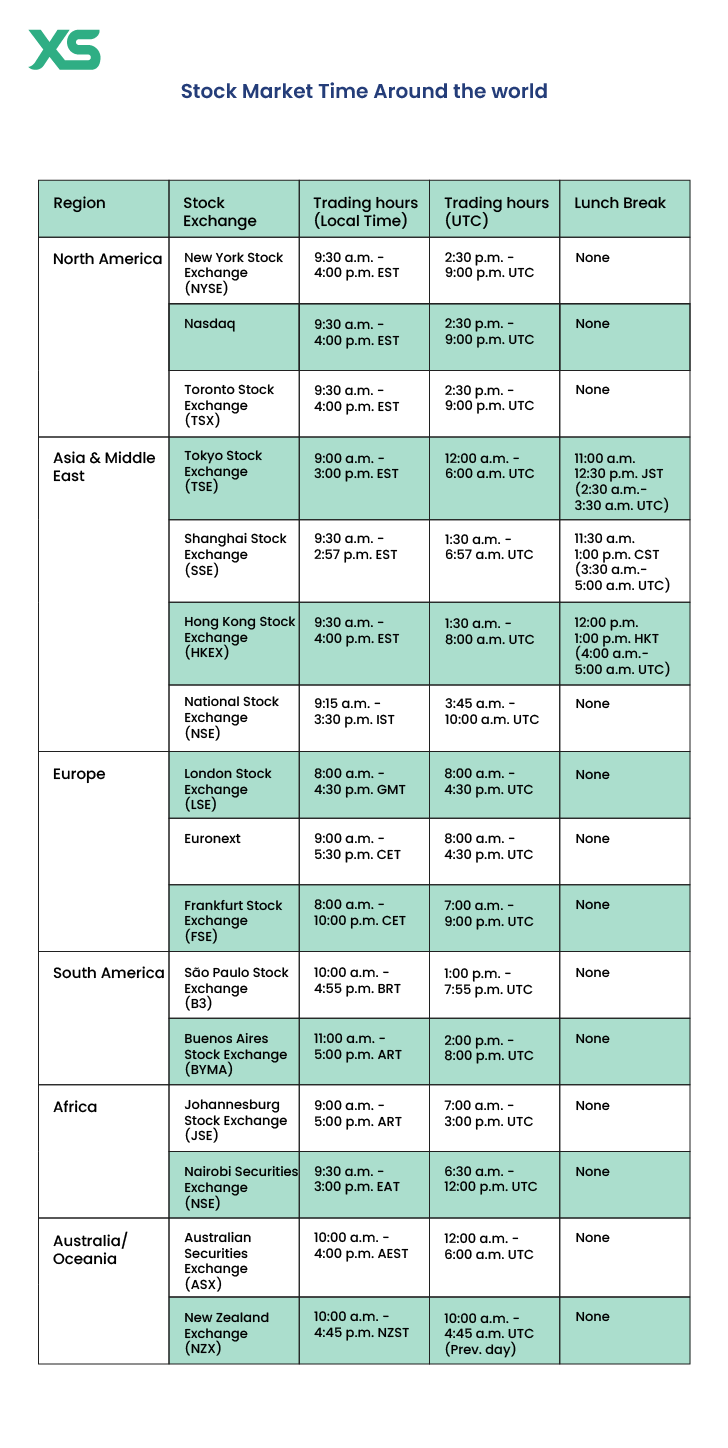
NYSE and Nasdaq: The Core Trading Session
For the vast majority of individual and institutional investors, the primary trading window for the US stock market is from 9:30 AM Eastern Time (ET) to 4:00 PM ET, Monday through Friday. This six-and-a-half-hour period represents the most liquid and active phase of the trading day. During these hours, millions of transactions occur, contributing to efficient price discovery and robust market participation.
The choice of Eastern Time (ET) is crucial. As the financial capital of the United States, New York City dictates the standard time zone for market operations. Investors situated in other time zones—whether in the Central, Mountain, or Pacific time zones within the US, or internationally—must always convert ET to their local time to accurately track market openings and closings. For instance, if you’re on the West Coast (Pacific Time), the market opens at 6:30 AM PT and closes at 1:00 PM PT.
These established hours are not arbitrary. They are designed to balance several critical factors:
- Maximize Liquidity: Concentrating trading activity within a defined window ensures a high volume of buyers and sellers, leading to tighter spreads and more efficient execution of orders.
- Global Synchronization: While primarily catering to US participants, these hours allow for some overlap with European markets’ closing hours and before Asian markets fully open, facilitating global financial flows.
- Operational Efficiency: The time outside core hours is utilized for data processing, clearing and settlement of trades, system maintenance, and preparing for the next trading day.
Pre-Market and After-Hours Trading: Extending the Day
While the 9:30 AM to 4:00 PM ET window defines the core session, the stock market’s activity isn’t strictly confined to these hours. Modern technology and global connectivity have introduced extended trading sessions, commonly known as pre-market and after-hours trading.
Pre-Market Trading typically begins as early as 4:00 AM ET and runs until the market officially opens at 9:30 AM ET. This period allows market participants to react to news, earnings reports, or global market movements that occur overnight or before the opening bell. For instance, a major company might release its quarterly earnings report at 7:00 AM ET, and investors can begin trading shares based on this information in the pre-market session.
After-Hours Trading commences immediately after the 4:00 PM ET close and can extend as late as 8:00 PM ET. Similar to pre-market, this session provides an opportunity for investors to respond to late-breaking news, analyst upgrades or downgrades, or other events that unfold after the regular trading day concludes.
However, it’s vital for investors to understand the distinct characteristics of these extended sessions:
- Lower Liquidity: Fewer participants means fewer buyers and sellers, which can lead to wider bid-ask spreads and difficulty in executing large orders without significantly impacting the price.
- Higher Volatility: The thinner trading volume can amplify price movements, making stocks more susceptible to dramatic swings based on even small orders or limited news.
- Institutional Dominance: While retail investors increasingly have access, these sessions are often dominated by institutional traders who have sophisticated tools and the capacity to absorb higher risks.
While extended hours offer flexibility, they also come with increased risks. Investors considering trading outside of regular hours should exercise caution and be fully aware of the potential for reduced liquidity and heightened volatility.
Navigating Time Zones and Global Markets
The question “What time is the stock market open today?” can quickly become complex when one considers the global nature of finance. For investors, understanding how time zones impact their local trading experience and appreciating the interconnectedness of international markets is paramount.
The Impact of Geographic Location on Your Trading Day
For investors within the United States, adapting to Eastern Time is a straightforward conversion. Someone in Chicago (Central Time) knows the market opens at 8:30 AM CT. A trader in Denver (Mountain Time) starts at 7:30 AM MT, and a West Coast investor in Los Angeles (Pacific Time) tunes in at 6:30 AM PT. Brokerage platforms and financial news sites typically display market hours in ET, requiring individual investors to make this mental adjustment.
However, the challenge significantly increases for international investors. An investor in London, for example, must account for a five-hour time difference (when New York is on Eastern Daylight Time, EDT). When the NYSE opens at 9:30 AM EDT, it’s 2:30 PM BST (British Summer Time) in London. The market’s close at 4:00 PM EDT means 9:00 PM BST. For investors in Asia or Australia, the time difference can mean trading opportunities occur in the middle of their night, necessitating strategic planning or reliance on automated trading systems. This dynamic highlights the truly 24/7 nature of global finance, even if individual exchanges have defined operating hours.
A Glimpse at International Market Hours
While this article primarily focuses on US market hours, it’s insightful to briefly consider how major global markets operate, as their movements can influence pre-market and early trading in the US.
- London Stock Exchange (LSE): Generally operates from 8:00 AM to 4:30 PM GMT/BST. Its opening often precedes the US market, and its activity can set the tone for European trading.
- Tokyo Stock Exchange (TSE): Typically runs from 9:00 AM to 3:00 PM JST (Japan Standard Time), with a lunch break. As the first major market to open each day (based on a global calendar), its performance can influence Asian and, subsequently, European and US sentiment.
- Shanghai Stock Exchange (SSE): Operates from 9:30 AM to 3:00 PM CST (China Standard Time), also with a lunch break. Its massive scale and influence on global commodities and manufacturing make its movements closely watched.
The staggered opening and closing of these major global exchanges create a continuous flow of trading activity around the clock. News and economic data released in one region can ripple across other markets, influencing investor sentiment and stock prices even before an exchange officially opens. This interconnectedness underscores the importance of a broader global awareness for serious investors.
When the Markets Close: Holidays and Special Circumstances
The regular 9:30 AM to 4:00 PM ET schedule is the norm, but there are crucial exceptions that every investor must be aware of. Market closures, whether for holidays or unforeseen events, can impact liquidity, trading strategies, and access to capital.
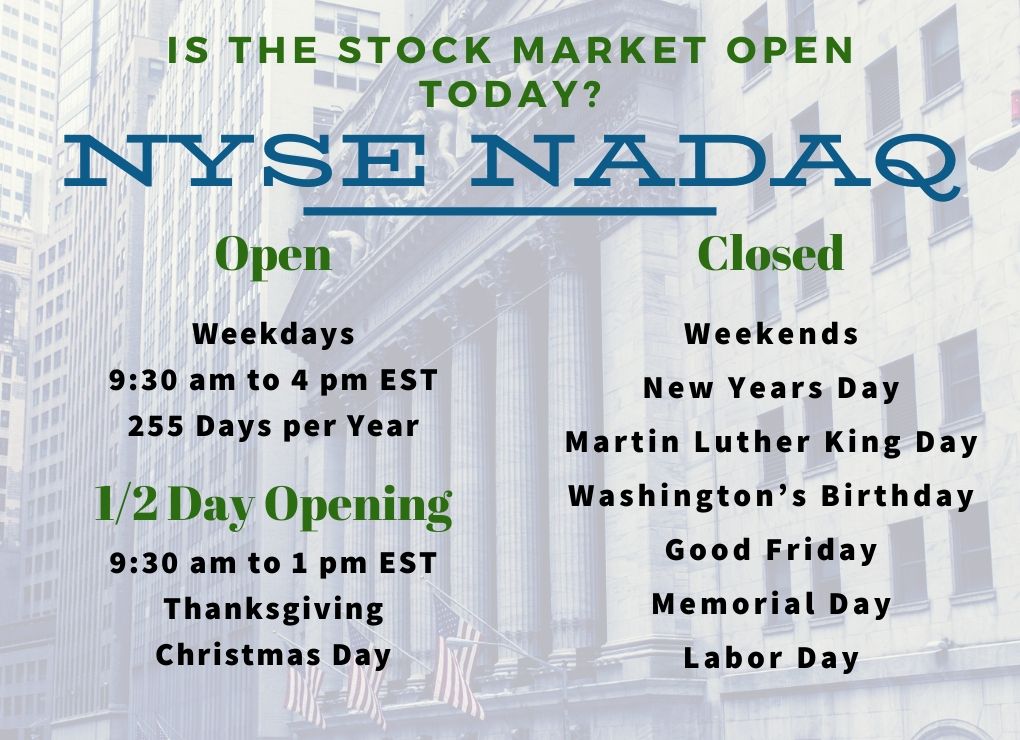
Understanding Market Holidays
US stock markets observe a number of national holidays, during which they remain closed for the entire day. These closures are typically predetermined and published well in advance by the exchanges. Key market holidays include:
- New Year’s Day (January 1st)
- Martin Luther King, Jr. Day (Third Monday in January)
- Presidents’ Day (Third Monday in February)
- Good Friday (Varies, usually March or April)
- Memorial Day (Last Monday in May)
- Juneteenth National Independence Day (June 19th)
- Independence Day (July 4th)
- Labor Day (First Monday in September)
- Thanksgiving Day (Fourth Thursday in November)
- Christmas Day (December 25th)
It’s important to note that if a holiday falls on a weekend, the market closure may be observed on the preceding Friday or the following Monday. For instance, if Christmas Day falls on a Saturday, the market might be closed on Friday, December 24th. Additionally, some holidays might entail an “early close” rather than a full closure, such as on the day after Thanksgiving (Black Friday) or Christmas Eve if it falls on a weekday. On these early-close days, the market often shuts down at 1:00 PM ET.
Diligent investors always check the official holiday schedule published by the NYSE and Nasdaq at the beginning of each year. Failing to do so can lead to missed trading opportunities or, more critically, an inability to manage positions or access funds when needed.
Early Closures and Market Interruptions
Beyond scheduled holidays, there are rare instances of early closures or even temporary halts due to special circumstances. While less frequent, these events are significant when they occur:
- Thanksgiving Eve / Christmas Eve: As mentioned, these days often feature an early close at 1:00 PM ET, allowing market participants to begin their holiday celebrations.
- Circuit Breakers: In periods of extreme market volatility, “circuit breakers” can be triggered. These are pre-defined thresholds that, if crossed, lead to temporary market-wide trading halts (e.g., 15 minutes) or even a full-day closure in severe cases (though this is extremely rare). Circuit breakers are designed to slow down panic selling or buying and allow market participants to absorb information before trading resumes.
- Unforeseen Events: Historically, markets have closed or seen shortened hours due to significant unforeseen events, such as national tragedies (e.g., September 11th attacks), severe weather, or major technical disruptions. While these are exceptional, they underscore the need for investors to remain adaptable and informed.
Staying updated through reliable financial news sources and checking your brokerage’s announcements is crucial, especially during holiday seasons or times of heightened global uncertainty.
Why Market Hours Matter to Investors
Understanding stock market hours extends far beyond merely knowing when you can place a trade. It profoundly influences liquidity, risk management, strategic decision-making, and ultimately, investment outcomes.
Liquidity and Price Discovery
The regular market hours (9:30 AM to 4:00 PM ET) are when liquidity is at its peak. With the broadest participation from retail investors, institutional funds, market makers, and high-frequency trading firms, there are ample buyers and sellers for most securities. This high liquidity ensures:
- Tighter Spreads: The difference between the highest bid price and the lowest ask price (the bid-ask spread) is typically narrowest during regular hours, leading to more efficient execution of trades.
- Efficient Price Discovery: The constant flow of orders and information during peak hours allows for stock prices to accurately reflect all available public information, leading to what is often considered a “fairer” market price.
- Reduced Slippage: For larger orders, high liquidity means a greater chance of executing the entire order at or very close to the desired price, minimizing “slippage”—the difference between the expected price of a trade and the price at which the trade is actually executed.
Outside of these core hours, especially in pre-market and after-hours trading, liquidity can be significantly lower. This can result in wider spreads, higher volatility, and a greater risk of price manipulation or unexpected price movements.
Risk Management and Information Flow
Market hours are integral to effective risk management. Investors need to consider:
- Managing Positions: If you hold a volatile stock, knowing the market hours allows you to decide whether to exit a position before the close, especially if significant news is expected overnight. Conversely, if you want to enter a new position based on an after-hours announcement, you must assess the risk of trading in a less liquid environment.
- Impact of News Releases: Major corporate announcements, economic data, or geopolitical developments often occur outside of regular trading hours. This allows market participants to digest the information before the next trading session begins. However, it also means that the opening bell can be accompanied by significant price gaps as the market attempts to “catch up” with the overnight news. Investors must be prepared for this potential volatility.
- Staying Informed: The financial world never truly sleeps. Being aware of major international market movements, commodity price changes, or significant news events that occur while US markets are closed is critical for anticipating potential impacts on your portfolio when trading resumes.
Strategic Trading and Investing Decisions
Different market phases present unique opportunities and challenges that can inform strategic decisions:
- Regular Session Trading: Ideal for most investors due to high liquidity and efficient pricing. Best for executing larger orders and relying on established technical and fundamental analysis.
- Pre-Market/After-Hours Trading: Can be advantageous for traders looking to capitalize on immediate reactions to news events before the broader market adjusts. However, it requires a higher risk tolerance and a clear understanding of reduced liquidity. These sessions are often used by institutions or experienced day traders.
- Overnight Holds: For long-term investors, market hours might seem less critical, but understanding when news breaks or when markets might be closed due to holidays is essential for managing portfolio exposure and being prepared for the next trading day’s open.
- Global Diversification: For those with internationally diversified portfolios, managing positions requires a sophisticated understanding of multiple market hours across different time zones.
In essence, market hours are a framework within which supply and demand interact most effectively. An informed investor not only knows these hours but also understands the dynamics of each trading phase, allowing them to make more strategic and risk-aware decisions.

Conclusion
The seemingly simple question, “What time is the stock market open today?”, unlocks a complex tapestry of operational mechanics, strategic considerations, and risk factors that every investor must master. The core trading hours of 9:30 AM to 4:00 PM ET form the backbone of US equity markets, providing the liquidity and efficiency necessary for robust price discovery. However, the extended sessions of pre-market and after-hours trading, coupled with the crucial understanding of market holidays and special closures, paint a more complete picture of the investment landscape.
For investors aiming for success, diligence in knowing the daily schedule, factoring in time zone differences, and preparing for planned and unplanned closures is not optional—it’s foundational. By staying informed and understanding the unique characteristics of each trading period, you can better manage risk, capitalize on opportunities, and ultimately navigate the intricate currents of the financial markets with greater confidence and strategic foresight. The clock is always ticking in the world of finance; knowing its schedule is your first step towards informed investing.
aViewFromTheCave is a participant in the Amazon Services LLC Associates Program, an affiliate advertising program designed to provide a means for sites to earn advertising fees by advertising and linking to Amazon.com. Amazon, the Amazon logo, AmazonSupply, and the AmazonSupply logo are trademarks of Amazon.com, Inc. or its affiliates. As an Amazon Associate we earn affiliate commissions from qualifying purchases.