
Navigating the complexities of tax obligations is a fundamental aspect of personal and business finance. When it comes to fulfilling your responsibilities to the Internal Revenue Service (IRS), understanding the available payment methods and processes is crucial for financial well-being and compliance. This guide delves into the various avenues for setting up payments with the IRS, offering strategic insights to manage your tax liabilities effectively and avoid unnecessary penalties. From direct electronic transfers to structured payment plans, the IRS provides several options designed to accommodate diverse financial situations.
Understanding Your IRS Payment Obligations
Before you can set up a payment, it’s essential to have a clear understanding of what you owe and why. This foundational step involves accurately identifying your tax liability and recognizing the critical deadlines that govern these payments. Missteps in this initial phase can lead to significant financial repercussions.
Identifying Your Tax Liability
Your tax liability stems from various sources, including income from wages, self-employment, investments, and capital gains. For most individuals, the primary obligation is income tax, calculated based on earnings and deductions reported on forms like the Form 1040. Self-employed individuals and those with significant income not subject to withholding (e.g., rental income, investment income) are also responsible for estimated taxes throughout the year. Businesses, depending on their structure, may owe payroll taxes, excise taxes, or corporate income taxes. It is paramount to review your completed tax forms and calculations meticulously, often with the assistance of tax software or a qualified professional, to ascertain the precise amount due. An accurate assessment is the first step towards a smooth payment process.
Key Due Dates and Penalties
The IRS operates on a strict calendar of due dates. For most individual taxpayers, the annual income tax deadline is April 15th (or the next business day if April 15th falls on a weekend or holiday). Estimated tax payments are typically due on April 15th, June 15th, September 15th, and January 15th of the following year. Missing these deadlines can trigger financial penalties, including interest on underpayments and additional fees for late payment. Even if you cannot pay the full amount by the due date, it is always advisable to file your tax return on time and pay as much as you can. Filing on time helps avoid the failure-to-file penalty, which is generally much steeper than the failure-to-pay penalty. Understanding these dates and their associated penalties empowers you to prioritize timely payments and mitigate potential financial setbacks.
Navigating Your IRS Payment Options
The IRS offers a variety of payment methods, each with its own advantages and considerations regarding convenience, security, and potential costs. Selecting the right option depends on your financial situation, the amount you owe, and your preference for electronic versus traditional transactions.
Direct Pay from Your Bank Account
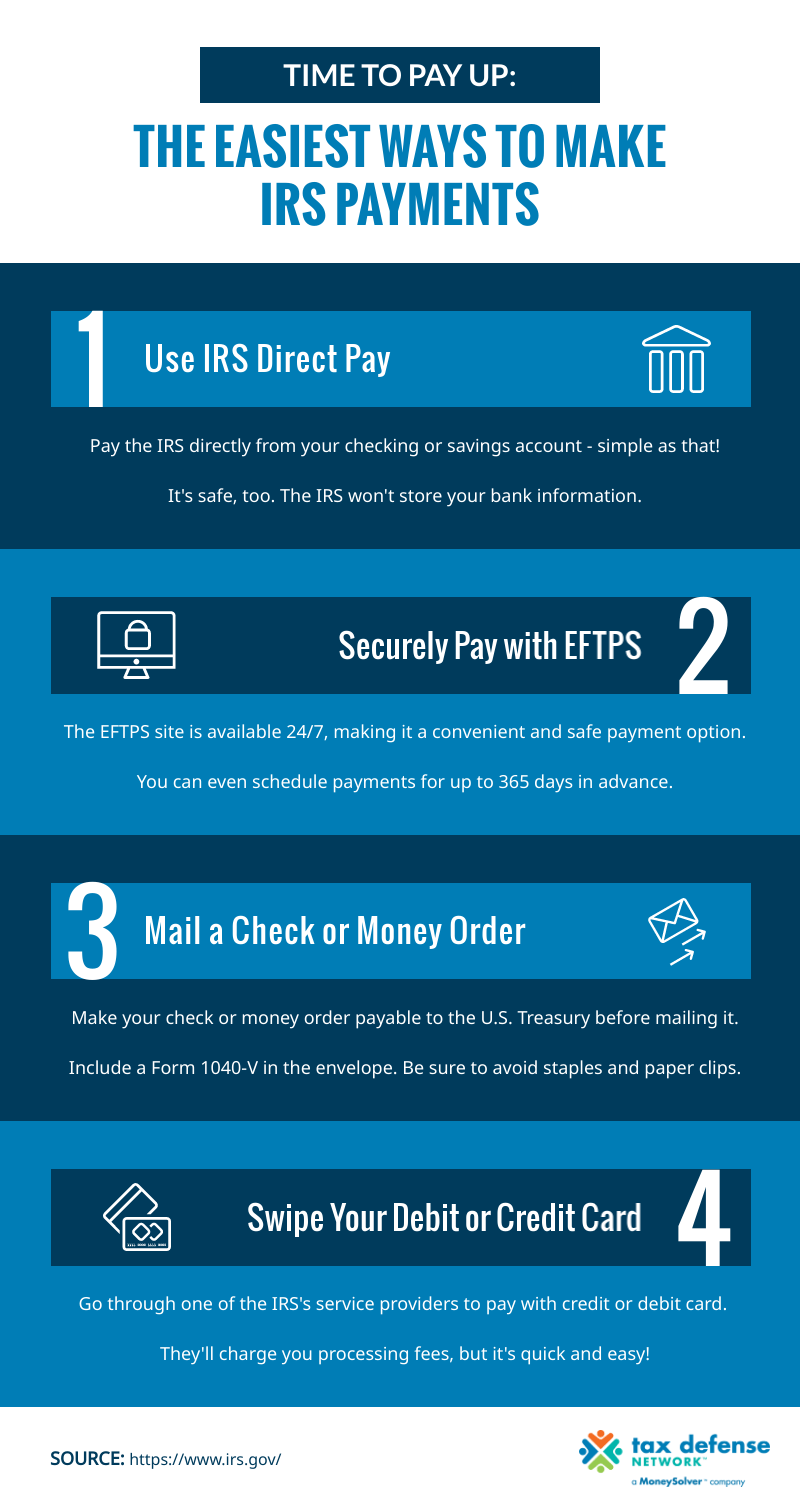
IRS Direct Pay is a free, secure, and convenient way to pay your taxes directly from your checking or savings account. This service allows you to schedule payments up to 365 days in advance, providing flexibility in managing your finances. You can use Direct Pay for various tax forms, including Form 1040 income tax, estimated tax payments, and some business taxes. To use this service, you’ll need basic information to verify your identity, such as your filing status, name, address, and date of birth, along with your Adjusted Gross Income (AGI) from a prior-year tax return. Once a payment is submitted, you receive an immediate confirmation number, which should be retained for your records. This method eliminates the need for checks, postage, and the associated processing delays, making it a highly recommended option for most taxpayers.
Debit Card, Credit Card, or Digital Wallet
For those who prefer the convenience of plastic or digital transactions, the IRS facilitates payments through authorized third-party payment processors. While the IRS itself does not charge a fee for these transactions, the processors do impose a convenience fee, which varies based on the processor and the type of card or digital wallet used. This method can be advantageous for individuals seeking to earn credit card rewards points or who require a short-term deferral of payment via their credit card statement. However, taxpayers should carefully weigh the convenience fees against potential rewards and interest charges if the credit card balance isn’t paid off promptly. Accepted payments include federal income tax, estimated taxes, and various business taxes.
Electronic Federal Tax Payment System (EFTPS)
The Electronic Federal Tax Payment System (EFTPS) is primarily designed for business taxpayers to make federal tax payments electronically, though individuals can also enroll. This system requires prior enrollment and typically takes a few days to set up. Once registered, taxpayers can schedule payments for up to 365 days in advance and review their payment history. EFTPS is particularly useful for businesses that make frequent tax payments, such as payroll taxes (Forms 941, 940) or estimated corporate income taxes. It offers a secure, reliable, and free method for electronic payments, providing robust tracking and confirmation features. Planning ahead for enrollment is key to utilizing this system effectively.
Check, Money Order, or Cashier’s Check
Traditional payment methods, such as mailing a check, money order, or cashier’s check, remain viable options for taxpayers. When paying by mail, it is crucial to make the check or money order payable to the “U.S. Treasury.” You must also write your name, address, daytime phone number, Social Security number (or Employer Identification Number for businesses), the tax year, and the related tax form or notice number on the check or money order. Mailing the payment along with a payment voucher (if applicable, such as Form 1040-V) ensures it is correctly processed. Always use the correct mailing address provided in your tax instructions or on IRS.gov for your specific type of payment. While less immediate than electronic options, this method is useful for those without bank accounts or who prefer paper transactions, though it lacks the instant confirmation of digital payments.
Cash Payments
While the IRS does not accept cash payments directly at its offices, taxpayers can make cash payments through retail partners like 7-Eleven, Family Dollar, and CVS Pharmacy, utilizing the PayNearMe service. To do this, you must first obtain a payment barcode from the IRS website or through a notice. You present this barcode at a participating retail location, along with your cash payment. The retailer will process the payment, and you will receive a receipt. There may be a small fee charged by the retail partner for this service. This option caters to individuals who primarily deal in cash or prefer not to use electronic methods, offering a secure way to convert cash into a trackable tax payment.
Strategic Considerations Before You Pay
Making a tax payment involves more than just selecting a method; it requires careful attention to detail and proactive planning to ensure accuracy and proper credit. Overlooking these strategic considerations can lead to processing delays, misapplication of payments, or even further penalties.

Verify Information and Accuracy
Before finalizing any payment, thoroughly verify all details. This includes the payment amount, the tax year to which the payment applies, and your identifying information (Social Security Number or Employer Identification Number). A common mistake is applying a payment to the wrong tax year or using an incorrect SSN, which can result in the payment not being credited to your account and the IRS assessing penalties for non-payment. If you are using an online payment system, double-check that the bank account or credit card information is correct. This meticulous review process can save you considerable time and frustration in rectifying errors later.
Plan for Processing Times
Each payment method has a different processing timeline. Electronic payments, such as IRS Direct Pay or EFTPS, are generally processed the same day or within one to two business days, providing the quickest way to ensure your payment is recorded by the due date. Payments made by debit or credit card through third-party processors are also typically processed quickly. However, mailed checks or money orders can take several days to arrive and be processed, especially during peak tax season. Factor these processing times into your payment strategy, especially when approaching a deadline. Sending a mailed payment close to the due date increases the risk of it being considered late, incurring penalties.
Maintaining Accurate Records
Robust record-keeping is a cornerstone of sound financial management, particularly concerning tax payments. For electronic payments, always save the confirmation number provided. For mailed payments, retain a copy of the check or money order, and note the date it was sent. If paying cash through a retail partner, keep the physical receipt provided. Additionally, maintain copies of all tax forms, notices, and any correspondence with the IRS. These records serve as critical proof of payment in case of discrepancies or audits. Organizing these documents, whether digitally or in physical folders, ensures that you can quickly retrieve them if questions about your tax obligations or payments arise in the future.
What If You Can’t Pay On Time? IRS Payment Plans
Financial difficulties can sometimes prevent taxpayers from meeting their tax obligations by the due date. The IRS understands these challenges and offers several options for taxpayers who cannot pay their taxes in full, helping them avoid enforced collection actions and manage their debt more effectively.
Short-Term Payment Plan
If you expect to be able to pay your tax liability within a short period, the IRS may grant you a short-term payment plan, typically up to 180 days. While this option provides a temporary reprieve, interest and penalties continue to accrue during this period. You can request a short-term payment plan directly through the IRS website, by phone, or by mail. This plan is ideal for those who anticipate receiving funds (e.g., a bonus, a specific receivable) that will cover their tax debt within a few months, allowing them to avoid the complexities of a long-term agreement.
Installment Agreement
For taxpayers who need more time to pay off their debt, an installment agreement allows you to make monthly payments for up to 72 months. This option is available if you owe a combined total of under $50,000 (for individuals) or $25,000 (for businesses) in tax, penalties, and interest. While an installment agreement does reduce certain penalties, interest still accrues, albeit at a lower rate than if no agreement were in place. Setting up an installment agreement can often be done online through the IRS website, or by filing Form 9465, Installment Agreement Request. Establishing an installment agreement prevents the IRS from pursuing more aggressive collection actions, such as levies or liens, provided you adhere to the terms of the agreement.
Offer in Compromise (OIC)
An Offer in Compromise (OIC) allows certain taxpayers to resolve their tax liability with the IRS for a lower amount than what they originally owe. An OIC is generally considered when there is doubt as to collectibility, meaning the IRS believes you cannot pay the full amount of tax due, or when there is doubt as to liability, meaning you don’t believe you owe the full amount. This option is typically reserved for taxpayers experiencing significant financial hardship and who can demonstrate that paying the full amount would cause economic hardship. The application process for an OIC is rigorous, requiring detailed financial disclosures and often professional assistance to navigate Form 656, Offer in Compromise, and its accompanying forms.
Temporary Delay of Collection (Currently Not Collectible Status)
In cases of extreme financial hardship, where paying any amount would leave you unable to meet basic living expenses, the IRS may determine that your account is “Currently Not Collectible” (CNC). This means the IRS temporarily delays collection until your financial situation improves. While collection efforts are suspended, interest and penalties continue to accrue, and the IRS may periodically review your financial status to see if you are able to resume payments. This status is not an elimination of debt but a temporary deferral of collection, intended for situations where immediate payment would cause severe economic distress.
Confirming Your Payment and Record Keeping
After taking the crucial step of making your tax payment, the process isn’t truly complete until you’ve confirmed its successful application and securely stored your documentation. This final stage is vital for financial peace of mind and protection against future inquiries.
Post-Payment Verification
Once you’ve submitted a tax payment, especially if it was a significant amount or near a deadline, it’s prudent to verify that the IRS has received and correctly applied it. For electronic payments, the confirmation number you receive is your immediate proof. You can also check your bank or credit card statements to ensure the transaction has cleared. The IRS also offers an online account system where individual taxpayers can view their payment history, balance due, and tax records. For payments made by mail, patience is key, but if you don’t receive an acknowledgment or notice within a reasonable timeframe (typically several weeks), you may want to contact the IRS directly to inquire about the payment status. Proactive verification helps prevent issues from festering into larger problems.

Organize Your Financial Documents
Maintaining a meticulous system for all your financial documents, especially those related to tax payments, is a non-negotiable best practice. Keep digital and/or physical copies of all payment confirmations, canceled checks, bank statements showing tax payments, and any correspondence you’ve had with the IRS regarding your tax liability or payment arrangements. A well-organized record-keeping system allows for quick retrieval of information if you ever need to prove a payment, dispute a notice, or provide documentation during an audit. This habit not only safeguards your financial standing but also streamlines future tax preparation, reinforcing your ability to manage your financial obligations effectively and confidently.
aViewFromTheCave is a participant in the Amazon Services LLC Associates Program, an affiliate advertising program designed to provide a means for sites to earn advertising fees by advertising and linking to Amazon.com. Amazon, the Amazon logo, AmazonSupply, and the AmazonSupply logo are trademarks of Amazon.com, Inc. or its affiliates. As an Amazon Associate we earn affiliate commissions from qualifying purchases.