
Facing a tax bill you can’t pay in full by the deadline can be an incredibly stressful experience. Many taxpayers find themselves in this predicament due to unforeseen circumstances, financial hardship, or simply misjudging their tax liability throughout the year. The good news is that the Internal Revenue Service (IRS) understands these challenges and offers various payment options designed to help taxpayers resolve their outstanding tax debts without facing severe penalties or collection actions. Ignoring the problem will only make it worse; proactive communication and understanding your options are crucial.
This comprehensive guide will walk you through the process of applying for a payment plan with the IRS, outlining the different types of plans available, eligibility criteria, and the step-by-step application process. By taking control of your tax obligations, you can mitigate stress, avoid further penalties, and work towards financial stability.
Understanding IRS Payment Plans
When you owe the IRS money, but can’t pay it all at once, a payment plan allows you to make manageable monthly payments over time. This prevents the IRS from pursuing more aggressive collection actions like wage garnishments, bank levies, or property liens, which can severely impact your financial life.
What is an IRS Payment Plan?
An IRS payment plan is essentially an agreement between you and the IRS, allowing you to pay your tax debt, plus any accrued penalties and interest, over a specified period. The primary goal is to provide taxpayers with a structured way to pay off their liabilities without undue financial hardship. Entering into such an agreement demonstrates your willingness to comply with tax laws and can significantly improve your standing with the IRS. It’s an essential tool for maintaining financial peace of mind while fulfilling your civic duty.
Types of IRS Payment Plans
The IRS offers several types of payment arrangements, each suited to different financial situations and debt amounts. Understanding these options is the first step in choosing the right path for you.
Installment Agreement (IA)
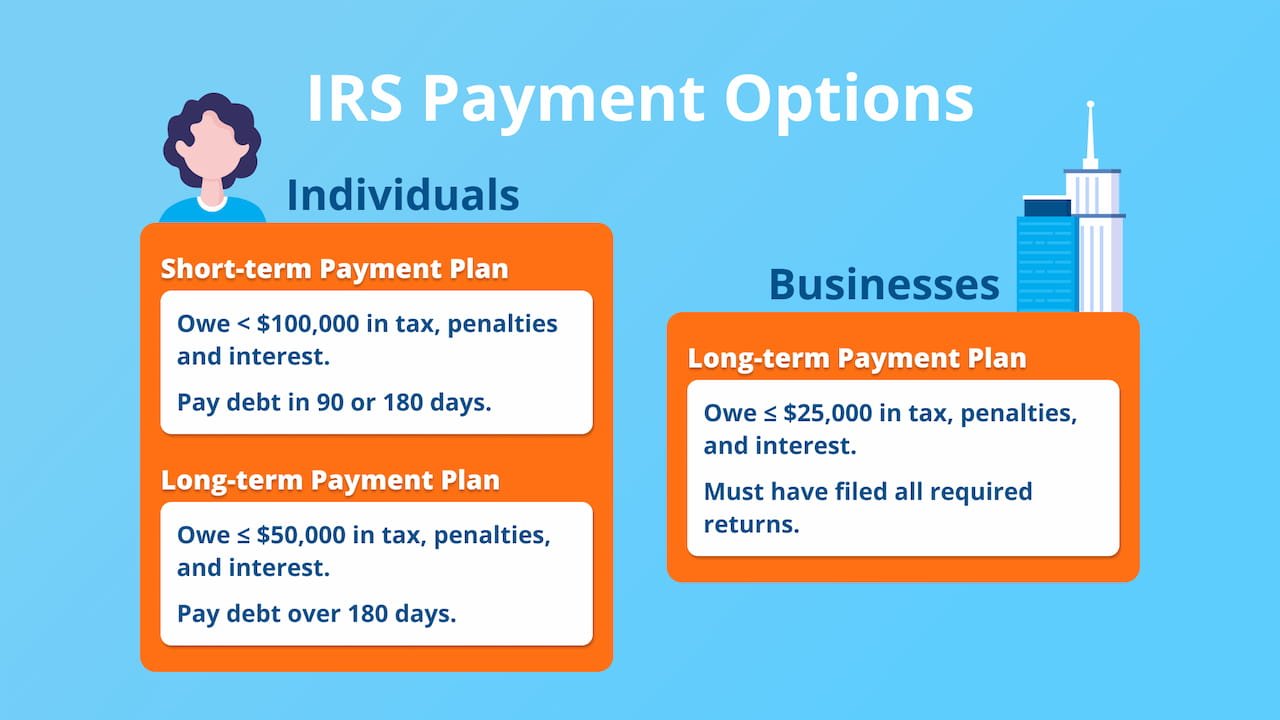
This is the most common and straightforward payment plan. An Installment Agreement allows taxpayers to make fixed monthly payments for up to 72 months (six years). It’s generally available to individuals who owe a combined total of under $50,000 (including tax, penalties, and interest) and businesses that owe under $25,000 in tax, penalties, and interest. To qualify, you must have filed all required tax returns and be current with your estimated tax payments or tax withholding for the current tax year. While an IA helps avoid more aggressive collection actions, interest and penalties continue to accrue, albeit at a reduced failure-to-pay penalty rate once the agreement is established.
Offer in Compromise (OIC)
An Offer in Compromise allows certain taxpayers to resolve their tax liability with the IRS for a lower amount than what they originally owe. An OIC is typically granted when there’s genuine doubt as to the collectibility of the debt, or when paying the full amount would create an economic hardship. The IRS considers your ability to pay, your income, expenses, and asset equity when evaluating an OIC. This option is generally for taxpayers in severe financial distress and is a more complex application process with a lower acceptance rate compared to an Installment Agreement. It’s usually considered a last resort when other payment options are not feasible.
Temporary Non-Collectibility (CNC)
If the IRS determines that you currently cannot pay any of your tax debt due to financial hardship, they may place your account in “Currently Not Collectible” status. This is a temporary measure, meaning the IRS agrees not to pursue collection efforts for a period, though interest and penalties will continue to accrue. The IRS will periodically review your financial situation, and if it improves, you will be expected to resume payments or enter into a formal payment plan. This option is typically for individuals with very limited income and no assets that could be used to pay the tax debt.
Eligibility and Pre-Application Considerations
Before you dive into the application process, it’s crucial to understand the prerequisites and gather all necessary information. Being prepared will streamline the process and increase your chances of approval.
Who Qualifies for an IRS Payment Plan?
While specific criteria vary slightly by the type of plan, general qualifications for an IRS payment plan, particularly an Installment Agreement, include:
- Filed All Required Tax Returns: You must be current with all your tax filings. The IRS will not approve a payment plan if you have outstanding tax returns from previous years.
- Current on Estimated Taxes/Withholding: For the current tax year, you must be up-to-date with your tax obligations, either through payroll withholding or estimated tax payments. This demonstrates your ongoing commitment to tax compliance.
- Total Amount Owed: For streamlined Installment Agreements, there are limits on the total amount you can owe (e.g., $50,000 for individuals, $25,000 for businesses). Debts exceeding these amounts may require a more detailed financial review.
- No Prior History of Default: While not always an absolute disqualifier, a history of defaulting on previous IRS payment plans can make approval more challenging and may require more stringent conditions.
Gather Your Information
Preparation is key. Before initiating contact with the IRS or submitting an application, ensure you have the following information readily available:
- Your Most Recent Tax Returns: Copies of your filed tax returns for all applicable years.
- Personal Identification: Your Social Security Number (SSN) or Individual Taxpayer Identification Number (ITIN). If applying jointly, your spouse’s information as well.
- Financial Statements: Recent bank statements (checking and savings), investment account statements.
- Income Details: Pay stubs, W-2s, 1099s, and any other documentation proving your current income.
- Expense Details: A detailed list of your monthly living expenses (housing, utilities, food, transportation, medical, insurance, etc.). Be prepared to provide supporting documentation if requested.
- Asset Information: Details about any assets you own, such as real estate, vehicles, and their current market values, along with any outstanding loans against them.
- IRS Notices: Any correspondence you’ve received from the IRS regarding your tax debt.
Having this information organized will not only help you accurately complete the application but also allow you to confidently discuss your financial situation if the IRS requires further clarification.
The Importance of Filing All Returns
It cannot be stressed enough: you must file all delinquent tax returns before the IRS will consider any payment plan. Even if you can’t pay the taxes owed, filing the returns is a non-negotiable first step. Failing to file can result in separate penalties, and the IRS will not negotiate payment terms if your tax liability is not fully established. If you need help filing past-due returns, consider consulting with a tax professional.
The Application Process: Step-by-Step
Once you’ve determined your eligibility and gathered your financial information, you’re ready to apply for a payment plan. The method you choose will depend on the type of plan and your specific circumstances.
Online Application (OPA) for Installment Agreements
For many taxpayers seeking an Installment Agreement, the fastest and easiest method is using the IRS’s Online Payment Agreement (OPA) application. This service is available 24/7 and allows eligible individuals to set up a short-term payment plan (up to 180 days) or a long-term Installment Agreement (up to 72 months).
- Who Can Use It: Individuals who owe a combined total of tax, penalties, and interest of $50,000 or less, and businesses that owe $25,000 or less. You must be able to make payments within 72 months.
- Process: Visit the IRS website and navigate to the OPA tool. You’ll need to verify your identity, provide your tax liability details, and propose a monthly payment amount. You can also set up direct debit payments from your bank account, which is often recommended as it can help avoid missed payments and may lower the user fee for setting up the agreement.
- Confirmation: If approved, you’ll receive immediate confirmation. The user fee for setting up the agreement is lower when applying online and choosing direct debit.
Application via Mail (Form 9465)

If you don’t qualify to use the OPA tool (e.g., you owe more than the specified limits, or prefer not to use online services), you can apply for an Installment Agreement by mail using Form 9465, Installment Agreement Request.
- Process: Complete Form 9465 accurately, providing your personal information, the amount you owe, and your proposed monthly payment amount. You’ll also need to indicate the date you want your payments to begin.
- Submission: Mail the completed Form 9465 with your tax return or to the address specified in the form instructions or IRS notice.
- IRS Review: The IRS will review your request. They may accept your proposed payment plan, suggest an alternative, or request additional financial information. Expect to receive a response within 30 days.
Applying for an Offer in Compromise (OIC)
Applying for an Offer in Compromise is a more extensive and complex process, generally requiring a detailed financial disclosure.
- Forms: To apply for an OIC, you’ll typically need to submit Form 656, Offer in Compromise, and Form 433-A (OIC), Collection Information Statement for Wage Earners and Self-Employed Individuals, or Form 433-B (OIC), Collection Information Statement for Businesses, along with supporting documentation.
- Evaluation: The IRS evaluates OICs based on “doubt as to collectibility” (can you truly pay the full amount?) or “effective tax administration” (would paying the full amount cause significant economic hardship?). This involves a thorough review of your income, expenses, assets, and ability to pay.
- Fees: A non-refundable application fee (unless you meet low-income guidelines) and an initial payment are typically required with your OIC submission.
- Complexity: Due to the complexity and low acceptance rate, many taxpayers opt to work with a qualified tax professional when pursuing an OIC.
Seeking Professional Assistance
For complex tax situations, large debts, or when navigating an Offer in Compromise, enlisting the help of a qualified tax professional (such as an Enrolled Agent, CPA, or tax attorney) can be invaluable. They can:
- Assess Your Situation: Help you understand your best payment options.
- Prepare Documentation: Ensure all forms are correctly filled out and all necessary financial information is submitted.
- Negotiate with the IRS: Act as your representative, communicating with the IRS on your behalf.
- Increase Success Rates: Their expertise can significantly improve the chances of your application being approved.
Managing Your Payment Plan
Getting approved for a payment plan is a significant step, but managing it effectively is equally important to avoid defaulting and incurring further penalties.
Adhering to the Agreement
Once your payment plan is in place, consistent and timely payments are paramount.
- Make Payments on Time: Missing payments can lead to the IRS defaulting your agreement, which can trigger more aggressive collection actions and the re-imposition of higher penalties.
- Set Reminders: Use calendar reminders, automatic bank payments, or the IRS Direct Debit option to ensure you never miss a due date.
- Maintain Compliance: Continue to file all future tax returns on time and pay any current year taxes by the due date. Failure to do so can also result in the termination of your payment plan.
Adjusting Your Plan
Life happens, and financial circumstances can change. If you find yourself unable to meet the terms of your existing payment plan, do not wait for the IRS to contact you.
- Contact the IRS Immediately: Reach out to the IRS as soon as possible to explain your situation.
- Request a Modification: You may be able to modify your payment amount, suspend payments temporarily, or explore other options. The IRS is often more lenient with taxpayers who communicate proactively.
- Provide Updated Financial Information: Be prepared to provide updated financial statements and explain how your circumstances have changed.
Penalties and Interest
It’s crucial to remember that even with an approved payment plan, interest and penalties will continue to accrue on your outstanding balance until it’s paid in full.
- Interest: Interest rates are set quarterly and compounded daily.
- Penalties: While the failure-to-pay penalty rate is reduced once an Installment Agreement is in place, it does not disappear.
- Minimizing Costs: The best way to minimize these additional costs is to pay off your tax debt as quickly as your financial situation allows. Consider making additional payments when possible or reviewing your budget for areas where you can free up funds.
Common Pitfalls and Best Practices
Navigating tax debt can be daunting, but avoiding common mistakes and adopting best practices can lead to a smoother resolution.
Don’t Ignore IRS Notices
One of the biggest mistakes taxpayers make is ignoring correspondence from the IRS. These notices contain vital information about your tax debt, potential penalties, and available options. Always open and read IRS letters carefully, and respond promptly to avoid escalating issues. Ignoring them will not make the problem go away; it will only worsen it.
Understanding Your Financial Situation Honestly
When applying for any payment plan, especially an OIC, being realistic and honest about your income, expenses, and assets is critical. The IRS has extensive resources to verify financial information. Providing inaccurate or misleading details can lead to delays, rejection of your application, or even accusations of fraud. Take the time to accurately assess your current financial standing before proposing any payment terms.
The Role of Tax Professionals
While many taxpayers can successfully apply for an Installment Agreement on their own, a tax professional can be an invaluable asset, especially when:
- The Debt is Significant: Large tax debts often involve more complex calculations and negotiation strategies.
- You’re Considering an OIC: OICs are intricate and require a deep understanding of IRS guidelines. A professional can help build a strong case and improve your chances of acceptance.
- You Have Multiple Years of Unfiled Returns: A professional can help you get caught up on filings while also strategizing on payment plans.
- You’re Overwhelmed or Stressed: A tax professional can alleviate the burden, handle communications, and provide peace of mind.
By working with an experienced professional, you gain an advocate who understands the nuances of tax law and can represent your best interests before the IRS.
Conclusion
Facing an unpayable tax bill can feel overwhelming, but the IRS offers clear pathways to resolve your debt through various payment plans. Whether it’s a straightforward Installment Agreement, a complex Offer in Compromise, or temporary non-collectible status, options exist to fit different financial situations. The key is to act proactively, understand your eligibility, meticulously gather your financial information, and choose the application method best suited for your circumstances.
Remember that while these plans provide relief, penalties and interest continue to accrue. Diligent adherence to your payment agreement and ongoing tax compliance are essential for successfully resolving your tax debt and preventing future issues. Don’t let tax debt paralyze you; take the initiative to communicate with the IRS, explore your options, and secure your financial future.
aViewFromTheCave is a participant in the Amazon Services LLC Associates Program, an affiliate advertising program designed to provide a means for sites to earn advertising fees by advertising and linking to Amazon.com. Amazon, the Amazon logo, AmazonSupply, and the AmazonSupply logo are trademarks of Amazon.com, Inc. or its affiliates. As an Amazon Associate we earn affiliate commissions from qualifying purchases.