
Facing an unexpected tax bill can be a daunting experience, particularly when immediate payment in full isn’t feasible. The Internal Revenue Service (IRS) understands that taxpayers sometimes encounter financial hardships that prevent them from meeting their obligations by the due date. Rather than ignoring the problem, which can lead to escalating penalties and interest, the most prudent course of action is to proactively engage with the IRS to establish a structured payment plan. This article will guide you through the process of understanding, selecting, and setting up an IRS payment plan, ensuring you navigate your tax debt responsibly and strategically.

Ignoring a tax debt does not make it disappear; instead, it compounds the problem with additional penalties and interest, and can even lead to more aggressive collection actions such as liens or levies. The IRS is generally willing to work with taxpayers who demonstrate a genuine effort to resolve their outstanding liabilities. Establishing a payment plan not only provides a manageable path to financial recovery but also offers a degree of peace of mind. By understanding the various options available and the steps involved in securing an agreement, you can transform a stressful financial burden into a structured, achievable goal.
Understanding Your IRS Payment Options
When you cannot pay your taxes in full, the IRS offers several different solutions designed to help taxpayers manage their debt. The key is to understand which option best fits your financial situation, as each comes with its own eligibility requirements, benefits, and potential drawbacks. Making an informed decision is crucial for long-term financial stability.
Short-Term Payment Plan
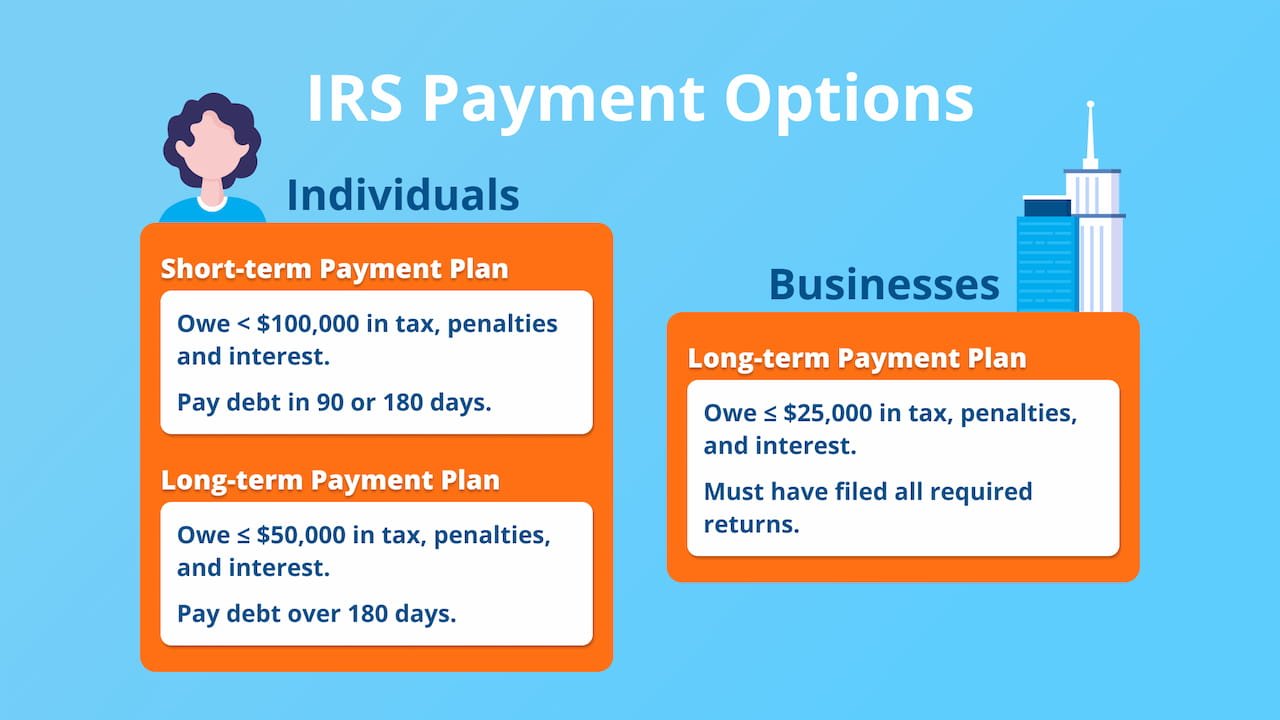
If you believe you can pay your full tax liability within 180 days, you might qualify for a short-term payment plan. This option grants you a temporary extension to pay your tax, but interest and penalties will continue to accrue until the balance is paid in full. It’s a useful bridge for those who anticipate receiving funds in the near future, perhaps from a bonus, a sale of property, or a maturing investment, and simply need a little more time. The advantage here is that it’s relatively easy to set up, often requiring just a phone call or an online request, and avoids the complexity of longer-term agreements. However, it’s essential to be realistic about your ability to pay within the timeframe, as failure to do so could lead to the IRS suggesting an Installment Agreement or pursuing other collection actions.
Offer in Compromise (OIC)
An Offer in Compromise (OIC) allows certain taxpayers to resolve their tax liability with the IRS for a lower amount than what they originally owe. The IRS considers an OIC if there’s doubt as to collectibility, meaning they believe you cannot pay the full amount due, or if there’s doubt as to liability, meaning you don’t believe you owe the tax in the first place. Another basis is effective tax administration, where collecting the full amount would cause significant economic hardship or would be unfair and inequitable. This option is generally reserved for situations of significant financial distress.
To qualify for an OIC, the IRS will evaluate your ability to pay, your income, expenses, and asset equity. They want to ensure that accepting a lower amount is in the best interest of both the taxpayer and the government. While an OIC can offer substantial relief, it’s a complex process that often requires detailed financial documentation and can take a considerable amount of time to be approved. Many taxpayers seek professional assistance from tax attorneys or Enrolled Agents when pursuing an OIC due to its intricate nature and low acceptance rate. It’s not a guaranteed solution, but for those who genuinely cannot afford to pay their full tax debt, it presents a vital opportunity.
Currently Not Collectible (CNC) Status
In extreme cases of financial hardship, the IRS may determine that you are Currently Not Collectible (CNC). This means the IRS has agreed that you do not have the ability to pay any of your tax debt at this time. While your account is in CNC status, the IRS will stop collection efforts, such as sending notices or pursuing levies. However, this is not a permanent solution, nor does it forgive the debt. Interest and penalties continue to accrue, and the IRS will periodically review your financial situation (typically annually) to see if your circumstances have improved.
To be placed in CNC status, you’ll need to provide comprehensive financial information, including income, expenses, assets, and liabilities, demonstrating that you cannot meet basic living expenses while also making tax payments. The IRS will conduct a thorough analysis, and if approved, it offers a temporary reprieve from active collection. It’s important to note that while in CNC status, any future tax refunds you are due will typically be applied to your outstanding tax liability. This option is typically considered a last resort before more drastic measures and is best explored with the guidance of a tax professional.
Installment Agreement (IA)
The most common and accessible payment plan offered by the IRS is the Installment Agreement (IA). An IA allows you to make monthly payments for up to 72 months (six years) to pay off your tax liability. This option is available to taxpayers who owe a combined total of $50,000 or less in tax, penalties, and interest, or businesses that owe $25,000 or less and have filed all required tax returns. It’s considered a “streamlined” option, meaning it’s generally easier to qualify for compared to an OIC, and the IRS typically won’t require detailed financial statements unless your debt exceeds these thresholds.
While an Installment Agreement makes your payments more manageable, interest and penalties continue to apply until the balance is paid in full. However, the failure-to-pay penalty is often reduced once an Installment Agreement is in place. The main benefit is that it prevents the IRS from taking more aggressive collection actions, such as placing a lien on your property or levying your bank accounts or wages, as long as you adhere to the terms of the agreement. It provides a structured, predictable path out of tax debt, making it a cornerstone of effective financial planning for those with outstanding tax obligations.
Eligibility and Application for an Installment Agreement
Understanding the general options is one thing, but knowing if you specifically qualify and how to apply for an Installment Agreement is critical for moving forward. The process is designed to be relatively straightforward for the majority of taxpayers, particularly for those with smaller debts.
Who Qualifies for an Installment Agreement?
As mentioned, individuals generally qualify for a streamlined Installment Agreement if they owe $50,000 or less in combined tax, penalties, and interest, and businesses qualify if they owe $25,000 or less. A crucial prerequisite for both individuals and businesses is that all required tax returns must be filed. Even if you cannot pay, filing your returns on time or requesting an extension for filing is paramount. The IRS will not approve an Installment Agreement if you have unfiled tax returns. Furthermore, you must agree to pay off the balance within 72 months (six years). If your debt exceeds these thresholds, you can still apply for an Installment Agreement, but the IRS will likely require a more detailed financial statement (Form 433-F or 433-A) to determine your ability to pay.
Gathering Necessary Information
Before applying, gather all relevant documentation. This typically includes:
- Your Social Security Number (SSN) or Individual Taxpayer Identification Number (ITIN).
- Your date of birth.
- Your address.
- The IRS notice number or letter number (if you’ve received one).
- The amount you owe.
- The amount you can pay monthly.
- Your banking information if you plan to make payments via direct debit.
For non-streamlined agreements (debt exceeding the thresholds), you’ll also need comprehensive financial data, including income from all sources, expenses (housing, utilities, transportation, food, medical, etc.), and details of all assets (bank accounts, investments, real estate, vehicles) and liabilities (mortgages, loans, credit cards). Being prepared with this information will expedite the application process.
How to Apply
There are several ways to apply for an Installment Agreement:
-
Online Payment Agreement (OPA) Application: For individuals who owe $50,000 or less, or businesses that owe $25,000 or less, the quickest and easiest way is often through the IRS’s Online Payment Agreement application. This allows you to set up a monthly payment plan directly through their website. You’ll typically receive an immediate response regarding approval.
-
By Mail (Form 9465): You can request an Installment Agreement by filling out Form 9465, Installment Agreement Request, and attaching it to your tax return or mailing it separately to the IRS office where you filed your return. This method takes longer for processing and approval.
-
By Phone: You can call the IRS directly to discuss your options and potentially set up an Installment Agreement. The general IRS toll-free number for individuals is 1-800-829-1040, and for businesses, it’s 1-800-829-4933. Be prepared for potentially long wait times, especially during peak tax season.
- Through a Tax Professional: A tax attorney, Enrolled Agent, or Certified Public Accountant (CPA) can help you navigate the process, communicate with the IRS on your behalf, and ensure you submit all necessary documentation correctly. This is particularly advisable for more complex situations or larger debts.
Fees and Interest
When you enter into an Installment Agreement, there are usually fees associated with the setup. The exact fee can vary depending on whether you apply online, by phone, or by mail, and whether you opt for direct debit payments (which often come with a lower fee). For instance, setting up an agreement online with direct debit is typically less expensive than by mail without direct debit. Low-income taxpayers may qualify for a reduced fee.
It’s crucial to remember that interest and penalties continue to accrue on your unpaid balance, even with an Installment Agreement in place, though the failure-to-pay penalty rate may be reduced. The interest rate is the federal short-term rate plus 3 percentage points, and it can adjust quarterly. Therefore, while an IA provides payment flexibility, it doesn’t eliminate the cost of carrying tax debt. Paying off your debt as quickly as possible remains the most financially prudent strategy.
Navigating the Installment Agreement Process
Once you’ve applied for an Installment Agreement, understanding what happens next and how to manage the agreement is vital to avoid future complications. This ongoing management ensures you remain in good standing with the IRS and successfully resolve your tax debt.
Understanding Your Monthly Payment
The IRS will calculate your minimum monthly payment based on the total amount you owe and the length of the agreement (up to 72 months). For streamlined agreements, this calculation is typically straightforward. However, for non-streamlined agreements, the IRS will review your financial information to determine your “reasonable collection potential,” which considers your disposable income after essential living expenses. You might propose a monthly payment you believe you can afford, but the IRS has the final say in approving the amount. It’s important to set a payment you can consistently make without further straining your finances.
What Happens After Approval?
Upon approval of your Installment Agreement, you will receive a confirmation letter from the IRS detailing the terms of the agreement, including your monthly payment amount, due date, and total balance. It’s critical to review this letter carefully and understand all the conditions. You are then expected to make your payments consistently and on time.
In addition to making your monthly payments, a critical condition of an Installment Agreement is that you must remain compliant with all future tax obligations. This means:
- Filing all future tax returns on time: Even if you can’t pay the new tax due, you must file.
- Paying any new tax liabilities in full by the due date: If you incur new tax debt and don’t pay it, you could default on your Installment Agreement.
- Making estimated tax payments or adjusting your withholding: This is crucial to prevent future tax liabilities from building up again.
Consequences of Defaulting
Defaulting on an Installment Agreement carries significant consequences. A default occurs if you:
- Fail to make a payment on time.
- Miss a payment.
- Fail to file a future tax return.
- Fail to pay any new tax liability by its due date.
If you default, the IRS may terminate your Installment Agreement, and the full remaining balance of your tax debt could become immediately due. The IRS can then resume more aggressive collection actions, including issuing levies on your bank accounts or wages, or placing liens on your property. They may also send you a notice of intent to levy or terminate the agreement. Reinstating an agreement after default is possible but often requires additional fees and a more stringent review of your financial situation.
Modifying or Terminating Your Agreement
Life circumstances can change, and your financial situation might improve or worsen. If you find you can no longer afford your current monthly payment, or if you wish to pay off your debt faster, you can request to modify your Installment Agreement.
- Increasing Payments: If your financial situation improves, paying more than the agreed-upon minimum will reduce the total interest and penalties you pay over time and help you clear your debt sooner.
- Decreasing Payments: If you face new financial hardship, contact the IRS immediately to discuss a modification. You may need to provide updated financial information to demonstrate your reduced ability to pay. The IRS might adjust your payment or explore other options like an OIC or CNC status if appropriate.
The IRS also has the right to review your agreement periodically. If they discover you have significantly increased your income or acquired new assets, they may request a modification to your payment amount. Maintaining open communication with the IRS and proactively addressing changes in your financial situation is crucial for successful long-term management of your Installment Agreement.
Strategies for Managing Tax Debt Effectively
Beyond setting up a payment plan, adopting broader financial strategies can help you manage your existing tax debt and prevent future issues. A proactive and informed approach is the most effective way to navigate tax obligations.
The Importance of Tax Planning
Effective tax planning is not just for the wealthy; it’s a critical component of personal finance for everyone. Regularly reviewing your income, expenses, and potential tax deductions or credits throughout the year can help you avoid surprises at tax time.
- Adjusting Withholding: If you frequently owe a significant amount, consider adjusting your W-4 form with your employer to increase your withholding. This ensures more tax is paid throughout the year, reducing your year-end liability.
- Estimated Taxes: If you are self-employed or have other income not subject to withholding, make sure to pay estimated taxes quarterly (Form 1040-ES). Failure to do so can result in underpayment penalties.
- Tax-Advantaged Accounts: Utilize retirement accounts (401(k), IRA), Health Savings Accounts (HSA), or other tax-advantaged savings vehicles to reduce your taxable income and save for the future simultaneously.
- Record Keeping: Maintain meticulous records of income, expenses, and deductions. Good record-keeping simplifies tax preparation and provides necessary documentation if the IRS has questions.
By implementing sound tax planning strategies, you can minimize the chances of facing a large, unexpected tax bill that necessitates an IRS payment plan in the future.
Seeking Professional Assistance
While the IRS provides resources for taxpayers to navigate their options, complex tax situations often warrant professional guidance. Tax attorneys, Enrolled Agents (EAs), and Certified Public Accountants (CPAs) specialize in tax law and can offer invaluable assistance.
- Expert Advice: Professionals can assess your unique financial situation and recommend the most suitable payment option, whether it’s an Installment Agreement, OIC, or CNC status.
- Negotiation and Representation: They can communicate directly with the IRS on your behalf, negotiate terms, and represent you in audits or appeals, saving you time and stress.
- Compliance Assurance: A professional can ensure all necessary forms are completed accurately and submitted on time, reducing the risk of errors or delays.
- Long-Term Planning: Beyond resolving immediate debt, a tax professional can help you develop a long-term tax strategy to prevent future problems.
For larger debts, complicated financial situations, or if you feel overwhelmed by the process, investing in professional assistance can be a cost-effective decision in the long run.
Avoiding Future Tax Issues
Resolving current tax debt is only half the battle; the other half is implementing strategies to avoid similar problems in the future. This involves a combination of financial discipline and proactive tax management.
- Budgeting and Emergency Fund: Create a realistic budget that accounts for all your expenses, including a line item for taxes. Build an emergency fund to cover unexpected expenses, which can prevent you from dipping into funds reserved for tax payments.
- Regular Financial Review: Periodically review your income, expenses, and investments to identify any changes that might impact your tax situation. Adjust your tax planning as needed.
- Stay Informed: Tax laws change. Staying informed about new legislation or seeking advice from your tax professional can help you adapt and remain compliant.
- Prioritize Tax Payments: Treat tax obligations as a priority. Just like your mortgage or rent, taxes are a non-negotiable expense that must be budgeted for.
By adopting these strategies, you can gain greater control over your financial health and reduce the likelihood of accumulating tax debt, moving towards a more secure financial future.
Establishing an IRS payment plan, such as an Installment Agreement, is a responsible and effective way to manage tax debt when immediate payment in full is not possible. It demonstrates a commitment to resolving your obligations and can prevent more severe collection actions. While interest and penalties still apply, the structured payment plan provides a clear path to financial recovery. By understanding your options, diligently preparing your application, and adhering to the terms of your agreement, you can navigate your tax challenges with confidence. Moreover, embracing proactive tax planning and seeking professional guidance can fortify your financial position, ensuring that past tax hurdles become lessons learned rather than recurring obstacles. Take the first step today; solutions are available, and the IRS is generally willing to work with taxpayers committed to fulfilling their responsibilities.
aViewFromTheCave is a participant in the Amazon Services LLC Associates Program, an affiliate advertising program designed to provide a means for sites to earn advertising fees by advertising and linking to Amazon.com. Amazon, the Amazon logo, AmazonSupply, and the AmazonSupply logo are trademarks of Amazon.com, Inc. or its affiliates. As an Amazon Associate we earn affiliate commissions from qualifying purchases.