
Compound interest, often hailed as the “eighth wonder of the world” by Albert Einstein, is a fundamental concept in personal finance and investing that can profoundly impact an individual’s financial trajectory. Unlike simple interest, which is calculated only on the principal amount, compound interest is calculated on the initial principal and also on all the accumulated interest from previous periods. This reinvestment of interest back into the principal creates a powerful accelerating effect, causing your money to grow at an ever-increasing rate over time. Understanding how compound interest is calculated is not just a theoretical exercise; it’s a critical step towards making informed financial decisions, whether you’re saving for retirement, investing in the stock market, or even managing debt. This article will demystify the mechanics of compound interest, break down its core formula, explore the variables that influence its power, and provide practical insights into how you can harness it to achieve your financial goals.
Understanding the Essence of Compound Interest
At its heart, compound interest represents the concept of earning returns on your returns. It’s a powerful engine for wealth creation, transforming small, consistent efforts into substantial financial gains over the long term. To truly appreciate its significance, it’s helpful to first understand what it is not, and then delve into why its cumulative effect is so potent.
Simple vs. Compound Interest: A Fundamental Distinction
The clearest way to grasp compound interest is to contrast it with simple interest. Simple interest is a straightforward calculation based solely on the original principal amount. For example, if you invest $1,000 at a 5% simple interest rate per year, you would earn $50 each year, regardless of how many years pass. The interest earned is not added back to the principal for subsequent calculations.
Compound interest, however, changes the game entirely. Using the same example, if your $1,000 investment earns 5% compound interest annually, in the first year, you’d still earn $50. But in the second year, the interest would be calculated on $1,050 (your original principal plus the first year’s interest), yielding $52.50. This means your new principal for the third year would be $1,102.50, and so on. The interest earned begins to earn interest itself, creating a self-reinforcing cycle of growth. This subtle yet profound difference is what gives compound interest its remarkable power to exponentially increase wealth over time.
Why Compounding Matters: The Snowball Effect
The power of compound interest is often referred to as the “snowball effect.” Imagine a small snowball rolling down a hill; as it gathers more snow, it grows larger, picking up even more snow at an accelerated pace. Your investments behave similarly with compound interest. Initially, the growth might seem modest, but as the principal amount swells with accumulated interest, the absolute dollar amount of interest earned in each subsequent period becomes significantly larger. This non-linear growth trajectory is what makes compounding such an indispensable tool for long-term financial planning. It means that the longer your money remains invested and continues to compound, the more substantial its growth will be, making time a critical ally in wealth accumulation.
Deconstructing the Compound Interest Formula
While the concept of compound interest is intuitively powerful, understanding its precise calculation requires familiarizing yourself with its underlying mathematical formula. This formula allows you to accurately project the future value of an investment or savings, taking into account the principal, interest rate, compounding frequency, and time.
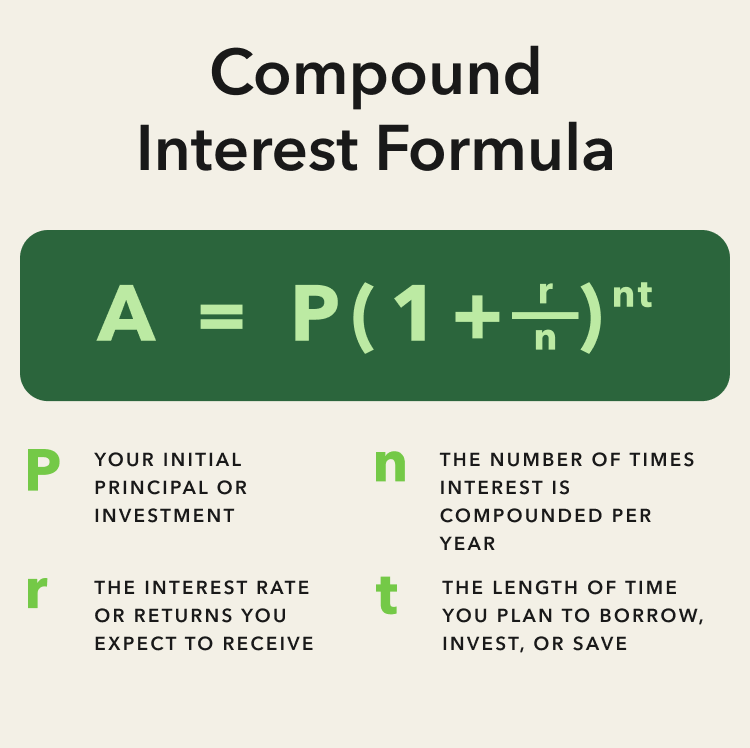
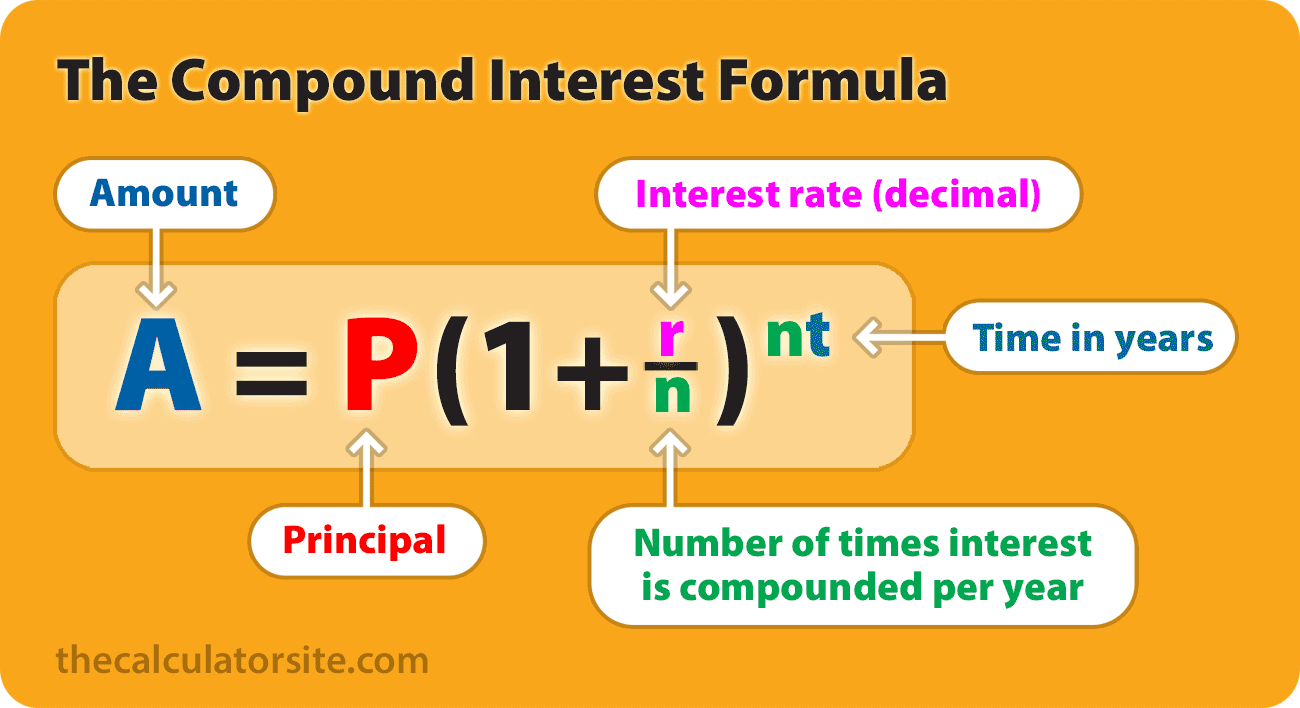
The Core Formula Explained: A = P (1 + r/n)^(nt)
The standard formula for calculating compound interest is:
A = P (1 + r/n)^(nt)
Where:
- A = The future value of the investment/loan, including interest. This is the amount you will have at the end of the compounding period.
- P = The principal investment amount (the initial deposit or loan amount).
- r = The annual interest rate (as a decimal). For example, if the annual interest rate is 5%, then ‘r’ would be 0.05.
- n = The number of times that interest is compounded per year. This refers to how frequently the interest is added to the principal.
- t = The number of years the money is invested or borrowed for.
This formula elegantly captures the exponential growth that defines compound interest. The term (1 + r/n) represents the growth factor for each compounding period, and raising it to the power of (nt) accounts for the total number of compounding periods over the entire investment horizon.
Breaking Down Each Variable
Let’s look at each component in more detail to ensure a thorough understanding:
- P (Principal): This is your starting point. It’s the initial sum of money you deposit into an account or the initial amount you borrow. A higher principal will naturally lead to a higher future value, assuming all other variables remain constant.
- r (Annual Interest Rate): This is the percentage return your investment is expected to generate annually. It’s crucial to convert this percentage into a decimal for calculation (e.g., 7% becomes 0.07). The higher the interest rate, the faster your money will grow.
- n (Number of Compounding Periods per Year): This variable is often overlooked but is incredibly important. It dictates how frequently interest is added to the principal.
- Annually: n = 1
- Semi-annually: n = 2
- Quarterly: n = 4
- Monthly: n = 12
- Daily: n = 365 (or 360 in some financial calculations)
The more frequently interest is compounded, the faster your money grows, as the interest starts earning interest sooner.
- t (Time in Years): This is the duration for which the money is invested or borrowed. Time is arguably the most powerful variable in the compound interest formula. Even small differences in the number of years can lead to vastly different outcomes due to the exponential nature of compounding. The longer the investment period, the greater the compounding effect.
Step-by-Step Calculation Walkthrough
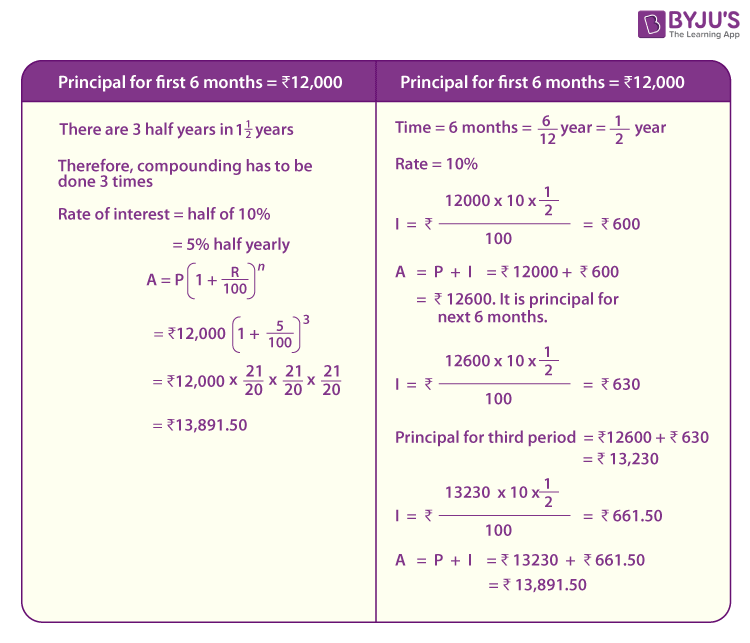
Let’s illustrate with a practical example. Suppose you invest $10,000 in a savings account that offers an annual interest rate of 6%, compounded monthly, for 5 years.
-
Identify the variables:
- P = $10,000
- r = 6% = 0.06 (as a decimal)
- n = 12 (compounded monthly)
- t = 5 years
-
Substitute the values into the formula:
A = $10,000 (1 + 0.06/12)^(12*5) -
Perform the calculation within the parentheses first:
0.06 / 12 = 0.005
1 + 0.005 = 1.005 -
Calculate the exponent:
12 * 5 = 60 -
Raise the term in parentheses to the power of the exponent:
(1.005)^60 ≈ 1.34885 -
Multiply by the principal:
A = $10,000 * 1.34885
A ≈ $13,488.50
After 5 years, your initial $10,000 investment would grow to approximately $13,488.50. The total interest earned would be $3,488.50 ($13,488.50 – $10,000). If this were simple interest, you would have only earned $3,000 ($10,000 * 0.06 * 5). The extra $488.50 is the direct result of compounding.
The Critical Role of Compounding Frequency and Time
While the principal, interest rate, and time are crucial, the frequency at which interest is compounded plays a much larger role than many people realize. Coupled with the sheer duration of an investment, these factors can dramatically alter the final accumulated amount.
How Often Interest is Applied: Daily, Monthly, Annually
The ‘n’ in our formula – the number of times interest is compounded per year – is a silent but powerful variable. The more frequently interest is compounded, the faster your money grows, all else being equal. This is because interest begins earning interest sooner.
- Annually (n=1): Interest is added once a year. This is the slowest rate of compounding.
- Semi-annually (n=2): Interest is added twice a year.
- Quarterly (n=4): Interest is added four times a year.
- Monthly (n=12): Interest is added twelve times a year. This is a common frequency for many savings accounts and fixed deposits.
- Daily (n=365): Interest is added every day. This offers the highest possible compounding frequency in most practical scenarios, leading to slightly greater returns than less frequent compounding.
While the difference between, say, quarterly and monthly compounding might seem minor in the short term, it can become substantial over decades. Banks and financial institutions often advertise an Annual Percentage Yield (APY), which already takes compounding frequency into account, giving consumers a more accurate representation of the effective annual return compared to the Annual Percentage Rate (APR), which does not.
The Unsung Hero: The Power of Time in Compounding
Of all the variables, time (t) is arguably the most impactful when it comes to long-term wealth accumulation through compound interest. Because compounding is exponential, extending the investment period by just a few years can add disproportionately large amounts to the final sum. The earlier you start investing, the more time your money has to grow and compound. A dollar invested today has far more potential to grow than a dollar invested a decade from now, even if the interest rate and compounding frequency are the same. This highlights the immense benefit of starting early, even with modest amounts, rather than waiting until you have a larger sum to invest.
The Impact of Regular Contributions
While the core formula assumes a single initial principal, real-world investing often involves regular contributions. While the formula itself doesn’t directly account for this, the principle of compound interest is applied to each new contribution. Each time you add money to your investment, that new money also begins to earn interest and compound. This creates an even more powerful growth trajectory. Consistent, regular contributions, combined with the magic of compound interest over time, are the bedrock of successful long-term financial planning for retirement or other significant life goals. They accelerate the “snowball effect” dramatically, allowing you to reach your financial objectives much faster.
Practical Applications and Maximizing Your Financial Growth
Understanding the “how” of compound interest calculation is only half the battle; the real value lies in applying this knowledge to make smarter financial decisions. Compound interest isn’t just an abstract formula; it’s a powerful force that impacts various aspects of your financial life, both positively and negatively.
Compound Interest in Savings and Investments
The most straightforward application of compound interest is in savings accounts, Certificates of Deposit (CDs), and various investment vehicles like mutual funds, exchange-traded funds (ETFs), and stocks that reinvest dividends.
- Savings Accounts: Even basic savings accounts often pay compound interest, though typically at lower rates. This is an excellent starting point for new investors to see the concept in action.
- Certificates of Deposit (CDs): CDs offer higher interest rates than standard savings accounts in exchange for locking up your money for a fixed term. The interest is compounded regularly, providing predictable growth.
- Retirement Accounts (401(k)s, IRAs): These accounts are prime examples of leveraging compound interest over decades. Contributions made early in your career have the longest runway to compound, often growing into substantial sums by retirement age. Reinvesting dividends and capital gains within these accounts significantly amplifies the compounding effect.
- Dividend-Paying Stocks and Funds: When you own stocks or funds that pay dividends, choosing to reinvest those dividends to buy more shares is a direct application of compounding. More shares mean more future dividends, which can then buy even more shares, creating an accelerating cycle of wealth creation.
The Double-Edged Sword: Compound Interest and Debt
While beneficial for savers, compound interest can be a formidable foe for borrowers. High-interest debts, such as credit card balances, payday loans, and even some personal loans, often accrue interest that compounds frequently – sometimes daily or monthly. If you don’t pay off your entire balance, the interest from the previous period is added to your principal, and then new interest is calculated on that larger amount. This is how credit card debt can spiral out of control, making it incredibly difficult to pay off the principal amount. Understanding this negative side of compounding underscores the importance of:
- Paying off high-interest debt quickly: Prioritize debts with the highest interest rates to minimize the compounding effect working against you.
- Avoiding unnecessary debt: Be mindful of the interest rates and terms of any loans you take on.
- Making more than minimum payments: This reduces the principal faster, thereby reducing the base on which compound interest is calculated.
Leveraging Financial Tools and Calculators
You don’t need to manually perform complex calculations every time you want to project growth. Numerous online compound interest calculators are available, which allow you to input different variables (principal, interest rate, compounding frequency, time, and even regular contributions) and instantly see the future value of your investment. Many investment platforms also provide projections based on your contributions and assumed returns. These tools are invaluable for:
- Goal Setting: Visualizing how much you need to save to reach specific financial targets (e.g., retirement, down payment).
- Scenario Planning: Comparing different interest rates, compounding frequencies, or investment durations.
- Motivation: Seeing the potential growth can be a powerful motivator for consistent saving and investing.
- Spreadsheets: For those comfortable with tools like Microsoft Excel or Google Sheets, building your own compound interest calculator can offer more customization and flexibility for complex scenarios involving varying contributions or interest rates.
Strategic Approaches to Harnessing Compounding
To truly maximize the benefits of compound interest, consider these strategic approaches:
- Start Early: This is perhaps the most critical piece of advice. The longer your money has to compound, the more significant the final sum will be. Even small amounts invested early can outperform much larger sums invested later.
- Invest Consistently: Regular contributions, even modest ones, significantly amplify the compounding effect. Automate your savings and investments to ensure consistency.
- Prioritize Higher Interest Rates (for investments): While higher rates usually come with higher risk, understanding the potential for growth with different rates is crucial. For savings, seek out accounts with the highest APY.
- Minimize Fees: High fees can erode your returns, effectively reducing the “r” in your formula. Choose low-cost investment vehicles and platforms.
- Reinvest Earnings: For investments that generate income (like dividends or bond interest), always opt to reinvest them back into the principal to fully leverage compounding.
The Long-Term Perspective: Embracing Financial Prosperity
The true genius of compound interest lies not just in its mathematical precision, but in its ability to transform consistent effort and patience into substantial wealth. It’s a testament to the idea that small, smart decisions made repeatedly over time can lead to extraordinary outcomes.
Starting Early: The Golden Rule
The most impactful decision you can make regarding compound interest is to start as early as possible. Consider two individuals: Investor A starts investing $200 per month at age 25, earning an average 7% annual return, and stops contributing at age 35. Investor B waits until age 35 to start, also investing $200 per month at 7% return, but continues until age 65. Despite Investor B contributing for a much longer period (30 years vs. 10 years), Investor A’s early start often results in a significantly larger sum by age 65, purely because their initial contributions had an extra decade of compounding. This illustrates why “time in the market” often beats “timing the market.”
Patience and Persistence: A Virtuous Cycle
Compound interest doesn’t deliver instant gratification. Its effects are most pronounced over long horizons. This necessitates patience and persistence. There will be market fluctuations and economic downturns, but those who stick to their long-term investment strategies and allow compounding to work its magic are typically the ones who reap the greatest rewards. Financial success, powered by compound interest, is a marathon, not a sprint. By understanding how compound interest is calculated, embracing its mechanics, and applying its principles diligently, you empower yourself to build a robust financial future, turning today’s efforts into tomorrow’s prosperity.
aViewFromTheCave is a participant in the Amazon Services LLC Associates Program, an affiliate advertising program designed to provide a means for sites to earn advertising fees by advertising and linking to Amazon.com. Amazon, the Amazon logo, AmazonSupply, and the AmazonSupply logo are trademarks of Amazon.com, Inc. or its affiliates. As an Amazon Associate we earn affiliate commissions from qualifying purchases.