
The question “how many companies are in the Dow Jones?” is a deceptively simple one, yet it unlocks a deeper understanding of one of the world’s most enduring and frequently cited financial market indicators. For investors, financial enthusiasts, and casual observers alike, the Dow Jones Industrial Average (DJIA) often serves as a quick barometer for the health and direction of the U.S. stock market. But beyond the daily headlines and percentage changes, lies a carefully curated index whose composition and methodology are vital to grasp.
At its core, the answer is straightforward: The Dow Jones Industrial Average is comprised of 30 large, publicly traded companies. These aren’t just any companies; they are often referred to as “blue-chip” stocks, representing some of the largest, most stable, and most influential corporations across various sectors of the U.S. economy. Understanding why it’s 30, how these companies are chosen, and what this selection signifies provides crucial insights into the broader financial landscape and how investors interpret market movements.

Unpacking the Dow Jones Industrial Average: A Foundation of Market Insight
The Dow Jones Industrial Average isn’t merely a collection of stocks; it’s a historical artifact and a dynamic reflection of American economic power. Since its inception, it has evolved from a small list of nascent industrial firms to a benchmark for global financial markets.
More Than Just a Number: The Dow’s Historical Context
Conceived by Charles Dow, co-founder of Dow Jones & Company and The Wall Street Journal, the DJIA was first published on May 26, 1896. Initially, it comprised just 12 companies, primarily railroads, cotton, sugar, and oil companies—true “industrials” of their time. Its original purpose was to provide a simple, understandable measure of the stock market’s performance, offering clarity in an era before widespread financial data accessibility. Over the decades, the number of companies fluctuated, settling on 30 in 1928, a figure that has remained consistent ever since. This historical journey underscores its resilience and adaptability as the U.S. economy transformed from an industrial powerhouse to a service and technology-driven giant.
The Definitive Answer: Thirty Blue-Chip Giants
As confirmed, the DJIA consistently tracks 30 companies. These aren’t chosen randomly; they represent a carefully selected group believed to embody the broad trends and health of the American corporate sector. Unlike broader indices like the S&P 500, which aims for extensive market representation, the Dow’s strength lies in its concentrated focus on a smaller, yet highly influential, set of companies. This makes it a powerful, albeit specialized, indicator. Each company within the Dow is a titan in its respective field, boasting significant market capitalization, strong financial performance, and a recognized brand presence, often globally.
The Enduring “Industrial” Misnomer
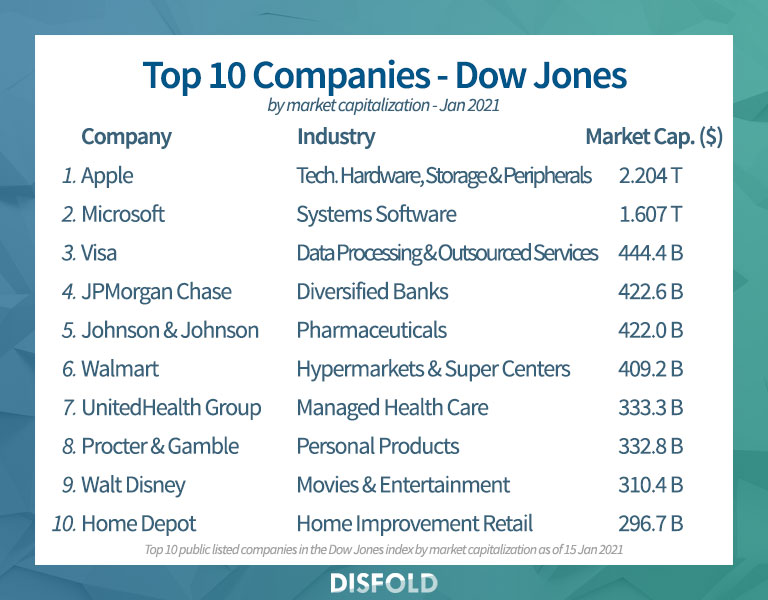
One of the most common points of confusion surrounding the DJIA is the “Industrial” in its name. While historically accurate, today, the term is largely a vestige. Modern Dow components span a diverse array of sectors, including technology (Apple, Microsoft), healthcare (Johnson & Johnson, UnitedHealth Group), finance (JPMorgan Chase, Visa), retail (Walmart, Home Depot), and consumer goods (Procter & Gamble, Coca-Cola). Very few of its current constituents would be classified as traditional “industrial” companies in the old sense. This evolution reflects the changing structure of the U.S. economy, where innovation, services, and global connectivity now drive growth more than heavy manufacturing. The name persists due to tradition, but its composition is decidedly modern and broad-based.
The Rigorous Process of Selection and Evolution
The companies that make up the Dow are not static; the index is a living entity, with constituents added and removed over time to ensure it remains relevant and representative of the economy. This dynamic nature is critical to its ongoing utility as a financial benchmark.
Who Decides? The S&P Dow Jones Indices Committee
The task of selecting and maintaining the DJIA’s components falls to the Averages Committee, managed by S&P Dow Jones Indices. This committee, comprising representatives from S&P Dow Jones Indices and The Wall Street Journal, continuously reviews the index’s composition. Their decisions are not driven by strict quantitative rules but rather by a qualitative assessment designed to maintain the index’s integrity and its representative power. This discretionary approach allows the committee to respond to significant economic shifts and corporate developments in a way that purely algorithmic indices might not.
Key Criteria for Dow Inclusion
While there aren’t rigid criteria, the committee generally considers several factors when evaluating potential candidates for inclusion:
- Reputation and Sustained Growth: The company must have an excellent reputation, demonstrated sustained growth, and be of interest to a large number of investors.
- Large Market Capitalization: While not the sole determinant (as the Dow is price-weighted, not market-cap weighted), a very large market capitalization is typically a prerequisite, indicating a financially robust and influential company.
- Industry Representation: The committee aims for a diverse representation of sectors to ensure the index reflects various facets of the U.S. economy, preventing over-concentration in one area.
- U.S.-Based and Publicly Traded: Companies must be U.S. domiciled and listed on one of the major U.S. exchanges.
- Avoiding Overlap: New additions should not duplicate existing industry representation, contributing to the index’s overall diversity.
These criteria underscore the Dow’s role not just as a performance tracker but as a curated collection of companies deemed most indicative of American corporate excellence and economic direction.
Dynamic Composition: A Reflection of Economic Shifts
The DJIA has undergone numerous changes throughout its history, reflecting major shifts in the U.S. and global economies. For instance, companies like General Electric, a continuous member for over a century, were eventually replaced as their prominence waned relative to emerging sectors. More recently, Salesforce, Amgen, and Honeywell were added, replacing ExxonMobil, Pfizer, and Raytheon Technologies, respectively. These changes illustrate a deliberate pivot towards technology, healthcare, and advanced industrials, away from legacy energy and pharmaceuticals, signifying the evolving landscape of American economic leadership. Each change sparks discussion among investors about what it means for the market and the future of the economy.
Why 30 Companies? Understanding the Dow’s Design Philosophy
The choice of 30 companies is not arbitrary; it’s central to the Dow’s original design philosophy and its enduring role as a key market indicator. This relatively small number dictates aspects of its calculation and its interpretation.
Simplicity and Representativeness

The initial rationale for a small number of components was simplicity. In the late 19th century, calculating an average of a vast number of stocks would have been impractical. While modern technology removes this constraint, the tradition of 30 companies persists. This number aims to strike a balance: small enough to be easily understood and tracked, yet large enough to represent a significant portion of the U.S. equity market and provide a snapshot of various key industries. It’s a “snapshot” rather than a comprehensive “panorama,” serving a different analytical purpose than broader indices.
The Price-Weighted Methodology
Crucially, the DJIA is a price-weighted index. This means that companies with higher stock prices have a greater impact on the index’s value than companies with lower stock prices, regardless of their market capitalization. When the Dow was first conceived, this simple arithmetic average was the easiest method to calculate. Over time, to account for stock splits and other corporate actions, a “Dow Divisor” was introduced. This divisor adjusts the total sum of the 30 stock prices so that the index value remains comparable despite changes in composition or stock splits.
The price-weighted methodology stands in contrast to market-capitalization-weighted indices (like the S&P 500), where companies with larger market caps (total value of outstanding shares) have a greater influence. This distinction is significant: a small percentage change in a high-priced Dow stock will move the index more than the same percentage change in a lower-priced Dow stock, even if the latter is a larger company by market value. This aspect is often cited as both a strength (simplicity) and a limitation (potential for distortion) of the DJIA.
What the “Dow Effect” Means for Investors
Changes in the Dow’s components can create a phenomenon known as the “Dow effect.” When a company is announced as a new addition, its stock price often sees a temporary bump, driven by anticipation of increased institutional buying (e.g., from index funds that track the Dow) and enhanced prestige. Conversely, a company removed from the index might experience a slight dip. For individual investors, understanding this effect is less about trying to “trade the news” and more about recognizing the symbolic importance of Dow inclusion. It signals a company’s perceived status as a market leader and can influence investor sentiment, particularly among those who value stability and proven performance.
The Dow’s Role in Modern Investing: Strengths and Criticisms
Despite its age and unique calculation method, the Dow Jones Industrial Average remains profoundly influential. However, its utility in modern investing is often debated, prompting investors to understand both its advantages and its limitations.
A Quick Pulse Check on the Economy
The DJIA’s primary strength lies in its long history and immediate recognizability. For many, it offers a quick, albeit high-level, assessment of the market’s mood and the economy’s direction. Its daily movements are widely reported and can influence overall investor confidence. When the Dow rises significantly, it often suggests optimism about corporate earnings and economic growth. Conversely, a sharp decline can signal investor anxiety. For a broad, immediate sense of market sentiment, the Dow serves an undeniable purpose. It’s an accessible headline figure that provides an instantaneous snapshot.
Limitations as a Broad Market Indicator
While useful for a quick check, relying solely on the DJIA for a comprehensive understanding of the market is problematic due to its inherent limitations:
- Limited Scope: With only 30 companies, it represents a tiny fraction of the thousands of publicly traded companies in the U.S. It misses small-cap, mid-cap, and many emerging growth companies, which can significantly outperform or underperform the large-cap blue chips.
- Price-Weighted Bias: As discussed, its price-weighted methodology means higher-priced stocks disproportionately influence the index, regardless of the company’s overall size or market capitalization. This can lead to a skewed representation.
- Lack of Diversification: Being concentrated in 30 large companies, it does not offer broad diversification across all sectors or company sizes, making it less representative of the entire economy than a market-cap-weighted index with hundreds of components.
Dow vs. S&P 500 vs. Nasdaq: A Comparative Lens
To gain a holistic market perspective, investors typically look beyond just the Dow.
- S&P 500: Often considered the truer benchmark for the U.S. large-cap equity market, the S&P 500 tracks 500 of the largest U.S. companies by market capitalization. It is market-cap-weighted, meaning larger companies have a greater impact. Its broader scope and methodology make it a more comprehensive gauge of market performance.
- Nasdaq Composite: This index comprises over 3,000 stocks listed on the Nasdaq stock exchange, heavily weighted towards technology and growth companies. It is also market-cap-weighted and offers a deeper look into the tech and innovative sectors.
Understanding these different indices allows investors to contextualize market movements and develop a more nuanced view of where capital is flowing and which segments of the economy are thriving. The Dow is one tool among many, each offering a distinct perspective.
Navigating the Dow’s Influence: Practical Insights for Investors
For investors, the DJIA is more than just a headline number; it’s a piece of the complex puzzle that informs investment decisions. Understanding its intricacies can lead to more informed strategies.
How Changes Impact Portfolios
For most individual investors, the direct impact of a change in Dow components on their diversified portfolios is usually minimal. Unless one holds a highly concentrated portfolio tracking the Dow or invests in an ETF specifically designed to replicate the DJIA, the effect is largely symbolic. However, significant shifts in the Dow’s composition, moving towards or away from certain sectors, can highlight broader economic trends that investors should consider in their long-term asset allocation strategies. It signals which industries are gaining or losing prominence in the eyes of market leaders.
Beyond the Index: Fundamental Analysis Remains Key
While the Dow offers a macro-level perspective, successful investing still hinges on thorough fundamental analysis. Whether a company is in the Dow or not, its intrinsic value, financial health, management quality, competitive landscape, and growth prospects are what truly determine its long-term potential. Investors should avoid making decisions based solely on a company’s inclusion in a prominent index and instead focus on understanding the underlying business.
Diversification: The Prudent Investor’s Mantra
Ultimately, the DJIA serves as a reminder of the importance of diversification. While its 30 blue-chip companies are powerful, a truly diversified portfolio extends far beyond them, encompassing a wider range of industries, company sizes, and asset classes. By combining exposure to various market segments, investors can mitigate risks associated with any single index or sector, positioning themselves for more stable and resilient long-term growth.
In conclusion, the answer to “how many companies are in the Dow Jones?” is a firm 30. But the depth of understanding that follows this simple fact reveals the Dow’s rich history, its unique methodology, its ongoing relevance as a market bellwether, and its critical place within a broader suite of financial indicators that savvy investors utilize to navigate the complexities of the global economy.
aViewFromTheCave is a participant in the Amazon Services LLC Associates Program, an affiliate advertising program designed to provide a means for sites to earn advertising fees by advertising and linking to Amazon.com. Amazon, the Amazon logo, AmazonSupply, and the AmazonSupply logo are trademarks of Amazon.com, Inc. or its affiliates. As an Amazon Associate we earn affiliate commissions from qualifying purchases.