
In the dynamic world of personal finance, platforms like Robinhood have democratized investing, making it accessible to millions. However, just as important as understanding how to invest is knowing how to access your funds when needed. Whether you’re rebalancing your portfolio, covering an unexpected expense, or simply consolidating your finances, withdrawing money from Robinhood is a straightforward process, provided you understand the mechanics and considerations involved. This comprehensive guide will walk you through every step, ensuring a smooth and informed withdrawal experience.
Robinhood, known for its commission-free trading, offers various avenues for managing your capital, including deposits and withdrawals. While the platform excels at making investing simple, the process of extracting funds carries specific rules, limits, and timelines that investors must be aware of. This article will demystify these aspects, equipping you with the knowledge to efficiently manage your money within and out of your Robinhood account.
Navigating Robinhood’s Withdrawal Landscape
Understanding the basics of how Robinhood processes withdrawals is the first step towards a successful transfer. The platform prioritizes security and compliance, which dictates certain procedures and limitations. Getting your money out is fundamentally about transferring funds from your brokerage account to a linked bank account.
Understanding Your Available Funds
Before initiating any withdrawal, it’s crucial to distinguish between different types of funds within your Robinhood account. Your total account value might include both settled cash and unsettled funds, or the value of securities you hold. Only settled cash is available for withdrawal.
- Settled Cash: This refers to money that is not currently invested in stocks or other securities, and that has cleared all necessary transaction periods. When you sell a stock, for instance, the proceeds aren’t immediately available for withdrawal. Due to regulatory requirements, stock trades typically take two business days (T+2) to settle. Options trades also follow a T+1 settlement period. You must wait for these funds to settle before they can be transferred out of your Robinhood account.
- Unsettled Funds: These are proceeds from recent stock sales that have not yet completed their settlement period. Attempting to withdraw unsettled funds will result in an error or a delayed transfer until the settlement period is complete.
Always check your “Buying Power” or “Withdrawable Cash” balance within the Robinhood app or website to confirm the exact amount you can withdraw immediately. This transparency helps prevent frustration and ensures you are working with accurate figures.
Linking and Verifying Your Bank Account
Robinhood requires a linked and verified bank account for all withdrawals. This is a standard security measure designed to protect your funds and prevent unauthorized access.
- Adding a Bank Account: If you haven’t already, you’ll need to link your external bank account. This is typically done by navigating to the “Transfers” section within the Robinhood app or website, selecting “Linked Accounts,” and then “Add Account.”
- Instant Verification: Robinhood often uses instant verification services (like Plaid) where you log into your bank account through a secure portal. This method verifies your account instantly and allows for quicker transfers.
- Micro-Deposit Verification: If instant verification isn’t an option, Robinhood will send two small “micro-deposits” (typically a few cents) to your bank account within 1-2 business days. You’ll then need to enter the exact amounts of these deposits back into Robinhood to verify your account. This confirms you own the bank account.
- Security and Accuracy: Ensure the details you provide are accurate. Any discrepancies can delay or reject your withdrawal. For security reasons, Robinhood generally only allows withdrawals to bank accounts held in your name. Joint accounts are usually acceptable as long as your name is on the account.
Once your bank account is linked and verified, it will be the default destination for your cash withdrawals. You can link multiple bank accounts, but you’ll need to select the desired one for each withdrawal.
A Step-by-Step Guide to Cash Withdrawals
The process of withdrawing cash from Robinhood is designed to be user-friendly, mirroring the simplicity of the app itself. Following these steps will ensure a smooth transaction.
Initiating an ACH Transfer
The most common method for withdrawing funds from Robinhood is via an Automated Clearing House (ACH) transfer. These electronic transfers are free of charge for standard withdrawals and are the primary method for moving money between your Robinhood account and your linked bank account.
- Open the Robinhood App/Website: Log into your Robinhood account.
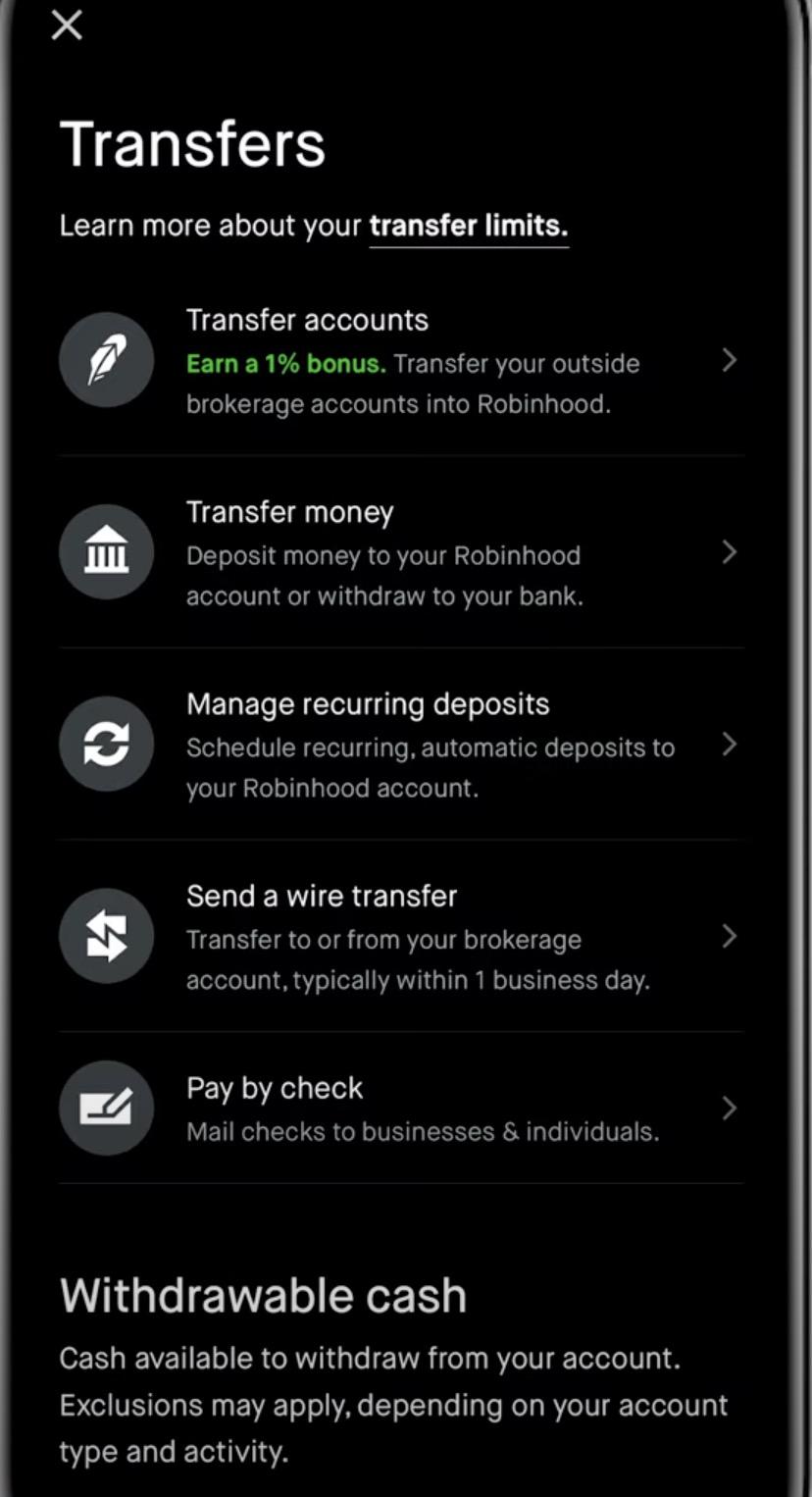
- Navigate to Transfers: Locate the “Transfers” icon or section, usually found at the bottom navigation bar in the app or under your account settings on the website.
- Select “Transfer to Your Bank”: From the transfer options, choose the one that allows you to move funds from Robinhood to your bank.
- Choose Your Linked Bank Account: If you have multiple accounts linked, select the specific bank account where you want the funds to go.
- Enter the Withdrawal Amount: Input the exact amount you wish to withdraw. Remember, this must be less than or equal to your “Withdrawable Cash” balance.
- Review and Confirm: Carefully review all the details: the amount, the destination bank account, and the estimated arrival date. Once satisfied, confirm the transfer.
ACH transfers typically take 3-5 business days to complete. The exact timing can depend on your bank’s processing times and when you initiate the transfer (e.g., transfers initiated on weekends or holidays will start processing on the next business day). Robinhood will provide an estimated arrival date, which is a good benchmark.
Exploring Wire Transfers for Larger Sums
While ACH transfers are convenient for most withdrawals, Robinhood also offers wire transfers, particularly for larger sums or when you need funds more quickly. However, wire transfers often come with specific fees and additional steps.
- Fees: Robinhood charges a fee for outgoing domestic wire transfers (typically $25). This fee will be deducted from your withdrawal amount.
- Process: Initiating a wire transfer usually requires contacting Robinhood support directly or finding a specific option within the transfer section for wire transfers. You’ll need to provide your bank’s wire transfer details (routing number, account number, swift code for international wires, bank address, etc.).
- Speed: Wire transfers are generally faster than ACH, often arriving within 1-2 business days once initiated and processed by Robinhood.
- Limits: While ACH transfers have daily and monthly limits (discussed below), wire transfers may allow for higher single transaction amounts, making them suitable for substantial withdrawals.
For the average investor, ACH transfers suffice. Wire transfers are typically reserved for urgent or very large withdrawals where the fee and extra steps are justified by the need for speed or capacity.
Critical Considerations Before You Withdraw
Successfully withdrawing money isn’t just about following the steps; it’s also about understanding the financial nuances and potential impacts of your decision.
The All-Important Settlement Period
As mentioned, this is perhaps the most common source of confusion for new investors. When you sell a stock, the funds from that sale are not immediately available for withdrawal. The standard settlement period for stock trades is T+2, meaning the transaction is finalized two business days after the trade date. For options, it’s T+1.
- Example: If you sell stocks on Monday, the funds will typically settle on Wednesday. Only then can you initiate a withdrawal. If you sell on Friday, the funds won’t settle until Tuesday (assuming no holidays).
- Why it matters: Attempting to withdraw funds before they settle will result in your withdrawal being delayed or rejected. Always factor in this settlement period when planning your withdrawals, especially if you need the money by a specific date.
Daily and Monthly Withdrawal Limits
Robinhood, like many financial institutions, imposes limits on the amount of money you can withdraw within certain periods. These limits are in place for security reasons and to manage risk.
- Typical Limits: For ACH transfers, Robinhood generally has a daily withdrawal limit (often around $50,000) and a monthly withdrawal limit (potentially higher, e.g., $250,000). These limits can vary based on your account history and verification status.
- Wire Transfer Limits: Wire transfers often have higher per-transaction limits, making them suitable for exceeding ACH daily limits, though the overall monthly limit might still apply.
- Checking Your Limits: You can usually find your specific withdrawal limits within the Robinhood app or by contacting their customer support. If you need to withdraw an amount exceeding these limits, you’ll either have to make multiple withdrawals over several days or discuss alternatives with Robinhood support, potentially involving a wire transfer.
Understanding Potential Tax Implications
Withdrawing money from your Robinhood account can have significant tax implications, especially if you’re pulling out profits from investments. This is a crucial financial planning aspect that often gets overlooked.
- Capital Gains Tax: If you sell investments for a profit and withdraw those proceeds, you may be subject to capital gains tax.
- Short-Term Capital Gains: Profits from investments held for one year or less are taxed at your ordinary income tax rate.
- Long-Term Capital Gains: Profits from investments held for more than one year are taxed at preferential long-term capital gains rates, which are typically lower than ordinary income rates.
- Tax Loss Harvesting: Conversely, if you sell investments at a loss, you can use these losses to offset capital gains and, to a limited extent, ordinary income.
- Dividends and Interest: Any dividends or interest earned and withdrawn are also typically taxable income in the year they are received.
- Reporting: Robinhood will provide you with tax documents (like Form 1099-B for brokerage transactions) summarizing your investment activity for the tax year. It’s essential to consult with a qualified tax advisor to understand your specific obligations and optimize your tax strategy before making significant withdrawals, especially those involving substantial capital gains. Withdrawing your initial deposited principal generally does not incur tax, but anything beyond that which represents growth will be subject to capital gains if held in a taxable brokerage account.
Beyond Cash: Transferring Your Investments
Sometimes, getting your “money out” of Robinhood doesn’t mean converting it to cash. It might mean moving your actual investments to another brokerage.
The ACATS Process: Moving Securities Between Brokers
The Automated Customer Account Transfer Service (ACATS) is a system that allows investors to transfer their entire brokerage account, or specific securities, from one brokerage firm to another. This is often preferred if you’re consolidating accounts or moving to a platform that better suits your long-term investment strategy.
- Initiating the Transfer: The ACATS process is typically initiated from the receiving brokerage firm (the one you want to move your assets to). You’ll provide them with your Robinhood account details, and they will handle the transfer request.
- Types of Transfers: You can usually opt for a full transfer (moving all assets and cash) or a partial transfer (moving specific securities or a portion of your cash).
- Fees: Robinhood charges a fee for outgoing ACATS transfers (typically $75). The receiving firm might also have fees, but many offer to reimburse transfer fees for new customers.
- Timeline: ACATS transfers can take 5-10 business days to complete. During this time, your assets might be temporarily unavailable for trading.
This method avoids selling your investments, thus potentially deferring capital gains taxes until you eventually sell them at the new brokerage. It’s an excellent option for maintaining your investment positions while changing platforms.
When to Sell vs. When to Transfer
Deciding whether to sell your investments and withdraw cash or transfer the securities via ACATS depends on your specific goals and circumstances.
- Sell and Withdraw Cash:
- Pros: Quick access to cash, simple process.
- Cons: Triggers capital gains/losses, potential for market timing issues (missing out on gains while out of the market).
- Best For: Needing immediate cash for expenses, simplifying your portfolio, or completely exiting certain positions.
- Transfer Securities (ACATS):
- Pros: Defers capital gains tax, maintains your investment positions, avoids market timing risk.
- Cons: Involves a transfer fee, assets may be unavailable for trading during the transfer period, takes longer than a cash withdrawal.
- Best For: Changing brokers without disrupting your long-term investment strategy, consolidating multiple brokerage accounts.
Carefully consider your financial needs, tax situation, and investment strategy before deciding which route to take. Consulting with a financial advisor can help clarify the best approach for your individual circumstances.
Common Hurdles and How to Overcome Them
While Robinhood aims for a seamless experience, occasional issues can arise during the withdrawal process. Knowing how to troubleshoot these can save you time and stress.
Addressing Delayed or Failed Withdrawals
Several factors can lead to delays or outright failure in your withdrawal request:
- Unsettled Funds: This is the most frequent culprit. Ensure all funds are settled before attempting a withdrawal.
- Bank Account Discrepancies: Incorrect bank account numbers, routing numbers, or issues with your bank’s side can cause rejections. Double-check all details.
- Withdrawal Limits: Exceeding daily or monthly withdrawal limits will cause the transfer to fail.
- Account Restrictions: If your Robinhood account has any active restrictions (e.g., due to suspicious activity, margin calls, or regulatory inquiries), withdrawals may be temporarily blocked.
- Recent Deposits: Robinhood has a policy that funds deposited via ACH may not be immediately withdrawable to prevent fraud. You might need to wait a few business days after a deposit before those specific funds can be withdrawn.
- Large Withdrawals: Very large withdrawals sometimes trigger additional security reviews, leading to delays.
If your withdrawal is delayed or fails, first review your transaction history and account balances to identify any obvious issues like unsettled funds or limit breaches. Then, check your linked bank account for any notifications or rejections from your bank.

Leveraging Robinhood Support Resources
When you encounter persistent issues or have questions that aren’t answered by the in-app guides, Robinhood’s customer support is your next point of contact.
- In-App Help Center: Robinhood has an extensive help center within the app and on its website. This resource often contains detailed FAQs and troubleshooting guides for withdrawals.
- Email Support: For non-urgent issues, you can submit a support ticket via email. Be prepared to provide specific details about your withdrawal attempt (date, amount, error messages) and your account information.
- Phone Support: For more urgent matters or complex issues, Robinhood offers phone support, though availability might be limited to certain hours. Check their contact page for the most current phone numbers and operating hours.
When contacting support, be clear and concise in your communication, providing all relevant details upfront. This will help them diagnose and resolve your issue more efficiently. Remember, platform support can provide technical assistance and clarify Robinhood policies, but for tax or complex financial planning advice, it’s best to consult a qualified professional.
Getting your money out of Robinhood is a fundamental aspect of managing your investments. By understanding the withdrawal processes, being mindful of settlement periods and limits, and considering the tax implications, you can ensure a smooth and efficient transfer of your funds, aligning with your broader financial goals.
aViewFromTheCave is a participant in the Amazon Services LLC Associates Program, an affiliate advertising program designed to provide a means for sites to earn advertising fees by advertising and linking to Amazon.com. Amazon, the Amazon logo, AmazonSupply, and the AmazonSupply logo are trademarks of Amazon.com, Inc. or its affiliates. As an Amazon Associate we earn affiliate commissions from qualifying purchases.