
Purchasing a vehicle is a significant financial decision for most individuals and households. Beyond the excitement of choosing the perfect car, understanding the financial mechanics of an auto loan is paramount to ensuring affordability and long-term financial stability. A seemingly small difference in interest rates or loan terms can translate into thousands of dollars over the life of the loan. This guide will demystify the process of calculating an auto loan, equipping you with the knowledge and tools to make informed decisions and secure a deal that aligns with your financial goals.
Calculating your auto loan isn’t just about finding out your monthly payment; it’s about comprehending the total cost of borrowing, identifying potential savings, and negotiating with confidence. Whether you’re considering a new car, a used one, or refinancing an existing loan, a clear understanding of the calculation process is your most powerful asset. We’ll delve into the essential components that make up an auto loan, explore various calculation methods, and discuss the critical factors that influence your borrowing costs, all strictly within the realm of personal finance and financial tools.
Understanding the Key Components of an Auto Loan
Before you can effectively calculate your auto loan, it’s crucial to grasp the fundamental elements that dictate its structure and cost. These components interact to determine both your monthly payments and the total amount you’ll repay.
Principal Amount
The principal amount is the actual sum of money you borrow to purchase the vehicle. This isn’t necessarily the sticker price of the car. It’s the purchase price minus any down payment, trade-in value, or rebates. For instance, if a car costs $30,000, and you put down $5,000 and have a $3,000 trade-in, your principal amount would be $22,000. Understanding this initial figure is vital because interest is charged directly on this principal. The lower your principal, the less you’ll pay in interest over the loan’s term, highlighting the benefit of a substantial down payment or a valuable trade-in.
Interest Rate (Annual Percentage Rate – APR)
The interest rate is arguably the most impactful component of your auto loan. It represents the cost of borrowing money, expressed as a percentage of the principal amount per year. When comparing loan offers, always look at the Annual Percentage Rate (APR), which includes not only the interest rate but also certain fees charged by the lender, giving you a more comprehensive picture of the true cost of credit. A lower APR translates directly to lower monthly payments and less money paid overall. Factors like your credit score, the loan term, and the current economic climate heavily influence the interest rate you qualify for. Even a difference of one or two percentage points can save you hundreds, if not thousands, of dollars over the life of the loan.
Loan Term
The loan term, or repayment period, is the duration over which you agree to repay the borrowed principal and interest. Auto loan terms typically range from 36 months (3 years) to 84 months (7 years), with 60 or 72 months being common. A shorter loan term means higher monthly payments but less interest paid over the life of the loan. Conversely, a longer loan term results in lower monthly payments, making the car seem more affordable in the short term, but you’ll pay significantly more interest overall and potentially expose yourself to negative equity for a longer period. Balancing affordability with the total cost of borrowing is key when selecting a loan term.
Down Payment and Trade-in Value
A down payment is the initial sum of money you pay upfront towards the purchase of the vehicle. It directly reduces the principal amount you need to borrow, thereby lowering your monthly payments and the total interest accrued. Financial experts often recommend a down payment of at least 10-20% for a new car and 20% or more for a used car. Similarly, if you trade in your current vehicle, its agreed-upon value will also be subtracted from the car’s price, further reducing the amount you need to finance. Both a down payment and trade-in value are powerful tools to minimize your loan amount and, consequently, your overall borrowing costs. They also demonstrate financial responsibility to lenders, which can sometimes lead to more favorable loan terms.
Core Auto Loan Calculation Methods
Equipped with an understanding of the key components, the next step is to actually perform the calculation. There are several reliable methods to calculate your auto loan, ranging from manual formulas to sophisticated digital tools.
Manual Calculation Using the Amortization Formula
For those who prefer a granular understanding or need to calculate without internet access, the amortization formula is the bedrock of loan calculations. This formula is universally used for fixed-payment loans, including auto loans.
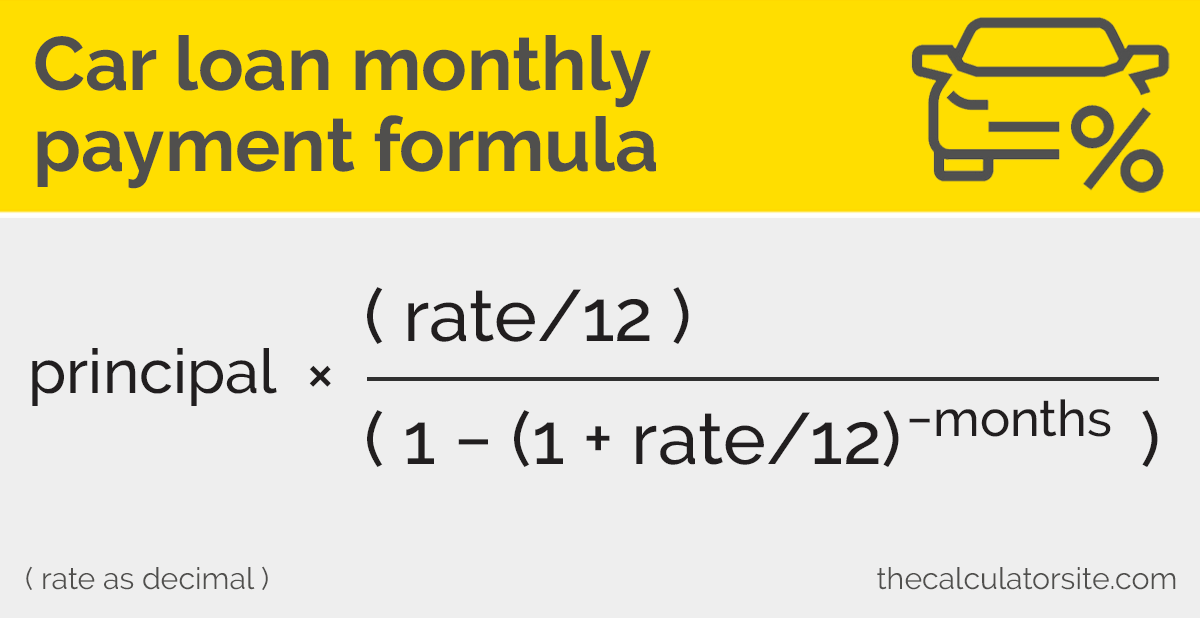
The formula for calculating your monthly loan payment (M) is:
M = P [ i (1 + i)^n ] / [ (1 + i)^n – 1 ]
Where:
M= Monthly paymentP= Principal loan amount (the amount you’re borrowing)i= Monthly interest rate (your annual interest rate divided by 12)n= Total number of payments (loan term in years multiplied by 12)
Step-by-step example:
Let’s assume you borrow $25,000 (P) for a new car at an annual interest rate of 6% (APR) over 60 months (n).
- Calculate monthly interest rate (i): 6% APR / 12 months = 0.06 / 12 = 0.005
- Calculate total number of payments (n): 5 years * 12 months/year = 60 months
- Plug values into the formula:
M = 25000 [ 0.005 (1 + 0.005)^60 ] / [ (1 + 0.005)^60 – 1 ]- First, calculate
(1 + 0.005)^60:(1.005)^60≈ 1.34885 - Then, calculate the numerator:
25000 [ 0.005 * 1.34885 ]=25000 * 0.00674425≈168.60625 - Then, calculate the denominator:
[ 1.34885 – 1 ]=0.34885 - Finally,
M = 168.60625 / 0.34885≈$483.25
This manual method, while more involved, provides a deep understanding of how each variable contributes to the final payment figure. It also enables you to play with different scenarios (e.g., what if the interest rate was 5%?) to see their impact.
Utilizing Online Auto Loan Calculators
For ease, speed, and accuracy, online auto loan calculators are an invaluable financial tool. Websites of banks, credit unions, automotive portals, and personal finance sites offer these free resources. They are designed to be user-friendly: you simply input the principal amount, interest rate (APR), and loan term, and the calculator instantly provides your estimated monthly payment.
Benefits of online calculators:
- Instant Results: Get immediate payment estimates without manual calculations.
- Scenario Planning: Quickly adjust variables (e.g., down payment, loan term, interest rate) to see how they impact payments.
- Amortization Schedules: Many advanced calculators can generate a full amortization schedule, showing how much principal and interest you pay each month over the life of the loan.
- Accessibility: Available on any device with internet access.
When using these tools, ensure you’re inputting the correct APR, not just the nominal interest rate, to get the most accurate monthly payment estimate that reflects all borrowing costs.
Leveraging Spreadsheet Software (Excel/Google Sheets)
Spreadsheet programs like Microsoft Excel or Google Sheets offer a powerful and flexible way to calculate auto loans and manage your financial planning. They come with built-in financial functions that simplify complex calculations.
The most common function for calculating a loan payment is the PMT function:
=PMT(rate, nper, pv, [fv], [type])
Where:
rate: The interest rate per period (e.g., annual APR / 12).nper: The total number of payments for the loan (e.g., loan term in years * 12).pv: The present value, or the principal amount of the loan.[fv]: (Optional) The future value, or a cash balance you want to attain after the last payment is made. For loans, this is usually 0.[type]: (Optional) Whether payments are due at the beginning (1) or end (0) of the period. For most loans, this is 0.
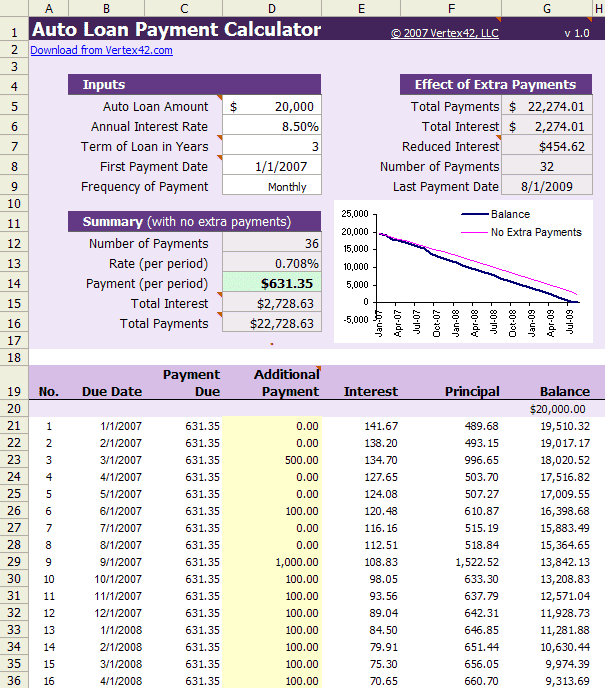
Example using PMT function:
For our previous example (P = $25,000, 6% APR, 60 months):
rate= 0.06 / 12 = 0.005nper= 60pv= -25000 (enter as a negative number if you want a positive payment result, representing an outflow)
The formula would be: =PMT(0.005, 60, -25000)
This would yield approximately $483.25, matching the manual calculation. Spreadsheets allow you to create dynamic models, easily changing input cells to see the impact on payments and even building out full amortization tables with ease. This method is particularly useful for sophisticated personal finance tracking.
Factors Influencing Your Auto Loan Calculation
The numbers you input into a calculator are not arbitrary; they are the result of various financial factors that influence your borrowing power and cost. Understanding these elements can help you optimize your loan terms.
Credit Score Impact
Your credit score is arguably the single most significant factor influencing the interest rate you’ll be offered. Lenders use credit scores (like FICO or VantageScore) to assess your creditworthiness and the likelihood of you repaying the loan. A higher credit score (typically 700+) indicates a lower risk to lenders, qualifying you for the best, lowest interest rates. Conversely, a lower credit score will result in higher interest rates, significantly increasing your monthly payment and total cost of the loan. Prior to applying for an auto loan, it’s wise to check your credit report for inaccuracies and work on improving your score if necessary.
Loan Fees and Taxes
Beyond the principal and interest, auto loans often come with various fees and taxes that can impact the total cost. These can include:
- Origination fees: Charged by the lender for processing the loan.
- Documentation fees: Paid to the dealership for processing paperwork.
- Title and registration fees: Government-mandated fees for vehicle ownership.
- Sales tax: A percentage of the vehicle’s purchase price, varying by state.
- Prepayment penalties: Some loans may charge a fee if you pay off the loan early (less common for auto loans but worth checking).
While some fees might be negotiable, others are fixed. It’s crucial to get a comprehensive breakdown of all fees and taxes before finalizing a loan. These costs can either be paid upfront or rolled into the loan amount, which increases your principal and, consequently, the interest you pay. Always ask for the “out-the-door price” which includes all costs.
Lender Type: Dealer vs. Bank vs. Credit Union
Where you get your loan can significantly affect the terms and rates available.
- Dealership Financing: Convenient, as it’s often a one-stop shop. Dealers work with multiple lenders and may offer promotional rates, but they also add a markup to the interest rate to profit from the financing.
- Banks: Traditional financial institutions that offer competitive rates, especially to customers with good credit. They have various loan products and are generally transparent.
- Credit Unions: Member-owned financial cooperatives often known for offering some of the lowest interest rates and more flexible terms, especially for members. They may also be more forgiving to those with less-than-perfect credit.
It’s always recommended to get pre-approved for a loan from a bank or credit union before visiting a dealership. This provides you with a baseline interest rate to compare against any offers from the dealer, empowering you with stronger negotiation leverage.
Pre-approval Benefits
Obtaining a pre-approval from a lender before you even step foot on a car lot is a powerful financial strategy. A pre-approval means a lender has reviewed your credit and financial situation and has conditionally agreed to lend you a specific amount at a particular interest rate.
Advantages of pre-approval:
- Clear Budget: You know exactly how much you can afford, preventing you from falling in love with a car outside your budget.
- Negotiation Power: You become a cash buyer in the eyes of the dealership, as you already have financing secured. This allows you to focus on negotiating the car’s price, not the financing terms.
- Comparison Shopping: You can compare the pre-approved rate with any financing offers from the dealership, ensuring you get the best possible deal.
- Time Savings: Streamlines the car-buying process by taking the financing hurdle out of the equation upfront.
A pre-approval letter typically has an expiration date (e.g., 30-60 days), giving you a window to make your purchase.
Beyond the Monthly Payment: Total Cost and Affordability
While the monthly payment is the most immediate concern, a truly comprehensive understanding of your auto loan extends to its total cost and how it fits into your broader financial picture.
Calculating Total Interest Paid
A common pitfall is focusing solely on the monthly payment. Over the life of the loan, the total amount of interest paid can be substantial. To calculate the total interest paid, simply multiply your monthly payment by the total number of payments (loan term), and then subtract the principal amount of the loan.
Example:
If your monthly payment is $483.25 over 60 months for a $25,000 principal:
- Total amount repaid: $483.25 * 60 = $28,995
- Total interest paid: $28,995 – $25,000 = $3,995
This figure highlights why a lower interest rate and shorter loan term are financially advantageous. Even small differences in APR can add up to thousands of dollars in interest over several years.
Debt-to-Income Ratio
Your debt-to-income (DTI) ratio is a crucial metric that lenders use to assess your ability to manage monthly payments and repay debts. It’s calculated by dividing your total monthly debt payments by your gross monthly income. A low DTI ratio (typically below 36-43%) indicates you have sufficient income to handle additional debt, making you a more attractive borrower. Taking on a new auto loan will increase your DTI. Regularly monitoring this ratio helps you ensure that your total debt burden remains manageable, preventing financial strain and maintaining your credit health.
The True Cost of Vehicle Ownership
An auto loan calculation focuses on the borrowing cost, but the true cost of owning a vehicle extends far beyond just your loan payments. When budgeting for a car, you must also consider:
- Car Insurance: Mandatory and can vary significantly based on vehicle type, driver’s age, location, and coverage.
- Fuel Costs: Directly related to gas prices, your daily commute, and the car’s fuel efficiency.
- Maintenance and Repairs: Routine oil changes, tire rotations, and unexpected repairs are inevitable. Newer cars might have lower immediate maintenance costs, but all vehicles require ongoing care.
- Registration and Licensing: Annual fees to legally operate your vehicle.
- Depreciation: The decrease in a car’s value over time. While not a direct cash outlay, it’s a significant financial aspect, especially if you plan to trade in or sell the car in the future.
Factoring in these additional expenses provides a holistic view of your automotive budget, ensuring that your monthly auto loan payment is just one piece of a financially sustainable puzzle.
Strategies for Lowering Your Auto Loan Cost
Armed with calculation knowledge, you can proactively implement strategies to minimize your auto loan expenses:
- Improve Your Credit Score: A higher score unlocks lower interest rates.
- Make a Larger Down Payment: Reduces the principal amount borrowed and thus the total interest.
- Choose a Shorter Loan Term: While monthly payments will be higher, you’ll pay significantly less interest over time.
- Shop Around for Lenders: Compare offers from banks, credit unions, and dealerships to find the best APR.
- Get Pre-Approved: Strengthens your negotiation position at the dealership.
- Consider a Less Expensive Vehicle: A lower purchase price means a smaller principal to finance.
- Refinance an Existing Loan: If interest rates have dropped or your credit score has improved since you first bought your car, refinancing could save you money.

Conclusion
Calculating an auto loan is far more than a simple arithmetic exercise; it’s a critical financial skill that empowers you to navigate one of life’s significant purchases with confidence and clarity. By understanding the core components—principal, interest rate, and loan term—and by leveraging various calculation methods, you can accurately forecast your financial obligations. Furthermore, recognizing the influence of factors like your credit score, additional fees, and lender choice allows you to optimize your loan terms strategically.
Ultimately, a truly responsible approach extends beyond just the monthly payment to encompass the total cost of interest, your overall debt-to-income ratio, and the broader financial implications of vehicle ownership. By meticulously calculating, planning, and employing smart financial strategies, you can secure an auto loan that not only gets you behind the wheel of your desired vehicle but also supports your long-term financial health and goals. Take control of your auto loan, and drive away with financial peace of mind.
aViewFromTheCave is a participant in the Amazon Services LLC Associates Program, an affiliate advertising program designed to provide a means for sites to earn advertising fees by advertising and linking to Amazon.com. Amazon, the Amazon logo, AmazonSupply, and the AmazonSupply logo are trademarks of Amazon.com, Inc. or its affiliates. As an Amazon Associate we earn affiliate commissions from qualifying purchases.