
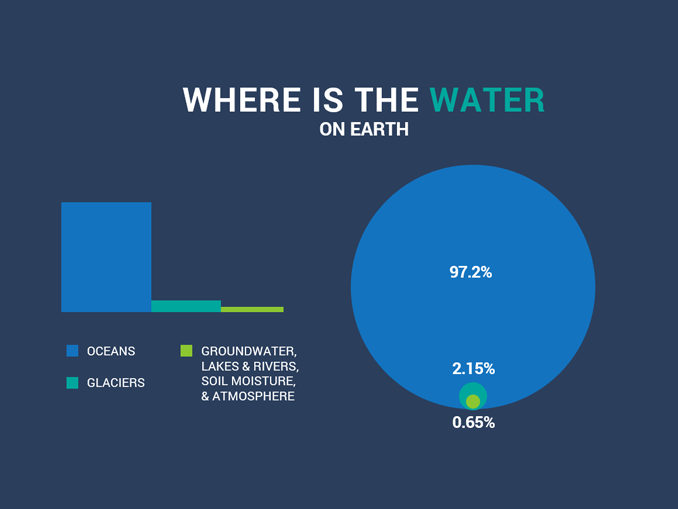
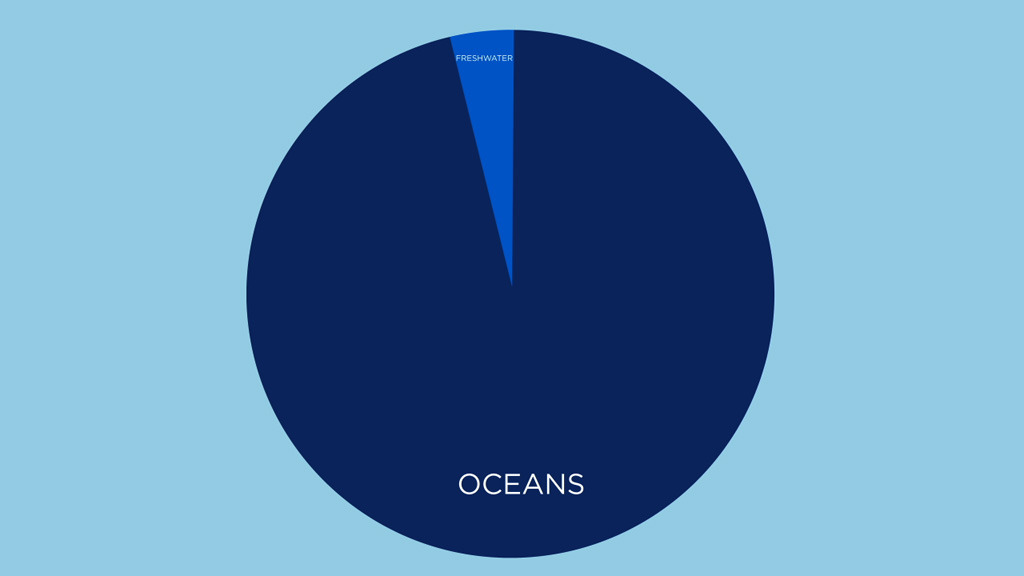
The question of freshwater availability on Earth is not merely an academic curiosity; it’s a fundamental query that underpins global sustainability, resource management, and human development. While our planet is famously dubbed the “Blue Marble,” the vast expanse of oceans conceals a stark reality: the overwhelming majority of this water is saline. Understanding the precise percentage of freshwater is crucial, and technology plays an increasingly vital role in not only quantifying this resource but also in how we access, purify, and distribute it. This article delves into the technological underpinnings of freshwater assessment and management, exploring the innovations that help us comprehend and confront the global water challenge.

The Technological Landscape of Water Assessment
Accurately determining the percentage of freshwater on Earth is a monumental task, one that has evolved significantly with advancements in technology. From early estimations to sophisticated satellite imaging and sophisticated hydrological modeling, technology has been the backbone of our understanding.
Remote Sensing and Satellite Technology
The dawn of the space age revolutionized our ability to survey Earth’s resources. For water assessment, satellite technology offers an unparalleled perspective. Orbiting platforms equipped with multispectral and hyperspectral sensors can detect variations in water bodies based on their physical and chemical properties.
Measuring Surface Water Extent and Salinity
Satellites like Landsat and Sentinel provide continuous monitoring of lakes, rivers, and reservoirs. By analyzing reflected light and thermal emissions, scientists can map the surface area of freshwater bodies with remarkable precision. Furthermore, advancements in microwave radiometry and altimetry allow for the estimation of surface salinity. While direct salinity measurement from space is challenging for inland waters, these technologies are invaluable for understanding the broader oceanic salinity patterns and identifying areas where freshwater inputs might be diluted or influenced by saltwater intrusion. For instance, missions like the European Space Agency’s (ESA) Soil Moisture and Ocean Salinity (SMOS) satellite are dedicated to measuring soil moisture and ocean salinity, indirectly contributing to a holistic understanding of Earth’s water cycle.
Groundwater Detection and Mapping
Perhaps the most elusive freshwater resource is groundwater. Traditional methods involve extensive drilling and physical surveying, which are costly and time-consuming. However, new technologies are emerging to address this challenge. Gravity recovery and climate experiment (GRACE) satellites, for example, measure minute changes in Earth’s gravity field. These variations can be directly linked to changes in water mass, including underground aquifers. By observing these gravitational anomalies over time, scientists can infer whether groundwater reserves are being depleted or replenished. Furthermore, advanced ground-penetrating radar (GPR) and electromagnetic induction (EMI) techniques, often deployed from drones or specialized vehicles, offer high-resolution mapping of shallow groundwater tables and aquifer boundaries. These technologies are transforming our ability to identify and manage this vital subterranean resource.
Hydrological Modeling and Big Data Analytics
While remote sensing provides raw data, it’s the sophisticated hydrological models, powered by big data analytics and high-performance computing, that truly allow us to synthesize this information and understand the intricate dynamics of freshwater distribution.
Global Water Cycle Simulation
Complex computer models are built to simulate the entire global water cycle – evaporation, transpiration, precipitation, runoff, and infiltration. These models integrate data from satellites, ground-based weather stations, stream gauges, and even citizen science initiatives. By running these simulations, researchers can estimate the total volume of freshwater present in various reservoirs – glaciers, ice caps, groundwater, lakes, rivers, and soil moisture – and how it changes seasonally and over longer climatic timescales. The resolution and accuracy of these models are constantly improving, thanks to increased computational power and more comprehensive datasets.
Predictive Analytics for Water Scarcity
Beyond current assessment, technology is crucial for predicting future water availability. Machine learning algorithms and artificial intelligence (AI) are being trained on historical hydrological data, climate projections, and land-use patterns to forecast regions at risk of water scarcity. These predictive models can inform policy decisions, aid in infrastructure planning (e.g., reservoirs, desalination plants), and support early warning systems for droughts. The ability to anticipate water stress allows for proactive interventions, mitigating the socio-economic impacts of shortages.
Technological Innovations in Freshwater Access and Purification
Even if we accurately know the percentage of freshwater, its accessibility and usability are heavily dependent on technological solutions, particularly in regions facing scarcity or dealing with contaminated sources.
Desalination Technologies: A Growing Frontier
With over 97% of Earth’s water being saltwater, desalination – the process of removing salt and other minerals from seawater or brackish water – represents a critical technological frontier for expanding freshwater supplies. While historically energy-intensive and costly, continuous innovation is making desalination more viable.
Reverse Osmosis (RO) Advancements
Reverse osmosis (RO) is currently the most widely used desalination technology. It employs semipermeable membranes to filter out salts under pressure. Recent technological leaps in RO include the development of more durable and efficient membranes, improved energy recovery systems that recapture energy from the brine stream, and advanced pre-treatment processes that reduce membrane fouling. Nanotechnology is also playing a role, with research into novel nanomaterials for membranes that can achieve higher filtration rates with less energy. Automated monitoring systems and AI-driven operational adjustments are further optimizing the performance and reducing the operational costs of RO plants.
Emerging Desalination Techniques
Beyond RO, research and development are exploring alternative desalination methods. Forward Osmosis (FO) is gaining traction, using a semipermeable membrane and a concentrated “draw solution” to pull water from saline sources. This method is often more energy-efficient for certain applications and can be coupled with other processes. Membrane distillation (MD) is another promising technique that utilizes a temperature gradient across a hydrophobic membrane to evaporate water, leaving salts behind. Technologies like electrodialysis (ED) use electrical fields to separate ions and are particularly effective for brackish water. The ongoing pursuit of innovative desalination technologies is driven by the imperative to unlock vast, untapped saltwater resources.
Water Treatment and Purification Systems
For freshwater sources that are contaminated by pollutants, pathogens, or industrial waste, advanced treatment and purification technologies are essential to render them safe for consumption and other uses.
Advanced Filtration and Membrane Technologies
Similar to desalination, advanced filtration and membrane technologies are crucial for treating freshwater. Ultrafiltration (UF) and nanofiltration (NF) membranes can remove suspended solids, bacteria, viruses, and even dissolved organic matter and certain minerals from freshwater sources. These systems are often more compact and energy-efficient than traditional treatment methods and are finding applications in both large-scale municipal treatment plants and smaller, localized purification units.
Emerging Disinfection and Purification Methods
Beyond physical filtration, new disinfection methods are transforming water purification. Ultraviolet (UV) disinfection, which uses UV light to inactivate microorganisms, is becoming more widespread due to its effectiveness and lack of chemical byproducts. Electrochemical disinfection methods are also being explored, utilizing electrical currents to kill pathogens. Furthermore, the integration of sensors with AI-powered analytics allows for real-time monitoring of water quality and automated adjustments to purification processes, ensuring consistent safety and efficiency. Innovations in activated carbon filtration and advanced oxidation processes are also helping to remove emerging contaminants like pharmaceuticals and microplastics.
The Role of Technology in Water Management and Conservation
Beyond assessing and purifying, technology is pivotal in how we manage and conserve the limited freshwater resources available to us. This includes smart infrastructure, data-driven conservation strategies, and innovative approaches to water reuse.
Smart Water Grids and IoT Technologies
The concept of a “smart water grid” is revolutionizing water management. Leveraging the Internet of Things (IoT), these systems integrate sensors, communication networks, and data analytics to provide real-time insights into water distribution and consumption.
Real-time Monitoring and Leak Detection
Sensors embedded in water pipes can monitor flow rates, pressure, and acoustic anomalies. AI algorithms can analyze this data to detect leaks instantaneously, often before they become significant issues. This not only conserves water but also reduces the energy required for pumping and the cost of repairs. Smart meters at the consumer level provide granular data on water usage, empowering both utilities and individuals to identify inefficiencies.
Optimized Distribution and Demand Management
By understanding real-time demand patterns through smart grids, water utilities can optimize the distribution of treated water, ensuring that supply meets demand efficiently and minimizing energy expenditure. Predictive analytics, powered by smart grid data, can forecast demand fluctuations, allowing for proactive operational adjustments. This intelligent management system is crucial for ensuring equitable distribution and preventing shortages.
Water Reuse and Recycling Technologies
As freshwater scarcity intensifies, the technologies that enable water reuse and recycling are becoming indispensable. Treating wastewater to a standard where it can be safely reintroduced into the water cycle offers a sustainable alternative to relying solely on virgin freshwater sources.
Advanced Wastewater Treatment for Reuse
Modern wastewater treatment plants employ multi-stage processes, including biological treatment, membrane filtration (UF, NF), and advanced disinfection (UV, ozone), to remove contaminants and pathogens from municipal and industrial wastewater. This treated effluent can then be used for a variety of purposes, such as irrigation, industrial processes, groundwater recharge, and even, in some advanced systems, for potable reuse after rigorous purification and monitoring. Technologies like membrane bioreactors (MBRs) combine biological treatment with membrane filtration in a single unit, offering a compact and highly efficient solution for wastewater treatment and reuse.
Industrial Water Recycling and Closed-Loop Systems
Industries often consume large volumes of water. Technological advancements are enabling industries to implement closed-loop water systems where water is treated and reused within their own facilities, significantly reducing their reliance on external freshwater sources. This includes specialized filtration, evaporation, and purification technologies tailored to the specific needs of different industrial processes. The economic and environmental benefits of such systems are substantial, contributing to both water conservation and operational efficiency.
In conclusion, while the precise percentage of freshwater on Earth remains a static figure that hovers around 2.5%, the dynamic and ever-evolving landscape of technology is fundamentally changing our relationship with this precious resource. From the satellite-driven quantification of our planet’s water reserves to the sophisticated engineering of desalination and purification systems, technology is at the forefront of addressing global water challenges. The continuous innovation in smart grids, data analytics, and reuse technologies offers a hopeful pathway towards more sustainable and equitable water management for generations to come. Understanding this technological imperative is key to ensuring that the finite freshwater available on Earth can continue to sustain life and development.
aViewFromTheCave is a participant in the Amazon Services LLC Associates Program, an affiliate advertising program designed to provide a means for sites to earn advertising fees by advertising and linking to Amazon.com. Amazon, the Amazon logo, AmazonSupply, and the AmazonSupply logo are trademarks of Amazon.com, Inc. or its affiliates. As an Amazon Associate we earn affiliate commissions from qualifying purchases.