
Understanding how interest works is the cornerstone of personal finance. While most people see a few extra dollars appear in their bank statement every month, few truly grasp the underlying mechanics that turn a modest deposit into a significant nest egg over time. Knowing how to calculate interest on a savings account is not just a mathematical exercise; it is a vital skill for anyone looking to optimize their financial health, compare banking products, and plan for long-term goals.
In this guide, we will break down the complexities of interest calculations, explore the difference between simple and compound growth, and provide you with the tools necessary to forecast your financial future with precision.

Understanding the Fundamentals of Interest: Simple vs. Compound
To accurately calculate your returns, you must first understand the two primary ways interest is applied to an account. While most modern savings accounts use compound interest, the concept of simple interest provides the foundational logic needed to understand more complex systems.
The Logic of Simple Interest
Simple interest is calculated solely on the initial amount of money you deposit, known as the principal. It does not take into account any interest that has accumulated over previous periods. While rare in modern savings accounts (more common in short-term loans or specific types of bonds), it is the easiest way to visualize how a rate applies to a balance.
The formula for simple interest is:
Interest = Principal × Annual Interest Rate × Time (in years)
For example, if you deposit $10,000 at a 5% simple interest rate for three years, you would earn $500 each year. At the end of the term, you would have $11,500.
The Power of Compound Interest
Compound interest is what financial experts often call “money making money.” Unlike simple interest, compound interest is calculated on the principal plus any interest that has already been added to the account. This creates a snowball effect where your wealth grows at an accelerating rate.
The frequency of compounding—whether it is daily, monthly, or annually—drastically affects your final balance. Most high-yield savings accounts compound interest daily and credit it to your account monthly. The more frequently interest compounds, the faster your balance grows.
The Variables That Influence Your Earnings
Before you plug numbers into a formula, you must identify the key variables that dictate how much a bank pays you. These variables are often listed in the fine print of your account agreement.
Principal and Periodic Deposits
The principal is your starting point. However, your interest earnings are rarely static because most savers contribute to their accounts over time. Calculating interest on a fluctuating balance requires looking at the “average daily balance,” which most banks use to determine the interest owed for a specific month.
APR vs. APY: Knowing the Difference
One of the most common points of confusion in personal finance is the difference between the Annual Percentage Rate (APR) and the Annual Percentage Yield (APY).
- APR reflects the simple interest rate over a year without accounting for compounding.
- APY reflects the real rate of return, including the effect of compounding.
When comparing savings accounts, always look at the APY. A 4.00% APR compounded daily actually results in a 4.08% APY. Over large sums and long periods, this fraction of a percent represents thousands of dollars.
The Impact of Time and Inflation
Time is the most potent variable in the interest equation. Because of the exponential nature of compounding, the “time in the market” is often more important than the “timing of the market.” However, savvy savers also consider the “real rate of return,” which is the interest rate minus the inflation rate. If your savings account earns 4% but inflation is at 3%, your purchasing power is only growing by 1%.
Step-by-Step Guide to Calculating Interest Manually
While online calculators are convenient, performing a manual calculation helps you understand the “why” behind your bank statement. Here is how to calculate compound interest using the standard formula.

The Compound Interest Formula
The standard formula for compound interest is:
A = P (1 + r/n)^(nt)
- A = The total amount of money accumulated after n years, including interest.
- P = The principal investment amount.
- r = The annual interest rate (decimal).
- n = The number of times that interest is compounded per year.
- t = The number of years the money is invested for.
A Practical Example
Suppose you have $5,000 in a high-yield savings account with a 4.5% interest rate, compounded monthly, and you want to know how much you will have after five years.
- Identify variables: P = 5,000; r = 0.045; n = 12; t = 5.
- Divide rate by compounding periods: 0.045 / 12 = 0.00375.
- Add 1 to the result: 1.00375.
- Calculate the exponent (n × t): 12 × 5 = 60.
- Raise the result to the power of the exponent: (1.00375)^60 ≈ 1.2517.
- Multiply by the principal: 5,000 × 1.2517 = $6,258.50.
In this scenario, you earned $1,258.50 in interest over five years simply by letting the money sit.
Calculating Monthly Interest Earned
If you want to see what your next monthly statement might look like, use this simplified daily interest formula:
(Account Balance × Interest Rate) / 365 days × Number of days in the month.
If you have $10,000 at 4% interest in a 31-day month:
($10,000 × 0.04) / 365 = $1.095 (daily interest)
$1.095 × 31 = $33.95 (monthly interest)
Maximizing Your Returns: Strategies for High-Yield Accounts
Knowing how to calculate interest is only half the battle; the other half is positioning your capital to earn the highest possible rate. In the current economic climate, traditional “big box” banks often offer measurably lower rates than online-only institutions.
Seeking High-Yield Savings Accounts (HYSA)
Brick-and-mortar banks often offer interest rates as low as 0.01%. In contrast, online banks can offer rates upwards of 4% or 5% because they have lower overhead costs. Over a decade, the difference between 0.01% and 4.5% on a $20,000 emergency fund is the difference between earning $20 and earning nearly $11,000 in interest.
The Strategy of “Interest Rate Chasing”
While it is not always practical to move money every month, staying informed about the Federal Reserve’s rate hikes or cuts is essential. When the Fed raises the federal funds rate, HYSAs typically follow suit. If your current bank hasn’t raised its rates in response to market trends, it may be time to move your principal to a more competitive institution.
Tax Implications of Earned Interest
It is a common mistake to forget that the IRS views interest earned as taxable income. At the end of the year, your bank will send you a Form 1099-INT if you earned more than $10 in interest. When calculating your “true” earnings, you must factor in your marginal tax rate. If you are in the 22% tax bracket, 22 cents of every dollar you earn in interest will go to the government, which is why some investors eventually look toward tax-advantaged accounts or municipal bonds as their wealth grows.
Tools and Resources for Accurate Financial Planning
In the digital age, you don’t need to do long-form algebra to manage your money. Several tools can help automate your interest calculations and projections.
Spreadsheet Automation
For those who like customized tracking, Microsoft Excel or Google Sheets are invaluable. Using the formula =FV(rate/n, n*t, 0, -P), you can create a dynamic dashboard that shows how your savings will grow if you change your monthly contribution or if the bank changes its interest rate.
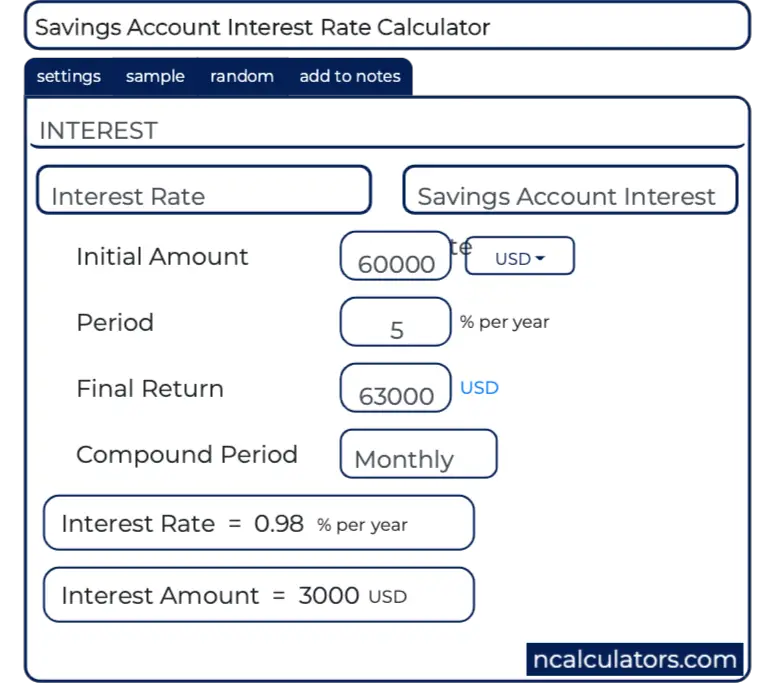
Online Calculators and Financial Apps
Many fintech platforms provide “What-If” scenarios. These tools allow you to visualize the impact of compounding over 10, 20, or 30 years. Using these resources can be a powerful psychological motivator; seeing a graph of your potential wealth often encourages more disciplined saving habits.
Periodic Financial Audits
Set a schedule—perhaps once every quarter—to recalculate your projected interest. Check your APY against the current market leaders. This ensures that your money is always working as hard as possible for you.
Calculating interest is more than a clerical task; it is an act of financial stewardship. By understanding the variables of principal, rate, and time, and by leveraging the exponential power of compounding, you transform your savings account from a stagnant bucket of cash into a dynamic engine for wealth creation. Whether you are saving for a house, an emergency fund, or retirement, the ability to forecast your earnings ensures that you remain the architect of your own financial future.
aViewFromTheCave is a participant in the Amazon Services LLC Associates Program, an affiliate advertising program designed to provide a means for sites to earn advertising fees by advertising and linking to Amazon.com. Amazon, the Amazon logo, AmazonSupply, and the AmazonSupply logo are trademarks of Amazon.com, Inc. or its affiliates. As an Amazon Associate we earn affiliate commissions from qualifying purchases.