
Purchasing a vehicle is one of the most significant financial decisions the average person will make, often second only to buying a home. Yet, it is frequently the area where most individuals make their gravest financial errors. The allure of a new car—the scent of the interior, the advanced safety features, and the social status it conveys—often clouds the cold, hard mathematics of personal finance.
To answer the question “How much car can I afford?”, one must look beyond the monthly payment and examine the long-term impact on their net worth, debt-to-income ratio, and future investment goals. This guide provides a professional framework for navigating the complexities of vehicle affordability, ensuring that your next ride accelerates your lifestyle without stalling your financial progress.

Mastering the 20/4/10 Rule of Vehicle Financing
In the world of personal finance, the “20/4/10 Rule” serves as the gold standard for maintaining a healthy balance between transportation needs and financial stability. This framework prevents buyers from becoming “car poor”—a state where a disproportionate amount of income is dedicated to a depreciating asset.
The 20% Down Payment
A common mistake in modern car buying is the “zero down” offer. While enticing, starting a loan with zero equity puts the buyer immediately underwater because a car’s value drops the moment it leaves the lot. By putting at least 20% down, you create a financial buffer. This equity protects you if the car is totaled or if you need to sell it unexpectedly, ensuring that the insurance payout or sale price covers the remaining loan balance.
The 4-Year Loan Term
While 72-month and 84-month loans are becoming the industry norm, they are often a trap designed to make expensive cars appear affordable through lower monthly payments. A 4-year (48-month) term is the maximum recommended duration for an auto loan. Shorter terms result in less interest paid over the life of the loan and force you to buy a car that truly fits your budget. If you cannot afford the payments on a 4-year term, the car is likely too expensive for your current income.
The 10% Income Cap
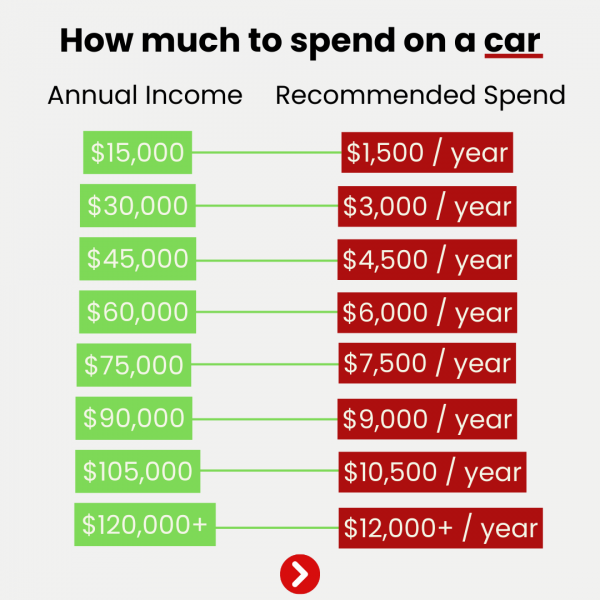
The final pillar of this rule dictates that your total transportation costs—including loan payments, insurance, and fuel—should not exceed 10% of your gross monthly income. For some conservative financial planners, this figure is applied to net (take-home) income for even greater security. Adhering to this cap ensures that you have sufficient remaining capital to fund your retirement accounts, emergency fund, and other essential living expenses.
Calculating the Total Cost of Ownership (TCO)
The sticker price of a car is merely the tip of the iceberg. To understand true affordability, one must calculate the Total Cost of Ownership (TCO). This encompasses every dollar that will leave your pocket over the duration of your ownership.
Insurance Premiums and Registration
Insurance costs vary wildly based on the vehicle’s safety rating, repair costs, and performance capabilities. Before signing a purchase agreement, it is vital to obtain an insurance quote for the specific VIN or model. Additionally, annual registration fees and sales taxes can add thousands of dollars to the initial cost. In some states, personal property taxes on vehicles are an ongoing annual expense that must be factored into the monthly budget.
Maintenance, Repairs, and Consumables
Every vehicle requires maintenance, but the costs are not distributed equally across brands. Luxury European imports often require specialized parts and labor that can double or triple the maintenance budget compared to a domestic or Japanese economy car. Beyond scheduled oil changes, one must account for “consumables”—tires, brakes, and batteries. A set of high-performance tires for a sports SUV can cost significantly more than standard tires for a sedan, impacting your long-term liquidity.
The Hidden Tax of Depreciation
While not a direct monthly out-of-pocket expense, depreciation is the single largest cost of car ownership. Most new cars lose roughly 20% of their value in the first year and 60% within the first five years. From a wealth-building perspective, you are trading liquid capital for a rapidly devaluing asset. Understanding the depreciation curve of different brands allows a savvy buyer to choose vehicles that “hold their value,” effectively lowering the TCO when it comes time to trade or sell.

The Role of Credit Scores and Interest Rates in Affordability
Your creditworthiness is the engine that drives your financing options. A difference of a few percentage points in an interest rate can translate into thousands of dollars over the life of a loan, directly impacting how much “car” your money can actually buy.
How Your Score Impacts the Annual Percentage Rate (APR)
Lenders use your credit score to gauge the risk of default. “Prime” borrowers (typically those with scores above 720) qualify for the lowest promotional rates, sometimes as low as 0% to 3%. “Subprime” borrowers may face rates of 15% to 25%. On a $30,000 loan, the difference between a 3% rate and an 18% rate is nearly $11,000 in interest alone. Improving your credit score before shopping is often the most effective way to increase your car-buying power.
The Long-Term Cost of High-Interest Debt
High-interest auto loans are “toxic debt” because the interest rate often exceeds the expected return on most traditional investments. If you are forced into a high-interest loan due to poor credit, the priority should be a reliable, low-cost vehicle that allows you to rebuild your credit and refinance or pay off the debt early. Using a car loan as a tool to build credit is only effective if the payment is manageable and doesn’t lead to further financial strain.
Strategic Decision-Making: New, Used, or Lease?
Once the budget is established, the next financial crossroads is determining the acquisition strategy. Each path has distinct implications for your balance sheet.
The New Car Premium vs. Used Value
The primary benefit of a new car is the manufacturer’s warranty and the absence of a “history.” However, the financial cost of this peace of mind is the steep initial depreciation mentioned earlier. The “sweet spot” for many financial experts is the 2- to 3-year-old certified pre-owned (CPO) vehicle. These cars have already taken the largest depreciation hit but still offer modern safety features and often include an extended factory warranty.
Leasing as a Financial Tool
Leasing is often criticized in the personal finance community because it results in no equity at the end of the term. However, for business owners who can deduct lease payments as a business expense, or for individuals who prioritize driving a new vehicle every three years without the hassle of resale, it can be a calculated choice. The key is understanding that leasing is a lifestyle choice, not a wealth-building one. It generally remains the most expensive way to operate a vehicle over a lifetime.
The Opportunity Cost of a Car Payment
Every dollar sent to a car lender is a dollar that isn’t being invested in the stock market or real estate. If you invest $500 a month in a diversified index fund starting at age 25, you could potentially have over $1 million by age 65 (assuming a 7% average annual return). If that same $500 is perpetually tied up in a car payment, the “cost” of the car isn’t just the sticker price—it’s the lost millions in retirement.
Integrating the Purchase into Your Broader Financial Plan
A car should never be viewed in isolation. It must be a integrated component of your total financial ecosystem.
Analyzing Your Debt-to-Income (DTI) Ratio
Lenders look at your DTI when you apply for a mortgage. If a high car payment pushes your DTI above 36-43%, you may find yourself unable to qualify for a home loan. Before committing to a vehicle, consider your 5-year plan. If homeownership is on the horizon, a modest car choice today could be the key to securing a mortgage tomorrow.
The Sinking Fund Strategy
The most financially sound way to “afford” a car is to pay in cash. If a loan is necessary, the goal should be to make it your last one. By continuing to “pay yourself” a car payment into a dedicated savings account (a sinking fund) after your current loan is paid off, you can accumulate the cash needed for your next vehicle. This turns the tables on the financial institutions, allowing you to earn interest on your money rather than paying it to them.
In conclusion, determining how much car you can afford requires a transition from emotional shopping to clinical financial analysis. By adhering to the 20/4/10 rule, accounting for the total cost of ownership, and respecting the impact of interest and depreciation, you can enjoy the utility and pleasure of a vehicle without compromising your long-term financial independence. A car is a tool for transportation; don’t let it become a barrier to your wealth.
aViewFromTheCave is a participant in the Amazon Services LLC Associates Program, an affiliate advertising program designed to provide a means for sites to earn advertising fees by advertising and linking to Amazon.com. Amazon, the Amazon logo, AmazonSupply, and the AmazonSupply logo are trademarks of Amazon.com, Inc. or its affiliates. As an Amazon Associate we earn affiliate commissions from qualifying purchases.