
The question of what a single Bitcoin is “worth” is perhaps the most debated topic in modern finance. To some, it is a speculative bubble with no intrinsic value; to others, it is “digital gold,” a revolutionary financial asset that represents the future of global wealth preservation. Unlike a stock, which is valued based on discounted future cash flows, or a bond, which is valued by its yield, Bitcoin does not produce earnings or dividends. This makes its valuation a unique challenge that requires a deep dive into market psychology, monetary policy, and the fundamental shift in how we perceive money in the 21st century.

The Mechanics of Market Value: Supply, Demand, and Scarcity
At its most basic level, the “worth” of a Bitcoin is determined by the same force that governs any other commodity: the equilibrium between supply and demand. However, Bitcoin introduces a mathematical certainty to the supply side that is unprecedented in the history of money.
The Impact of the 21 Million Cap
In traditional fiat currency systems, central banks can increase the money supply at will, leading to the devaluation of the currency over time. Bitcoin operates on a “hard cap” of 21 million coins. This programmed scarcity is the bedrock of its value proposition. As of today, over 19 million Bitcoins have already been mined. The decreasing rate of new supply—enforced by the “halving” event every four years—creates a supply shock that has historically preceded significant price appreciation. From an investment perspective, when demand increases against a fixed or shrinking supply growth rate, the price must rise to clear the market.
Liquidity and Market Sentiments
Beyond fixed supply, Bitcoin’s worth is influenced by its liquidity. As one of the most liquid assets in the world, it trades 24/7 across hundreds of global exchanges. This constant price discovery means that Bitcoin is worth exactly what the next person is willing to pay for it at any given second. In the short term, this price is driven by market sentiment, macroeconomic news (such as CPI data or Federal Reserve interest rate decisions), and institutional flows. For the retail investor, understanding that “worth” is a moving target driven by global liquidity is essential for managing volatility.
Valuation Models: How Analysts Measure Bitcoin’s Price
Because Bitcoin lacks traditional financial metrics like a P/E (Price-to-Earnings) ratio, financial analysts have developed alternative models to estimate its “fair value.” These models attempt to strip away the noise of daily volatility to find a fundamental baseline.
The Stock-to-Flow (S2F) Model
Originally applied to precious metals like gold and silver, the Stock-to-Flow model measures the relationship between the existing “stock” (total supply) and the “flow” (newly produced supply entering the market). A higher ratio indicates that an asset is increasingly scarce. Because Bitcoin’s flow is cut in half every four years, its S2F ratio continues to climb, leading some analysts to project valuations in the hundreds of thousands, or even millions, of dollars per coin. While the model is controversial and has faced criticism for not accounting for demand-side collapses, it remains a primary framework for long-term “Money” niche investors.
Metcalfe’s Law and Network Effects
Another popular valuation method is based on Metcalfe’s Law, which states that the value of a network is proportional to the square of the number of its connected users. This is the same principle used to value social media giants like Facebook or telecommunications networks. In the context of Bitcoin, as the number of active wallets, transaction volume, and merchant adoption grows, the intrinsic value of the network increases. Investors using this model view Bitcoin not just as a coin, but as a financial rail. The more people who use the rail, the more valuable each “share” (Bitcoin) of that rail becomes.
The Cost of Production Model
For those who prefer a “bottom-up” approach, the cost of production model calculates the worth of a Bitcoin based on the energy and hardware costs required to mine one. Bitcoin miners act as a floor for the price; if the market price falls significantly below the cost of mining, miners may shut down, reducing the hash rate and eventually leading to a difficulty adjustment that stabilizes the ecosystem. Historically, the cost of production has served as a reliable support level during bear markets, providing a “fundamental” value based on real-world resource expenditure.
Bitcoin as a Strategic Asset Class
To understand what a Bitcoin is worth, one must look at its role within a broader investment portfolio. It is increasingly being viewed not as a medium of exchange for daily coffee purchases, but as a strategic reserve asset.
The “Digital Gold” Thesis
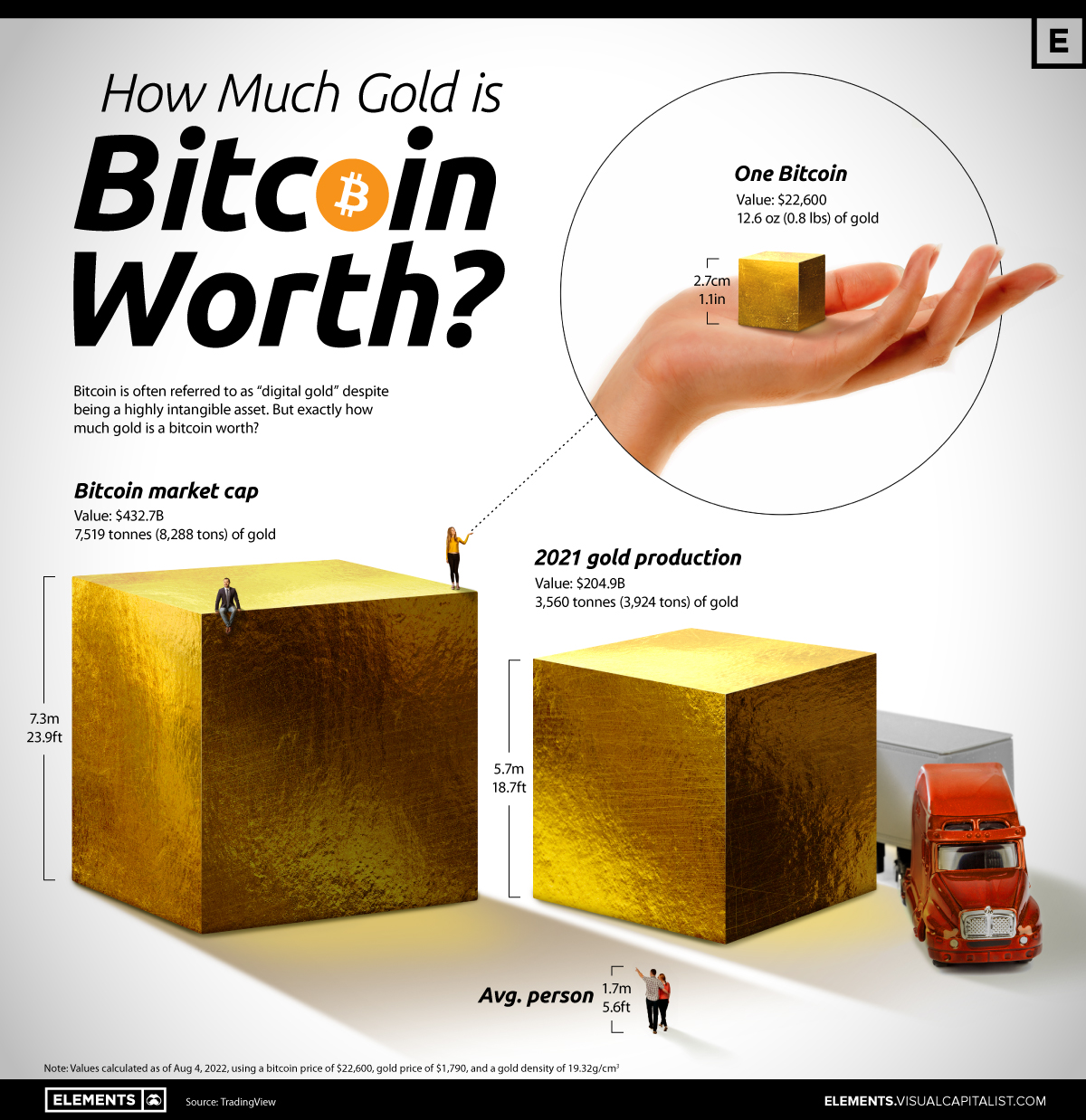
The most prevalent narrative in the financial sector is that Bitcoin is a superior version of gold. Gold has a market cap of roughly $14 trillion. If Bitcoin were to capture even 20% of gold’s market share as a global store of value, its price would need to reach several hundred thousand dollars per coin. Unlike physical gold, Bitcoin is weightless, infinitely divisible, and can be sent across the globe in minutes. For institutional investors, Bitcoin’s “worth” is tied to its potential to disrupt the centuries-old monopoly gold has held on wealth preservation.
Diversification and Risk-Adjusted Returns
From a portfolio management perspective, Bitcoin’s worth lies in its low correlation with traditional assets like stocks and bonds over long time horizons. Adding a small allocation of Bitcoin (1% to 5%) to a traditional 60/40 portfolio has historically increased the total return without significantly increasing the maximum drawdown. This “asymmetric risk-return profile”—where the potential upside is significantly greater than the 100% downside—is a key reason why wealth managers are increasingly including it in client portfolios.
External Factors: Inflation, Regulation, and Institutional Adoption
The financial environment in which Bitcoin exists plays a massive role in its valuation. Bitcoin does not exist in a vacuum; it is a response to the current global financial system.
Hedging Against Fiat Devaluation
When inflation rises and the purchasing power of currencies like the US Dollar or the Euro declines, the relative worth of Bitcoin tends to increase. Investors flee to “hard assets” that cannot be debased. In countries experiencing hyperinflation, such as Argentina or Turkey, the “worth” of Bitcoin is often much higher than the global spot price because it represents a lifeline for protecting one’s life savings. In this sense, Bitcoin acts as an insurance policy against monetary mismanagement.
The Institutional “Seal of Approval”
The recent approval of Spot Bitcoin ETFs (Exchange-Traded Funds) by major financial institutions like BlackRock and Fidelity has fundamentally changed the valuation landscape. These financial tools allow pension funds, 401(k) providers, and sovereign wealth funds to invest in Bitcoin through traditional brokerage accounts. This “wall of money” creates a new baseline of demand that was previously inaccessible. As Bitcoin moves from the “fringe” of finance to a standard component of institutional balance sheets, its perceived risk decreases, which traditionally leads to a higher valuation floor.
Regulatory Clarity and Market Stability
The worth of an asset is also tied to its legal status. In the past, the threat of a “government ban” acted as a weight on Bitcoin’s price. However, as major economies develop clear regulatory frameworks (like MICA in Europe), the “existential risk” premium begins to fade. While regulation may seem counter-intuitive to the “decentralized” ethos, from a Money and Investment standpoint, it provides the certainty required for large-scale capital entry, which is a necessary precursor for the next stage of price discovery.
Conclusion: The Subjective and Objective Worth
In the final analysis, what is a Bitcoin worth? Objectively, it is worth the current market price reflected on global exchanges—a figure that fluctuates based on liquidity and macro trends. Subjectively, however, its worth is determined by its utility as a censorship-resistant, borderless, and provably scarce form of money.
For the short-term trader, Bitcoin is a high-volatility instrument for capturing alpha. For the long-term investor, it is a revolutionary tool for escaping the cycle of currency devaluation. As the world becomes increasingly digital and trust in centralized institutions fluctuates, the “worth” of a decentralized, math-based asset is likely to be measured not just in dollars, but in the freedom and security it provides to the holder. Whether it settles at $50,000 or $500,000, its true value lies in its role as the first successful attempt at a global, private, and immutable ledger of value.
aViewFromTheCave is a participant in the Amazon Services LLC Associates Program, an affiliate advertising program designed to provide a means for sites to earn advertising fees by advertising and linking to Amazon.com. Amazon, the Amazon logo, AmazonSupply, and the AmazonSupply logo are trademarks of Amazon.com, Inc. or its affiliates. As an Amazon Associate we earn affiliate commissions from qualifying purchases.