
The landscape of digital communication is evolving at a breakneck pace. As technology reshapes how we interact, our language adapts to fit the constraints and capabilities of the platforms we use. From the early days of 160-character SMS limits to the sophisticated, AI-driven instant messaging apps of today, brevity has remained a cornerstone of digital literacy. One such term that has permeated our screens is “mmk.” While it may seem like a simple typo or a random string of characters to the uninitiated, “mmk” is a nuanced component of the modern digital lexicon.

In this exploration, we will dive into the technological origins of text shorthand, the specific meaning and usage of “mmk,” and how the software we use every day—from predictive text algorithms to enterprise communication tools—influences the way we talk to one another.
The Evolution of Digital Shorthand in Messaging Apps
To understand “mmk,” one must first understand the technological environment that birthed it. Digital shorthand is not merely a product of “lazy” typing; it is a strategic response to the evolution of mobile hardware and software interfaces.
From T9 Predictive Text to Instant Messaging
In the late 1990s and early 2000s, mobile hardware utilized the T9 (Text on 9 keys) system. Typing a single word required multiple rhythmic presses on a numeric keypad. This friction led users to develop heavy abbreviations to save time and reduce physical strain. While we have transitioned to capacitive touchscreens and full QWERTY virtual keyboards, the cultural habit of brevity has stuck.
“MMK” is a direct descendant of this efficiency-first mindset. As messaging moved from SMS to internet-protocol-based apps like WhatsApp, iMessage, and Telegram, the cost of sending a message dropped to near zero, but the “time cost” of typing remained. Shorthand like “mmk” allows for a rapid-fire exchange that mimics the cadence of a real-life conversation more closely than formal prose.
The Efficiency of Compression in Modern UI
Modern User Interface (UI) design focuses on minimizing the “interaction cost”—the sum of mental and physical effort a user must exert to reach a goal. In the context of a text message, the goal is often acknowledgment.
When a developer designs a messaging app, they prioritize speed. Features like “Quick Replies” or “Tapback” reactions (the heart, thumbs up, or laugh icons) are software solutions to the need for brief acknowledgment. “MMK” serves a similar purpose for the user; it is a manual “quick reply” that signifies the message has been read and understood without requiring the formality of a full sentence.
Breaking Down “MMK”: Meaning and Context in the Tech Landscape
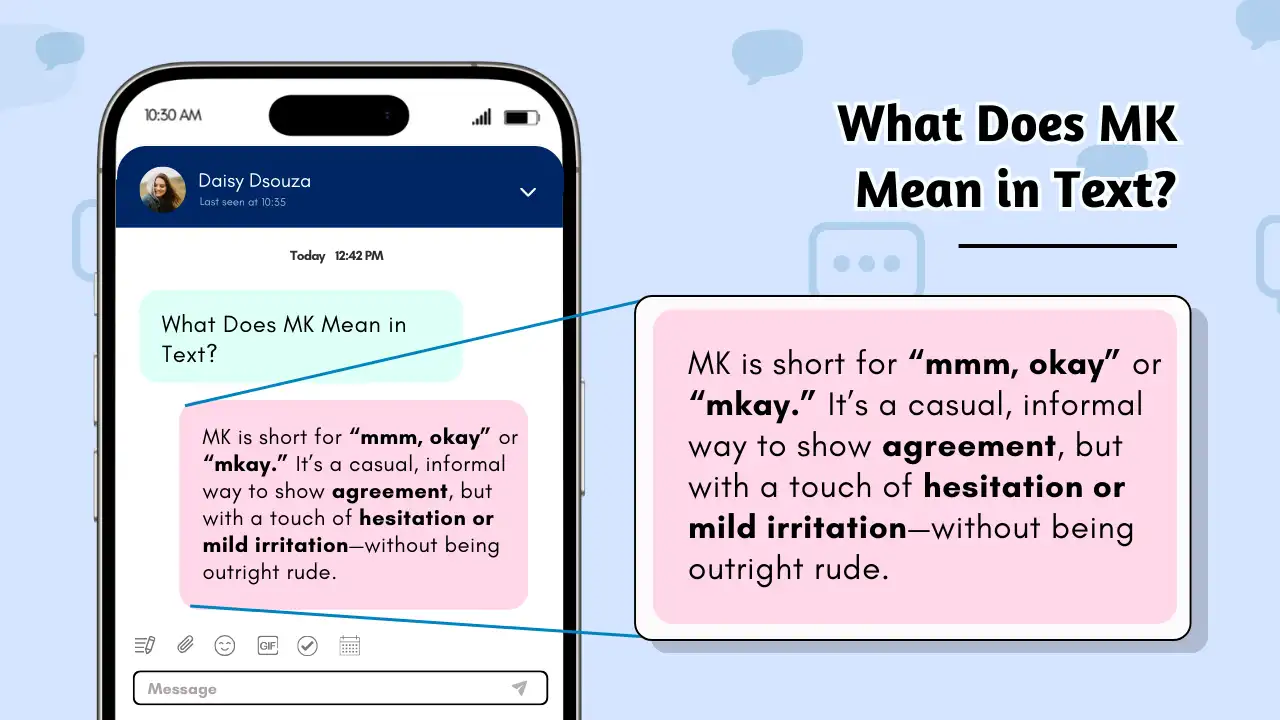
At its core, “mmk” is a phonetic spelling of the way a person might say “Mmm, okay” in a verbal conversation. However, in the realm of digital text, its meaning can shift based on the software context and the relationship between the participants.
Linguistic Origins: The Phonetic “Mmm-kay”
Unlike “OK,” which is a standard affirmation, or “K,” which can often come across as cold or dismissive in a digital context, “mmk” carries a specific tonal quality. The double “m” suggests a moment of reflection or a humming sound of agreement. In the world of Natural Language Processing (NLP), this is known as a “backchannel communication”—a way to show you are listening without taking over the conversation.
Technologically, the rise of “mmk” reflects a move toward “speech-modelled” texting. As our devices become more integrated into our lives, we no longer view a text as a letter (a formal document) but as a transcript of a spoken thought. “MMK” captures the nuance of human speech that “OK” sometimes lacks.
Nuance and Tone in Digital-Only Communication
One of the greatest challenges in software-mediated communication is the loss of non-verbal cues. Without facial expressions or vocal inflection, text can be easily misinterpreted.
- The Affirmative “mmk”: Used to signal “I hear you and I agree.”
- The Questioning “mmk?”: Used at the end of a set of instructions to mean “Is that understood?”
- The Skeptical “mmk”: Depending on the preceding tech-interaction (such as a delayed response), it can imply a “Sure, if you say so” attitude.
Apps that incorporate “typing indicators” (the three dots that show someone is responding) add another layer to “mmk.” If a user sees those dots for several seconds only to receive an “mmk,” the software has inadvertently signaled that the sender put thought into that specific, brief choice of words.
The Role of AI and Autocorrect in Shaping Textual Slang
The software living inside our smartphones plays a silent but powerful role in how we use slang like “mmk.” We are no longer the sole authors of our messages; we are co-authoring them with sophisticated machine-learning models.
How Natural Language Processing (NLP) Decodes Slang
Modern operating systems like iOS and Android use Natural Language Processing to predict what we are going to type next. When you type “mm,” the keyboard’s dictionary may suggest “mmk” if it has learned your habits.
This creates a feedback loop. Because the software makes it easy to type “mmk” through predictive text or autocorrect “learning,” the user is more likely to use it. Over time, the software’s “User Dictionary” validates the slang, moving it from a non-standard string of letters to a recognized term in the user’s personal digital vocabulary.
Smart Replies and the Algorithmic Adoption of Shorthand
Tech giants like Google have implemented “Smart Reply” features in Gmail and Android Messages. These features use deep learning to suggest three possible responses to an incoming message.
If an algorithm notices that millions of users respond to “See you at 5?” with “mmk,” it may eventually begin suggesting that shorthand as a one-tap button. This is the ultimate intersection of technology and language: when an algorithm codifies a slang term into a clickable UI element, it transitions from “internet speak” into a standardized functional tool.
Digital Etiquette and Security in Professional Communication Tools
As the line between personal and professional technology blurs, terms like “mmk” are migrating from SMS into professional hubs like Slack, Microsoft Teams, and Discord. This migration brings about new questions regarding digital etiquette and even security.
Syncing Informal Language with Corporate Software
Professional communication platforms are designed to increase “velocity”—the speed at which a team can move. In a high-velocity tech environment, long-form emails are often replaced by quick bursts of text. In this setting, “mmk” is frequently used among developers and project managers to acknowledge a technical update or a bug fix.
However, the “professionalism” of such terms is often dictated by the platform’s culture. In a formal CRM (Customer Relationship Management) tool like Salesforce, “mmk” might be seen as unprofessional. In a casual Slack channel dedicated to a specific software sprint, it is the standard language of the trade.
Data Privacy and the Analysis of Text Metadata
From a digital security and data standpoint, every “mmk” sent over a corporate network is a data point. Large-scale organizations often use “sentiment analysis” software to monitor the morale of their workforce or the satisfaction of their customers.
These AI tools are trained to recognize shorthand. If a customer service bot receives an “mmk” from a user, the underlying software must determine if that represents a “positive” sentiment (agreement) or a “neutral/negative” sentiment (dismissiveness). The accuracy of these AI tools depends on their ability to understand the context of slang. Furthermore, in the context of digital forensics, the specific use of “mmk” versus “okay” can even be used to establish a “stylometric” profile—a digital fingerprint of a person’s unique typing style that can be used to verify identity or authorship in cybersecurity investigations.

Conclusion: The Future of Concise Communication
“MMK” is more than just a three-letter text; it is a microcosm of how technology, linguistics, and human behavior intersect. It represents our desire to remain human and expressive within the rigid confines of digital interfaces. As we move toward a future dominated by Voice User Interfaces (VUI) and even more advanced AI assistants, our shorthand will continue to adapt.
For tech-savvy users, understanding these nuances is essential. Whether you are navigating a thread on a developer forum, acknowledging a task in a project management app, or simply texting a friend, “mmk” stands as a testament to the efficiency of modern digital communication. As software continues to learn from us, and we continue to adapt to our software, the language of the future will likely become even more compressed, more algorithmic, and more reflective of the tools we use to connect with the world.
aViewFromTheCave is a participant in the Amazon Services LLC Associates Program, an affiliate advertising program designed to provide a means for sites to earn advertising fees by advertising and linking to Amazon.com. Amazon, the Amazon logo, AmazonSupply, and the AmazonSupply logo are trademarks of Amazon.com, Inc. or its affiliates. As an Amazon Associate we earn affiliate commissions from qualifying purchases.