
In the dynamic world of finance, from managing personal budgets to analyzing investment portfolios and steering business growth, understanding change is paramount. Absolute figures, while providing a snapshot, often fail to convey the true magnitude or significance of a change. This is where the percentage increase between two numbers becomes an indispensable tool. It transforms raw data into meaningful insights, offering a standardized way to measure growth, progress, and performance across diverse financial contexts. Whether you’re tracking your investment returns, evaluating a salary offer, or assessing your company’s sales growth, mastering this simple yet powerful calculation is a cornerstone of financial literacy and strategic decision-making in the Money realm.
The Core Concept: Understanding Percentage Increase
At its heart, a percentage increase quantifies the relative growth of a value from an initial point to a final point. It doesn’t just tell you how much something increased, but how much it increased in proportion to its original size. This distinction is critical in finance, as a $1,000 increase means vastly different things if your initial value was $10,000 versus $100.
Why Percentages Matter in Finance
Percentages provide context and allow for apples-to-apples comparisons. Imagine two investments: Investment A grew from $1,000 to $1,500, and Investment B grew from $10,000 to $10,500. In absolute terms, both increased by $500. However, in percentage terms, Investment A saw a 50% increase, while Investment B saw only a 5% increase. This clarifies which investment performed better relative to its initial capital. Without percentages, you might wrongly conclude they performed equally well. They are crucial for assessing efficiency, growth rates, and return on investment (ROI), enabling informed choices in personal finance, investing, and business operations.
The Fundamental Formula
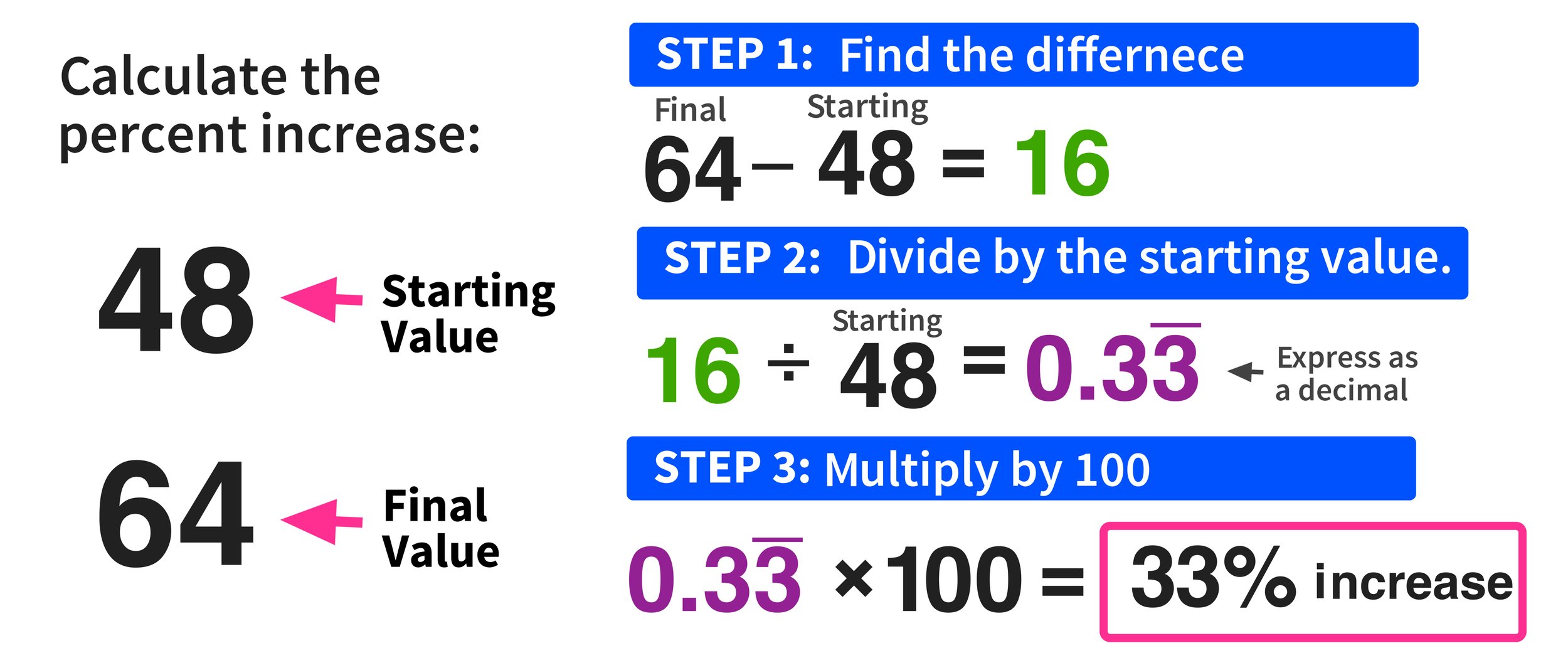
The calculation for percentage increase is straightforward and relies on three key pieces of information: the original value, the new value, and the difference between them.
The formula is:
$$ text{Percentage Increase} = frac{text{New Value} – text{Original Value}}{text{Original Value}} times 100 $$
Let’s break down the components:
- New Value (or Final Value): The higher number, representing the amount after the increase.
- Original Value (or Initial Value): The starting number, representing the amount before the increase.
- Difference (New Value – Original Value): This is the absolute amount of the increase. Dividing this difference by the Original Value gives you the growth as a decimal or fraction relative to the starting point.
- Multiplying by 100: This converts the decimal or fractional result into a percentage.
Step-by-Step Calculation
To solidify your understanding, let’s walk through an example:
Scenario: Your monthly income increased from $4,000 to $4,600. What is the percentage increase?
- Identify the Original Value: $4,000
- Identify the New Value: $4,600
- Calculate the Difference (New Value – Original Value):
$4,600 – $4,000 = $600 - Divide the Difference by the Original Value:
$600 / $4,000 = 0.15 - Multiply by 100 to get the percentage:
$0.15 times 100 = 15%$
Therefore, your monthly income increased by 15%. This step-by-step approach ensures accuracy and clarity, whether you’re performing manual calculations or setting up a spreadsheet.
Real-World Applications in Personal Finance
Understanding percentage increase is not just an academic exercise; it’s a vital skill for managing your personal finances effectively, making smarter decisions, and achieving your financial goals.
Tracking Your Investments
For investors, percentage increase is the primary language of performance.
- Stock Growth: If you bought a stock at $50 per share and it’s now worth $65, that’s a 30% increase (($65 – $50) / $50 * 100). This tells you the actual return on your capital.
- Mutual Fund Returns: Fund managers report performance as percentage gains over various periods (e.g., year-to-date, 1-year, 5-year returns). Comparing these percentages allows you to evaluate which funds have performed best relative to their starting value, rather than just by their absolute dollar growth.
- Cryptocurrency Gains: The volatile world of crypto heavily relies on percentage changes to track rapid price movements and portfolio growth.
Analyzing Your Budget and Spending
A budget is a living document, and percentage increases help you understand its evolution.
- Expense Changes: If your grocery bill jumped from $400 to $460 in a month, that’s a 15% increase. This signals a need to investigate price hikes, changes in habits, or potential overspending.
- Income Growth: As seen in our earlier example, knowing your income increased by 15% gives you a clear picture of your improved financial standing.
- Savings Rate: If you aim to increase your savings rate from 10% to 15% of your income, you’re dealing directly with percentages to monitor progress towards your financial objectives.
Salary Negotiations and Raises
When discussing compensation, percentages are key. A 5% raise on a $60,000 salary is a $3,000 increase, while a 5% raise on a $100,000 salary is a $5,000 increase. While both are 5%, understanding the percentage helps you contextualize the new total and compare offers effectively. You can also calculate the percentage increase needed to reach a specific salary target, empowering you during negotiations.
Debt Reduction Progress
Tracking debt repayment through percentage reduction can be highly motivating. If you started with a $10,000 credit card debt and have paid off $2,000, you’ve achieved a 20% reduction. Seeing these percentage milestones can provide encouragement and a clear picture of your progress towards becoming debt-free.
Strategic Insights for Business and Investing
Beyond personal finance, percentage increase is a critical metric for businesses and serious investors, guiding strategic decisions and evaluating market dynamics.
Business Growth Metrics
For businesses, percentage increase is foundational to assessing health and performance.
- Sales Growth: A company reporting 20% year-over-year sales growth is seen as performing well, indicating increasing revenue. This percentage allows investors and management to compare growth rates across industries or against competitors, regardless of the absolute dollar amounts.
- Profit Margins: An increase in profit margin from 10% to 12% might seem small in absolute terms, but it represents a 20% relative increase in efficiency or pricing power, significantly impacting the bottom line.
- Customer Acquisition: Tracking the percentage increase in new customers or recurring subscribers provides insights into marketing effectiveness and market penetration.
Market Analysis and Trends
Investors and analysts use percentage increases to understand broader economic and market trends.
- Industry Growth Rates: Sectors like technology or renewable energy might experience higher percentage growth rates than mature industries, signaling investment opportunities.
- Inflation Rates: The Consumer Price Index (CPI) is often reported as a percentage increase, indicating the rate at which prices for goods and services are rising, which directly impacts purchasing power and investment strategies.
- Competitor Performance: Benchmarking a company’s sales or profit growth against its competitors’ percentage increases helps assess its market position and competitive advantage.
Evaluating Investment Opportunities
Percentage increase forms the basis for more advanced investment metrics like Compound Annual Growth Rate (CAGR), which smooths out volatile annual returns to show the average annual percentage growth over multiple years. Understanding simple percentage increase is the first step towards grasping how investments grow over time, including the powerful effect of compounding returns.
Common Pitfalls and Misinterpretations
While straightforward, misapplying the percentage increase calculation can lead to flawed conclusions. Awareness of these common pitfalls is essential.
The Base Value Trap
The “Original Value” (or base value) is critically important. Always ensure you are dividing by the correct starting point. If you incorrectly use the new value as the denominator, you’ll calculate a percentage decrease from the new value to the old, or simply get a meaningless number. For instance, if a stock went from $100 to $120, the increase is 20%. If you accidentally divided by $120, you’d get 16.67%, which is the percentage decrease required to get from $120 back to $100. Always be clear about which number is your starting point.
Small Base, Big Percentage
A small absolute increase can translate into a massive percentage increase if the original value is very small. For example, if a company’s profit goes from $1 to $10, that’s a 900% increase. While technically correct, this large percentage might be misleading if the overall business is still negligible. Context is key: a 900% increase on $1 is less significant than a 10% increase on $1 million. Always consider the absolute numbers alongside the percentages, especially when the base is low, to avoid overstating or misinterpreting growth.
Confusing Increase with Decrease
It’s easy to mix up the formulas for percentage increase and percentage decrease. For an increase, the new value is always greater than the original value, resulting in a positive percentage. For a decrease, the new value is less than the original value, and the formula often involves (Original Value – New Value) / Original Value to yield a positive percentage decrease, or (New Value – Original Value) / Original Value will yield a negative percentage. Being mindful of whether the change is positive or negative ensures you apply the correct calculation and interpret the result accurately.
Leveraging Financial Tools for Calculation
While understanding the manual calculation is fundamental, modern financial tools can automate and simplify the process, especially for large datasets or frequent calculations.
Spreadsheet Functions (Excel/Google Sheets)
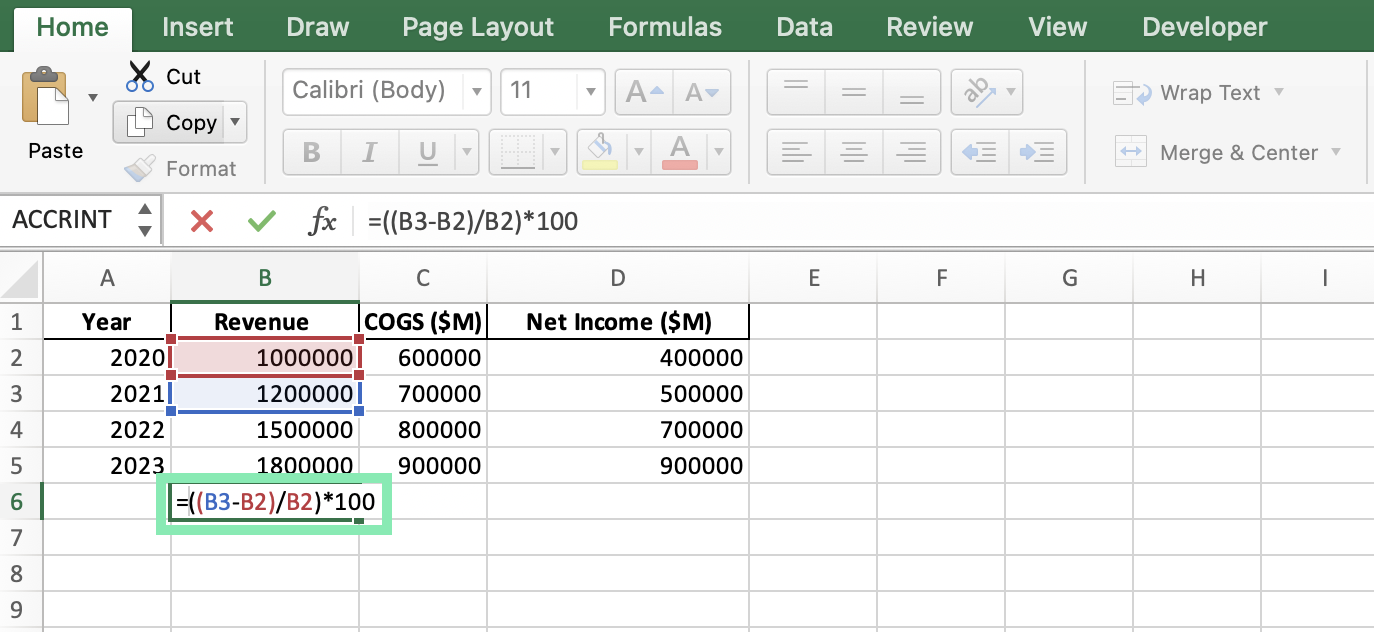
Spreadsheets are invaluable for financial analysis. The percentage increase formula can be directly entered.
If your original value is in cell A2 and your new value is in cell B2, the formula in C2 would be:
=(B2-A2)/A2
To display this as a percentage, simply format cell C2 as a percentage. This instantly calculates the increase for numerous rows of data, making it efficient for tracking portfolios, budget changes, or sales figures over time.
Online Calculators and Apps
Numerous online percentage calculators and financial apps can quickly determine percentage increases without manual formula entry. These are excellent for quick, ad-hoc calculations, such as figuring out the percentage gain on a single stock trade or the percentage increase in your rent. Many financial apps built for budgeting or investing also automatically display percentage changes for various metrics, offering immediate insights.

When to Use Calculators vs. Manual Calculation
While tools offer convenience, understanding the manual calculation provides a deeper comprehension of what the number represents.
- Manual Calculation: Best for learning the concept, verifying results from tools, or when you only have a few numbers and want to quickly grasp the underlying logic. It builds financial literacy.
- Spreadsheets/Calculators: Ideal for repetitive tasks, large datasets, avoiding human error, and streamlining financial analysis in business or complex personal finance scenarios.
A balanced approach involves understanding the manual process and then leveraging technology to enhance efficiency and scale your analysis.
In conclusion, the percentage increase between two numbers is far more than a simple mathematical operation; it is a critical lens through which we view and interpret financial change. From the micro-level of personal income and expenses to the macro-level of investment growth and business performance, this calculation provides essential context, enables meaningful comparisons, and empowers informed decision-making. By mastering this fundamental concept and understanding its applications and potential pitfalls, you equip yourself with a potent tool for navigating the complexities of the financial world and steering your financial journey towards greater insight and success.
aViewFromTheCave is a participant in the Amazon Services LLC Associates Program, an affiliate advertising program designed to provide a means for sites to earn advertising fees by advertising and linking to Amazon.com. Amazon, the Amazon logo, AmazonSupply, and the AmazonSupply logo are trademarks of Amazon.com, Inc. or its affiliates. As an Amazon Associate we earn affiliate commissions from qualifying purchases.