
Understanding how interest works is a foundational skill in personal finance, whether you’re saving for a future goal, taking out a loan, or managing investments. Among the various types of interest, simple interest is the most straightforward to grasp and calculate. It forms the basis of many financial transactions and is often the first concept introduced when discussing the cost of borrowing or the return on savings. While sophisticated financial products often involve more complex calculations like compound interest, a solid understanding of simple interest is indispensable for making informed everyday financial decisions. This article will demystify simple interest, breaking down its core components, revealing the easy-to-use formula, and illustrating its practical applications in various real-world scenarios. By the end, you’ll be equipped to confidently calculate simple interest and apply this knowledge to your financial planning.
Understanding the Core Components of Simple Interest
To effectively calculate simple interest, it’s crucial to first understand the three fundamental variables that drive the calculation. These components are intertwined and collectively determine the total interest earned or paid over a specific period. Each plays a distinct role in the formula, and accurately identifying them is the first step toward successful calculation.
The Principal (P): Your Starting Point
The principal, often denoted as ‘P’, is the initial amount of money involved in a financial transaction. It’s the original sum that is either borrowed or invested. If you take out a loan, the principal is the amount you borrowed. If you deposit money into a savings account, the principal is your initial deposit. In essence, it’s the base figure upon which interest will be calculated. For example, if you deposit $1,000 into a savings account, your principal is $1,000. If you take out a $5,000 personal loan, the principal is $5,000. It’s the “seed money” that grows with interest or incurs interest as a cost.
The Interest Rate (R): The Cost or Earning Percentage
The interest rate, represented by ‘R’, is the percentage charged by a lender for the use of assets, or paid by a bank for the use of a depositor’s money. It’s almost always expressed as an annual percentage. This means the rate specifies how much interest will accrue over one full year. It’s crucial to remember that for calculation purposes, the percentage rate must be converted into a decimal. For instance, an interest rate of 5% should be written as 0.05 in the formula. A rate of 10% becomes 0.10, and 2.5% becomes 0.025. This conversion is a common point of error for many, but it’s a simple step that ensures the accuracy of your calculation. The interest rate reflects either the return on your investment or the cost of your borrowing.
The Time (T): The Duration of the Agreement
Time, symbolized by ‘T’, refers to the duration for which the money is borrowed or invested. In the simple interest formula, time is always expressed in years. This is critical because, as mentioned, the interest rate is typically an annual rate. Therefore, if the duration of the loan or investment is given in months or days, it must be converted into its equivalent in years. For example, 6 months would be 0.5 years (6/12), and 3 months would be 0.25 years (3/12). A period of 18 months would be 1.5 years (18/12). Similarly, if the time is given in days, you would divide the number of days by 365 (or 360 in some commercial calculations, though 365 is standard for consumer finance). Ensuring consistency in units for time and rate is vital for accurate simple interest calculations.
The Simple Interest Formula Demystified
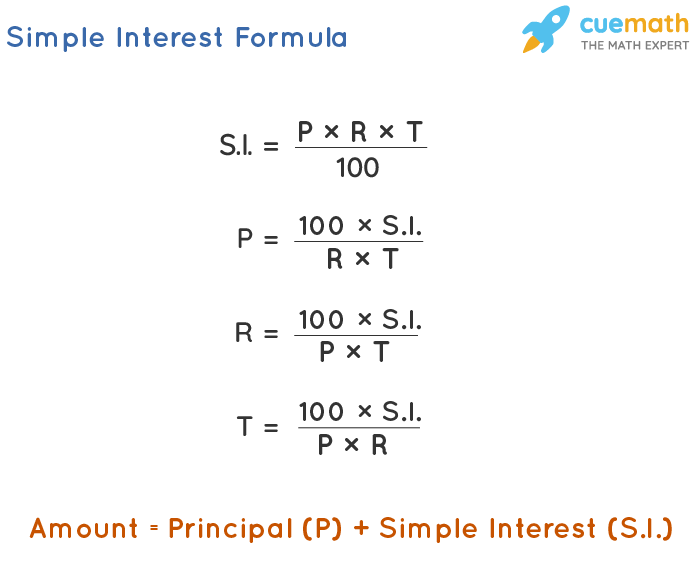
With a clear understanding of the principal, rate, and time, we can now assemble these components into the universally recognized simple interest formula. This formula is remarkably straightforward and elegant, allowing anyone to quickly determine the interest earned or owed.
Introducing I = P x R x T
The formula for calculating simple interest is:
I = P × R × T
Where:
- I = Simple Interest (the total dollar amount of interest earned or paid)
- P = Principal (the initial amount of money)
- R = Annual Interest Rate (as a decimal)
- T = Time (in years)
This formula directly calculates the amount of interest over the specified period. To find the total amount due at the end of the term (principal + interest), you would simply add ‘I’ to ‘P’. The beauty of this formula lies in its linear nature; the interest only depends on the initial principal and doesn’t compound on previously earned interest.
Step-by-Step Calculation Examples
Let’s put the formula into practice with a few common scenarios to solidify your understanding.
Example 1: Savings Deposit
Imagine you deposit $2,000 into a savings account that offers a simple interest rate of 3% per year. You leave the money in the account for 2 years. How much simple interest will you earn?
- P = $2,000
- R = 3% = 0.03 (as a decimal)
- T = 2 years
Using the formula:
I = P × R × T
I = $2,000 × 0.03 × 2
I = $60 × 2
I = $120
You would earn $120 in simple interest over 2 years. Your total balance at the end of the 2 years would be $2,000 (principal) + $120 (interest) = $2,120.
Example 2: Small Personal Loan
Suppose you take out a short-term personal loan of $1,500 at a simple annual interest rate of 8% for 6 months. What is the total interest you will pay?
- P = $1,500
- R = 8% = 0.08
- T = 6 months. Remember to convert this to years: 6/12 = 0.5 years.
Using the formula:
I = P × R × T
I = $1,500 × 0.08 × 0.5
I = $120 × 0.5
I = $60
You would pay $60 in simple interest over the 6-month period. The total amount you’d repay would be $1,500 (principal) + $60 (interest) = $1,560.
Example 3: Time Conversion with Days
Let’s say you invest $5,000 at a simple interest rate of 4% for 90 days. How much interest do you earn?

- P = $5,000
- R = 4% = 0.04
- T = 90 days. Convert to years: 90/365 ≈ 0.246575 years (it’s best to keep as many decimal places as possible or use the fraction 90/365 for accuracy).
Using the formula:
I = P × R × T
I = $5,000 × 0.04 × (90/365)
I = $200 × (90/365)
I = $18,000 / 365
I ≈ $49.32
You would earn approximately $49.32 in simple interest over 90 days.
Applications and Real-World Scenarios
Simple interest, despite its straightforward nature, plays a significant role in various financial products and situations. Understanding where it applies can help you make more informed decisions as a borrower or a saver.
Simple Interest in Lending
Simple interest is commonly used for short-term loans, particularly those where the repayment schedule is not complex or extended over many years. Examples include some personal loans, specific types of business loans, and often payday loans, though these come with very high rates. When simple interest applies to a loan, the interest charged is solely based on the original principal amount borrowed. This means that if you’re comparing loan offers, calculating the simple interest can give you a clear picture of the minimum cost of borrowing without the complexities of compounding interest being added to the principal. It allows borrowers to easily determine the total amount they will owe by the end of the loan term.
Simple Interest in Savings and Investments
While most long-term savings accounts and investments leverage compound interest to maximize returns, simple interest still has its place. Some basic savings accounts, especially those with very low balances or specific types of bonds, might pay simple interest. Certificates of Deposit (CDs) often advertise their interest rates in a way that implies simple interest, although they may compound internally. For investors, understanding simple interest is crucial when analyzing certain fixed-income securities or when a quick, approximate calculation of returns is needed for a short investment horizon. It provides a baseline for understanding the basic return on your capital before considering the effects of compounding.
Practical Use Cases for Borrowers and Savers
For borrowers, knowing how to calculate simple interest empowers them to compare different loan offers more effectively. If two lenders offer different simple interest rates for the same principal and term, a quick calculation reveals which one is cheaper. It also helps borrowers understand the actual cost of their debt and plan their repayments. For savers, simple interest calculations can help determine the minimum earnings on a deposit or investment, enabling them to evaluate if a particular savings product meets their financial goals. It’s a vital tool for assessing short-term financial commitments and benefits.
Beyond Simple Interest: When to Consider Compound Interest
While simple interest is fundamental, it’s important to recognize its limitations and understand when more complex interest calculations, specifically compound interest, become relevant. This distinction is crucial for long-term financial planning and understanding true wealth accumulation or debt burden.
Simple vs. Compound: A Crucial Distinction
The key difference between simple and compound interest lies in how interest is calculated over time. Simple interest is only calculated on the original principal amount. The interest earned or charged does not get added back to the principal to earn or incur more interest. Compound interest, on the other hand, is calculated on the initial principal and also on the accumulated interest from previous periods. This means “interest on interest.” Over time, compounding causes the balance to grow much faster than it would with simple interest, creating an exponential growth curve. While simple interest is a linear growth model, compound interest is geometric.
The Power of Compounding
The “power of compounding” is a widely recognized principle in finance. For savers and investors, compounding means that their money grows at an accelerating rate, as previously earned interest starts earning interest itself. This is why long-term investments like retirement accounts, mutual funds, and even most high-yield savings accounts utilize compounding interest. For borrowers, compounding can be a significant disadvantage, as interest can accrue rapidly on unpaid balances, making debt much more expensive over time. Credit cards are a prime example of compounding debt. While understanding simple interest is a solid foundation, recognizing when and how compound interest applies is essential for comprehending true financial growth and the long-term cost of debt. It’s the critical step for moving from basic financial literacy to strategic financial planning.
Tips for Managing Simple Interest Effectively
Leveraging your understanding of simple interest can significantly enhance your financial decision-making, whether you’re looking to borrow or save. Practical application of this knowledge can lead to smarter choices and better financial outcomes.
For Borrowers:
When simple interest applies to a loan, it’s generally easier to predict the total cost.
- Understand Total Cost: Always calculate the total interest payable over the loan term using I = P x R x T. Add this to the principal to know your full repayment obligation.
- Compare Offers: Use your simple interest calculation skills to compare different lenders. Even a small difference in the annual rate can save you money over the loan’s duration.
- Consider Early Repayment: With simple interest, the total interest paid is directly proportional to the time you hold the loan. If you can afford to pay off a simple interest loan earlier than scheduled, you will reduce the ‘T’ value and thus the total interest you pay, saving you money, provided there are no early repayment penalties.
For Savers:
For savings products offering simple interest, maximizing your returns involves focusing on the core components.
- Seek Higher Rates: Since interest is solely dependent on the principal and rate, prioritize accounts or investments that offer a higher annual simple interest rate (R) if all other factors are equal.
- Understand Terms: Be clear about how frequently interest is paid out and if it truly remains simple interest or if there’s any compounding involved, even if infrequent.
- Compare Simple vs. Compound Options: Always compare simple interest products with compound interest alternatives. For long-term savings, compound interest almost always yields significantly higher returns. Simple interest might be suitable for very short-term holds or specific bonds where the interest payment is distinct from the principal.

Utilizing Financial Tools
Modern technology offers a plethora of tools to assist with interest calculations, making financial planning even more accessible.
- Online Calculators: Numerous websites offer free simple interest calculators. These tools allow you to input P, R, and T and instantly get the ‘I’ value. They are excellent for quick checks and verifying your manual calculations.
- Spreadsheets: Software like Microsoft Excel or Google Sheets are incredibly powerful for financial calculations. You can set up simple formulas (e.g.,
=A2*B2*C2where A2 is principal, B2 is rate, C2 is time) to calculate simple interest for multiple scenarios, allowing for easy comparison and scenario planning. - Financial Apps: Many personal finance apps include built-in calculators or integrate with financial tools that can help you project earnings or costs based on simple interest, aiding in budgeting and goal setting.
By thoughtfully applying these tips and utilizing available tools, you can effectively manage simple interest in your financial life, empowering you to make informed decisions that align with your financial goals.
Understanding how to figure out simple interest is more than just a mathematical exercise; it’s a vital component of financial literacy. From calculating the cost of a basic loan to estimating the return on a short-term savings deposit, the formula I = P x R x T provides a clear, concise pathway to understanding fundamental financial transactions. While compound interest often dominates discussions around long-term wealth building, simple interest remains the bedrock upon which many financial concepts are built. By mastering its components and applications, you gain an invaluable tool for analyzing financial products, comparing offers, and ultimately making smarter, more confident choices with your money. Embrace this fundamental knowledge, and you’ll be well on your way to greater financial empowerment.
aViewFromTheCave is a participant in the Amazon Services LLC Associates Program, an affiliate advertising program designed to provide a means for sites to earn advertising fees by advertising and linking to Amazon.com. Amazon, the Amazon logo, AmazonSupply, and the AmazonSupply logo are trademarks of Amazon.com, Inc. or its affiliates. As an Amazon Associate we earn affiliate commissions from qualifying purchases.