
For many investors, opening a brokerage app to see a sea of red can trigger an immediate sense of unease. Whether it is a sharp intraday dip or the beginning of a sustained correction, the question “why is the stock market dropping today?” is one of the most frequently searched queries in the financial world. While the immediate catalyst may change—ranging from a sudden geopolitical shift to a disappointing inflation report—the underlying mechanics of market declines are usually rooted in a few core economic principles.
Understanding why the market is pulling back requires looking beyond the ticker symbols and into the machinery of global finance. Market movements are rarely the result of a single isolated event; rather, they are the culmination of investor sentiment, monetary policy, and corporate health intersecting at a single point in time.
1. The Heavy Hand of Monetary Policy and Macroeconomics
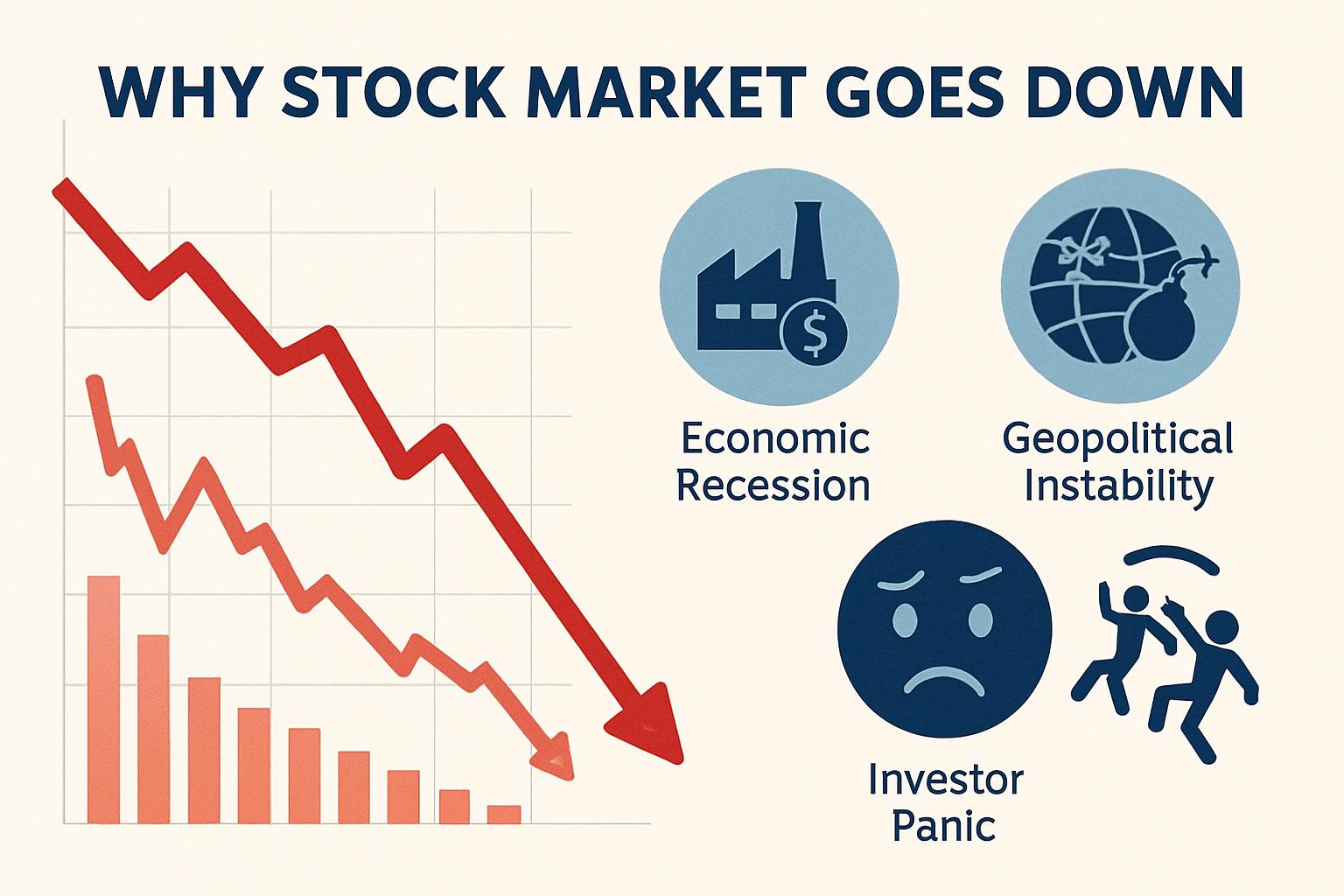
The most common driver of market downturns in the modern era is the shifting landscape of monetary policy. Central banks, particularly the Federal Reserve in the United States, act as the primary “conductors” of the financial markets. When the economy shows signs of overheating or when inflation begins to erode purchasing power, the tools used to cool the system often lead to stock market volatility.
The Correlation Between Interest Rates and Valuations
Interest rates are the “gravity” of the financial markets. When the Federal Reserve raises interest rates to combat inflation, the cost of borrowing for both consumers and corporations increases. For businesses, higher interest rates mean higher debt-servicing costs, which directly eats into net profit margins. For investors, higher rates make “risk-free” assets, such as Treasury bonds, more attractive. When a 10-year Treasury note offers a higher yield, the relative appeal of “risky” assets like stocks diminishes, leading to a rotation out of equities and a subsequent drop in market prices.
Inflationary Pressures and the CPI
Markets are forward-looking mechanisms. When Consumer Price Index (CPI) data or Producer Price Index (PPI) reports come in higher than expected, investors begin to price in the likelihood of more aggressive rate hikes. Inflation also creates uncertainty regarding consumer behavior; if the cost of living rises too quickly, discretionary spending slows down, impacting the revenue streams of everyone from retail giants to tech service providers. The fear of “stagflation”—a combination of stagnant growth and high inflation—is often enough to send indices into a tailspin.
2. Corporate Earnings and the “Future Outlook” Trap
While macroeconomic data sets the stage, individual corporate performance provides the script. We often see the market drop during “earnings season,” even when companies report profits. This paradox occurs because the stock market does not just trade on what a company did; it trades on what the company will do.
The Impact of Guidance and Growth Projections
When a publicly traded company releases its quarterly results, the most scrutinized part of the report is the “guidance”—the management’s forecast for the coming months. If a blue-chip company meets its current profit targets but lowers its future outlook due to supply chain issues, labor costs, or softening demand, investors often sell the stock in anticipation of a slowdown. Because many large-cap stocks are heavily weighted in indices like the S&P 500, a negative outlook from a handful of tech or healthcare giants can drag the entire market down.
Valuation Realignment in Growth Sectors
In periods of “easy money” (low interest rates), growth stocks—particularly in the technology sector—often see their valuations soar to levels that assume perfect execution for years to come. When the market experiences a “today” drop, it is often a “valuation reset.” Investors decide that they are no longer willing to pay a high multiple for future earnings that are suddenly at risk. This leads to a rapid sell-off in high-flying growth names, which can create a contagion effect across other sectors as liquidity dries up.
3. Geopolitical Uncertainty and Global Contagion

The global financial system is more interconnected today than at any point in history. Events occurring thousands of miles away can have an immediate and visceral impact on domestic stock prices. Markets detest uncertainty, and geopolitical strife is the ultimate source of unpredictability.
Trade Conflicts and Resource Scarcity
Geopolitical tensions often manifest in the form of trade barriers, sanctions, or disruptions to the supply of essential commodities like oil, gas, and semiconductors. If a conflict threatens the flow of energy from the Middle East or wheat from Eastern Europe, the immediate result is a spike in commodity prices. This “input cost inflation” puts pressure on corporate margins across the globe. Investors react to these threats by moving into “safe-haven” assets like gold or the U.S. Dollar, selling off equities in the process.
The Domino Effect of International Indices
Market volatility is rarely localized. If the Hang Seng in Hong Kong or the DAX in Germany experiences a significant decline overnight, it often sets a negative tone for the U.S. market open. This contagion is driven by global institutional investors who manage portfolios across multiple time zones. If they are forced to cover losses in one region, they may sell profitable positions in another to maintain liquidity, leading to a synchronized global downturn.
4. Technical Factors and the Psychology of the “Sell”
Not every market drop is fueled by a change in fundamental economic reality. Sometimes, the “why” behind a drop is found in the very structure of how modern trading occurs. The rise of algorithmic trading and the psychological thresholds of human investors play a massive role in daily volatility.
Algorithmic Trading and Stop-Loss Cascades
A significant portion of daily trading volume is executed by high-frequency trading (HFT) algorithms. These programs are designed to react to specific price triggers. If a major index like the S&P 500 breaks below a “key support level” (a price point that has historically prevented further drops), it can trigger a wave of automated sell orders. This creates a “snowball effect” where the initial drop triggers more selling, which pushes the price lower, triggering even more algorithms.
Fear, Margin Calls, and the VIX
Human emotion still plays a pivotal role in market behavior. The VIX, often called the “Fear Gauge,” measures the market’s expectation of 30-day volatility. When the VIX spikes, it indicates that investors are buying “put options” to protect themselves against further losses. Furthermore, investors who trade on “margin” (using borrowed money from their broker) may be forced to sell their positions if the value of their holdings drops below a certain level. These forced liquidations—known as margin calls—can turn a minor correction into a sharp, painful drop as investors are compelled to sell at any price to satisfy their debt.
5. Strategic Management: Navigating the Downswing
While seeing the value of a portfolio decline is difficult, seasoned investors view these moments as a necessary part of the wealth-building process. The key to surviving a dropping market is to transition from an emotional response to a strategic one.
The Power of Dollar-Cost Averaging
For long-term investors, market drops can actually be beneficial. Through a strategy known as dollar-cost averaging (DCA), an investor continues to contribute a fixed amount of money at regular intervals, regardless of price. When the market drops, that fixed amount of money buys more shares. Over time, this lowers the average cost basis of the investment. Rather than trying to “time the bottom,” which is nearly impossible, DCA allows the investor to benefit from the eventual recovery.
Rebalancing and the “Quality” Pivot
A market downturn is an excellent time to perform a “portfolio stress test.” This involves rebalancing—selling assets that have become overrepresented and buying those that are undervalued. It is also an opportunity to pivot toward “quality.” Companies with strong balance sheets, consistent cash flows, and low debt-to-equity ratios tend to weather market storms much better than speculative startups. By focusing on fundamental business health rather than daily price action, investors can maintain the discipline required to stay invested through the volatility.
The stock market is a complex ecosystem of competing interests, data points, and emotions. While the specific reason for a drop today might be a singular headline, the broader context is usually a mix of rising rates, earnings expectations, and technical triggers. By understanding these mechanics, investors can move away from panic and toward a more informed, resilient financial strategy.
aViewFromTheCave is a participant in the Amazon Services LLC Associates Program, an affiliate advertising program designed to provide a means for sites to earn advertising fees by advertising and linking to Amazon.com. Amazon, the Amazon logo, AmazonSupply, and the AmazonSupply logo are trademarks of Amazon.com, Inc. or its affiliates. As an Amazon Associate we earn affiliate commissions from qualifying purchases.