
In the realm of personal and business finance, the ability to calculate and interpret percentages is not merely a mathematical skill—it is a foundational pillar of financial literacy. Whether you are evaluating the performance of a stock portfolio, determining the true cost of a loan, or calculating the profit margins of a startup, percentages provide the necessary context to turn raw numbers into actionable insights. Understanding “how to find percentage” is the first step toward moving from passive money management to active wealth building.
This guide explores the diverse applications of percentage calculations within the “Money” niche, providing you with the tools to navigate interest rates, investment returns, and business metrics with professional precision.
The Fundamentals of Financial Mathematics
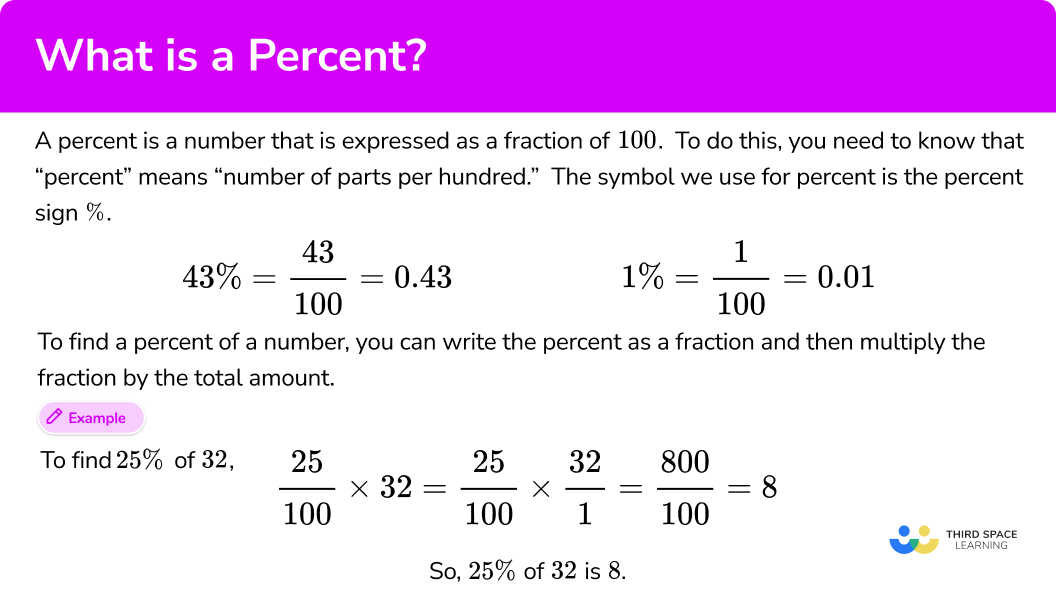
Before diving into complex investment ratios, one must master the core logic of the percentage. In finance, a percentage represents a fraction of 100, allowing us to compare disparate figures on a level playing field.
Understanding the Basic Formula
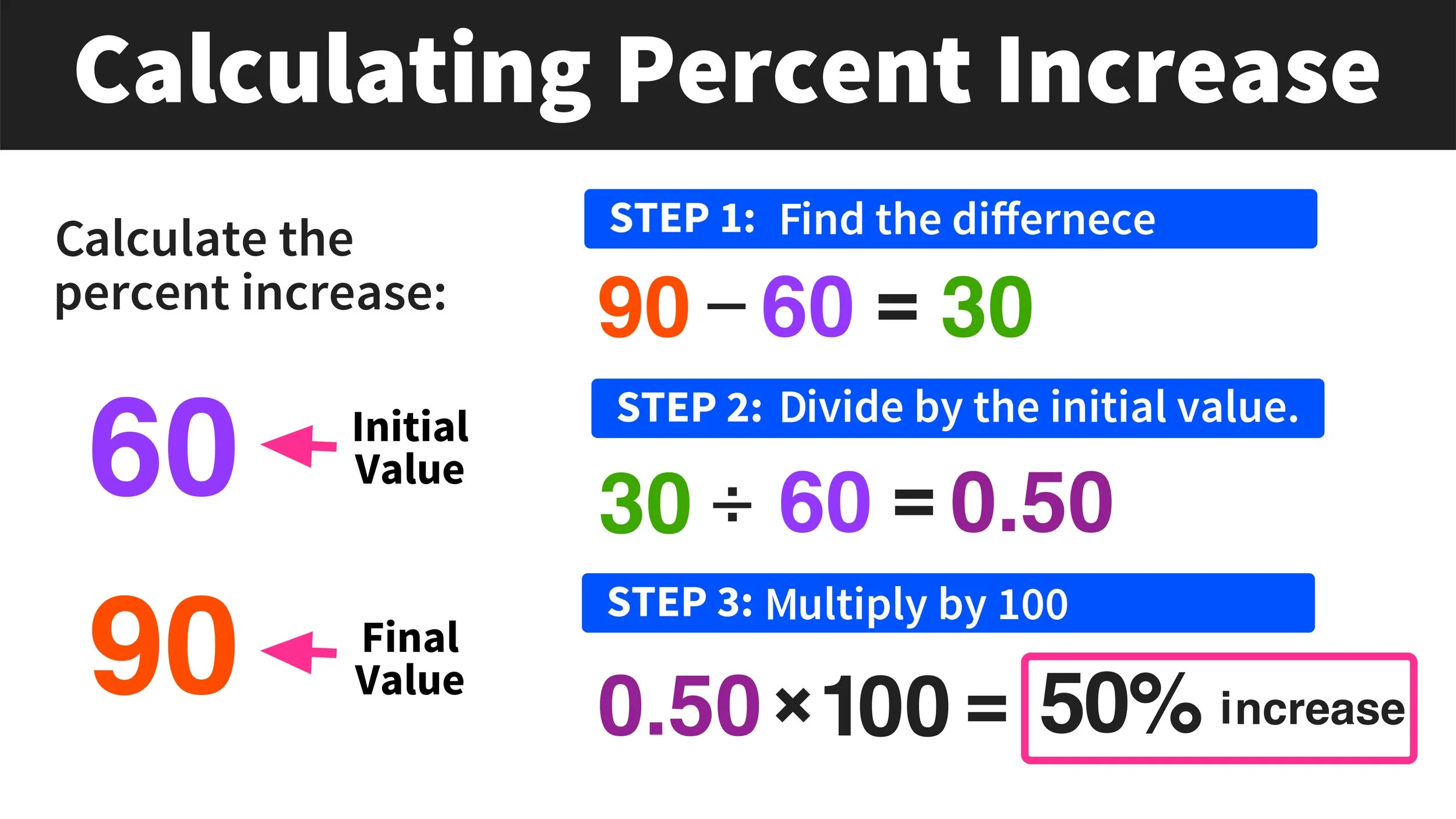
At its most basic level, finding a percentage involves identifying the relationship between a “part” and a “whole.” The universal formula is:
(Part / Whole) × 100 = Percentage
For example, if you save $500 out of a $4,000 monthly salary, you divide 500 by 4,000 to get 0.125. Multiplying by 100 reveals a 12.5% savings rate. In professional finance, this basic calculation is the building block for analyzing everything from debt-to-income ratios to asset allocation.
Converting Decimals and Fractions in Finance
Financial analysts often work with decimals (0.07) rather than percentages (7%) because decimals are easier to use in multi-step equations. To convert a percentage to a decimal, you move the decimal point two places to the left. This is critical when calculating compounding interest or tax obligations, where precision to the fourth or fifth decimal place can represent thousands of dollars in difference over time.
Calculating Returns on Investment (ROI)
For any investor, the most critical use of percentage is determining the Return on Investment (ROI). This metric tells you how much money you have gained or lost relative to the amount you invested.
Simple vs. Annualized Returns
A simple return is calculated by taking the current value of an investment, subtracting the original cost, and dividing that difference by the original cost.
Formula: [(Current Value – Original Cost) / Original Cost] × 100
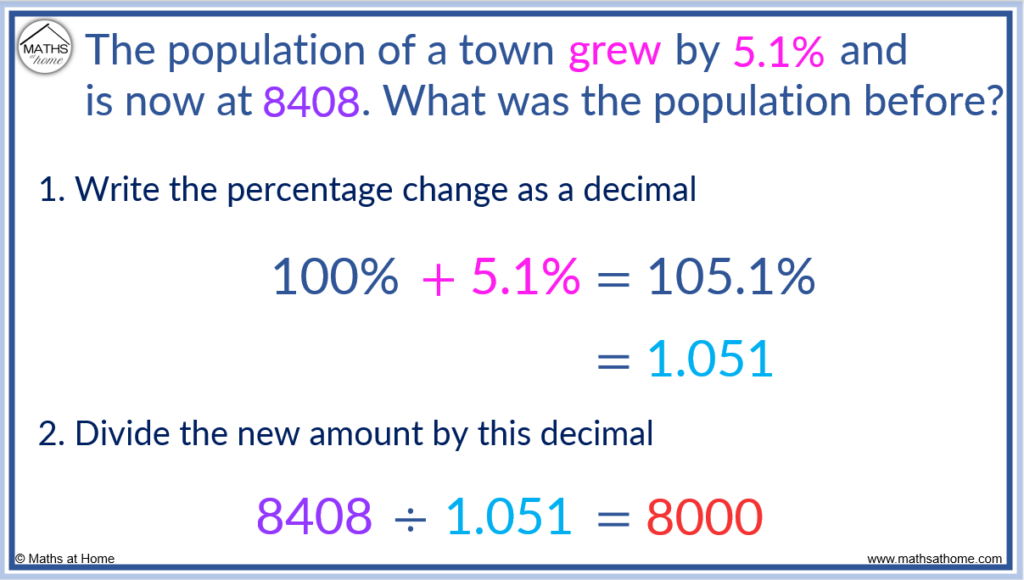
However, professional investors prefer “Annualized Returns.” If Investment A grows 20% over five years and Investment B grows 10% in one year, Investment B is actually the superior performer on a time-adjusted basis. Understanding how to find the percentage growth per year allows you to compare a high-yield savings account to a volatile stock market index fairly.
The Impact of Compounding
Compound interest is often called the “eighth wonder of the world.” When you calculate percentages on top of previously earned percentages, your wealth grows exponentially. To find the future value of an investment, you don’t just add a flat percentage; you multiply the principal by (1 + r)^n, where ‘r’ is the interest rate as a decimal and ‘n’ is the number of periods. Mastering this percentage logic is what separates those who struggle with debt from those who build generational wealth.
Navigating Personal Finance: Interest and Debt
On the flip side of investing is debt. Whether it is a mortgage, a car loan, or credit card debt, the cost of borrowing is always expressed as a percentage: the Annual Percentage Rate (APR).
Calculating APR and Monthly Interest
While a credit card might boast a 24% APR, that interest is usually calculated daily. To find your monthly interest charge, you must divide the annual percentage by 12. Understanding this helps you realize that a “small” 2% monthly interest rate is actually a staggering 24% annually. Professional money management requires looking past the monthly payment to the percentage-based cost of capital.
Understanding Credit Card Math and “Basis Points”
In the world of high finance and banking, professionals often speak in “basis points” (BPS). One basis point is equal to 1/100th of 1 percent (0.01%). When the Federal Reserve raises interest rates by 50 basis points, they are raising them by 0.50%. Being able to translate these minute percentage shifts into real-world dollar amounts is a hallmark of a sophisticated financial mind. For instance, on a $500,000 mortgage, a shift of just 25 basis points (0.25%) can result in over $20,000 in additional interest payments over the life of the loan.
Business Finance: Profit Margins and Markup
For entrepreneurs and business owners, finding percentages is the key to maintaining a healthy bottom line. Knowing your revenue is meaningless if you do not understand your margins.
Gross Profit vs. Net Profit Margins
Gross profit margin measures the percentage of revenue that exceeds the cost of goods sold (COGS).
Formula: [(Total Revenue – COGS) / Total Revenue] × 100
However, the Net Profit Margin is the “truth” of a business. It calculates what percentage of every dollar earned remains as profit after all expenses—taxes, rent, payroll, and marketing—have been paid. A company might have a massive 70% gross margin but a slim 5% net margin. High-level financial strategy involves identifying which expenses are eating into that percentage and optimizing them to improve the “take-home” ratio.
Using Percentages to Scale Operations
When a business decides to scale, they use “Percentage of Sales” forecasting. By looking at historical data, a CFO might determine that marketing historically costs 15% of total revenue. If the goal for next year is $10 million in revenue, they know to budget $1.5 million for marketing. This percentage-based planning allows businesses to grow predictably without overextending their liquid assets.
Tax Obligations and Inflationary Analysis
Percentages also dictate our relationship with the government and the broader economy. Taxes and inflation are the two “hidden” percentages that can erode wealth if not properly managed.
Estimating Income Tax Brackets
Most modern tax systems are “progressive,” meaning different portions of your income are taxed at different percentages. Finding your “effective tax rate” is different from finding your “marginal tax bracket.” Your marginal bracket is the percentage you pay on your last dollar earned, while your effective rate is the total percentage of your income that goes to the government. Mastering this distinction is vital for tax planning and determining whether a tax-advantaged investment (like a 401k or IRA) is beneficial for your specific financial situation.
The Psychology of Discounts and Inflation
Inflation is the percentage by which the cost of goods increases, effectively acting as a percentage decrease in your purchasing power. If inflation is 5%, your money is worth 5% less than it was last year. To maintain wealth, your income and investment percentages must exceed the inflation percentage.
Furthermore, in consumer finance, understanding “percentage off” is a tool for smart spending. A 20% discount on a $1,000 item saves you more than a 50% discount on a $200 item. By focusing on the absolute dollar value derived from the percentage, you avoid the common psychological traps set by retailers.
Conclusion: The Power of the Percent
Finding a percentage is more than a simple division exercise; it is the language of value, risk, and growth. In the world of money, those who do not understand percentages are destined to pay them, while those who master them are positioned to earn them. By applying these formulas and concepts to your savings, investments, and business ventures, you gain a level of clarity that raw numbers alone can never provide. Whether you are calculating the “Rule of 72” to see how fast your money will double or auditing your business expenses, the percentage remains your most powerful tool for long-term financial health.
aViewFromTheCave is a participant in the Amazon Services LLC Associates Program, an affiliate advertising program designed to provide a means for sites to earn advertising fees by advertising and linking to Amazon.com. Amazon, the Amazon logo, AmazonSupply, and the AmazonSupply logo are trademarks of Amazon.com, Inc. or its affiliates. As an Amazon Associate we earn affiliate commissions from qualifying purchases.