
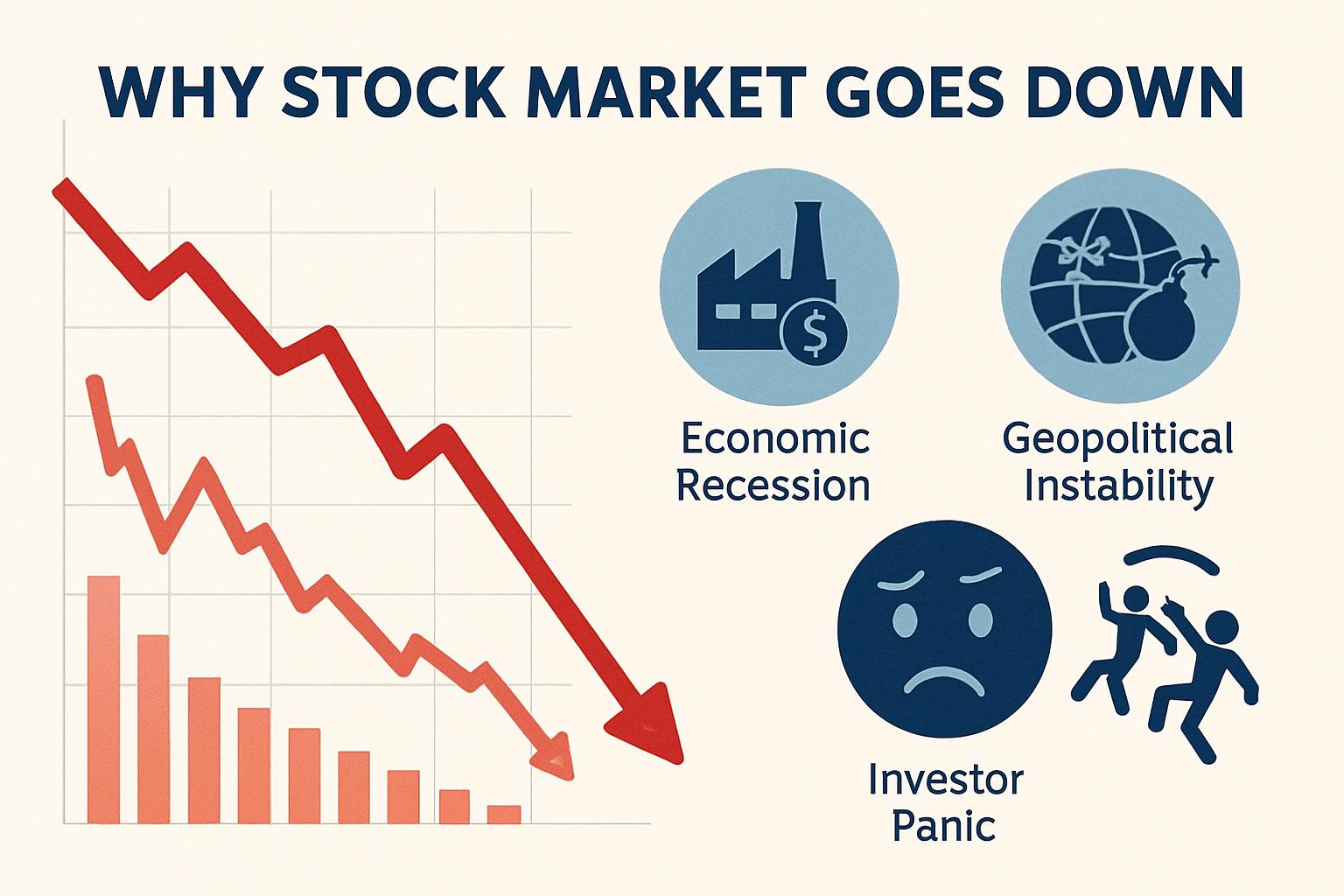
The rhythm of the stock market is rarely a straight line upward. For many investors, logging into a brokerage account to see a sea of red can be a jarring experience. When the U.S. market experiences a significant downturn, it is rarely the result of a single isolated event. Instead, it is typically a confluence of macroeconomic pressures, corporate performance shifts, and psychological triggers that converge to dampen investor enthusiasm.
Understanding “why the market is down today” requires a deep dive into the mechanics of the financial world. It involves looking past the headlines and examining the underlying gears of the global economy. By dissecting these factors, investors can move from a state of reactive anxiety to one of informed perspective, allowing them to make decisions based on logic rather than fear.

Macroeconomic Indicators: The Role of Inflation and Interest Rates
At the heart of almost every major market move lies the “cost of money.” In the United States, this is dictated largely by the Federal Reserve and its management of interest rates. When the market turns downward, the first place seasoned analysts look is the latest data on inflation and the central bank’s subsequent reaction.
The Federal Reserve’s Hawkish Stance
The Federal Reserve has a dual mandate: to promote maximum employment and to maintain stable prices. When inflation rises above the target 2% threshold, the Fed often adopts a “hawkish” stance, raising the federal funds rate. This increases the cost of borrowing for both consumers and businesses.
For the stock market, higher interest rates act like gravity. As rates rise, the present value of future corporate earnings decreases. This is particularly punishing for “growth” stocks, such as those in the technology sector, which are valued based on profits expected years into the future. When the market anticipates that the Fed will keep rates “higher for longer,” investors often sell off equities in favor of safer, interest-bearing assets like Treasury bonds.
CPI Data and Its Ripple Effects
The Consumer Price Index (CPI) is the most watched gauge of inflation. If a new CPI report shows that prices are rising faster than expected, it sends a shockwave through the New York Stock Exchange and the Nasdaq. High inflation erodes the purchasing power of consumers, leading to decreased spending. For businesses, it means higher input costs for raw materials and labor. If companies cannot pass these costs on to consumers, their profit margins shrink. The market reacts to this potential for lower profitability by repricing stocks downward almost instantly.
Corporate Earnings and the Reality of Profit Margins
While the “macro” picture sets the stage, individual company performance provides the script. The U.S. market is heavily weighted by a few massive entities, often referred to as the “Magnificent Seven” or “Big Tech.” When these giants stumble, they can pull the entire S&P 500 or Nasdaq Composite down with them.
The Weight of Big Tech and Guidance Shifts
Investors don’t just buy a stock for what it earned yesterday; they buy it for what it will earn tomorrow. This is why “guidance”—a company’s own forecast for future performance—is often more important than the actual earnings report. If a major tech company reports record profits but warns of a slowdown in cloud computing demand or AI integration for the next quarter, its stock price will likely plummet. Due to the market-cap-weighted nature of major indices, a 5% drop in a trillion-dollar company has a much larger impact on “the market” than a 5% drop in a mid-sized firm.
Supply Chain Disruptions and Margin Compression
In a globalized economy, a hiccup in a manufacturing hub halfway across the world can lead to a red day on Wall Street. Whether it is a shortage of semiconductors, a blockage in a major shipping lane, or a spike in energy costs, these “supply-side” issues increase the cost of doing business. When companies report “margin compression”—meaning they are making less profit on every dollar of sales—investors become wary. A down day in the market is often a collective realization that the era of “easy growth” may be facing a temporary bottleneck.
Geopolitical Tensions and Global Uncertainty

Markets crave stability and predictability. Geopolitical instability is the antithesis of both. When news breaks regarding international conflict, trade disputes, or significant policy shifts in other major economies, the U.S. market often responds with a “flight to safety.”
Trade Relations and Energy Prices
The U.S. economy is inextricably linked to global trade. Tensions between the U.S. and major trading partners can lead to tariffs, which are essentially taxes that increase costs for domestic companies. Furthermore, any instability in oil-producing regions can lead to a spike in crude prices. Because energy is a fundamental input for almost every industry—from transportation to plastics—rising oil prices act as a stealth tax on the entire economy. When energy costs jump, discretionary spending drops, and the market reflects this anticipated economic cooling.
The Impact of International Conflict on Risk Appetite
During times of geopolitical crisis, investors experience a decrease in “risk appetite.” They move capital out of “risk-on” assets like stocks and into “risk-off” assets like gold, the U.S. Dollar, or government bonds. This mass exodus of capital from the equity markets creates downward pressure on prices. Today’s market dip might simply be the result of a “wait and see” approach as investors pause to assess the long-term implications of a new global development.
Psychological Factors: Market Sentiment and Technical Selling
Finance is often treated as a hard science, but it is deeply rooted in human psychology. The market is a collection of millions of individuals and algorithms making decisions based on perception as much as reality.
Fear, Greed, and the VIX Index
The CBOE Volatility Index, or VIX, is often called the “Fear Gauge.” It measures the market’s expectation of 30-day volatility. When the VIX spikes, it indicates that investors are nervous. Fear is a powerful catalyst for selling. Once a downward trend begins, it can become a self-fulfilling prophecy. “Panic selling” occurs when investors see prices dropping and sell their positions to avoid further losses, which in turn causes prices to drop even further.
Programmatic Trading and Stop-Loss Cascades
In the modern era, a significant portion of market volume is driven by high-frequency trading (HFT) and algorithmic models. These programs are often set to sell automatically if a stock hits a certain price (a “stop-loss” order). If a piece of bad news triggers a small dip, it can set off a chain reaction of automated sell orders. These “cascades” can cause the market to drop much further and much faster than the underlying fundamentals would suggest, leading to the sharp intraday declines we often see.
Navigating the Downturn: Long-term Strategies for Individual Investors
While a down market can be stressful, it is a standard feature of the financial landscape. History shows that the U.S. market has recovered from every single downturn it has ever faced. For the disciplined investor, these days are not a signal to exit, but a time to reassess and refine their strategy.
The Importance of Diversification
One of the best defenses against a down market is a well-diversified portfolio. If your investments are spread across different sectors (Healthcare, Utilities, Consumer Staples, etc.) and different asset classes (Stocks, Bonds, Real Estate), a hit to one specific area—like a tech sell-off—won’t be catastrophic to your entire net worth. Diversification ensures that you are not overly exposed to the specific narrative driving the market down on any given day.
Maintaining a Long-Term Perspective
The “noise” of daily market fluctuations can be deafening. However, for those with a time horizon of ten, twenty, or thirty years, today’s dip is likely a minor blip on a long-term chart. Successful investing is often less about “timing the market” and more about “time in the market.”
Investors who use strategies like Dollar-Cost Averaging (DCA)—investing a fixed amount of money at regular intervals regardless of price—actually benefit from down days. When the market is down, your fixed investment buys more shares. When the market eventually recovers, those shares purchased at a “discount” contribute significantly to long-term wealth accumulation.
Conclusion
A down day in the U.S. market is rarely a random event. It is a complex reaction to interest rate projections, corporate health, global politics, and collective human emotion. While the sight of a declining balance is never pleasant, it serves as a reminder of the inherent risks—and the ultimate rewards—of participating in the capitalist system. By understanding the “why” behind the move, you can remain calm, stay the course, and remember that in the world of investing, the sun almost always rises again.
aViewFromTheCave is a participant in the Amazon Services LLC Associates Program, an affiliate advertising program designed to provide a means for sites to earn advertising fees by advertising and linking to Amazon.com. Amazon, the Amazon logo, AmazonSupply, and the AmazonSupply logo are trademarks of Amazon.com, Inc. or its affiliates. As an Amazon Associate we earn affiliate commissions from qualifying purchases.