
Taking control of your personal finances is a cornerstone of financial independence, and a significant part of that journey involves understanding and managing your taxes. While the prospect of doing your own taxes can seem daunting, filled with arcane rules and complex forms, it is an entirely achievable and incredibly empowering endeavor for many individuals. Opting for the do-it-yourself (DIY) approach to tax filing not only saves you money on professional fees but also deepens your understanding of your financial landscape, enabling better future financial planning. This comprehensive guide will demystify the process, equipping you with the knowledge and confidence to navigate the tax season successfully on your own.
Understanding the Fundamentals of Tax Filing
Before diving into the specifics, it’s crucial to grasp the foundational concepts that underpin the U.S. tax system. A solid understanding here will make the subsequent steps much clearer and less intimidating.
What is Tax Filing and Why is it Necessary?
At its core, tax filing is the process of submitting a formal declaration to the Internal Revenue Service (IRS) – or your state tax authority – detailing your income, expenses, and other relevant financial information for the preceding calendar year. This declaration is used to calculate your tax liability, determine if you owe additional taxes, or if you are due a refund.
Why is it necessary? Firstly, it’s a legal obligation. The U.S. operates on a “pay-as-you-go” tax system, meaning taxes are typically withheld from paychecks or paid via estimated taxes throughout the year. Filing your return reconciles these payments with your actual tax obligation. Secondly, taxes are fundamental to funding public services, from infrastructure and education to healthcare and defense. Understanding your contribution fosters a sense of civic responsibility.
Key Tax Concepts You Need to Know
Navigating tax forms and software requires familiarity with certain terminology. Here are some of the most critical concepts:
- Gross Income: This is the total of all your income from all sources before any deductions or exemptions. It includes wages, salaries, tips, interest, dividends, business income, capital gains, and more.
- Adjusted Gross Income (AGI): AGI is your gross income minus certain “above-the-line” deductions, such as contributions to traditional IRAs, student loan interest, and certain educator expenses. Your AGI is a crucial figure, as many deductions and credits are limited or phased out based on your AGI.
- Deductions: These reduce your taxable income. You can either take the standard deduction (a fixed dollar amount based on your filing status) or itemize deductions (list out specific eligible expenses like mortgage interest, state and local taxes, and charitable contributions). You should choose the option that results in a lower taxable income.
- Credits: Unlike deductions, which reduce your taxable income, tax credits directly reduce the amount of tax you owe, dollar for dollar. Some credits are refundable (meaning you can get money back even if you owe no tax), while others are non-refundable (reducing your tax liability to zero, but no further). Examples include the Child Tax Credit, Earned Income Tax Credit, and education credits.
- Taxable Income: This is your AGI minus your deductions (standard or itemized). This is the amount of income on which your tax liability is calculated, using progressive tax brackets.
- Withholding: The amount of income tax your employer withholds from your paycheck and sends directly to the IRS. Properly adjusting your W-4 form can help ensure you don’t overpay or underpay throughout the year.
Deciding If DIY Tax Filing Is Right for You
While DIY tax filing offers significant benefits, it’s not for everyone. Consider these factors:
- Complexity of Your Tax Situation: If you have a relatively straightforward tax situation (e.g., W-2 income only, standard deduction), DIY is likely feasible. If you have multiple income sources, significant investment activity, self-employment income, rental properties, or complex deductions, it might require more time and research, or you might consider professional help initially.
- Time Commitment: DIY tax filing requires dedicating time to gather documents, input data, and review your return carefully.
- Comfort with Numbers and Details: An aptitude for organization and attention to detail is highly beneficial.
- Access to Resources: Modern tax software simplifies much of the process, guiding you step-by-step. If you’re comfortable using such tools, your learning curve will be smoother.
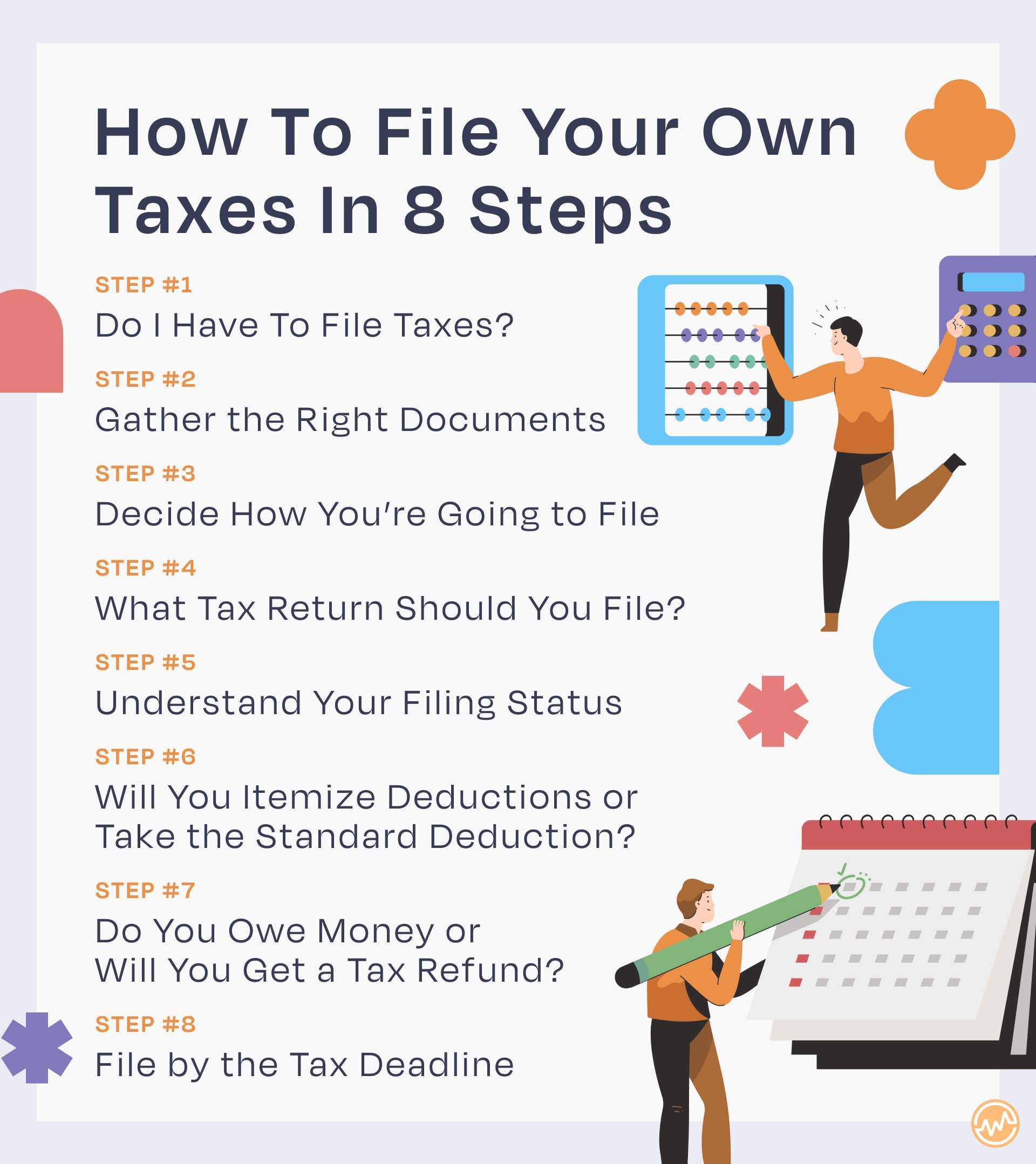
Gathering Your Essential Documents and Information
The single most critical step in successful DIY tax filing is meticulous preparation. Having all your necessary documents on hand before you begin will save you immense frustration and prevent errors.
Income Statements
These forms detail all the income you received throughout the tax year.
- W-2 Form (Wage and Tax Statement): Received from each employer you worked for during the year, showing your wages, tips, and other compensation, along with federal, state, and local taxes withheld.
- 1099 Forms: These come in various types:
- 1099-INT: For interest income from banks, credit unions, etc.
- 1099-DIV: For dividend income from stocks and mutual funds.
- 1099-MISC: For miscellaneous income, such as rent, royalties, or payments for services (if you’re an independent contractor and received more than $600 from one source).
- 1099-NEC: Specifically for nonemployee compensation (freelance or contractor income) replacing the relevant box on 1099-MISC for this purpose.
- 1099-B: For proceeds from brokerage and barter exchange transactions (stock sales).
- 1099-R: For distributions from pensions, annuities, retirement or profit-sharing plans, IRAs, and insurance contracts.
- 1099-G: For certain government payments, such as unemployment compensation or state tax refunds.
- K-1 Forms: For income from partnerships, S corporations, and trusts. These are often complex and can arrive later than other forms.
Deduction and Credit Documentation
To claim deductions and credits, you need supporting documentation. Keep these organized throughout the year.
- Homeownership: Mortgage interest statement (Form 1098), real estate tax bills.
- Student Loans: Student loan interest statement (Form 1098-E).
- Education Expenses: Tuition statements (Form 1098-T), receipts for books and supplies.
- Medical Expenses: Receipts for unreimbursed medical, dental, and vision expenses (if itemizing and exceeding AGI threshold).
- Childcare Costs: Provider’s name, address, and taxpayer identification number (TIN) for the Child and Dependent Care Credit.
- Charitable Contributions: Receipts or acknowledgment letters for cash and non-cash donations.
- Retirement Contributions: Records of contributions to IRAs, 401(k)s, HSAs (if not already on W-2 or 1099-R).
- Business Expenses: For self-employed individuals, detailed records of all business income and expenses.
Personal Information and Prior Year’s Returns
You’ll also need:
- Social Security Numbers (SSNs) or Individual Taxpayer Identification Numbers (ITINs) for yourself, your spouse, and all dependents.
- Your prior year’s tax return (especially your Adjusted Gross Income, which is often required for identity verification when e-filing).
- Bank account and routing numbers for direct deposit of refunds or direct debit of taxes owed.
Choosing Your DIY Tax Filing Method
Once your documents are in order, the next step is to select the method you’ll use to prepare and file your return. Modern options range from completely free services to robust commercial software.
Free Tax Filing Options
For many taxpayers, especially those with lower to moderate incomes, free options are readily available and highly effective.
- IRS Free File: The IRS partners with commercial tax software providers to offer free online tax preparation and e-filing to taxpayers who meet specific income requirements (usually below a certain AGI threshold). This is an excellent option for qualifying individuals, as it uses trusted software at no cost.
- Free Versions of Commercial Software: Many popular tax software brands offer free editions, typically for simple returns (e.g., W-2 income, standard deduction). Be mindful of income limits and potential upgrade costs if your situation proves more complex than the free version handles.

Commercial Tax Software
For those whose income exceeds the Free File threshold or who prefer more robust features, commercial tax software is the most popular DIY method.
- TurboTax, H&R Block, TaxAct, TaxSlayer, FreeTaxUSA: These are some of the leading providers. They offer a guided, interview-style process that makes tax preparation straightforward, asking questions and populating forms based on your answers.
- Features and Ease of Use: Different software may excel in specific areas. Some are known for their user-friendly interfaces, while others might offer more in-depth guidance for complex situations. Most provide free trials or “start for free” options, allowing you to gauge their suitability before purchasing.
- Cost and Different Versions: Software typically comes in tiers (e.g., Deluxe, Premier, Self-Employed), with prices increasing with the complexity of your tax situation. Compare features carefully to ensure the version you choose supports all your necessary forms and schedules.
Manual Filing (Paper Forms)
While increasingly rare, you can still prepare your taxes by hand using paper forms.
- Pros: Absolutely free (except for postage), offers a deep dive into the actual tax forms.
- Cons: Very time-consuming, highly susceptible to errors, no built-in error checking, slower processing for refunds.
- Where to Get Forms: You can download and print forms directly from the IRS website (IRS.gov) or order them by mail.
Navigating the Tax Filing Process Step-by-Step
Regardless of the software or method you choose, the core steps of preparing your return remain consistent.
Inputting Your Income Data
Begin by accurately entering all your income information from your W-2s, 1099s, K-1s, and other income statements. Tax software will prompt you for each relevant document. Double-check every number against your original forms to prevent errors. Ensure you report all income, even if you didn’t receive a 1099 (e.g., freelance income under $600 from one client).
Identifying and Claiming Deductions & Credits
This is where you can significantly reduce your tax liability. The software will typically guide you through common deductions and credits based on your input.
- Standard vs. Itemized: The software will calculate both and advise which option provides the greater tax benefit. If you itemize, diligently input all eligible expenses.
- Credits: Ensure you claim all credits for which you qualify, such as the Child Tax Credit, Earned Income Tax Credit, education credits, or dependent care credits. Understanding eligibility criteria is key here; refer to IRS guidelines if unsure.
Reviewing Your Return for Accuracy
This step is critical and should never be rushed.
- Software Checks: Tax software performs internal audits, flagging potential errors or missing information. Pay close attention to these warnings.
- Manual Review: Even with software, manually review your entire return. Check for:
- Correct spelling of names and SSNs.
- Accurate bank account details for direct deposit.
- All income sources reported.
- All applicable deductions and credits claimed.
- No duplicate entries.
- Prior Year Comparison: Compare your current year’s return to your previous year’s, especially if your financial situation hasn’t changed drastically. Significant variances might indicate an error.
Filing Your Return
Once you are confident your return is accurate, it’s time to file.
- E-file vs. Mail: Electronic filing (e-file) is the safest, fastest, and most common method. Your return is processed quicker, and you receive confirmation of its acceptance. If mailing, ensure all necessary forms are included, signed, and sent to the correct IRS address.
- Payment Options (If You Owe):
- Direct Debit: Most e-file services allow you to authorize a direct debit from your bank account.
- IRS Direct Pay: Pay directly from your checking or savings account on the IRS website.
- Credit/Debit Card: Through approved third-party processors (fees may apply).
- Check/Money Order: Mail with Form 1040-V (Payment Voucher).
- Refunds (If You’re Due One): Opt for direct deposit for the quickest refund.
Post-Filing Considerations and Future Planning
Filing your taxes isn’t just about completing a task; it’s an opportunity for ongoing financial learning and optimization.
What to Do If You Owe Taxes or Expect a Refund
- If You Owe: If you can’t pay the full amount by the deadline, you can typically request a short-term payment plan or an offer in compromise (OIC) with the IRS. Interest and penalties may still apply.
- If You Expect a Refund: Track your refund status using the IRS “Where’s My Refund?” tool. Most e-filed refunds are issued within 21 days.
Keeping Meticulous Records
Once filed, don’t discard your documents. The IRS generally recommends keeping tax records for at least three years from the date you filed your original return or two years from the date you paid the tax, whichever is later. For more complex situations, like underreporting income, the period can extend to six years. Store both physical and digital copies securely. This includes your filed return, all supporting documents, and proof of payment or refund.
Planning for Next Year’s Taxes
Use the insights gained from doing your own taxes to optimize your financial strategy for the coming year.
- Adjusting Withholdings: If you received a large refund, you might be overpaying throughout the year. Adjust your W-4 form with your employer to have less tax withheld, giving you more money in your paycheck. Conversely, if you owed a lot, consider increasing your withholdings to avoid a surprise tax bill next year.
- Estimated Taxes: If you have significant income not subject to withholding (e.g., self-employment income, large investment gains), you may need to pay estimated taxes quarterly using Form 1040-ES.
- Tax-Advantaged Savings: Explore opportunities to reduce taxable income through contributions to retirement accounts (401(k), IRA), Health Savings Accounts (HSAs), or other tax-deferred investments.
- Track Deductible Expenses: Keep a running log or digital folder for potential deductions and credits throughout the year, rather than scrambling at tax time.
Doing your own taxes is a powerful step towards greater financial literacy and control. While it requires diligence and attention to detail, the sense of accomplishment and the financial insights gained are invaluable. By understanding the fundamentals, meticulously preparing, leveraging appropriate tools, and maintaining organized records, you can confidently take charge of your tax obligations and build a stronger foundation for your financial future.
aViewFromTheCave is a participant in the Amazon Services LLC Associates Program, an affiliate advertising program designed to provide a means for sites to earn advertising fees by advertising and linking to Amazon.com. Amazon, the Amazon logo, AmazonSupply, and the AmazonSupply logo are trademarks of Amazon.com, Inc. or its affiliates. As an Amazon Associate we earn affiliate commissions from qualifying purchases.