
For the modern university student, the challenge of balancing a rigorous academic schedule with a tight personal budget is a perennial struggle. In this landscape, subscription services are often viewed as discretionary expenses—luxuries that can be trimmed when funds run low. However, Amazon Prime Student stands out as a unique hybrid: a service that functions as both a lifestyle convenience and a strategic financial tool. Understanding “how much” Amazon Prime costs for students requires looking beyond the sticker price and examining the broader economic impact on a student’s monthly budget.

In this guide, we will analyze the direct costs of Amazon Prime Student, evaluate the monetary value of its integrated perks, and explore how students can leverage this membership to optimize their personal finances.
The Direct Cost of Entry: Understanding the Prime Student Fee Structure
The most immediate question any budget-conscious student asks is the bottom line. Amazon has positioned its student tier as an aggressive loss-leader, designed to capture the loyalty of the Gen Z demographic long before they reach their peak earning years. This results in a price point that is significantly lower than the standard retail membership.
The 6-Month Trial: A No-Cost Introduction
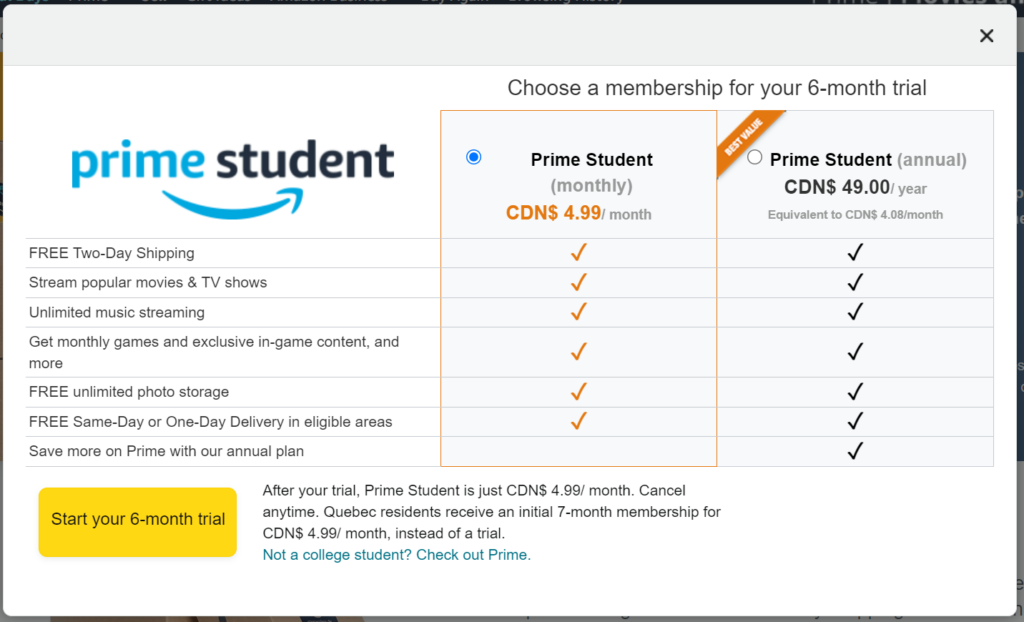
Unlike the standard 30-day trial offered to the general public, Amazon Prime Student begins with a robust six-month trial period at no cost. From a personal finance perspective, this is a rare opportunity to access a premium service with zero capital outlay. During these six months, students receive almost all the core benefits of a paid membership, including two-day shipping and Prime Video. This window allows students to track their usage and determine if the eventual subscription fee will offer a positive return on investment (ROI).
Monthly vs. Annual Payments: Calculating Long-Term Savings
Once the six-month trial concludes, the membership transitions to a paid subscription. As of 2024, the cost of Amazon Prime Student is $7.49 per month. For those who can afford a larger upfront payment, the annual subscription is priced at $69 per year.
When we break down the math, the annual plan offers substantial savings. Paying monthly for 12 months totals approximately $89.88. By opting for the $69 annual payment, students save roughly $21 per year—a 23% discount over the monthly rate. For a student managing a lean budget, these incremental savings are vital. When compared to the standard Amazon Prime rate of $14.99 per month or $139 per year, the student discount represents a 50% reduction in cost, making it one of the most aggressive student discounts in the digital economy.
Eligibility and Verification: Maintaining the Discounted Rate
To qualify for these rates, students must provide proof of enrollment. Typically, this is done through a .edu email address or by submitting documentation such as a student ID, transcript, or tuition bill. The financial importance of this step cannot be overstated; the discount is generally available for up to four years or until graduation, whichever comes first. Proactively managing this verification ensures that the subscription does not accidentally roll over into the full-price tier, which could disrupt a carefully planned monthly budget.
Quantifying the Perks: Beyond Free Shipping
To truly understand the “cost” of Prime Student, one must account for the expenses it replaces. A membership is not just a fee for shipping; it is a bundled package of services that, if purchased individually, would cost a student hundreds of dollars more per year.
Prime Video and Music: Consolidation of Subscription Costs
In the current “subscription economy,” the average consumer pays for multiple streaming services. By utilizing Prime Video and Prime Music (included in the membership), a student can potentially cancel other services like Netflix or Spotify. Prime Video offers a massive library of films and original content, while Prime Music provides ad-free access to millions of songs. If a student replaces a $15/month Netflix subscription with Prime Video, the Prime Student membership effectively pays for itself twice over before a single package is even shipped.
Exclusive Student Discounts: Textbooks, Tech, and Essentials
Amazon integrates specific marketplaces within the Prime Student ecosystem. One of the most significant financial advantages is the access to textbook rentals and discounts. Textbooks are a notorious “hidden cost” of higher education, often reaching hundreds of dollars per semester. Prime Student members frequently receive additional percentages off textbook purchases or access to lower rental rates. Furthermore, Amazon offers “Student-Only” deals on laptops, tablets, and dorm essentials, providing a targeted way to save on high-ticket items necessary for academic success.
Partner Benefits: Grubhub+ and Travel Savings
One of the most valuable additions to the Prime Student portfolio in recent years is the inclusion of Grubhub+. Students receive a free year of this service, which offers $0 delivery fees on food orders over a certain amount. For a student who orders takeout even twice a month, the savings on delivery fees alone can exceed the monthly cost of the Prime subscription. Additionally, Amazon has partnered with travel platforms like StudentUniverse to offer discounted flights and bus travel, further extending the financial utility of the membership into the realm of personal travel and holiday commutes.
The Opportunity Cost: Is Prime Student a Smart Financial Move?
While the discounts are lucrative, a professional financial analysis must also consider the “convenience tax”—the tendency to spend more simply because spending has been made easier.
Avoiding the “Convenience Tax” and Impulse Spending
The primary risk of Amazon Prime Student is the psychological effect of “free” and “fast” shipping. Behavioral economics suggests that when the friction of a transaction is removed (e.g., one-click ordering and same-day delivery), consumers are more likely to make impulse purchases. For a student, a $7.49 monthly fee is a bargain, but if that membership leads to $50 of unnecessary impulse spending each month, the “deal” becomes a financial liability. To maximize the financial benefit of Prime Student, users must maintain the discipline to use the service for planned, necessary purchases rather than dopamine-driven shopping.
Comparative Analysis: Prime Student vs. Standard Membership
When evaluating the ROI, it is helpful to look at the “break-even point.” If the standard shipping cost for a non-Prime order is $5.99, a student only needs to place two orders per month to justify the $7.49 monthly fee. However, when you factor in the $0 delivery fees from Grubhub+ and the included streaming services, the break-even point occurs almost immediately. For any student who uses the internet for more than just research, the Prime Student membership is statistically likely to be one of the most “profitable” line items in their budget, provided they utilize the full suite of included tools.
Strategic Budgeting with Amazon Prime Student
To get the most out of the membership, students should view it as a component of their broader financial strategy. It is not just a recurring charge; it is a platform for cost-avoidance.
Leveraging Prime for Shared Household Expenses
For students living in shared housing or dorms, Prime Student can be used to consolidate the purchase of bulk household goods—such as cleaning supplies, paper products, and non-perishable snacks. By using the “Subscribe & Save” feature in conjunction with the Prime Student discount, housemates can automate their essential shopping at a lower price point than local convenience stores, which often have high markups in college towns. This collaborative approach to budgeting further reduces the individual financial burden.
Seasonal Spending: Optimizing Prime Day for Student Needs
Prime Student members have full access to Prime Day, Amazon’s annual massive sales event. For a savvy student, this is the time to make major financial moves. By deferring the purchase of necessary electronics, bedding, or professional attire for internships until Prime Day, a student can save hundreds of dollars. Treating the membership as a gateway to these exclusive high-value windows is a hallmark of sophisticated personal financial management.
Conclusion: A High-Yield Asset for the Student Budget
In conclusion, “how much” Amazon Prime is for students is a question that yields a surprisingly positive answer. At $7.49 a month or $69 a year, it represents one of the most significant price-to-value ratios in the consumer market today. However, the true value is not found in the price tag itself, but in how the student integrates the service into their financial life.
By treating Prime Student as a tool for consolidation—merging entertainment, food delivery, and shopping into one discounted fee—students can effectively lower their cost of living. When managed with discipline to avoid impulse buys, Amazon Prime Student ceases to be a mere expense and becomes a strategic asset, helping students navigate the expensive years of higher education with a bit more financial breathing room.
aViewFromTheCave is a participant in the Amazon Services LLC Associates Program, an affiliate advertising program designed to provide a means for sites to earn advertising fees by advertising and linking to Amazon.com. Amazon, the Amazon logo, AmazonSupply, and the AmazonSupply logo are trademarks of Amazon.com, Inc. or its affiliates. As an Amazon Associate we earn affiliate commissions from qualifying purchases.