
In an age defined by rapid innovation and profound discoveries, the terms “science” and “technology” are often used interchangeably, blurring lines that are, in fact, quite distinct. While intimately related and interdependent, understanding their fundamental differences is crucial for appreciating the unique contributions each makes to human progress. Science, at its heart, is a quest for knowledge and understanding, driven by curiosity about how the natural world operates. Technology, conversely, is the application of that knowledge to create tools, systems, and methods that solve problems and improve human life. This distinction, though seemingly simple, underpins the entire edifice of modern civilization, from the earliest stone tools to the most advanced AI algorithms.
To truly grasp their relationship, we must delve into their core definitions, explore their symbiotic dance, examine their distinct methodologies, trace their historical evolution, and finally, consider their profound impact on society. By dissecting these concepts, we gain not only a clearer vocabulary but also a deeper insight into the engines driving our future.
Unpacking the Core Definitions: Science as Knowledge, Technology as Application
The journey to distinguish science from technology begins with a precise understanding of what each term truly represents. While they are often partners in progress, their fundamental nature and primary objectives diverge significantly.
Defining Science: The Pursuit of Understanding
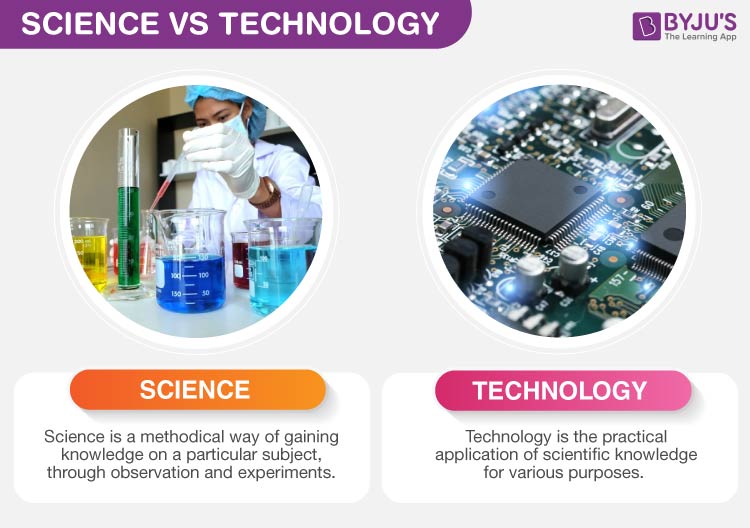
Science, in its purest form, is a systematic and organized endeavor that builds and organizes knowledge in the form of testable explanations and predictions about the universe. It is a process of discovery, driven by an inherent human curiosity to comprehend why and how things work. Scientists observe phenomena, formulate hypotheses, conduct experiments, collect data, and analyze results to arrive at theories that explain natural laws and principles. The primary goal of science is not to create a product or solve an immediate practical problem, but rather to expand the collective body of human knowledge. Whether it’s astrophysics exploring the origins of the cosmos, biology unraveling the complexities of life, or quantum physics probing the subatomic realm, science seeks objective truths and universal principles without direct regard for their practical utility. Its value lies in the intellectual understanding it provides, the enlightenment it offers, and the fundamental theories it establishes. The knowledge generated by science is, in essence, the raw material, the theoretical framework, upon which much of technology is built.
Defining Technology: The Application of Knowledge
Technology, on the other hand, is the application of scientific knowledge for practical purposes, particularly in industry, engineering, and daily life. It encompasses the creation, development, and use of tools, machines, techniques, crafts, systems, or methods of organization to solve problems, fulfill needs, or achieve specific objectives. If science asks “why?”, technology asks “how can we use this to do something useful?”. From the invention of the wheel and the printing press to the internet and artificial intelligence, technology is driven by a desire to innovate, to build, and to improve the human condition. It translates scientific discoveries into tangible solutions, transforming abstract principles into functional artifacts and processes. For instance, the scientific understanding of electromagnetism led to the technology of electricity grids and motors. The scientific discovery of semiconductors enabled the technology of microchips, which in turn power our computers and smartphones. Technology is inherently purpose-driven and pragmatic, focused on generating practical outcomes and facilitating human endeavors.
The Symbiotic Relationship: A Dance of Discovery and Innovation
While distinct in their core definitions, science and technology are inextricably linked in a dynamic, mutually beneficial relationship. They don’t just coexist; they actively propel each other forward in an endless loop of discovery and application. This symbiosis is the engine of modern progress, each discipline providing essential fuel for the other.
How Science Fuels Technology
Scientific breakthroughs frequently lay the groundwork for entirely new technological frontiers. Without the fundamental understanding provided by scientific research, many technologies simply wouldn’t exist. For example, the scientific study of light and optics, exploring its properties and behaviors, was a prerequisite for the invention of the telescope, the microscope, and ultimately, fiber optics and laser technology. Similarly, Einstein’s theory of relativity, a purely scientific endeavor, had profound implications for GPS technology, which relies on precise timekeeping adjusted for relativistic effects. The discovery of DNA’s structure in biology paved the way for genetic engineering and biotechnology. In essence, science expands the realm of possibility, providing new principles and phenomena that engineers and inventors can then harness to create novel solutions. It offers the “what-if” scenarios that technology then strives to make a reality.
How Technology Advances Scientific Discovery
The relationship is far from one-sided. Technology often provides the sophisticated tools and methodologies that enable scientists to push the boundaries of knowledge even further. Advanced microscopes, particle accelerators, radio telescopes, powerful supercomputers, and sophisticated sensors are all technological marvels that allow scientists to observe, measure, and analyze phenomena at scales and complexities previously unimaginable. For instance, the development of powerful computing technology has enabled theoretical physicists to perform complex simulations that validate or refute hypotheses, and for biologists to process vast amounts of genetic data. Space probes and satellites, products of advanced aerospace engineering, allow astronomers to gather data from distant celestial bodies, fueling new scientific theories about the universe. Moreover, new technologies can create entirely new fields of scientific inquiry; the internet, a technological innovation, gave rise to network science and new branches of data science.
The Iterative Loop of Progress
This back-and-forth interaction creates an iterative loop of progress. Scientific discovery leads to new technologies, which in turn enable more advanced scientific research, leading to further discoveries, and so on. It’s a continuous feedback mechanism. Consider the field of materials science: scientific understanding of material properties leads to the development of new alloys or composites (technology), which are then used to build more precise scientific instruments, enabling new experiments and discoveries about matter, leading to even more advanced materials. This cyclical relationship is not merely coincidental but fundamental to how both fields evolve and contribute to human flourishing. It ensures that the pursuit of knowledge and the drive for practical application remain perpetually intertwined.
Distinct Goals and Methodologies
Despite their deep interdependency, science and technology maintain distinct goals and often employ different methodologies, reflecting their core purposes. Understanding these differences further clarifies their individual identities and contributions.
Science’s Objective: Explaining the Universe
The primary objective of science is to understand, explain, and predict the natural world. Its ultimate goal is to formulate universal laws and theories that describe how phenomena occur, providing a comprehensive understanding of reality. This pursuit is largely theoretical and aims for intellectual satisfaction and the expansion of knowledge for its own sake. A scientist might spend years studying black holes, not necessarily to create a product from them, but to understand their nature and impact on the cosmos. The success of a scientific endeavor is measured by its accuracy in prediction, its explanatory power, and its ability to withstand rigorous testing and peer review. The methodology is typically characterized by observation, hypothesis formation, experimentation, data collection, analysis, and peer-reviewed publication, all aimed at achieving consensus on scientific truths.

Technology’s Objective: Solving Human Problems
Conversely, technology’s primary objective is utilitarian: to create solutions to practical problems, satisfy human needs, or achieve specific functional goals. Its aim is to build, design, and improve, leading to tangible products, processes, or systems. An engineer, working in the realm of technology, might take the scientific principles of aerodynamics to design a more fuel-efficient aircraft or develop software to manage complex data. The success of a technological endeavor is measured by its effectiveness, efficiency, reliability, cost-effectiveness, and its ability to meet specific user requirements or market demands. The methodology in technology often involves design thinking, engineering principles, prototyping, testing, optimization, and implementation. It’s a process of transforming ideas and scientific principles into practical applications that can be used or consumed by society.
Divergent Approaches and Tools
While both fields rely on logical reasoning and empirical evidence, their day-to-day approaches and the specific tools they emphasize can differ. Scientists often focus on reducing complex systems to their fundamental components to understand underlying mechanisms. They might use particle accelerators to probe the smallest particles or telescopes to observe distant galaxies. Their “tools” are often instruments designed for precise measurement and observation. Technologists, on the other hand, often focus on synthesis and integration, combining existing knowledge and components to build new functional systems. Their “tools” are often design software, manufacturing equipment, coding languages, and project management methodologies. While both require creativity and problem-solving, the scientist’s creativity is often directed towards formulating new theories, while the technologist’s creativity is focused on devising new solutions or improving existing ones.
The Evolution of Human Progress: From Ancient Tools to AI
The interplay between science and technology is not a recent phenomenon but a historical constant that has shaped human civilization from its very beginnings, though the pace and complexity have drastically increased over millennia.
Historical Interplay and Milestones
In early human history, the distinction between science and technology was often blurred, with practical innovations emerging from observation and trial-and-error rather than explicit scientific theory. Early humans developed tools like stone axes (technology) through empirical observation of materials and forces (proto-science). The invention of agriculture, the wheel, and metalworking were all driven by practical needs, often without a deep theoretical understanding of the underlying principles.
The Scientific Revolution (16th-18th centuries) marked a pivotal shift, establishing a systematic approach to understanding the natural world. Discoveries by figures like Newton, Galileo, and Copernicus laid the scientific foundations that would eventually power the Industrial Revolution. The steam engine, for example, a cornerstone of early industrial technology, benefited from a burgeoning understanding of thermodynamics. The 19th and 20th centuries witnessed an accelerated intertwining, with scientific breakthroughs in electromagnetism leading directly to telegraphy, radio, and electrical power. The discovery of quantum mechanics fueled the development of transistors and lasers, which are foundational to modern electronics and information technology.
The Accelerating Pace of Technological Advancement
Today, the speed at which scientific discoveries are translated into technological applications is astounding. The internet, born from scientific research networks, transformed communication and commerce in mere decades. The Human Genome Project, a massive scientific undertaking, quickly spawned a new generation of biotechnologies. This acceleration is partly due to the very technologies we’ve developed – powerful computers, advanced simulation tools, and global communication networks allow for faster research, development, and dissemination of information. The loop of progress is tightening, leading to exponential growth in both scientific knowledge and technological capability.
Contemporary Challenges and Ethical Considerations
While this rapid advancement brings immense benefits, it also introduces complex challenges and ethical dilemmas. Technologies like artificial intelligence, genetic editing (CRISPR), and advanced surveillance systems raise profound questions about privacy, equality, human identity, and the very future of society. Science provides the knowledge to achieve these capabilities, and technology provides the means. It then falls upon society, guided by ethical frameworks and often, new branches of inquiry like technoethics, to determine how these powerful tools should be used. The future requires not just more science and technology, but also a deeper understanding of their implications and responsible stewardship.
Impact on Society: Shaping Our World
The intertwined forces of science and technology have been the primary drivers of societal transformation, influencing every facet of human existence from economic structures to daily routines and our philosophical outlook.
Economic Growth and Industrial Revolutions
Historically, major leaps in technology have consistently fueled economic growth and triggered industrial revolutions. From the agricultural revolution, which allowed for settled societies, to the first Industrial Revolution powered by steam, and the second driven by electricity and mass production, technology has continually reshaped economies. The information age, defined by computers, the internet, and digital technologies, has created entirely new industries, jobs, and global markets, fundamentally altering how value is created and exchanged. Scientific research often leads to entirely new sectors – biotechnology, nanotechnology, and renewable energy are all industries born from advanced scientific understanding, creating wealth and improving living standards for billions.
Transforming Daily Life and Communication
Perhaps the most visible impact of science and technology is on our daily lives. From electric lighting and refrigeration to personal computers and smartphones, technological innovations have drastically changed how we live, work, and interact. Communication, in particular, has been revolutionized, moving from letters to instant global messaging and video calls, shrinking the world and fostering unprecedented levels of connectivity. Advances in medicine, stemming from biological and chemical sciences, have eradicated diseases, extended lifespans, and improved overall public health. Transportation technologies, from cars and planes to high-speed rail, have made travel faster and more accessible, facilitating trade and cultural exchange. These changes, driven by the practical application of scientific knowledge, have fundamentally reshaped human experience.

Future Implications and the Digital Frontier
As we stand on the cusp of new technological frontiers, the implications for the future are staggering. Artificial intelligence and machine learning, built upon sophisticated mathematical algorithms and computational science, promise to automate complex tasks, revolutionize industries, and offer new forms of human-computer interaction. Biotechnology holds the potential to cure intractable diseases, enhance human capabilities, and address global food security. Quantum computing, still largely in the realm of scientific research, promises to unlock processing powers that could solve problems currently deemed impossible. However, with these profound advancements come significant societal questions about job displacement, data privacy, algorithmic bias, and equitable access. Navigating these future landscapes will require not just continued scientific discovery and technological innovation, but also careful societal deliberation and ethical guidance to ensure that progress serves humanity responsibly.
In conclusion, while distinct in their primary aims and methodologies, science and technology are inseparable partners in the grand human endeavor of understanding and shaping the world. Science seeks to know; technology seeks to do. One provides the fundamental truths, the other provides the practical means. Their ongoing dance continues to redefine human potential and propel us towards an ever-evolving future, demanding both intellectual rigor and ethical foresight.
aViewFromTheCave is a participant in the Amazon Services LLC Associates Program, an affiliate advertising program designed to provide a means for sites to earn advertising fees by advertising and linking to Amazon.com. Amazon, the Amazon logo, AmazonSupply, and the AmazonSupply logo are trademarks of Amazon.com, Inc. or its affiliates. As an Amazon Associate we earn affiliate commissions from qualifying purchases.