
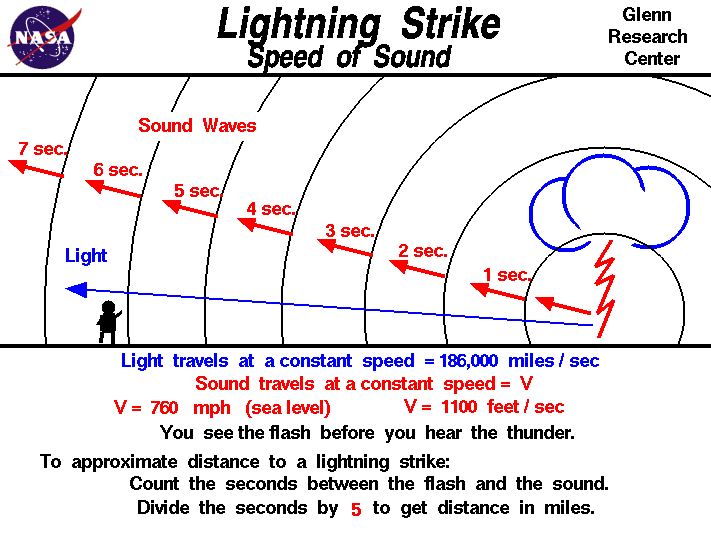
The phrase “the speed of sound” conjures images of scientific experiments, maybe a crack of thunder followed by a rumble, or the sharp retort of a rifle. It’s a fundamental concept in physics, a constant we learn about in school. But beyond the textbook definition – approximately 343 meters per second in dry air at 20 degrees Celsius – the speed of sound is a remarkably versatile and influential factor that touches upon technology, branding, and even our financial lives in ways you might not expect.
In this exploration, we’ll delve into the scientific underpinnings of sound’s speed, but more importantly, we’ll uncover its pervasive impact across the domains of technology, branding, and money, demonstrating how this seemingly simple measurement plays a surprisingly complex and crucial role in our modern world.
The Science Behind the Speed: How Sound Travels
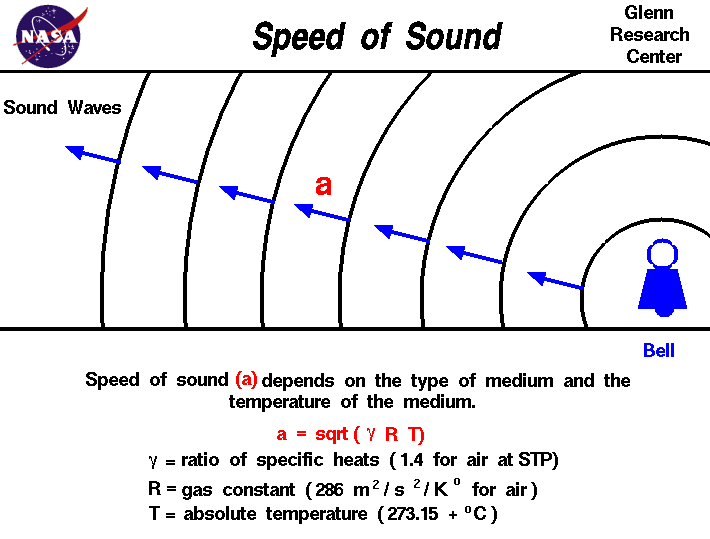
At its core, sound is a wave, a disturbance that propagates through a medium. Imagine dropping a pebble into a still pond; ripples spread outwards. Sound waves are similar, but instead of water, they travel through air, liquids, or solids by causing particles in the medium to vibrate. The speed at which these vibrations travel is what we call the speed of sound.
Several factors influence this speed. The most significant are the properties of the medium itself:
- Density: Denser materials generally transmit sound faster. Think of how sound travels much more efficiently through a solid metal rod than through air. The particles in a solid are packed much closer together, allowing vibrations to be passed on more readily.
- Elasticity (or Stiffness): More elastic materials, meaning those that return to their original shape quickly after being deformed, transmit sound faster. Steel, for instance, is far more elastic than rubber, and sound travels considerably faster through it.
- Temperature: For gases like air, temperature is a crucial factor. As temperature increases, air molecules move faster and collide more frequently, thus transmitting sound waves more quickly. This is why the speed of sound is often specified at a particular temperature.
- Phase: Sound travels at different speeds in different states of matter. It’s slowest in gases, faster in liquids, and fastest in solids. For example, the speed of sound in water is around 1482 m/s, significantly faster than in air. In solids like aluminum, it can reach over 6000 m/s.
The Role of Pressure and Humidity
While density and elasticity are primary drivers, other factors can have a subtle impact. Pressure in gases has a surprisingly minimal effect on the speed of sound. This is because while increased pressure means more molecules, it also means they are closer together, and these two effects tend to cancel each other out. However, humidity does have a slight influence. Water vapor molecules are lighter than the average air molecule (nitrogen and oxygen). When humidity increases, the air becomes slightly less dense, leading to a marginal increase in the speed of sound.
Understanding these fundamental principles is not just an academic exercise. It forms the bedrock for how we engineer and utilize sound in countless technological applications.
Sound Speed in the Digital Realm: Tech Innovations and Applications
The speed of sound, a seemingly natural phenomenon, has become an indispensable element in a vast array of technological advancements. From how we communicate to how we navigate and even how we experience entertainment, its properties are harnessed to create sophisticated systems.
H2: Sonic Technologies: Echoes of Speed in Innovation
The ability to measure and manipulate sound waves based on their speed is fundamental to many modern technologies.
H3: Sonar and Ultrasound: Seeing with Sound
One of the most prominent examples is sonar (Sound Navigation and Ranging). This technology, often associated with submarines and marine exploration, uses sound pulses to detect objects underwater. By emitting a sound wave and measuring the time it takes for the echo to return, sonar systems can determine the distance, size, and even shape of objects. The speed of sound in water is a critical variable in these calculations. The accuracy of sonar is directly proportional to the precise knowledge of sound’s speed in the specific aquatic environment, which can vary with temperature, salinity, and pressure.
Similarly, ultrasound technology utilizes sound waves with frequencies higher than the human hearing range. In medicine, ultrasound imaging allows doctors to visualize internal organs, monitor fetal development, and diagnose a range of conditions without invasive procedures. The speed of sound in human tissues is remarkably consistent, allowing for precise depth measurements of structures within the body. When the ultrasound beam encounters a boundary between different tissues (like bone and muscle, or fluid and tissue), some of the sound is reflected back as an echo. The time taken for this echo to return, coupled with the known speed of sound in that tissue, enables the creation of detailed 2D and 3D images. This application is a testament to how understanding the speed of sound can lead to life-saving diagnostic tools.
H3: Acoustics and Audio Engineering: Crafting the Sonic Experience
In the realm of audio engineering and acoustics, the speed of sound is paramount for designing everything from concert halls to headphones. The way sound waves reflect and refract within a space, and how they travel from a source to a listener’s ear, is governed by the speed of sound.
- Room Acoustics: Architects and acousticians carefully consider the speed of sound when designing spaces where sound quality is critical. The reverberation time of a room, how long it takes for sound to decay, is directly influenced by how quickly sound waves travel and reflect off surfaces. Understanding this allows for the creation of environments that enhance speech intelligibility or musical richness.
- Audio Equipment Design: The design of speakers, microphones, and headphones implicitly relies on the speed of sound. For example, in multi-speaker systems, the precise timing of sound arriving at different listening positions is crucial for creating immersive audio experiences like surround sound. Any delay or discrepancy can lead to phase cancellations and a degraded listening experience.
- Soundproofing and Noise Control: The effectiveness of soundproofing materials is often evaluated based on how they interact with sound waves, including their speed. Different materials absorb or reflect sound differently, and understanding the speed at which sound travels through them is key to designing effective barriers against unwanted noise.
H3: Communication Technologies: The Unseen Hand of Sound Speed
While we often think of digital communication as instantaneous, the underlying principles of some communication systems still acknowledge the limitations and properties of sound.
- Early Communication Systems: While not directly the speed of sound, early telegraph and telephone systems, in a way, were about transmitting information at speeds far exceeding human travel. The development of these technologies was driven by the desire to overcome the limitations of physical travel and signal transmission, a quest deeply rooted in understanding how signals propagate.
- Modern Networking: In the context of data transmission, while light signals travel through fiber optics at nearly the speed of light, the concept of latency – the delay in data transmission – is a direct consequence of the time it takes for signals to travel. While not sound itself, the principle of signal propagation time, influenced by the medium, remains a fundamental consideration in network design and performance optimization.
The speed of sound, therefore, is not just a physical constant; it’s a fundamental parameter that engineers leverage to create everything from life-saving medical devices to breathtaking audio experiences. Its influence in the tech world is subtle yet profound, shaping the devices and systems we interact with daily.
Branding in the Echo Chamber: How Sound Speed Shapes Perception

The speed of sound, though an objective physical property, has a fascinating and often underestimated impact on how brands are perceived and how their messages resonate with their audience. While not a direct marketing tool like a logo or a jingle, the underlying principles of sound’s propagation and its perceived speed can influence user experience and brand identity.
H2: The Sonic Signature: Brand Identity and Sound
Brands are increasingly recognizing the power of sound as a crucial element of their identity. This extends beyond just catchy jingles to encompass the overall sonic experience a brand provides.
H3: The Sound of Reliability: Engineering Trust Through Audio Cues
In the realm of technology, particularly in areas like automotive or aerospace, the precise timing and quality of sounds are integral to conveying reliability and safety. A well-engineered engine sound, the reassuring “thunk” of a car door closing, or the subtle chime of a successful system activation – these are all sonic cues designed to build trust. The perceived consistency and predictability of these sounds, indirectly linked to how sound travels and is processed, contribute to a brand’s reputation for quality. If these sounds are jarring or inconsistent, they can erode user confidence, even if the underlying technology is sound.
H3: Immersive Experiences and Brand Engagement
The rise of virtual and augmented reality (VR/AR) has amplified the importance of realistic soundscapes. Brands that can create truly immersive experiences, where the audio perfectly matches the visual, can forge deeper connections with their audience. This requires a sophisticated understanding of how sound travels and interacts with the virtual environment, ensuring that the sonic elements are delivered with accurate timing and spatialization. A brand that excels in delivering these high-fidelity, spatially accurate audio experiences can cultivate an image of innovation and technological prowess.
H3: User Interface Sounds and Brand Personality
Even seemingly minor UI sounds – the click of a button in an app, the notification alert of a new message – contribute to a brand’s personality. The choice of sounds, their tone, and their timing can subtly communicate aspects of the brand’s identity. A playful app might use cheerful, chirpy sounds, while a professional business application might opt for more understated, sophisticated tones. The speed at which these sounds are delivered and their clarity are crucial for a smooth and intuitive user experience, reinforcing the brand’s intended image.
H3: The “Instantaneous” Illusion: Managing Expectations in Digital Interactions
While digital signals travel at near light speed, the human perception of interactions is often influenced by factors that mimic the limitations of sound. For example, in online gaming or video conferencing, latency – the delay in communication – is a critical factor. Brands that can minimize this latency, providing a more responsive and “instantaneous” experience, are often perceived as superior. While not directly about the speed of sound, the desire for immediate feedback in digital interactions echoes our innate expectation of rapid signal transmission, a concept fundamentally informed by our understanding of how quickly information can travel.
The speed of sound, therefore, serves as an underlying principle in creating the sonic environments that shape brand perception. By carefully crafting audio experiences, brands can engineer trust, foster engagement, and subtly communicate their identity, all while leveraging the fundamental physics of how sound travels.
Sound Speed and the Bottom Line: Financial Implications of Sonic Phenomena
The influence of the speed of sound may not seem immediately obvious in the world of finance, but upon closer examination, its impact ripples through various financial aspects, from technological investments to the very way we conduct business.
H2: The Economics of Sound: From Infrastructure to Investment
The principles of sound propagation and its speed are intrinsically linked to the development and adoption of numerous technologies that have significant financial implications.
H3: Investing in Sonic Technologies: The Market for Sound
The technologies we discussed earlier – sonar, ultrasound, advanced audio engineering – represent substantial markets. Companies that develop and deploy these technologies, whether for medical imaging, marine exploration, entertainment, or defense, are significant players in the global economy. Investment in research and development for improved sonic technologies, aiming for greater accuracy, efficiency, and new applications, is a continuous driver of financial growth. The financial success of these companies is directly tied to their ability to harness and exploit the properties of sound, including its speed, to create valuable products and services.
H3: Infrastructure and Communication Costs
The speed of sound also plays a role in the infrastructure that underpins our global economy. While fiber optic cables transmit data at near light speed, other communication methods, especially in specialized or remote environments, might still rely on acoustic principles. Furthermore, understanding the limitations of signal propagation, even if at the speed of light, informs the cost of building and maintaining communication networks. Latency, the delay in data transfer, can have significant financial consequences in high-frequency trading, cloud computing, and real-time logistics. Minimizing latency, by optimizing signal paths and infrastructure, is a constant pursuit for companies, impacting their operational efficiency and profitability.
H3: The Cost of Noise and the Value of Quiet
In industrial settings, construction, and even densely populated urban areas, noise pollution can have tangible financial costs. These can include healthcare expenses related to stress and hearing damage, reduced productivity due to distractions, and the cost of implementing noise mitigation strategies. Conversely, the value of quiet environments can be significant. Luxury real estate in quiet locations often commands a premium. Brands that can effectively manage and mitigate noise in their products or services can create a competitive advantage and justify higher price points. The financial implications of managing sound, including understanding how it travels and its impact, are therefore considerable.
H3: Audio-Visual Presentations and Business Communication
In the corporate world, effective communication is paramount. Whether it’s a product launch, a shareholder meeting, or a sales pitch, the clarity and impact of audio-visual presentations are critical. The quality of microphones, speakers, and the acoustics of the presentation space all influence how well the message is received. A poorly delivered presentation, where sound is distorted or unclear due to the limitations of the audio system or the room’s acoustics, can lead to misunderstandings, missed opportunities, and ultimately, financial losses. Investing in quality audio-visual equipment and ensuring appropriate acoustic design for meeting spaces are financial decisions that directly impact business outcomes.
In conclusion, while the speed of sound might seem like a purely scientific concept, its influence extends into the very fabric of our economy. From the groundbreaking technologies it enables to the subtle ways it shapes brand perception and the tangible financial costs and benefits associated with sound management, understanding the speed of sound offers a richer perspective on the interconnectedness of our world. It’s a reminder that even seemingly simple physical phenomena have far-reaching implications in the complex systems of technology, branding, and finance.
aViewFromTheCave is a participant in the Amazon Services LLC Associates Program, an affiliate advertising program designed to provide a means for sites to earn advertising fees by advertising and linking to Amazon.com. Amazon, the Amazon logo, AmazonSupply, and the AmazonSupply logo are trademarks of Amazon.com, Inc. or its affiliates. As an Amazon Associate we earn affiliate commissions from qualifying purchases.