
Huntington’s Disease (HD) is a devastating, inherited neurodegenerative disorder that affects nerve cells in the brain. It is a progressive condition, meaning it worsens over time, leading to significant physical, cognitive, and psychiatric impairments. While the title of this article might suggest a direct link to the technological, branding, or financial domains typically covered by this website, understanding the fundamental nature of Huntington’s Disease is crucial, as it touches upon areas like diagnostic technology, the branding of medical research, and the financial burden it places on individuals and healthcare systems. This article will delve into the core aspects of Huntington’s Disease, exploring its genetic basis, the complex range of symptoms it presents, the diagnostic approaches, and the ongoing efforts in research and treatment, all while acknowledging how these elements intersect with the broader themes of technology, brand perception, and financial impact.

The Genetic Blueprint of Huntington’s Disease: An Inherited Predisposition
At its heart, Huntington’s Disease is a genetic disorder. It is caused by a mutation in a single gene, the HTT gene, which is responsible for producing a protein called huntingtin. This gene is located on chromosome 4. The mutation involves an abnormal expansion of a repeated DNA sequence (cytosine-adenine-guanine, or CAG) within the HTT gene.
Understanding the CAG Repeat Expansion
Normally, individuals have a certain number of CAG repeats within their HTT gene. However, in people with Huntington’s Disease, this repeat sequence is significantly elongated. The number of CAG repeats directly correlates with the likelihood of developing the disease and the age of onset.
- Typical Range: Most people have between 10 and 35 CAG repeats.
- Intermediate Range: Individuals with 36 to 39 CAG repeats may or may not develop symptoms of Huntington’s Disease. They also have a chance of passing on the expanded gene to their children.
- Reduced Penetrance: With 36 to 39 repeats, the onset of HD symptoms may be delayed or even never occur, but it carries a risk of passing on the mutation.
- Full Penetrance: Individuals with 40 or more CAG repeats are virtually certain to develop Huntington’s Disease during their lifetime. The higher the number of repeats, the earlier the onset of symptoms and often the more severe the disease progression.
This inherited nature is fundamental to understanding HD. It means that the disease is passed down from parent to child. Each child of a parent with Huntington’s Disease has a 50% chance of inheriting the mutated gene and developing the condition. This genetic inheritance pattern has profound implications for families, raising complex ethical and emotional considerations.
The Mechanism of Neurodegeneration: How the Mutation Harms Brain Cells
The expanded CAG repeats lead to the production of an altered huntingtin protein. This abnormal protein is toxic to nerve cells, particularly those in the basal ganglia, a region of the brain crucial for controlling movement, cognition, and emotion. While the exact mechanisms are still being researched, it’s understood that the mutated huntingtin protein can:
- Aggregate: The abnormal protein tends to clump together inside nerve cells, forming aggregates that can disrupt normal cellular function.
- Impair Cellular Processes: These aggregates can interfere with essential cellular processes such as protein degradation, gene expression, and mitochondrial function, leading to cell damage and eventual death.
- Trigger Cell Death: Over time, this damage leads to the progressive degeneration and death of neurons, particularly in the striatum (part of the basal ganglia) and the cerebral cortex. This neuronal loss underlies the characteristic symptoms of Huntington’s Disease.
The progressive loss of these specific brain cells explains the debilitating nature of HD, affecting the very circuits that control our ability to move, think, and feel.
The Multifaceted Symptoms of Huntington’s Disease: A Trio of Impairments
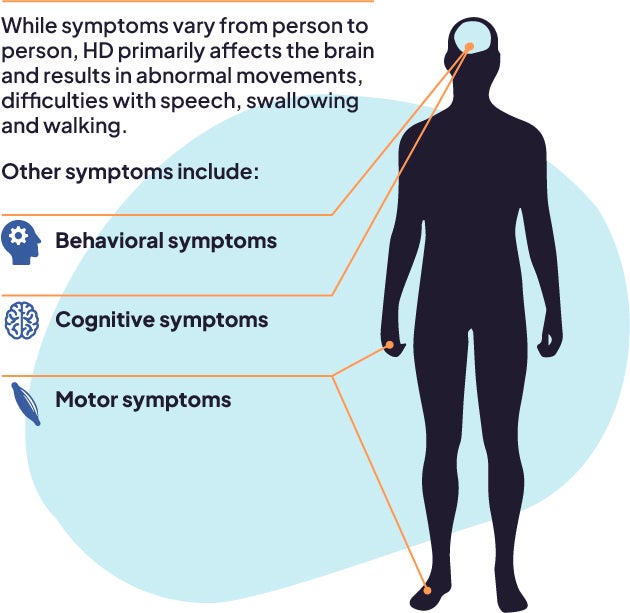
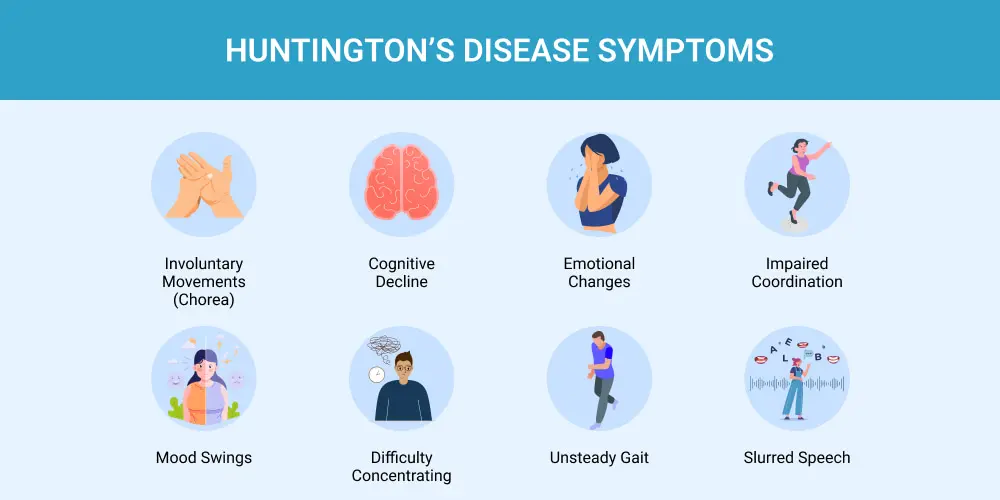
Huntington’s Disease is characterized by a triad of symptoms: motor, cognitive, and psychiatric disturbances. The manifestation and severity of these symptoms can vary significantly from person to person, and they typically develop gradually over years.
Motor Symptoms: The Disrupting Impact on Movement
The most recognizable symptoms of Huntington’s Disease are the involuntary and progressive motor disturbances. These often begin subtly and worsen over time, significantly impacting a person’s ability to perform everyday activities.
- Chorea: This is perhaps the most distinctive motor symptom. It refers to involuntary, jerky, and purposeless movements that can affect the face, trunk, and limbs. These movements can range from subtle twitches to violent flailing. As the disease progresses, chorea can interfere with walking, eating, speaking, and even breathing.
- Dystonia: This involves sustained or repetitive muscle contractions that cause abnormal postures and twisting movements. Dystonia can affect various parts of the body, leading to difficulties with fine motor skills and contributing to pain and discomfort.
- Impaired Voluntary Movement: As HD progresses, individuals may also experience a slowing down of movements (bradykinesia), rigidity, and problems with balance and coordination, making walking and other essential movements increasingly challenging.
- Speech and Swallowing Difficulties: The muscles involved in speech and swallowing can also be affected, leading to dysarthria (slurred speech) and dysphagia (difficulty swallowing), which can lead to choking and malnutrition.
Cognitive Symptoms: The Erosion of Mental Acuity
Beyond motor impairments, Huntington’s Disease profoundly affects cognitive function. These changes can impact memory, judgment, problem-solving abilities, and executive functions, making it difficult for individuals to manage their lives independently.
- Executive Dysfunction: This is a hallmark of HD and includes difficulties with planning, organizing, prioritizing tasks, and problem-solving. Individuals may struggle with abstract thinking and adapting to new situations.
- Memory Impairment: While short-term memory may be relatively preserved in the early stages, long-term memory and recall can be affected.
- Slowed Thinking: Information processing speed can become significantly slower, making it harder for individuals to keep up with conversations or complete tasks that require quick responses.
- Decreased Awareness: Some individuals may experience a decline in their awareness of their own condition and its impact on others.
Psychiatric Symptoms: The Emotional and Behavioral Toll
The psychiatric and behavioral symptoms of Huntington’s Disease are often among the earliest to appear and can be as debilitating as the motor and cognitive impairments. These can significantly affect a person’s quality of life and their relationships with others.
- Depression: This is extremely common in individuals with HD, often appearing long before motor symptoms. Symptoms can include persistent sadness, loss of interest, fatigue, and thoughts of suicide.
- Anxiety: Feelings of nervousness, worry, and unease are also frequently experienced.
- Irritability and Aggression: Some individuals may become easily frustrated, irritable, or exhibit aggressive behavior.
- Apathy: A loss of motivation and interest in activities can also be a significant symptom.
- Obsessive-Compulsive Behaviors: Repetitive thoughts and behaviors can emerge.
- Psychosis: In some cases, hallucinations and delusions can occur.
The complex interplay of these motor, cognitive, and psychiatric symptoms makes Huntington’s Disease a truly challenging condition to manage, requiring a multidisciplinary approach to care.
Diagnosis and Management: Navigating the Path Forward
Diagnosing Huntington’s Disease involves a combination of clinical assessment, family history, neurological examination, and genetic testing. While there is currently no cure for HD, a range of strategies and emerging technologies are employed to manage symptoms, improve quality of life, and advance research.
The Diagnostic Process: Identifying the Disease
The diagnosis of Huntington’s Disease typically follows these steps:
- Medical History and Family History: A thorough review of the patient’s symptoms and their family’s medical history is crucial, as the genetic component is paramount.
- Neurological Examination: A neurologist will assess motor skills, coordination, reflexes, eye movements, and cognitive function to identify characteristic signs of HD.
- Neuroimaging: While not always definitive in early stages, MRI or CT scans of the brain can help rule out other conditions and may show changes in brain structure, such as atrophy in the basal ganglia, in later stages.
- Genetic Testing: This is the definitive diagnostic tool. A blood test can analyze the HTT gene for the presence and number of CAG repeats. This test can confirm a diagnosis or be used for predictive testing in individuals with a family history of HD who do not yet have symptoms.
Therapeutic Avenues: Managing Symptoms and Improving Lives
Currently, there is no treatment that can stop or reverse the progression of Huntington’s Disease. However, a range of interventions can help manage its diverse symptoms and improve the quality of life for affected individuals and their families.
- Medications:
- For Motor Symptoms: Medications like tetrabenazine and deutetrabenazine can help control chorea. Antipsychotics can be used to manage involuntary movements, agitation, and hallucinations.
- For Psychiatric Symptoms: Antidepressants, anxiolytics, and antipsychotics are used to manage depression, anxiety, irritability, and psychosis.
- Therapies:
- Physical Therapy: Can help maintain mobility, improve balance, and prevent falls.
- Occupational Therapy: Focuses on adapting daily living activities and recommending assistive devices to maintain independence.
- Speech Therapy: Addresses difficulties with speech and swallowing, helping with communication and preventing choking.
- Nutritional Support: Addressing swallowing difficulties and ensuring adequate caloric intake is vital.
- Psychological Support: Counseling and support groups are essential for individuals and families coping with the emotional and psychological impact of HD.
The Role of Technology and Research: A Beacon of Hope
The fight against Huntington’s Disease is increasingly being powered by advancements in technology and ongoing research.
- Precision Medicine and Genetics: Understanding the genetic basis of HD has paved the way for precision medicine approaches. Researchers are exploring gene-silencing therapies that aim to reduce the production of the toxic huntingtin protein. These innovative approaches leverage advanced genetic engineering and molecular biology.
- Diagnostic Tools and Biomarkers: Technology is crucial in developing more sensitive and earlier diagnostic tools. Researchers are looking for biomarkers in blood or cerebrospinal fluid that can indicate the presence of HD even before symptoms become apparent. AI-powered analysis of brain scans and even wearable technology to monitor movement patterns are being explored to aid in early detection and symptom tracking.
- Drug Development: Significant investment and technological innovation are driving the development of new drugs. These range from small molecules designed to target specific pathways involved in neurodegeneration to novel gene therapies. The rigorous process of bringing these to market involves extensive clinical trials, often managed through sophisticated digital platforms.
- Patient Registries and Data Analysis: Large-scale patient registries are vital for collecting data on disease progression, treatment effectiveness, and genetic variations. Advanced data analytics and artificial intelligence are being used to mine this information, accelerating our understanding of HD and identifying potential therapeutic targets.
The Brand of Hope: Marketing Medical Progress and Support
The “brand” surrounding Huntington’s Disease research and advocacy is crucial. Organizations dedicated to HD work to:
- Raise Awareness: Educate the public and medical community about the disease, its symptoms, and its impact.
- Fund Research: Solicit donations and grants to fuel scientific discovery. This often involves compelling storytelling and clear communication of research progress, akin to branding a cause.
- Support Families: Provide resources, information, and community for individuals affected by HD and their caregivers. The “brand” of these organizations offers a promise of support and a shared mission.
- Advocate for Patients: Lobby for increased funding, better access to care, and improved policies affecting those with HD.
This concerted effort to build a strong, trustworthy “brand” for HD research and support is essential for garnering public engagement and driving progress.
The Financial Landscape: The Cost of Huntington’s Disease
The financial implications of Huntington’s Disease are significant, impacting individuals, families, and healthcare systems:
- Healthcare Costs: The long-term care needs of individuals with HD, including doctor’s visits, medications, therapies, and potential in-home care or nursing home placement, represent a substantial financial burden.
- Lost Income: As the disease progresses, individuals often lose the ability to work, leading to a significant reduction in household income.
- Caregiver Burden: Family members often become primary caregivers, which can lead to reduced working hours or complete job loss, further impacting family finances.
- Research Funding: While not a direct cost to patients, the significant investment required for research and drug development highlights the financial stakes involved in finding effective treatments and cures.
Understanding these financial aspects underscores the need for robust social support systems, comprehensive insurance coverage, and continued investment in research that can ultimately reduce the long-term financial burden of HD.
In conclusion, Huntington’s Disease is a complex and profoundly challenging neurodegenerative condition. While its origins are purely biological, its impact ripples through technological advancements in diagnosis and treatment, the crucial branding of research and advocacy efforts, and the significant financial considerations for affected individuals and society. Continued dedication to research, technological innovation, and compassionate care offers the most potent path forward in the ongoing battle against this devastating disease.
aViewFromTheCave is a participant in the Amazon Services LLC Associates Program, an affiliate advertising program designed to provide a means for sites to earn advertising fees by advertising and linking to Amazon.com. Amazon, the Amazon logo, AmazonSupply, and the AmazonSupply logo are trademarks of Amazon.com, Inc. or its affiliates. As an Amazon Associate we earn affiliate commissions from qualifying purchases.