
When we think about how traits are passed down through generations, the name Gregor Mendel and his pea plants often come to mind. His groundbreaking work laid the foundation for our understanding of genetics, introducing concepts like dominant and recessive alleles, and the predictable patterns of inheritance he observed. However, the biological world is far more intricate than Mendel’s initial, albeit fundamental, discoveries. While Mendelian inheritance provides a crucial baseline, a significant portion of how we inherit traits deviates from these classic rules. This deviation is known as non-Mendelian inheritance, a fascinating area that reveals the complexity and nuance of genetic transmission.

This article will delve into the world of non-Mendelian inheritance, exploring the mechanisms that lead to inheritance patterns that don’t neatly fit Mendel’s laws. We’ll examine how factors beyond simple dominant-recessive relationships contribute to the diversity of traits we see in living organisms.
Understanding the Foundations: Mendelian Inheritance in Brief
Before we venture into the exceptions, it’s essential to have a firm grasp of Mendel’s principles. Mendel’s experiments with pea plants led to two fundamental laws:
- The Law of Segregation: This law states that for any trait, each parent carries two alleles (versions of a gene), and these alleles separate during gamete formation (sperm and egg cells). Thus, each gamete receives only one allele.
- The Law of Independent Assortment: This law states that the alleles of different genes assort independently of each other during gamete formation, meaning the inheritance of one trait does not influence the inheritance of another, provided the genes are on different chromosomes or far apart on the same chromosome.
These laws are the bedrock of classical genetics, explaining how dominant alleles mask recessive ones, leading to predictable phenotypic ratios (the observable characteristics) in offspring, such as the 3:1 ratio for a monohybrid cross involving a heterozygous parent. For instance, if we consider a gene for flower color where purple (P) is dominant over white (p), a cross between two heterozygous plants (Pp x Pp) would theoretically yield 75% purple flowers and 25% white flowers.
However, as geneticists continued their research, it became clear that life’s genetic tapestry was woven with threads far more complex than these straightforward patterns.
Beyond Simple Dominance: Exploring Non-Mendelian Inheritance Mechanisms
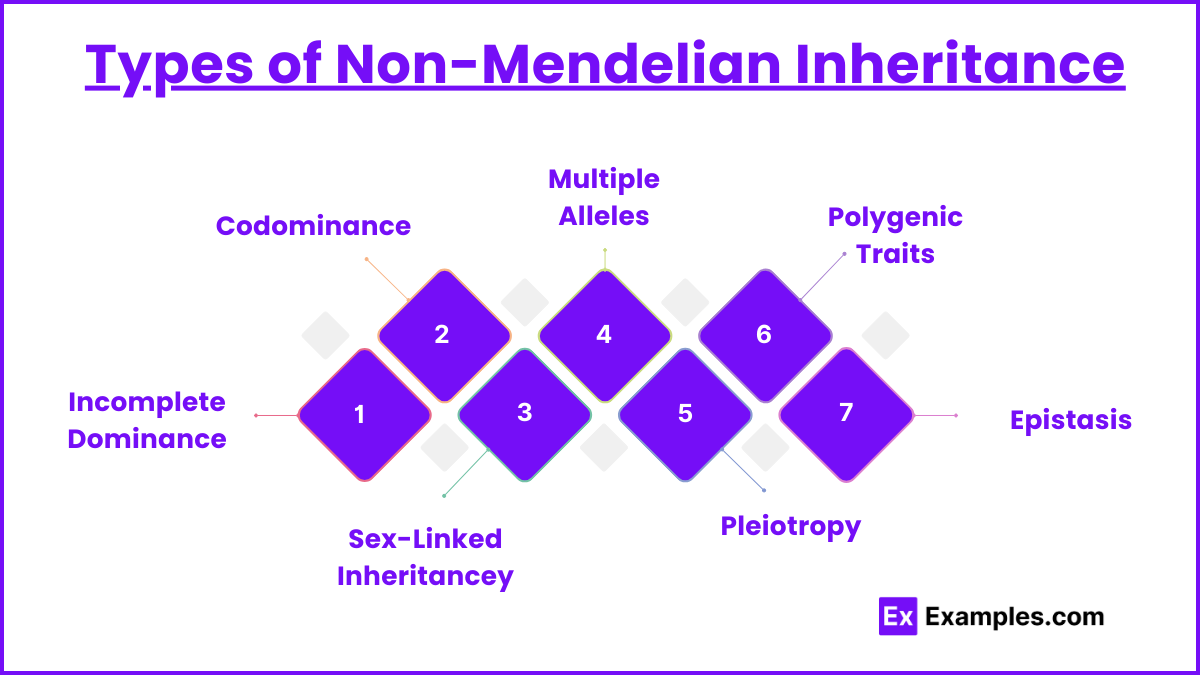
Non-Mendelian inheritance encompasses all patterns of inheritance that do not follow Mendel’s laws strictly. These deviations arise from various biological phenomena that influence how genes are expressed and transmitted. Let’s explore some of the most prominent examples:
Incomplete Dominance: The Blending of Traits
One of the most straightforward departures from Mendelian inheritance is incomplete dominance. In this scenario, neither allele is completely dominant over the other. Instead, when both alleles are present, the heterozygote displays an intermediate phenotype. It’s like a blending of the two parental traits.
Example: A classic example is the inheritance of flower color in snapdragons. If a red-flowered plant (RR) is crossed with a white-flowered plant (WW), their offspring (RW) will have pink flowers. The pink color is a result of the incomplete dominance of the red and white alleles. If these pink-flowered plants are then crossed, the offspring will exhibit a phenotypic ratio of 1:2:1 (red:pink:white), unlike the 3:1 ratio expected in complete dominance. This demonstrates that the heterozygote has a distinct phenotype, and each allele contributes to the observable trait.
Codominance: The Simultaneous Expression of Alleles
Codominance is another form of inheritance where both alleles in a heterozygous individual are fully and simultaneously expressed. Unlike incomplete dominance, where the traits blend, in codominance, both parental traits are visible.
Example: A well-known example is the ABO blood group system in humans. The gene for ABO blood type has three alleles: IA, IB, and i. Individuals can have one of six genotypes, leading to four possible phenotypes: type A, type B, type AB, and type O.
- Alleles IA and IB are codominant. This means that if an individual inherits both the IA and IB alleles, they will express both A and B antigens on their red blood cells, resulting in blood type AB.
- Both IA and IB are dominant over the i allele, which results in type O blood when present in the homozygous state (ii).
This codominance is crucial for blood transfusions, as individuals with type AB blood can receive blood from any ABO type because their immune system recognizes both A and B antigens.
Multiple Alleles: More Than Two Options
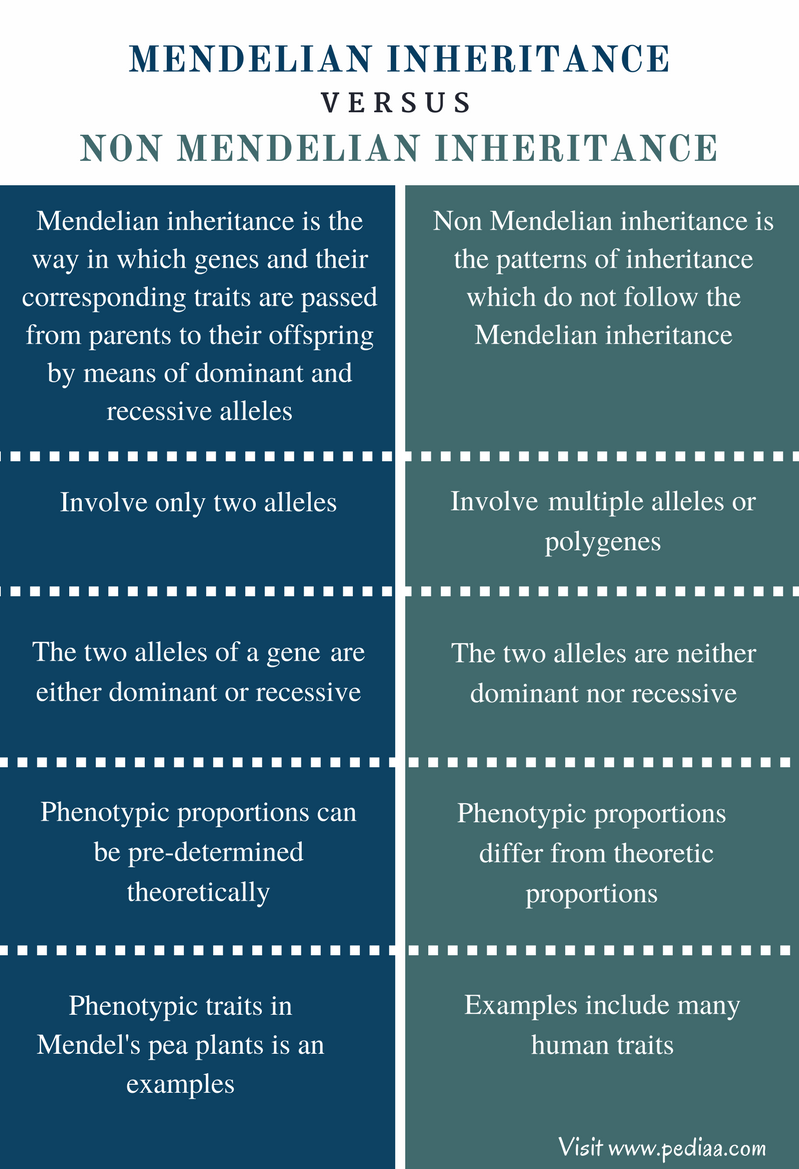
While Mendel’s work focused on genes with typically two alleles, many genes in a population exist in multiple allelic forms. This means that within a species, there are more than two possible versions of a particular gene. However, any individual diploid organism can only carry two of these alleles at a time (one on each homologous chromosome).
Example: The ABO blood group system, mentioned above, is also an excellent illustration of multiple alleles. With three alleles (IA, IB, and i) for the ABO gene, the possible combinations for individuals are greater than what would be possible with just two alleles. This increases the genetic diversity within a population regarding this specific trait.
Polygenic Inheritance: The Cumulative Effect of Many Genes
Many traits are not determined by a single gene but by the additive effects of multiple genes. This is known as polygenic inheritance. These traits often exhibit a continuous range of phenotypes, forming a bell-shaped curve when plotted for a population.
Example: Human height, skin color, and intelligence are classic examples of polygenic traits. Numerous genes, each with small additive effects, contribute to the final phenotype. For instance, with skin color, several genes control the production of melanin, and the combination of alleles an individual inherits for these genes determines the amount and type of melanin produced, leading to a wide spectrum of skin tones. Environmental factors also play a significant role in the expression of polygenic traits.
Sex-Linked Inheritance: Genes on the Sex Chromosomes
Sex-linked inheritance refers to traits that are determined by genes located on the sex chromosomes (X and Y chromosomes). In humans, females have two X chromosomes (XX), while males have one X and one Y chromosome (XY). Because the X and Y chromosomes are not homologous, genes on the X chromosome have different inheritance patterns in males and females.
Example: Red-green color blindness is a well-known X-linked recessive trait. The gene responsible for this condition is located on the X chromosome. If a female inherits a recessive allele for color blindness on one of her X chromosomes, she may still have normal vision if the other X chromosome carries the dominant allele. However, a male, having only one X chromosome, will express the trait if he inherits the recessive allele. This is why red-green color blindness is much more common in males than in females.
Epistasis: Gene Interactions
Epistasis occurs when the expression of one gene masks or modifies the expression of another gene at a different locus. The gene that masks the other is called epistatic, and the gene whose effect is masked is called hypostatic. This highlights that genes do not act in isolation but interact within complex genetic networks.
Example: Coat color in Labrador retrievers provides a good illustration of epistasis. There are two main genes involved: one for pigment color (B for black, b for brown) and another for pigment deposition (E for deposition, e for no deposition). If a dog has the genotype ee, it will have a yellow coat regardless of the alleles for pigment color (B or b) it possesses. The ‘ee’ genotype is epistatic to the gene controlling black or brown pigment, preventing its expression. Thus, a dog with genotype BBee will be yellow, and a dog with genotype bbee will also be yellow. Only when the genotype includes at least one ‘E’ allele (e.g., BBEe, BbEe, bbEe) will the pigment color gene have an effect.
Extranuclear Inheritance: Genetics Beyond the Nucleus
While most of our genetic material is housed within the nucleus, mitochondria (in eukaryotes) also contain their own small circular DNA molecules called mitochondrial DNA (mtDNA). This DNA is inherited maternally, as mitochondria are primarily passed down from the egg cell. Extranuclear inheritance, also known as cytoplasmic inheritance, refers to the inheritance of traits determined by genes located outside the nucleus.
Example: Certain genetic disorders affecting muscle function and energy production can be caused by mutations in mtDNA. Since these mitochondria are inherited from the mother, these conditions will be passed down exclusively through the maternal line.
The Significance of Non-Mendelian Inheritance
Understanding non-Mendelian inheritance is not merely an academic pursuit; it has profound implications across various fields:
- Medicine and Health: Many genetic diseases and predispositions deviate from Mendelian patterns. Recognizing incomplete dominance, codominance, sex-linked inheritance, and polygenic influences is crucial for accurate diagnosis, genetic counseling, and the development of targeted therapies. For instance, understanding the genetic basis of complex diseases like heart disease or diabetes requires acknowledging the roles of multiple genes and environmental factors.
- Agriculture and Animal Breeding: In developing improved crop varieties or livestock breeds, breeders utilize their knowledge of non-Mendelian inheritance to select for desirable traits that might be influenced by polygenic inheritance or epistasis. This allows for the creation of animals and plants with enhanced yields, disease resistance, or other beneficial characteristics.
- Evolutionary Biology: Non-Mendelian inheritance mechanisms contribute to the genetic diversity within populations, which is the raw material for evolution. The intricate ways genes interact and are inherited provide a richer understanding of how species adapt and change over time.
- Forensic Science: In DNA profiling, understanding variations in inheritance patterns, especially those related to codominance and multiple alleles, is essential for accurately identifying individuals and establishing familial relationships.
Conclusion
Gregor Mendel’s meticulous work provided an indispensable framework for understanding genetics. However, the study of life’s genetic mechanisms has revealed a universe far more complex and nuanced than his initial observations suggested. Non-Mendelian inheritance encompasses a diverse array of phenomena, from the blending of traits in incomplete dominance to the intricate interplay of genes in epistasis and the cumulative effects of multiple genes in polygenic inheritance.
By moving beyond the strict confines of Mendelian laws, we gain a deeper appreciation for the sophistication of genetic transmission, the vast diversity of life, and the intricate biological processes that shape who we are. This ongoing exploration continues to unlock new insights, with profound implications for medicine, agriculture, and our fundamental understanding of life itself. The intricate dance of genes, far from being a simple set of rules, is a captivating symphony of interactions and variations.
aViewFromTheCave is a participant in the Amazon Services LLC Associates Program, an affiliate advertising program designed to provide a means for sites to earn advertising fees by advertising and linking to Amazon.com. Amazon, the Amazon logo, AmazonSupply, and the AmazonSupply logo are trademarks of Amazon.com, Inc. or its affiliates. As an Amazon Associate we earn affiliate commissions from qualifying purchases.