
For the modern investor, the global financial markets represent a 24-hour cycle of information, speculation, and capital movement. However, despite the digital nature of contemporary trading, the physical stock exchanges—most notably the New York Stock Exchange (NYSE) and the Nasdaq—still adhere to a strictly regulated calendar of operation. Knowing exactly when the market is closed today, or in the coming weeks, is not merely a matter of convenience; it is a critical component of risk management, liquidity planning, and strategic execution.
Timing is everything in finance. A missed window for a trade due to an unforeseen holiday closure can lead to “gap risk,” where the price of an asset changes significantly while the market is closed, leaving the investor unable to react until the following opening bell. This guide provides an exhaustive look at the operating hours, holiday schedules, and strategic implications of market closures for anyone navigating the world of personal finance and institutional investing.
The Standard Operating Hours of Major U.S. Exchanges
To understand when the market is closed, one must first master the standard operating rhythm of the U.S. financial system. While technology allows for orders to be placed at any time, the actual execution and the “official” price discovery happen within specific windows.
Regular Trading Hours
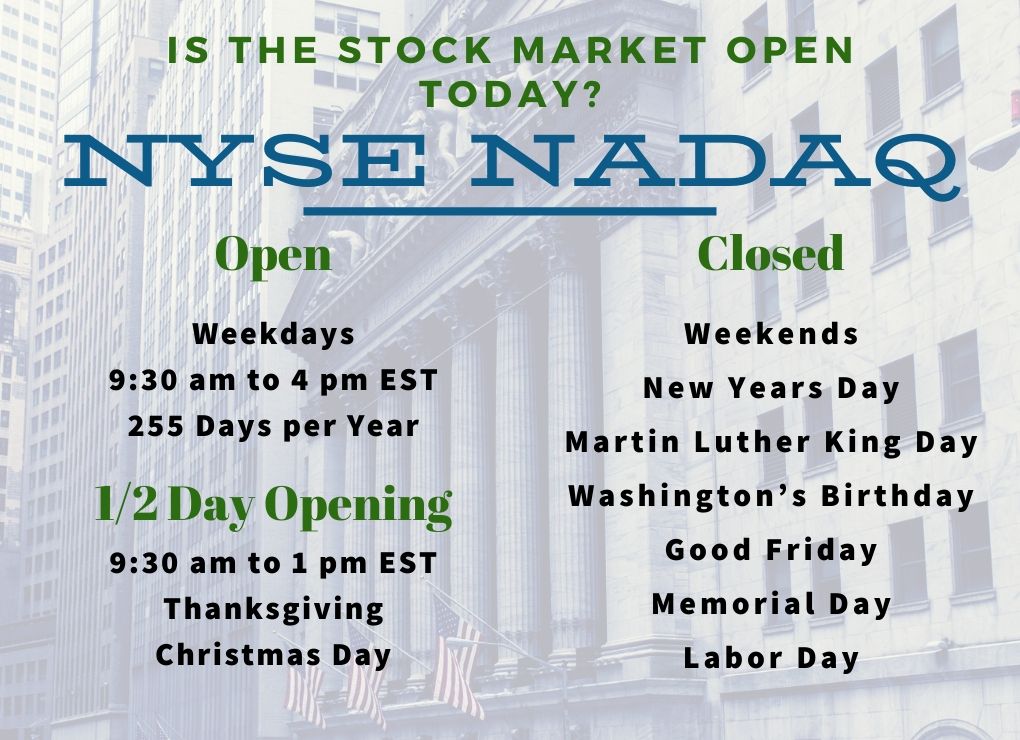
The core of the American financial day is the “regular session.” For both the NYSE and the Nasdaq, this session runs from 9:30 AM to 4:00 PM Eastern Time (ET), Monday through Friday. During these six and a half hours, liquidity is at its peak, spreads are generally at their narrowest, and the vast majority of retail and institutional volume is processed.
The opening bell at 9:30 AM marks the start of the “opening auction,” a process designed to consolidate all the buy and sell interest that accumulated overnight into a single opening price. Similarly, the 4:00 PM closing bell triggers the “closing auction” or “closing cross,” which determines the official daily closing price—a figure used by mutual funds to calculate Net Asset Value (NAV) and by traders to benchmark performance.
Extended Hours Trading
While the “market” might be closed to the general public outside of 9:30 AM to 4:00 PM, trading does not entirely stop. Extended hours trading is divided into two segments:
-
Pre-Market Session: This typically occurs from 4:00 AM to 9:30 AM ET.
-
After-Hours Session: This runs from 4:00 PM to 8:00 PM ET.
While these sessions offer flexibility for those reacting to breaking news or international events, they are characterized by lower liquidity and higher volatility. Many brokerages require clients to sign special disclosures before participating in extended hours due to the risk of wide bid-ask spreads and sudden price swings.
Official Market Holidays: When the Doors Stay Shut
Beyond the standard weekend closures (Saturday and Sunday), the U.S. stock market observes several federal and traditional holidays. It is important to note that the stock market does not always follow the federal government’s holiday schedule exactly. For example, while banks may be closed on Veterans Day or Columbus Day (Indigenous Peoples’ Day), the stock market typically remains open.
The Standard Holiday Calendar
If you are asking if the market is closed today, it is likely due to one of the following major observances:
-
New Year’s Day: Observed on January 1. If January 1 falls on a Saturday, the market is closed on the preceding Friday. If it falls on a Sunday, the market is closed on the following Monday.
-
Martin Luther King, Jr. Day: Observed on the third Monday in January.
-
Washington’s Birthday (Presidents’ Day): Observed on the third Monday in February.
-
Good Friday: This is a notable exception in the calendar. It is not a federal holiday, but the U.S. stock markets have historically closed on this day. It occurs on the Friday before Easter Sunday.
-
Memorial Day: Observed on the last Monday in May.
-
Juneteenth National Independence Day: The newest addition to the market calendar, observed on June 19. If this falls on a weekend, the closure moves to the nearest weekday.
-
Independence Day: Observed on July 4.
-
Labor Day: Observed on the first Monday in September.
-
Thanksgiving Day: Observed on the fourth Thursday in November.
-
Christmas Day: Observed on December 25.
Early Closures and Modified Schedules
In addition to full-day closures, the market frequently observes “early close” days. On these days, the regular session ends at 1:00 PM ET rather than 4:00 PM. These typically occur:
-
The day before or after Independence Day (depending on which day of the week July 4 falls).
-
The Friday after Thanksgiving (commonly known as Black Friday).
-
Christmas Eve (December 24), unless it falls on a weekend.
Why Market Closures Matter for Your Investment Strategy
Understanding the holiday schedule is about more than just knowing when you can’t trade; it is about understanding market mechanics and the psychological behavior of other investors.
The Impact on Liquidity and Volatility
In the days leading up to a major holiday closure, liquidity often begins to dry up. Large institutional “market makers” and hedge fund managers often square their positions or reduce their exposure to avoid holding large amounts of risk over a long weekend. When liquidity is low, even small trades can have a disproportionate impact on a stock’s price.
Investors should be wary of the “thin” markets that occur on the Wednesday before Thanksgiving or the last few days of December. During these times, price movements may not be representative of a stock’s true fundamental value but rather a reflection of low participation.
Gap Risk and Overnight Events
One of the greatest risks of a closed market is “gap risk.” This occurs when a significant news event happens—such as a geopolitical conflict, a natural disaster, or a surprise economic report—while the exchanges are closed. Because you cannot trade, you are “trapped” in your position. When the market finally opens the next day (or after a long weekend), the price may “gap” significantly lower or higher from the previous close.
For conservative investors, this is a reason to avoid using high leverage or speculative options strategies immediately before a long holiday weekend.
Settlement Cycles and the T+1 Rule
Another critical financial element affected by market closures is the settlement cycle. As of 2024, the U.S. market has moved to a “T+1” settlement cycle, meaning that when you sell a stock, the transaction officially settles, and the cash becomes available one business day later.
Market holidays do not count as business days. Therefore, if you sell a stock on the Friday before a three-day holiday weekend, your trade will not settle until the following Tuesday. For individuals relying on those funds for immediate side-hustle capital or personal expenses, this delay is a vital logistical consideration.
Strategic Opportunities Around Market Closures
While closures present risks, they also offer unique patterns that savvy investors have sought to exploit for decades. These are often referred to as “calendar effects” or “market anomalies.”
The Holiday Effect
Historical data has often shown that stock prices tend to rise in the few trading days preceding a major holiday. This is colloquially known as the “Holiday Effect.” Analysts attribute this to a combination of high spirits among investors, decreased short-selling activity, and “window dressing” by fund managers who want their portfolios to look strong before a break.
The Santa Claus Rally
Perhaps the most famous period involving market closures is the end-of-year window. The “Santa Claus Rally” typically refers to a trend where the market sees gains during the last five trading days of December and the first two trading days of January. This period is heavily interrupted by Christmas and New Year’s closures, yet it remains one of the most anticipated seasonal trends in finance.
International Divergence
For the diversified investor, it is essential to remember that while the U.S. market may be closed today, international markets might be wide open. The London Stock Exchange (LSE), the Tokyo Stock Exchange (TSE), and the Hong Kong Stock Exchange follow different cultural and national holiday schedules.
An event in a European market while the U.S. is closed for Thanksgiving can serve as a leading indicator for how the U.S. market will open the following day. Monitoring global “pre-market” indicators like the S&P 500 futures can help an investor gauge the temperature of the market even when the physical exchanges are silent.

Final Considerations for the Disciplined Investor
Navigating when the stock market is closed today is a fundamental skill in personal finance. It requires a blend of calendar management and strategic foresight. To ensure you are never caught off guard, consider the following best practices:
-
Synchronize Your Calendar: Manually add the NYSE/Nasdaq holiday schedule to your digital calendar at the start of every year.
-
Check the Bond Market: Note that the bond market (regulated by SIFMA) often has different closure rules than the stock market. For example, the bond market is often closed on Columbus Day and Veterans Day, even when the stock market is open.
-
Automate Your Alerts: Use financial apps and tools that send notifications for “Early Close” days, as these can easily be forgotten during busy work weeks.
-
Respect the “Quiet” Hours: Use market closures as a time for research and reflection. The best investment decisions are rarely made in the heat of a high-volume trading session but are instead the result of the calm analysis performed when the tickers have stopped scrolling.
The stock market’s schedule is the heartbeat of the financial world. By respecting its pauses and understanding its rhythms, you can move from being a reactive participant to a proactive strategist, ensuring that your money is always working for you—even when the exchange doors are locked.
aViewFromTheCave is a participant in the Amazon Services LLC Associates Program, an affiliate advertising program designed to provide a means for sites to earn advertising fees by advertising and linking to Amazon.com. Amazon, the Amazon logo, AmazonSupply, and the AmazonSupply logo are trademarks of Amazon.com, Inc. or its affiliates. As an Amazon Associate we earn affiliate commissions from qualifying purchases.